Cubist Style
Mechanical Elements (Fernand Léger)
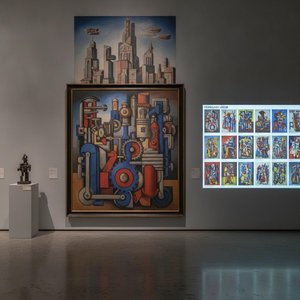
Fernand Léger (1881–1955) criou Mechanical Elements. Pertence ao movimento Cubist Style. É feito em Oil On Canvas. Está conservada no Metropolitan Museum of Art, em Nova York, Estados Unidos da América.
- Oil On Canvas
- Metropolitan Museum of Art, Nova York

 Visualizar na parede

 Pintura a Óleo Feita à Mão
 Compartilhar
 Compartilhar
 Ficha técnica


 Baixar imagem
 Semelhantes
 Raio X
 Ver diaporama
 Perguntas e Respostas

 Estatísticas
Mechanical Elements, em resumo
- Título
- Mechanical Elements
- Artista
- Fernand Léger (1881–1955)
- Artista nascido em
- Argentan, França
- Técnica
- Oil On Canvas
- Onde ver
- Metropolitan Museum of Art, Nova York, Estados Unidos da América
- Movimento
- Cubist Style
- Período
- Modern
- Tema
- mechanical elements, cubism, geometry, industrial design, abstraction, assemblage
O que Mechanical Elements retrata?
A Vision of Industrial Harmony
Fernand Léger’s “Mechanical Elements,” painted in 1924, stands as a striking testament to the burgeoning fascination with technology during the interwar period. More than just a depiction of gears and pipes—though undeniably prominent—the artwork embodies Léger's ambitious goal: to synthesize Cubist fragmentation with the dynamism of the machine age, creating an aesthetic that simultaneously challenged artistic conventions and reflected the transformative realities of modern life.
Born Joseph Fernand Henri Léger in Argentan, Normandy, 1881, Léger embarked on a journey from rural landscapes to the epicenter of Parisian avant-garde. Initially drawn to architecture, his artistic path swiftly pivoted toward painting after arriving in Paris around 1900, fueled by an unwavering conviction that art could engage with the complexities of its time.
Cubism Revisited: Geometric Precision
Léger’s stylistic evolution is inextricably linked to Cubism. Influenced profoundly by Picasso and Braque, he adopted the fractured perspective and simultaneous viewpoints characteristic of this revolutionary movement—a deliberate rejection of traditional representation in favor of exploring spatial relationships through geometric forms. However, Léger didn't simply replicate Cubist principles; he pushed them further, distilling them into a simplified vocabulary of circles, squares, and lines.
“Mechanical Elements” exemplifies this approach brilliantly. The canvas is dominated by interlocking geometric shapes—primarily circles and squares—arranged in a rhythmic pattern that evokes the precision and repetition found in industrial machinery. These forms aren’t merely decorative; they actively contribute to conveying a sense of movement and energy, mirroring the ceaseless pace of urban life.
Symbolism Beyond Mechanism
While the artwork's visual language speaks directly to the influence of technology, Léger imbued “Mechanical Elements” with deeper symbolic resonance. The repetition of geometric shapes isn’t merely a stylistic device; it represents an attempt to capture the impersonal logic and order inherent in industrial processes—a deliberate contrast to the organic forms favored by Impressionism and Post-Impressionism.
Furthermore, Léger's use of color – predominantly shades of gray punctuated by vibrant accents – underscores this thematic preoccupation. Gray symbolizes the materiality of metal and concrete, while bursts of color represent human vitality and creativity—a harmonious blend reflecting Léger’s belief that art could coexist with technological advancement without sacrificing beauty or emotional depth.
A Legacy of Innovation
"Mechanical Elements" cemented Léger's position as a pioneer of Tubism – a variant of Cubism developed by Léger himself—characterized by the use of tubular forms to represent objects and figures. This innovative technique anticipated developments in Pop Art decades later, demonstrating Léger’s enduring influence on subsequent generations of artists.
Today, reproductions of “Mechanical Elements” continue to captivate audiences with their bold aesthetic and intellectual ambition. They serve as a powerful reminder that art can not only reflect the spirit of its time but also actively shape our understanding of it—a timeless masterpiece celebrating both geometric precision and human resilience.
Em qual museu se encontra Mechanical Elements?
Metropolitan Museum of Art
Nova York, Estados Unidos da América
Origens e História do Metropolitan Museum of Art O Metropolitan Museum of Art nasceu de uma visão compartilhada por um grupo de empresários, financistas e importantes artistas e pensadores. Após sua incorporação em 1870, a instituição buscou um lar permanente para abrigar suas crescentes aquisições. Antes de se estabelecer em sua localização atual, o museu residiu brevemente na propriedade da Mansão Douglas, na West 14th Street.


Imagens em alta resolução de Mechanical Elements

Fernand Léger, Mechanical Elements, Metropolitan Museum of Art. Domínio público.
Cores ajustadas à obra original por um especialista digital, o ficheiro finamente retocado e fiel às pinceladas do artista.
Adquira o ficheiro de alta resoluçãoPerguntas sobre Mechanical Elements respondidas
Em qual museu se encontra a obra original de "Mechanical Elements"?
A obra original "Mechanical Elements", de Fernand Léger encontra-se no Metropolitan Museum of Art, Nova York, Estados Unidos da América. Uma reprodução permite que a obra seja exibida em sua casa.
Qual é a técnica utilizada em "Mechanical Elements", de Fernand Léger?
A técnica de "Mechanical Elements", de Fernand Léger é Oil On Canvas. As reproduções visam reproduzir a aparência desta técnica.
Quais temas aparecem em "Mechanical Elements", de Fernand Léger?
"Mechanical Elements", de Fernand Léger retrata: mechanical elements, cubism, geometry, industrial design, abstraction, assemblage, modern art.
A imagem de "Mechanical Elements", de Fernand Léger pode ser reproduzida livremente?
Informação de direitos autorais para "Mechanical Elements", de Fernand Léger: a obra está em em domínio público — seus direitos autorais expiraram. Isso determina se reproduções da imagem podem ser feitas livremente.
Quem é o artista por trás de "Mechanical Elements"?
"Mechanical Elements" foi criado por Fernand Léger. As informações nesta página descrevem a obra original de Fernand Léger.
A qual movimento artístico "Mechanical Elements", de Fernand Léger pertence?
"Mechanical Elements", de Fernand Léger pertence ao movimento Cubist Style. Este movimento fornece o contexto estilístico da obra.
A que fase da trajetória de Fernand Léger "Mechanical Elements" pertence?
"Mechanical Elements" representa o Mechanical Period de Fernand Léger.
Qual é a situação dos direitos autorais de "Mechanical Elements", de Fernand Léger?
O status de direitos autorais de "Mechanical Elements" - em domínio público — seus direitos autorais expiraram - decorre do falecimento do artista em 1955.
"Mechanical Elements" permaneceu no país de origem do seu artista?
Não – a obra de arte encontra-se no exterior. Fernand Léger nasceu em França, e o original de "Mechanical Elements" encontra-se num museu em Estados Unidos da América.
Sobre o artista, Fernand Léger

1881–1955, França
Fernand Léger
A Vida de Fernand Léger A história de Fernand Léger começa na aldeia de Argentan, situada na região de Orne, na Baixa Normandia. Ele chegou a este mundo em 4 de fevereiro de 1881, como filho único. Seus primeiros anos foram moldados pela quietude do campo francês e pela presença de sua mãe, Marie-Adèle Daunou. Seu pai, um homem que ganhava a vida como criador de gado, faleceu quando Fernand ainda era apenas um menino, deixando a criança para ser criada pela mãe em um lar marcado pela piedade e por uma certa natureza humilde.
Também de Fernand Léger
 A Cidade1919
 O Mecânico1920
 Três Mulheres1921
 Nudes na Floresta1910

Ensaios sobre Mechanical Elements
 Cubism Unveiled: How Picasso and Braque Redefined Modern Art through Geometric RevolutionExplore the revolutionary world of Cubism. Discover how Pablo Picasso and Georges Braque dismantled perspective to redefine modern art thro…
 Mastering the Machine Age: The 25 Best Artworks by Fernand LégerImmerse yourself in the vibrant world of Fernand Léger. Explore 25 iconic masterpieces of Cubism and Tubism, from bold geometric forms to m…
 Top 10 Obras de Arte com Vibração Industrial | OriginalUniqueArt.comDescubra 10 obras de arte icônicas que capturam a atmosfera industrial! Explore Monet, Manet e outros mestres do Impressionismo e Realismo.…