Alternar para Impressão
 Ler mais







































 Para obras de arte ou reproduções com mais de 105 cm (aproximadamente 41 polegadas) em qualquer um dos lados, a moldura será enviada como um kit desmontado. Este método garante uma entrega segura e evita danos durante o transporte.


A Mechanical Vision: Deconstructing Modernity with Fernand Léger
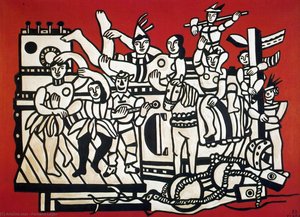
Fernand Léger’s Mechanical Element 1 is a pivotal work exemplifying his distinctive “Tubism,” an evolution of Cubism that wholeheartedly embraced the aesthetics and energy of the machine age. This painting boldly presents a fragmented human visage, constructed from interlocking mechanical components against a striking red backdrop – a testament to Léger's innovative approach.
Subject & Style: The Human-Machine Interface
Rather than portraying a conventional portrait, Léger dissects the human form into geometric shapes—cylinders, discs, and cog-like elements. This isn’t merely a depiction *of* machinery; it suggests an increasing integration of humanity with the mechanical world, perhaps even defining us by it. The inclusion of two clocks – one in the upper left corner and another near the center-right – underscores themes of time, precision, and relentless progress. Importantly, this fusion isn’t unsettling; instead, the face feels powerful and harmoniously constructed, suggesting a positive acceptance of modernity.
Technique & Composition: Boldness in Form and Color
Léger employs a flattened picture plane and strong, defined outlines characteristic of his mature style. The limited color palette – dominated by the intense red background and metallic tones of the mechanical components – creates a visually arresting contrast. The composition is carefully balanced despite its fragmented nature; circular elements scattered throughout act as visual anchors, guiding the viewer’s eye across the canvas. This deliberate arrangement prevents chaos, conveying ordered complexity.
Historical Context: Responding to an Industrial Age
Created during a period of rapid industrial growth in the early 20th century, Mechanical Element 1 reflects Léger’s fascination with the energy and efficiency of machines. He perceived beauty within their forms and believed they represented the future of art and society – a stark contrast to traditional academic painting focused on idealized nature or historical narratives. Léger's work paved the way for later movements like Pop Art, which also explored mass production and consumer culture.
Symbolism & Emotional Impact: A Contemplation of Transformation
The artwork evokes a sense of both awe and detachment. While celebrating technological advancement, it hints at a potential loss of individuality within an increasingly mechanized world. The red background adds intensity, perhaps suggesting the energy or even the inherent danger in this transformation. Ultimately, Mechanical Element 1 is open to interpretation – inviting viewers to contemplate their relationship with technology and its impact on human identity.
Display & Interior Design Recommendations
Due to its bold color palette and strong geometric forms, Mechanical Element 1 makes a powerful statement in modern or contemporary settings. Consider these display options:
- Minimalist Space: Allow the artwork’s dynamism to take center stage.
- Contextual Pairing: Display alongside other Cubist or early Modern works to highlight its historical lineage.
- Material Echoes: Complement with metallic accents in the room, echoing the mechanical elements within the painting.
- Focused Illumination: Use focused lighting to accentuate vibrant colors and textural details. This will truly bring out the depth of Léger’s vision.
This piece is sure to be a conversation starter, adding intellectual depth and visual interest to any collection or interior.
Perguntas e Respostas
Qual é a cor predominante em "Mechanical element1"?
Um tom Warm Sunset Tones percorre "Mechanical element1", de Fernand Léger.
Onde posso encontrar obras de arte semelhantes a "Mechanical element1", de Fernand Léger?
A página Obras semelhantes de "Mechanical element1", de Fernand Léger apresenta obras relacionadas.
Como "Mechanical element1", de Fernand Léger pode ser utilizado na decoração de interiores?
As recomendações de uso para "Mechanical element1", de Fernand Léger são (Statement) e o ambiente (Living Room).
 Visualizar na parede
 Compartilhar
 Compartilhar
 Detalhes
 Guia
Guia

 Baixar imagem
 Semelhantes
 Raio X
 Ver diaporama
 Q&A
Q&A Estatísticas