Social Realism
Execution (Evan Walters)
Evan Walters (1892–1951) criou Execution. Pertence ao movimento Social Realism. É feito em Oil On Canvas. Mede 77 × 107 cm.
- Oil On Canvas
- 77 × 107 cm

 Visualizar na parede

 Pintura a Óleo Feita à Mão
 Compartilhar
 Compartilhar
 Ficha técnica


 Baixar imagem
 Semelhantes
 Raio X
 Ver diaporama
 Perguntas e Respostas

 Estatísticas
Execution, em resumo
- Título
- Execution
- Artista
- Evan Walters (1892–1951)
- Artista nascido em
- Llangyfelach, País de Gales
- Técnica
- Oil On Canvas
- Dimensões
- 77 × 107 cm
- Movimento
- Social Realism
- Período
- Modern
- Tema
- industrial workers, social commentary, welsh art scene”, “factory life”, “black and white”, “portraiture”
O que Execution retrata?
Identification of the Artwork and Artist
The artwork titled Execution is a painting by the Welsh artist Evan Walters. This piece is an oil on canvas that measures 77 x 107 cm. The work depicts a group of figures gathered around a central individual in a scene of execution. The composition focuses on the tension between the surrounding onlookers and the solitary figure at the center of the arrangement.
Evan Walters was born in 1892 and died in 1951. His technical background included training as a painter and decorator in Morriston, Swansea, before he pursued formal studies at the Swansea School of Art, the Regent Street Polytechnic in London, and the Royal Academy Schools. His experience as a camouflage painter during World War I contributed to his specific understanding of light, shadow, and shape.
The subject matter of Execution explores themes of mortality and authority through a figurative arrangement. The painting utilizes a horizontal format to organize the figures within a shallow space. The background remains indistinct, which keeps the visual focus on the human forms in the foreground.
Composition and Visual Elements
The painting utilizes a horizontal format to organize a somber and dramatic execution scene. The composition is dominated by a group of figures that surround a central subject. This central figure is distinguished by a vertical orientation and a level of clarity that contrasts with the surrounding crowd. The arrangement of these figures creates a sense of encirclement, emphasizing the vulnerability of the individual at the center of the group. The background remains washed out and indistinct, providing little spatial recession and keeping the focus on the immediate interaction of the figures.
The color palette is predominantly muted and earthy. Shades of grey, brown, and beige define the scene, contributing to a sense of bleakness. These tones are applied across the canvas to maintain a heavy atmosphere. The lack of bright or saturated colors reinforces the gravity of the subject matter, which explores themes of power, violence, and mortality. The figures are positioned in a way that directs the viewer's eye toward the tension held within the central grouping.
Technique and Artistic Style
The work is executed in an expressive and impressionistic style, sharing visual characteristics with Expressionism. The application of oil paint on canvas involves layering the medium in broad, gestural strokes. These visible brushstrokes create a rough and uneven texture across the surface of the piece. The lines used to define forms are loose and gestural rather than precise or defined, contributing to a sense of fluidity. Outlines remain blurred, which avoids sharp detail in favor of a more immediate, tactile quality.
Lighting within the composition is diffused and somewhat indistinct, providing an even illumination that lacks strong highlights or deep shadows. This lack of high-contrast lighting contributes to a flat appearance. The perspective is similarly flattened, offering little sense of spatial recession or depth. The background remains washed out and indistinct, which minimizes the separation between the foreground figures and the space behind them. This approach emphasizes the physical presence of the paint and the immediate visual impact of the forms over realistic representation.
Imagens em alta resolução de Execution

Evan Walters, Execution.
Evan Walters (1892–1951), Execution, oil on canvas. Domínio público. Imagem: OriginalUniqueArt.com.
Perguntas sobre Execution respondidas
De que técnica é feita a obra "Execution"?
"Execution" é executada em Oil On Canvas.
Quais são as dimensões da obra original "Execution", de Evan Walters?
"Execution" mede 77 x 107 cm em sua forma original. As dimensões originais são uma referência útil ao escolher o tamanho de uma reprodução.
Quais temas aparecem em "Execution", de Evan Walters?
Os temas de "Execution" são industrial workers, social commentary, welsh art scene”, “factory life”, “black and white”, “portraiture”, “20th-century art”.
A imagem de "Execution", de Evan Walters pode ser reproduzida livremente?
"Execution", de Evan Walters está em em domínio público — seus direitos autorais expiraram. Este status determina como a imagem da obra pode ser reproduzida.
A qual artista "Execution" é atribuída?
"Execution" é atribuída a Evan Walters.
A qual movimento artístico pertence "Execution", de Evan Walters?
"Execution" é uma obra do Social Realism. O movimento indica a tradição artística da qual a obra faz parte.
A que período da carreira de Evan Walters pertence "Execution"?
"Execution" representa o 20th Century de Evan Walters.
Por que o status de direitos autorais de "Execution" é como é?
"Execution", de Evan Walters está em em domínio público — seus direitos autorais expiraram. O período de direitos autorais conta a partir do falecimento do artista, ocorrido em 1951.
O que "Execution" compartilha com o restante da obra de Evan Walters?
"Execution" integra a produção Social Realism de Evan Walters, cujos temas recorrentes incluem industrial realism, social critique", welsh identity, labor struggles, documenting hardship, walter's social focus, early 20th century, modernist influence.
Sobre o artista, Evan Walters

1892–1951, País de Gales
Evan Walters
A Alma da Paisagem Galesa: A Vida e a Visão de Evan Walters Evan John Walters ergue-se como uma figura singular na tapeçaria da história da arte galesa, um visionário cujo pincel estabeleceu uma ponte entre a aspereza industrial e uma profunda expressão artística. Nascido em 1893, em Llanfylech, aninhado em uma paisagem definida tanto pela tradição rural quanto pelas sombras emergentes da indústria, Walters possuía uma sensibilidade inata às texturas de sua terra natal. Seus anos formativos, passados entre os vales de Llangylicach e Mynyddbach, instilaram nele uma conexão profunda com a cultura e a língua galesas — um alicerce que mais tarde lhe permitiria traduzir a atmosfera densa das comunidades mineiras em narrativas visuais evocativas. Sua jornada artística foi marcada tanto pela disciplina prática quanto pelo refinamento acadêmico.
Também de Evan Walters
 The Cockle Woman1940
 Old Lady Reading1940
 Study for 'The Annunciation'1929
 Merry Go Round1930

Ensaios sobre Execution
 Spontaneity and Matter: Distinguishing CoBrA from Art InformelJean Dubuffet mixed sand, tar, and gravel into his 1947 works to create sculptural surfaces. Why did post-war artists reject traditional or…
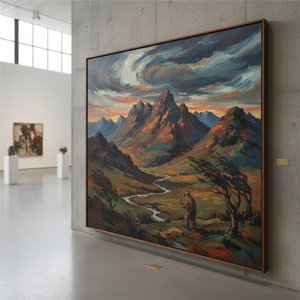 Evan Walters: A Study in Contemporary Landscape Painting & Emotional ResonanceExplore the captivating world of Evan Walters, a Welsh artist renowned for his evocative landscapes & social commentary. Discover his Impre…
 The Energetic Canvas: Exploring Dynamic Composition in Art History & Contemporary PracticeExplore the history of dynamic composition in art, from Renaissance chiaroscuro to modern asymmetry. Learn how masterful artists used balan…