 Visualizar na parede
 Compartilhar
 Compartilhar
 Detalhes
 Guia
Guia

 Baixar imagem
 Semelhantes
 Raio X
 Ver diaporama
 Perguntas e Respostas
 Estatísticas
Peaceable Kingdom (22)


 Ler mais
Obtenha um arquivo pronto para impressão que vai muito além da visualização na web. Cada imagem digital que vendemos provém de um arquivo mestre de alta resolução em nosso banco de dados — geralmente entre 5.000 e 15.000 pixels de largura — para que você possa imprimir em grandes formatos, realizar cortes precisos ou reproduzir detalhes minuciosos com total confiança.
Nenhum arquivo sai do nosso estúdio sem passar por um cuidadoso processo de revisão. Um especialista digital verifica as cores em relação à pintura original e as corrige se necessário, aumentando então a clareza e o detalhe com ferramentas profissionais de retoque — sempre mantendo a fidelidade às pinceladas e ao estilo do artista. O resultado é uma imagem que se assemelha à pintura, e não a um scan com filtros.
Aprovação antes da finalização: nosso especialista enviará a imagem por e-mail em até 72 horas para sua revisão. Não ficou satisfeito? Solicite melhorias ou correções, ou peça o reembolso caso a qualidade não atenda às suas expectativas.
Esta é a qualidade em que confiam editoras, estúdios de design, galerias e gráficas.
Imagem Digital
Baixe um arquivo de alta resolução para exibição pessoal, impressão e projetos criativos. ( Alternar para Impressão Comprar pintura feita à mão)
Incluído em cada compra de imagem digital
Entrega Digital Especializada e Garantida
Ao escolher o OriginalUniqueArt.com, você não está apenas adquirindo uma imagem — você está recebendo uma obra de arte digital profissionalmente aprimorada, elaborada com precisão e com garantia de satisfação. Aqui está tudo o que acompanha seu pedido, automaticamente:

Entrega rápida por e-mail
O seu arquivo de imagem digital em alta resolução será enviado por e-mail em até 72 horas após o pedido — pronto para uso imediato.

Arquivo Digital com IA Otimizado
Sua obra de arte é otimizada profissionalmente por meio de ferramentas avançadas de IA e edição manual, garantindo o máximo de detalhes, clareza e precisão de cores.

Reenvio gratuito vitalício
Apagou ou perdeu o seu ficheiro acidentalmente? Não se preocupe – nós reenviamos para si a qualquer momento, gratuitamente.

Sem Taxas de Importação - Sempre
Desfrute da sua obra de arte instantaneamente, sem taxas alfandegárias, impostos ou custos de entrega — downloads digitais são sempre isentos de taxas.

Garantia de Fidelidade de Cores
Garantimos que sua imagem digital reflita as cores originais com a maior fidelidade possível, utilizando ferramentas profissionais e gerenciamento de cores.

Garantia de satisfação de 100 dias
Se não estiver satisfeito com a sua imagem digital, nós a revisaremos ou reembolsaremos 100% dentro de 100 dias — sem perguntas.

Garantia de Reembolso 100%
Não está satisfeito? Receba o reembolso total em até 100 dias após o recebimento do seu arquivo digital — sem perguntas.

Descontos para pedidos em lote
Compre 3 imagens, economize 10% - Compre 5, economize 15% - Compre 10+, economize 20%. Ideal para projetos criativos, galerias e agências.
Peaceable Kingdom (22): A Quaker Vision of Harmony
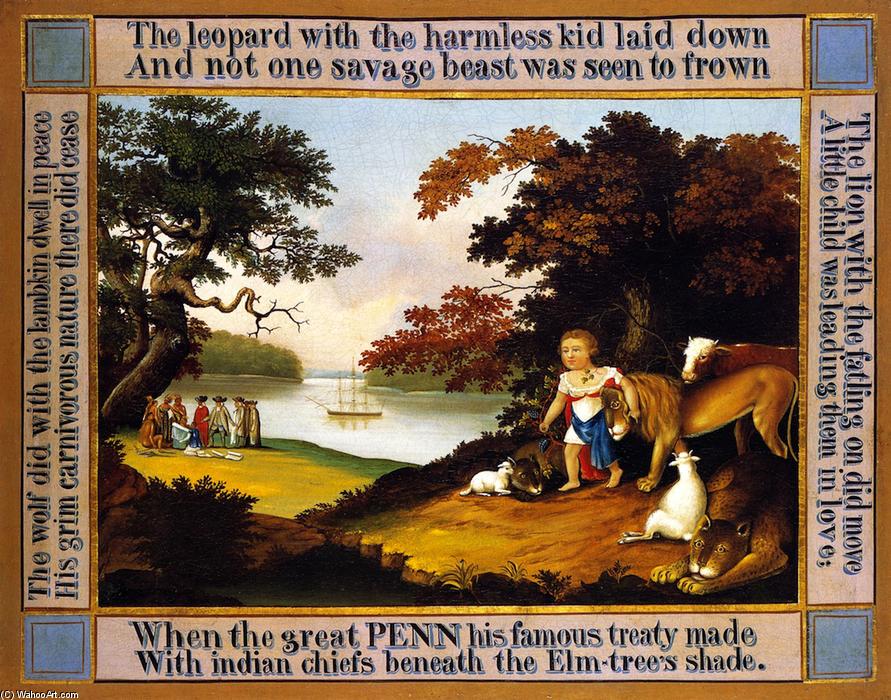
Edward Hicks’ “Peaceable Kingdom (22)” transcends mere visual beauty; it embodies a profound philosophical statement rooted in the Quaker faith and meticulously executed with masterful artistic technique. Created in 1826, this monumental oil painting resides at the Philadelphia Museum of Art, serving as an enduring emblem of American folk art and its contribution to shaping national identity.The Artist and His Vision
Edward Hicks (1780-1849), born in Attleboro, Pennsylvania, was a self-taught Quaker minister whose unwavering belief in “the inner light” profoundly influenced his artistic endeavors. Initially apprenticed as a coach maker, Hicks honed his decorative painting skills—a craft considered somewhat unconventional for the time—allowing him to express his spiritual convictions through captivating imagery. His Quaker faith instilled within him a deep appreciation for simplicity and peace, values that permeate every brushstroke of his celebrated “Peaceable Kingdom” series. This particular canvas captures Hicks’s distinctive style: a blend of realism infused with symbolic representation intended to convey moral lessons about coexistence.A Detailed Examination of Composition and Technique
The painting depicts a serene tableau featuring a young boy standing before two lions and a tiger, accompanied by numerous figures engaged in various activities—a meeting place for Native Americans and settlers—and culminating in a sailboat gliding across the horizon beneath a dominant elm tree. Hicks’s meticulous attention to detail is evident throughout; the artist skillfully employs oil paint on canvas, layering glazes to achieve rich textures that bring forth an astonishing level of realism. Lighting is soft and diffused, guiding the viewer's eye through the complex spatial relationships established within the scene. Perspective leans toward a flattened style characteristic of the Dutch Golden Age, prioritizing clarity and conveying a sense of grandeur. The color palette—dominated by warm earth tones—accentuates blues and greens in the landscape, creating an atmosphere of tranquility and unity. Precise lines delineate forms, fostering order amidst the multitude of elements depicted. Organic shapes reflect the natural world at the heart of Hicks’s artistic vision.Symbolism: Lions, Tigers, and Quaker Beliefs
“Peaceable Kingdom (22)” is laden with symbolism reflecting Hicks's core Quaker convictions. The lions and tigers—typically symbols of predatory aggression—are portrayed as gentle creatures coexisting peacefully with humans, mirroring Isaiah 11:6’s prophetic vision of harmony between animals and humankind. This deliberate juxtaposition underscores the artist’s desire for universal reconciliation and embodies the Quaker belief in divine compassion. Furthermore, the inclusion of Native Americans negotiating treaties symbolizes a commitment to justice and understanding across cultures—a crucial element within Hicks's broader philosophical framework. The elm tree represents steadfastness and spiritual resilience, anchoring the scene in a landscape imbued with symbolic significance.Legacy and Enduring Inspiration
“Peaceable Kingdom (22)” continues to inspire audiences worldwide with its timeless message of peace and unity. As a handmade oil painting reproduction, it offers an opportunity to experience this iconic artwork firsthand—a testament to Edward Hicks’s artistic genius and his enduring contribution to American art history. Its serene beauty and profound symbolism resonate deeply within the viewer, prompting contemplation on themes of compassion, harmony, and the importance of fostering dialogue between diverse perspectives.Perguntas e Respostas
"Peaceable Kingdom (22)" é uma obra famosa do Folk Art?
Dentro do movimento Folk Art, "Peaceable Kingdom (22)" possui um nível de popularidade Iconic.
Qual o tamanho e a orientação de impressão sugeridos para "Peaceable Kingdom (22)", de Edward Hicks?
Tamanho Large, orientação Landscape: esta é a configuração de impressão sugerida para "Peaceable Kingdom (22)", de Edward Hicks.
Como o movimento e a época se encontram em "Peaceable Kingdom (22)", de Edward Hicks?
"Peaceable Kingdom (22)", de Edward Hicks insere-se no movimento Folk Art, dentro da era Século XIX de seu criador.
Biografia do Artista
A Life Rooted in Faith and Vision
Edward Hicks, born April 4th, 1780, in the tranquil landscape of Attleboro (now Langhorne), Bucks County, Pennsylvania, was a figure uniquely positioned at the intersection of religious conviction and artistic expression. His story is not simply that of a self-taught painter, but of a dedicated Quaker minister whose spiritual journey profoundly shaped his distinctive visual language. Though born to Anglican parents, young Edward’s life took a pivotal turn when he came under the care of Matron Elizabeth Twining, a devout Quaker who instilled in him the core tenets of this faith – simplicity, peace, and an unwavering belief in the “inner light.” This early exposure would become the bedrock upon which his artistic vision was built. From the age of thirteen, Hicks apprenticed with coach makers William and Henry Tomlinson, mastering the techniques of decorative painting that would initially sustain him. However, even as he honed his skills in rendering ornate designs on carriages, a deeper calling resonated within him, one that would ultimately lead him down a path less traveled – a path where faith and artistry converged. By 1803, Hicks had fully embraced the Society of Friends, marrying Sarah Worstall and embarking on a life of itinerant preaching throughout Philadelphia, all while continuing to support his growing family through his painting skills.The Evolving Canvas: From Coachwork to Spiritual Landscapes
Hicks’s artistic development was far from conventional. He wasn't formally trained in the academic traditions of the time; instead, he cultivated a distinctly American folk art style born from observation, necessity, and deeply held beliefs. Initially, his paintings served practical purposes – house painting, coach decoration, tavern signs, and even decorative work on furniture and farm equipment. These early commissions provided financial stability but often conflicted with the Quaker emphasis on plainness and eschewal of worldly vanities. A period of hardship in 1815 saw Hicks briefly abandon ornamental painting for farming, a venture that proved unsuccessful. It was through encouragement from friends that he returned to his brushes in 1816, a turning point that allowed him to reconcile his artistic talents with his spiritual calling. He began to imbue his paintings with symbolic meaning, reflecting his Quaker worldview and personal interpretations of scripture. His canvases became vehicles for conveying messages of peace, harmony, and the promise of a divinely ordained order.The Peaceable Kingdom: A Vision of Harmony
Edward Hicks is most celebrated today for his series of paintings known collectively as *The Peaceable Kingdom*. Comprising over sixty variations created throughout his life, these works are arguably the most iconic examples of American folk art. Inspired by Isaiah 11:6-9 – a passage foretelling a time when natural predators would coexist peacefully – Hicks depicted scenes of wild animals and children living in idyllic harmony. The paintings often feature figures from colonial Pennsylvania history, such as William Penn negotiating treaties with Native Americans, further grounding the biblical vision within an American context. *The Peaceable Kingdom* is not simply a charming depiction of animal life; it’s a powerful statement about Hicks's belief that Pennsylvania represented a fulfillment of this prophetic ideal – a place where peace and justice could prevail. Each version of *The Peaceable Kingdom* possesses subtle variations in composition, color palette, and detail, reflecting Hicks’s evolving artistic sensibilities and deepening spiritual understanding. Notable examples include *Peaceable Kingdom (31)* housed at Yale University Art Gallery, and *Peaceable Kingdom (34)* which portrays Noah's Ark amidst a serene landscape.Beyond the Kingdom: A Broader Artistic Scope
While *The Peaceable Kingdom* remains his signature achievement, Hicks’s artistic output extended beyond this celebrated series. He painted landscapes, portraits, and historical scenes, each imbued with his characteristic folk art style and Quaker sensibility. His *Falls of Niagara*, now at the Abby Aldrich Rockefeller Folk Art Center, demonstrates his ability to capture the grandeur of nature while maintaining a sense of simplicity and reverence. Similarly, his depiction of *George Washington crossing...* – also held at the Abby Aldrich Rockefeller Folk Art Center – offers a unique folk perspective on this iconic moment in American history. Even seemingly mundane subjects like *Grave of William Penn at Jordans in England*, reveal Hicks’s deep connection to Quaker heritage and his ability to find spiritual significance in everyday scenes. These works, taken together, demonstrate the breadth of Hicks's artistic vision and his commitment to using art as a means of expressing his faith and values.A Lasting Legacy: The Folk Art Icon
Edward Hicks passed away on August 23rd, 1849, in Newtown, Pennsylvania, leaving behind a body of work that continues to resonate with audiences today. He is now recognized as a pivotal figure in American folk art, celebrated for his distinctive style, recurring themes, and profound spiritual depth. His paintings offer invaluable insights into the beliefs and values of the Society of Friends during the 19th century, providing a visual record of their commitment to peace, simplicity, and social justice. Hicks’s unique ability to blend religious faith with artistic expression created a body of work that is both visually compelling and spiritually meaningful. He remains a testament to the power of self-taught artistry and the enduring influence of Quaker ideals on American art history. His legacy continues to inspire artists and scholars alike, ensuring that his vision of harmony—both earthly and divine—will endure for generations to come.
Edward Hicks
1780 - 1849 , Estados Unidos da América
Breve Biografia
- Artistic Movement Or Style: Folk Art
- Artists Who Influenced This Artist: ['']
- Date Of Birth: April 4, 1780
- Date Of Death: August 23, 1849
- Full Name: Edward Hicks
- Nationality: American
- Notable Artworks:
- Peaceable Kingdom (31)
- Falls of Niagara
- George Washington crossing...
- Peaceable Kingdom (34)
- Place Of Birth: Langhorne, USA