Ring Around the Rosie
Reprodução em Óleo Feita à Mão
Óleo sobre tela pintado à mão no tamanho e moldura de sua escolha, feito sob encomenda pelos nossos artistas. ( Switch to Print
Switch to Digital Image)
P118B $10
P118H $10
P118W $10
P438Z $10
P508JH $12
P508YH $12
P805H $10
P805Z $10
P919BZ $10
P919G $10
P919XJ $10
P959ZH $10
P968JZ $12
W106C $8
W218G $10
W218JH $8
W218Y $10
W307PJ $10
W316G $10
W316PJ $8
W316Y $10
W398PJ $8
W4111J $10
W500HY $15
W500JH $15
W692G $12
W849H $8
W940BG $15
W953PJ $8
Escolha entre os nossos tamanhos pré-definidos que respeitam as proporções originais da obra de arte.

Pode inserir as suas próprias dimensões para se adequar a uma moldura ou espaço específico. Se o tamanho selecionado não corresponder às proporções da imagem original, iremos cortar a obra de arte ou estender a pintura com elementos adicionais pintados à mão. Um esboço digital será enviado para sua aprovação antes do início da produção.
Tenha em atenção que a pré-visualização no ecrã não reflete o corte ou extensão real. Apenas o esboço mostrará com precisão a composição final.
Embora tamanhos personalizados estejam disponíveis, recomendamos selecionar uma dimensão da lista predefinida para preservar as proporções originais.
Após o pedido, a equipa OriginalUniqueArt.com enviará um e-mail ao cliente para solicitar instruções e fornecer uma prévia do esboço.
Entrega mundial () em 3 a 4 semanas, em vez das 5 semanas padrão. (8 Setembro). Sem comprometer a qualidade.
Envio expresso gratuito para todo o mundo
Tela de Linho de Alta Qualidade
Seguro de transporte completo
Garantia de Reembolso de Impostos Alfandegários
Garantia de Fidelidade Cromática
Política de Devolução de 100 Dias (Apenas Defeitos)
Garantia de reembolso de 100%
Oferta de desconto por quantidade
Ring Around the Rosie
Técnica de Reprodução
Tamanho da Reprodução
-
Preço Total
$ 300
A Sun-Drenched Symphony of Childhood Joy
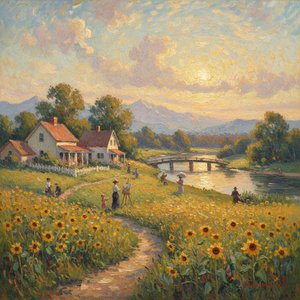
In the luminous realm of American Impressionism, few works capture the ephemeral essence of summer bliss as tenderly as Edward Henry Potthast’s 1910 masterpiece, “Ring Around the Rosie.” This painting is far more than a mere depiction of children at play; it is a vibrant window into a bygone era of uninhibited joy and communal harmony. As the viewer gazes upon the canvas, they are immediately transported to a sun-drenched park where the air seems to hum with the laughter of youth. Potthast, a master of capturing light, utilizes a brilliant palette of warm yellows and lush greens to recreate the radiant glow of a perfect afternoon, making the scene feel as though it is breathing right before our eyes.
The composition is a masterful dance of movement and balance. A group of children, caught in the rhythmic motion of their traditional game, forms the heart of the piece. Their small figures, interconnected by joined hands, create a circular energy that draws the eye inward, only to be led outward toward the surrounding landscape. Scattered throughout the periphery, adults linger in the soft shadows of the foliage, acting as silent guardians of this idyllic moment. This careful arrangement creates a sense of profound safety and continuity, suggesting a world where the innocence of childhood is cherished and protected by the community.
The Impressionist Touch: Light, Color, and Texture
Technically, “Ring Around the Rosie” serves as a testament to Potthast’s evolution from a disciplined lithographer to a celebrated Impressionist. Eschewing the rigid lines of his early academic training in Munich, the artist embraced the freedom of short, broken brushstrokes that define the American Impressionist style. These energetic applications of paint do not merely represent sunlight filtering through leaves; they embody the very vibration of heat and light. The texture of the paint creates a tactile sensation of movement, where the edges of figures seem to shimmer against the verdant backdrop, mimicking the way our own eyes struggle to focus on something moving rapidly in bright daylight.
For the discerning collector or interior designer, this painting offers an unparalleled emotional resonance. It possesses the rare ability to breathe life into a room, providing a focal point that is both sophisticated and deeply uplifting. The interplay of bold, saturated hues against softer, dappled light makes it a versatile piece for various high-end decors—from a classic, sunlit library to a contemporary, airy living space. To hang a reproduction of this work is to invite the warmth of a summer afternoon into one's home, offering a permanent escape into a landscape of peace, nostalgia, and enduring happiness.
Biografia do Artista
A Brushstroke of Leisure: The Life and Art of Edward Henry Potthast
Edward Henry Potthast, a name perhaps less immediately recognizable than those of Monet or Renoir, nevertheless occupies a significant and charming niche within the landscape of American Impressionism. Born in Cincinnati, Ohio, on June 10, 1857, Potthast’s journey was one of quiet determination, evolving from humble beginnings as a lithographer to becoming a celebrated painter of leisure and light. His canvases offer a window into a bygone era, capturing the joyful moments of American life at the turn of the twentieth century with a distinctive blend of European training and uniquely American sensibilities. The early years were marked by practical necessity; young Edward was compelled to abandon formal education at sixteen to contribute financially to his family, yet his artistic aspirations remained undimmed. He balanced demanding work with diligent study at the McMicken School of Design, honing skills that would later blossom into a successful career. This period instilled in him not only technical proficiency but also a deep appreciation for the value of perseverance – qualities evident throughout his life and reflected in the enduring appeal of his art.From Munich to Manhattan: The Shaping of an Impressionist Style
Potthast’s artistic education wasn't confined to American shores. He embarked on extended studies abroad, first in Antwerp and then, crucially, at the Royal Academy in Munich. This exposure to European academic traditions, particularly the influence of artists like Carl Marr, initially manifested in works characterized by subdued colors and dramatic contrasts – a far cry from the luminous palettes he would later embrace. However, it was his subsequent sojourn to France, specifically the areas around Fontainebleau, Barbizon, and Gréz, that proved transformative. Here, under the guidance of Robert W. Vonnoh, Potthast encountered the principles of Impressionism firsthand. He began to experiment with broken brushstrokes, a lighter palette, and an emphasis on capturing the fleeting effects of light and atmosphere – elements that would become hallmarks of his mature style. The French countryside, with its dappled sunlight and vibrant colors, profoundly influenced his artistic vision, leading him to abandon the darker tones he had initially favored. Returning to New York in 1895, he initially supported himself as an illustrator for prominent magazines like *Scribner’s* and *Century*, skills honed during his early lithographic work proving invaluable. This period allowed him to establish connections within the art world and gradually transition towards a full-time career as a fine artist.Capturing the American Spirit: Themes and Techniques
Potthast’s artistic vision centered on portraying scenes of everyday life, particularly those associated with leisure and recreation. He became renowned for his depictions of Central Park, bustling beaches along the New York and New England coasts, and idyllic landscapes filled with families enjoying their free time. Unlike some European Impressionists who focused on grand historical narratives or portraits of high society, Potthast celebrated the ordinary – picnics, boating excursions, children playing by the sea. His paintings radiate a sense of optimism and joy, reflecting the burgeoning prosperity and carefree spirit of the Gilded Age. He possessed an extraordinary ability to capture not just the visual appearance of these scenes but also the atmosphere of relaxed enjoyment and social interaction. His brushwork was loose yet precise, creating a shimmering effect that conveyed both the solidity of objects and the ephemeral quality of light. Potthast’s use of color was particularly noteworthy; he favored bright, saturated hues – yellows, blues, greens – to evoke the warmth of sunlight and the vibrancy of nature. He wasn't merely painting landscapes; he was painting moments of happiness and connection.Recognition and Legacy: A Lasting Contribution
Throughout his career, Edward Henry Potthast garnered significant recognition within the art establishment. He exhibited regularly at prestigious venues such as the National Academy of Design, the Society of American Artists, and the Salmagundi Club, earning numerous awards and accolades. His election to full membership in the National Academy in 1906 solidified his standing as a leading figure in American art. Potthast’s work quickly gained popularity among collectors and critics alike, contributing to his success during his lifetime. Today, his paintings are held in major museums across the United States, including the Cincinnati Museum of Art, the Brooklyn Museum, and the Virginia Museum of Fine Arts, among others. His influence can be seen in the works of later American Impressionists, who adopted his techniques for capturing light and color. Potthast's legacy lies not only in his technical skill but also in his ability to capture a specific moment in American history – an era of optimism, leisure, and burgeoning modernity. He offered a vision of American life that was both accessible and aspirational, celebrating the simple joys of everyday existence. *His paintings serve as a poignant reminder of a time when life seemed a little slower, a little brighter, and a little more carefree.*Further Exploration
- Explore his works at online databases like OriginalUniqueArt for high-quality reproductions.
- Delve deeper into his life through resources such as Wikipedia and dedicated artist websites.
- Seek out exhibitions featuring American Impressionism to experience Potthast’s paintings in person.
Edward Henry Potthast
1857 - 1927 , Estados Unidos da América
Dados Rápidos
- Artistic Movement Or Style: Impressionismo
- Artists Or Movements Influenced By This Artist: ['American Impressionism']
- Artists Who Influenced This Artist: ['T.S. Noble']
- Date Of Birth: 10 Jun 1857
- Date Of Death: 9 Mar 1927
- Full Name: Edward Henry Potthast
- Nationality: Americano
- Notable Artworks:
- A Happy Group
- Summer Day
- A July Day
- Place Of Birth: Cincinnati, EUA


A opção de vidro está disponível apenas para tamanhos inferiores a 110 cm