Alternar para Impressão
 Ler mais







































 Para obras de arte ou reproduções com mais de 105 cm (aproximadamente 41 polegadas) em qualquer um dos lados, a moldura será enviada como um kit desmontado. Este método garante uma entrega segura e evita danos durante o transporte.


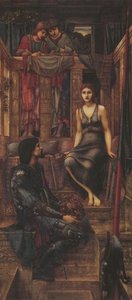
A Window Into Myth and Craftsmanship: Burne-Jones's 'Flight Into Egypt'
Edward Coley Burne-Jones’s “Flight Into Egypt,” conceived in 1872 as one of four designs for stained glass windows commissioned by Morris & Co. for Castle Howard, stands as a testament to the Pre-Raphaelite Brotherhood’s fascination with medieval storytelling and their commitment to artistic craftsmanship. More than just a depiction of biblical narrative—the perilous journey of Mary and Joseph fleeing Herod’s persecution—it embodies a profound exploration of faith, vulnerability, and the enduring power of visual symbolism. The window's genesis lies in the burgeoning Victorian interest in reviving classical ideals alongside a yearning for spiritual depth, mirroring the broader ethos of the Arts and Crafts movement championed by Morris himself.- Style & Technique: Burne-Jones departs from his typically opulent landscapes to adopt a strikingly linear style, prioritizing clarity and expressive gesture over meticulous detail—a deliberate choice reflecting the preliminary sketches he undertook before transferring the design onto glass. This simplified approach contrasts sharply with the richly ornamented frescoes adorning Castle Howard’s chapel, highlighting Morris & Co.’s desire for an aesthetic that resonated with both grandeur and understated elegance.
- Historical Context: The commission itself speaks volumes about the aristocratic patronage of the era and the transformative influence of Morris & Co. on Victorian interiors. George and Rosalind Howard's embrace of Arts and Crafts principles—including the removal of Pellegrini frescoes—demonstrates a conscious rejection of academic conventions in favor of organic forms and vibrant colors, mirroring Burne-Jones’s artistic vision.
- Symbolism: The composition is rife with symbolic references. Mary’s posture conveys unwavering devotion as she cradles her child, symbolizing purity and divine grace. Joseph's steadfast gaze embodies protection and resilience—a visual representation of the biblical narrative's core themes. Furthermore, the donkey itself serves as a humble vehicle for pilgrimage, underscoring the importance of simplicity and humility in spiritual pursuits.
Perguntas e Respostas
Existem obras semelhantes a "Design for"?
Obras de arte semelhantes a "Design for", de Edward Burne-Jones podem ser encontradas na página de Obras semelhantes desta obra.
Onde posso encontrar um guia sobre "Design for"?
A página Ficha informativa de "Design for", de Edward Burne-Jones oferece uma ficha informativa imprimível em duas folhas: a obra de arte com sua tabela de identificação, uma linha do tempo situando-a no período de vida do artista, outras obras do artista, a paleta de cores extraída e citações prontas para copiar em quatro estilos.
As cores de "Design for", de Edward Burne-Jones são vibrantes ou suaves?
A cor de "Design for" apresenta Subtle Color de saturação e Balanced de intensidade.
 Visualizar na parede
 Compartilhar
 Compartilhar
 Detalhes
 Guia
Guia

 Baixar imagem
 Semelhantes
 Raio X
 Ver diaporama
 Q&A
Q&A Estatísticas