

 Visualizar em escala
 Enviar
 Compartilhar
 Ver detalhes
 Guia de Obras do Aluno

 Baixar imagem
 Semelhantes
 Raio X
 Apresentação de slides
 Estatísticas
Maestà
 Tempera On Panel
- Italian Gothic
 1280
1280- Late Medieval
 218.0 x 118.0 cm
 Chiesa dei Servi
 Ver mais
Giclée / Impressão de Arte
Impressão giclée ou em tela de qualidade de museu, com produção rápida e opções flexíveis de acabamento. ( Encomendar reprodução pintada à mão Ver Imagem Digital)




P118B $10

P118H $10

P118W $10

P438Z $10

P508JH $12

P508YH $12

P805H $10

P805Z $10

P919BZ $10

P919G $10

P919XJ $10

P959ZH $10

P968JZ $12

W106C $8

W218G $10

W218JH $8

W218Y $10

W307PJ $10

W316G $10

W316PJ $8

W316Y $10

W398PJ $8

W4111J $10

W500HY $15

W500JH $15

W692G $12

W849H $8

W940BG $15

W953PJ $8




Escolha entre os nossos tamanhos pré-definidos que respeitam as proporções originais da obra de arte.

Você pode inserir suas próprias dimensões para se ajustar a uma moldura ou espaço específico. Se o tamanho selecionado não corresponder às proporções da imagem original, iremos recortar a obra de arte ou estender a imagem com uma borda espelhada ou preenchimento sólido. Um mockup digital será enviado para sua aprovação antes do início da produção.
Por favor, observe que a visualização na tela não reflete o recorte ou a extensão real. Apenas o mockup mostrará com precisão a composição final.
Embora tamanhos personalizados estejam disponíveis, recomendamos selecionar uma dimensão da lista predefinida para preservar as proporções originais.
Entrega mundial () em 2 semanas, em vez das 4/5 semanas padrão. (26 Setembro)

Envio expresso gratuito para todo o mundo

Tela de Linho Premium

Seguro de transporte total

Garantia de Reembolso de Impostos Alfandegários

Garantia de Fidelidade de Cor

Política de Devolução em 100 Dias (Apenas para Defeitos)

Garantia de reembolso de 100%

Desconto para múltiplas unidades
 A opção de vidro está disponível apenas para tamanhos inferiores a 110 cm

Maestà
Giclée / Impressão de Arte
Dimensões da Reprodução
-


Preço Total
$ 80
The Majesty of Siena: Duccio’s Pioneering Vision
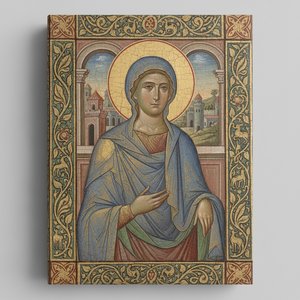
Duccio di Buoninsegna's Maestà, completed around 1280 in Siena, stands as a monumental achievement—a cornerstone upon which the burgeoning artistic landscape of Tuscany would be built. More than just a depiction of Mary and Jesus; it represents a decisive break from Byzantine formalism, embodying a nascent humanist impulse that sought to elevate religious art beyond mere representation towards genuine emotional expression. The painting’s genesis coincided with a period of profound spiritual fervor within Christendom, yet Duccio refused to adhere to the conventions of his time, forging instead a path toward a more nuanced and psychologically resonant portrayal of sacred subjects.- Subject Matter & Composition: At its core lies an exquisitely rendered Virgin Mary cradling Jesus Child—a motif deeply rooted in Byzantine iconography—however Duccio’s genius resided in his masterful manipulation of spatial perspective and compositional balance. Unlike the flattened, stylized backgrounds characteristic of earlier works, Maestà employs a subtly receding horizon line, creating a sense of depth that draws the viewer into the scene. The positioning of Mary and Jesus at the center, flanked by two angels—one on each side—reinforces their divine majesty while simultaneously establishing a harmonious equilibrium.
- Style & Technique: Duccio’s stylistic innovations are immediately apparent in his use of tempera paint on panel—a technique favored for its luminosity and durability. He eschewed the laborious process of glazing, opting instead for meticulous layering of pigments to achieve astonishing textural detail. Observe particularly the drapery of Mary's robe; it flows with an unprecedented realism, conveying movement and volume that surpasses anything seen in Byzantine art. This deliberate departure from tradition signaled a crucial step toward naturalism—a desire to capture not just what was seen but also how it felt.
Historical Context & Influences
The Maestà emerged during Siena’s Golden Age, a period marked by civic pride and artistic patronage. The painting served as a powerful emblem of papal authority—commissioned by Pope Nicholas III—and reflected the broader theological concerns of the era: contemplation on divine grace and the incarnation of Christ. However, Duccio's vision wasn’t solely defined by its ecclesiastical purpose. He drew inspiration from Romanesque art, particularly frescoes in churches like San Giorgio Maggiore in Venice, demonstrating a willingness to engage with artistic precedents while simultaneously forging his own distinctive voice. The influence of Byzantine mosaics—particularly those adorning Hagia Sophia—is undeniable, yet Duccio skillfully transformed these stylistic elements into something wholly original.Symbolism & Emotional Resonance
Beyond its formal achievements, Maestà is laden with symbolic significance. Mary’s serene countenance embodies humility and compassion—qualities considered paramount in Christian piety. The angels represent divine guardianship and proclaim the glory of God. The inclusion of three additional figures—one at the top left corner, one at the bottom left corner, and one on the right side—adds to the painting's complexity, suggesting a broader cosmic narrative encompassing creation and redemption. Most powerfully, Maestà communicates an overwhelming sense of spiritual contemplation—a profound appreciation for beauty and grace that transcends mere visual representation. It invites viewers to immerse themselves in the divine presence, fostering feelings of reverence and awe.A Legacy Enduring Through Reproduction
Today, OriginalUniqueArt’s meticulously crafted reproductions capture the essence of Duccio’s Maestà—preserving its luminous colors, textural richness, and emotive power. Whether adorning a grand salon or gracing a smaller interior space, this iconic artwork continues to inspire admiration for its artistic brilliance and spiritual depth. Explore our collection now and experience the majesty of Siena firsthand.Biografia do Artista
The Sienese Luminary: Duccio di Buoninsegna and the Dawn of a New Italian Vision
Duccio di Buoninsegna, born in Siena around 1255, stands as a pivotal figure bridging the stylistic chasm between the Byzantine world and the burgeoning artistic sensibilities of Italy. While biographical details remain frustratingly scarce—the man himself often obscured by the brilliance of his art—his impact on the Sienese School and the trajectory of Italian painting is undeniable. He emerged during a period where religious iconography was deeply entrenched, yet a yearning for greater naturalism and emotional resonance was beginning to stir within artistic circles. Duccio wasn’t merely a painter; he was an innovator who dared to infuse sacred narratives with human feeling, subtly shifting the focus from rigid formality towards a more intimate connection between the divine and the earthly realm. His early training remains somewhat mysterious, though speculation suggests possible influences ranging from Florentine masters to direct exposure to Byzantine artistry—perhaps even travels to Constantinople itself. Whatever his formative experiences, they coalesced into a unique style that would define an era.
A Synthesis of Tradition and Innovation
Duccio’s artistic development wasn't a sudden rupture with the past but rather a graceful evolution. His initial works were deeply rooted in Byzantine conventions: the lavish use of gold leaf to evoke celestial light, stylized figures possessing an ethereal quality, and a meticulous attention to religious symbolism. However, even within these established parameters, Duccio began to subtly introduce elements that foreshadowed his later innovations. He experimented with spatial arrangements, hinting at depth where flatness had previously reigned supreme. His color palettes, while still vibrant, gained a newfound subtlety and harmony. More importantly, he started imbuing his figures with a nascent sense of humanity—a gentle curve of the mouth suggesting a smile, a slight tilt of the head conveying contemplation. This wasn’t a rejection of Byzantine ideals but a refinement, an infusion of life into what had often been static representations. He skillfully blended tradition and innovation, creating a style that was both reverent and remarkably fresh.
Masterpieces of Faith and Artistry
Two works stand as testaments to Duccio’s genius: the *Rucellai Madonna* (1285) and, most famously, the *Maestà* (1308-1311). The *Rucellai Madonna*, commissioned for a chapel in Florence, marked a significant departure from conventional Byzantine iconography. Its composition, while still adhering to traditional forms, displayed a greater sense of spatial organization and a more naturalistic depiction of the Virgin Mary and Child. But it was the *Maestà*—a monumental altarpiece created for Siena Cathedral—that truly cemented Duccio’s legacy. This sprawling masterpiece comprises numerous panels depicting scenes from the life of the Virgin Mary and Christ, each one a miniature work of art in itself. The Maestà is not merely a collection of paintings; it's a visual narrative, unfolding with breathtaking detail and emotional depth. Duccio’s mastery of light and shadow, his ability to convey complex emotions through subtle gestures, and his innovative use of perspective all converge in this single, awe-inspiring work. Beyond these monumental pieces, works like *Polyptych No. 28* demonstrate his continued compositional skill and meticulous attention to detail.
Influences and Legacy
Duccio’s artistic journey was shaped by a complex interplay of influences. While deeply rooted in Byzantine tradition—particularly the luminosity and stylized figures characteristic of that era—he also absorbed elements from Florentine art, notably the naturalism and psychological depth championed by Giotto. Some scholars suggest he may have spent time in Paris, encountering the Gothic style prevalent there at the time. This synthesis of influences resulted in a uniquely Sienese style characterized by its elegance, emotional intensity, and innovative use of space. His work profoundly impacted subsequent generations of Italian painters, shaping the development of the Sienese School and contributing to the broader evolution of Italian painting. He helped define the Trecento art movement, leaving an indelible mark on the history of Western painting.
A Lasting Legacy: Shaping the Future of Italian Art
Duccio di Buoninsegna’s influence extended far beyond his lifetime. He revolutionized Italian painting, paving the way for the development of the Sienese School—a distinct artistic tradition characterized by its elegance, refinement, and emotional intensity. His emphasis on naturalism, spatial depth, and human emotion directly impacted subsequent generations of artists, influencing not only those within Siena but also painters in Florence and beyond. While Giotto is often credited with initiating the Renaissance style, Duccio’s contributions were equally crucial, laying the groundwork for the artistic innovations that would define the 14th century and beyond.
- He pioneered new approaches to depicting space and perspective.
- His paintings are renowned for their vibrant and harmonious color schemes.
- He infused his figures with a sense of humanity and emotional resonance.
Despite facing financial hardships during his life, Duccio’s artistic legacy endures. His masterpieces continue to inspire awe and admiration, serving as a powerful reminder of the transformative power of art. He helped define the Trecento art movement, leaving an indelible mark on the history of Western painting.

Duccio di Buoninsegna
1255 - 1319 , Itália
Informações Rápidas
- Artistic Movement Or Style: Gótico Sienês
- Artists Or Movements Influenced By This Artist: ['Escola Sienesa']
- Artists Who Influenced This Artist: ['Arte Bizantina']
- Date Of Birth: c. 1255
- Date Of Death: 1319
- Full Name: Duccio di Buoninsegna
- Nationality: Italiano
- Notable Artworks:
- Maestà
- Rucellai Madonna
- Place Of Birth: Siena, Itália
Artigos Relacionados
Proto-Renascimento: 10 Obras-Primas que Moldaram a Arte Moderna | OriginalUniqueArt
Descubra as 10 obras-primas do Proto-Renascimento que revolucionaram a arte! Explore Giotto, Duccio e Cimabue. Encontre reproduções de alta qualidade para decorar sua casa com OriginalUniqueArt.com. Inspire-se!
Late Medieval Masterpieces: 10 Artworks That Defined an Era | OriginalUniqueArt
Journey through 10 defining Late Medieval masterpieces – from Giotto's frescoes to Jan van Eyck’s realism. Explore the stories, techniques & vibrant colors of Gothic art. Find museum-quality reproductions and elevate your home decor with OriginalUniqueArt.com! Discover all masterpieces on OriginalUniqueArt.com
La Biennale de Veneza: 25 Obras-Primas para Inspirar sua Decoração
Descubra as 25 obras-primas da Bienal de Veneza! Explore a história, artistas e cores vibrantes que definem a arte veneziana. Encontre reproduções de alta qualidade para inspirar sua decoração em OriginalUniqueArt.com.
Giotto di Bondone: As 25 Obras-Primas que Definiram a Arte Renascentista | OriginalUniqueArt
Descubra as 25 obras-primas de Giotto di Bondone, o mestre da Renascença! Explore a história por trás dos afrescos icônicos, cores vibrantes e emoção atemporal. Reproduções de arte exclusivas para decorar sua casa com elegância em OriginalUniqueArt.com.
Obras-Primas em Têmpera sobre Painel: 10 Mestres que Revolucionaram a Arte | OriginalUniqueArt
Descubra 10 obras-primas em têmpera sobre painel que revolucionaram a arte! Explore a história de Giotto, Botticelli e outros mestres do Renascimento. Encontre reproduções de museu e inspire sua decoração com OriginalUniqueArt.com.


