Menu
Text size

() ·

A painting made for you, by hand

Christ before Pilate and Caiaphas

Reprodução em Óleo Feita à Mão

Óleo sobre tela pintado à mão no tamanho e moldura de sua escolha, feito sob encomenda pelos nossos artistas. ( Alternar para Impressão Alternar para Imagem Digital)

Descrição do Item

Explore Donatello's masterpiece, 'Christ before Pilate and Caiaphas,' a monumental bronze sculpture depicting Jesus’s trial before Roman authorities and Jewish leaders—a pivotal moment in Christian history.

Biografia do Artista

Donatello (1386-1466): Escultor renascentista florentino. Pioneiro na escultura nua independente como o "David", conhecido pelo realismo expressivo, influência clássica e técnicas inovadoras. Explore suas obras-primas e legado!

from ·

Chapter 1

How large should it be?

Slide to change the size; the picture on the left shows the frame at its real width. The proportions of the original are kept.

Tamanho padrão
personalizado
CM
INCH

Escolha entre os nossos tamanhos pré-definidos que respeitam as proporções originais da obra de arte.

largura
altura

Insira a largura e a altura desejadas para se ajustarem à sua moldura ou parede. Como esta obra é pintada à mão, para um tamanho com proporções diferentes, o artista poderá pintar um pouco mais ao redor da imagem ou reduzir ligeiramente a composição — você escolhe. Enviamos uma maquete digital para sua aprovação antes de iniciar a pintura. A imagem exibida nesta página não representa o resultado real — apenas a maquete mostra o resultado final.

Chapter 2

How should it arrive?

Choose the edges of the stretched canvas

Choose your frame

Corner sample of the WhiteWrap canvas edge finish, stretched on madeira maciça bars
White €1
Corner sample of the BlurSideWrap canvas edge finish, stretched on madeira maciça bars
Blurside €1
Corner sample of the ExtendedWrap canvas edge finish, stretched on madeira maciça bars
Extended €1
Corner sample of the P118B picture frame: poliestireno moldado, 5 cm wide and 3 cm thick
P118B €10
Corner sample of the P118H picture frame: poliestireno moldado, 5 cm wide and 3 cm thick
P118H €10
Corner sample of the P118W picture frame: poliestireno moldado, 5 cm wide and 3 cm thick
P118W €10
Corner sample of the P438Z picture frame: poliestireno moldado, 5.5 cm wide and 3.5 cm thick
P438Z €10
Corner sample of the P508JH picture frame: poliestireno moldado, 7 cm wide and 3.5 cm thick
P508JH €12
Corner sample of the P508YH picture frame: poliestireno moldado, 7 cm wide and 3.5 cm thick
P508YH €12
Corner sample of the P805H picture frame: poliestireno moldado, 5 cm wide and 3.5 cm thick
P805H €10
Corner sample of the P805Z picture frame: poliestireno moldado, 5 cm wide and 3.5 cm thick
P805Z €10
Corner sample of the P919BZ picture frame: poliestireno moldado, 7 cm wide and 3.5 cm thick
P919BZ €10
Corner sample of the P919G picture frame: poliestireno moldado, 7 cm wide and 3.5 cm thick
P919G €10
Corner sample of the P919XJ picture frame: poliestireno moldado, 7 cm wide and 3.5 cm thick
P919XJ €10
Corner sample of the P959ZH picture frame: poliestireno moldado, 5 cm wide and 3 cm thick
P959ZH €10
Corner sample of the P968JZ picture frame: poliestireno moldado, 6 cm wide and 4 cm thick
P968JZ €12
Corner sample of the W106C picture frame: madeira maciça, 5 cm wide and 3 cm thick
W106C €8
Corner sample of the W218G picture frame: madeira maciça, 5 cm wide and 3 cm thick
W218G €10
Corner sample of the W218JH picture frame: madeira maciça, 5 cm wide and 3 cm thick
W218JH €8
Corner sample of the W218Y picture frame: madeira maciça, 5 cm wide and 3 cm thick
W218Y €10
Corner sample of the W307PJ picture frame: madeira maciça, 6 cm wide and 3 cm thick
W307PJ €10
Corner sample of the W316G picture frame: madeira maciça, 6 cm wide and 3 cm thick
W316G €10
Corner sample of the W316PJ picture frame: madeira maciça, 6 cm wide and 3 cm thick
W316PJ €8
Corner sample of the W316Y picture frame: madeira maciça, 6 cm wide and 3 cm thick
W316Y €10
Corner sample of the W398PJ picture frame: madeira maciça, 5 cm wide and 3 cm thick
W398PJ €8
Corner sample of the W4111J picture frame: madeira maciça, 6.5 cm wide and 3.5 cm thick
W4111J €10
Corner sample of the W500HY picture frame: madeira maciça, 7 cm wide and 5 cm thick
W500HY €15
Corner sample of the W500JH picture frame: madeira maciça, 7 cm wide and 5 cm thick
W500JH €15
Corner sample of the W692G picture frame: madeira maciça, 8 cm wide and 4 cm thick
W692G €12
Corner sample of the W849H picture frame: madeira maciça, 5 cm wide and 3 cm thick
W849H €8
Corner sample of the W940BG picture frame: madeira maciça, 7.5 cm wide and 4.5 cm thick
W940BG €15
Corner sample of the W953PJ picture frame: madeira maciça, 6 cm wide and 3.5 cm thick
W953PJ €8
Corner sample of the H24-GOLD picture frame: madeira entalhada com gesso, 10 cm wide and 6 cm thick
H24-GOLD €30
Corner sample of the H24-SILVER picture frame: madeira entalhada com gesso, 10 cm wide and 6 cm thick
H24-SILVER €30
Corner sample of the H36-GOLD picture frame: madeira entalhada com gesso, 15 cm wide and 6.5 cm thick
H36-GOLD €45
Corner sample of the H36-SILVER picture frame: madeira entalhada com gesso, 15 cm wide and 6.5 cm thick
H36-SILVER €45
Prévia da moldura
Com moldura

Moulding: . Overall size with the frame: .

Chapter 3

Who paints it, and should anything change?

Examples of what can be changed: Replace face with customer photo; Add pet (e.g., replace cat with dog); Include hidden message in background; Change background landscape or elements.
After order, OriginalUniqueArt.com team will email client for instructions and provide a mockup preview

Entrega mundial () em 3 a 4 semanas, em vez das 5 semanas padrão. (29 Outubro). Sem comprometer a qualidade.

Chapter 4

The finishing touches

A nameplate, as in a museum?

Detalhes da Placa de Bronze Gravada

This elegant plaque features the artist's name and the title of the artwork, finely engraved for a timeless presentation.

It is made from bronze with a refined, elegant finish. The text is precisely laser-engraved for a sharp and permanent result. Measuring 9x2 cm, the plaque is compact yet easy to read. It's built to be durable and scratch-resistant, offering a professional, museum-quality look. Mounting is simple thanks to the included adhesive backing.

Detalhes da Placa de Acrílico Transparente

The plaque includes essential engraved details such as the artist's name, the title of the artwork, the date it was created, the type of media used-like oil on canvas or watercolor-a brief description of the piece, and a QR code that links to the complete artwork information.

It is crafted from clear acrylic, offering a sleek, modern appearance. The text is UV-engraved in black to ensure strong visual contrast. With a size of 10x15 cm, it ensures optimal readability. It comes equipped with two metal hooks for secure wall mounting. The plaque is designed to be weather-resistant, making it suitable for various environments, and it includes interactive features that work seamlessly with smartphone scanning.

Detalhes da Placa de Acrílico Preto

This elegant plaque includes engraved information such as the artist's name, the title of the artwork, the date it was created, the type of media used (like oil on canvas or watercolor), a short description of the artwork, and a QR code for quick access to more information.

The plaque itself is made from refined black acrylic with a premium finish. The text is laser-engraved in white for high contrast and readability. Its size is 10x15 cm, designed to be easy to read. It comes with two metal hooks for professional mounting. The design is sleek and fits any interior style. It is also weather-resistant and durable, with built-in digital integration for mobile compatibility.

A protective varnish?

When do you need it?

Chapter 5

Your painting, as you ordered it

Christ before Pilate and Caiaphas

Técnica de Reprodução

Tamanho da Reprodução

-

Artista Sênior de Elite

Mais detalhes, refinamento e tempo de produção adicional

-

Moldura para Reprodução

-

-

Para obras de arte ou reproduções com mais de 105 cm (aproximadamente 41 polegadas) em qualquer um dos lados, a moldura será enviada como um kit desmontado. Este método garante uma entrega segura e evita danos durante o transporte.

Montagem profissional necessária — este não é um produto DIY (faça você mesmo).
O kit deve ser montado e a tela esticada por um profissional de molduraria experiente, utilizando cola de madeira (não inclusa), um alicate de esticar tela e grampos para manter as travessas alinhadas enquanto a cola seca. A montagem incorreta ou a tensão desigual da tela podem danificar permanentemente a obra de arte e não estão cobertas pela nossa garantia.

  • Todas as barras de madeira maciça estão incluídas, precisamente cortadas ao tamanho certo.

  • Montado com os parafusos fornecidos, além de cola para madeira para as junções dos cantos, que não está inclusa e deve ser providenciada pelo seu moldurista.

  • São necessárias ferramentas profissionais não incluídas: um alicate de estiramento de tela (esticador) e grampos para manter as ripas alinhadas enquanto a cola seca.

Importante:
As junções dos cantos requerem cola para madeira, as ripas devem ser mantidas com grampos até que a cola esteja completamente seca, e o estiramento da tela na moldura montada requer um alicate de esticar tela. Nenhum destes itens está incluído no kit. Por favor, certifique-se de contar com um profissional de molduraria experiente antes de encomendar este tamanho.

Etiqueta de identificação

-

-

Verniz de Proteção

Verniz brilhante (realça as cores e protege contra a luz e a umidade)

-

Personalizar minha obra

Exemplos de alterações possíveis: Substituir o rosto por uma foto do cliente; Adicionar um animal de estimação (ex.: substituir gato por cachorro); Incluir uma mensagem oculta no fundo; Alterar a paisagem ou os elementos do fundo.

-

Urgente

Entrega mundial () em 3 a 4 semanas, em vez das 5 semanas padrão. (29 Outubro). Sem comprometer a qualidade.

-

Envio Expresso

Entrega mundial para em 5 semanas. (5 Novembro).

Com envio incluído

Preço Total

€ 529

Preço Total € 529

A opção de vidro está disponível apenas para tamanhos inferiores a 110 cm

Included with every order

  • Envio expresso gratuito para todo o mundo
  • Tela de Linho de Alta Qualidade
  • Seguro de transporte completo
  • Garantia de Reembolso de Impostos Alfandegários
  • Garantia de Fidelidade Cromática
  • Política de Devolução em 100 Dias (Apenas para Defeitos)
  • Garantia de reembolso de 100%
  • Oferta de desconto por quantidade

Donatello’s ‘Christ Before Pilate and Caiaphas’: A Crucible of Renaissance Emotion

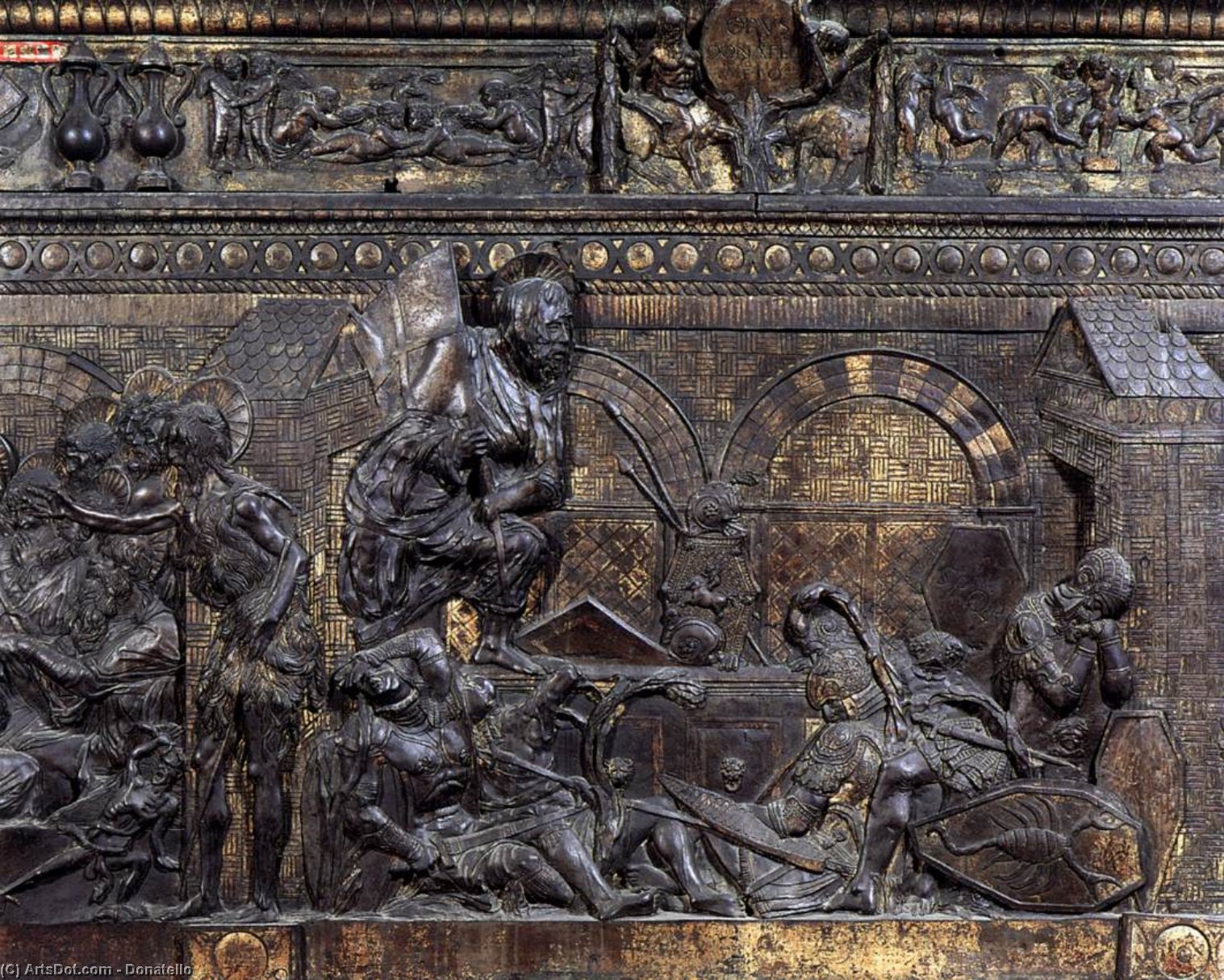
Donatello's 1460 bronze sculpture, “Christ Before Pilate and Caiaphas,” stands as a monumental achievement within the burgeoning artistic landscape of the Italian Renaissance. Housed in the San Lorenzo museum in Florence, this work transcends mere biblical representation; it’s a visceral exploration of human drama, political intrigue, and spiritual torment – a testament to Donatello's revolutionary approach to sculpture that profoundly shaped the course of Western art. The sheer density of figures, meticulously rendered in warm bronze tones, immediately draws the viewer into the heart of the scene: Christ, positioned at the apex of the composition, confronts the Roman governor and the Jewish high priest, their faces etched with a potent blend of authority, doubt, and perhaps even veiled judgment.

  • A Masterclass in Renaissance Realism: Donatello’s genius lies not just in his technical skill but in his ability to imbue stone – or in this case, bronze – with palpable emotion. The figures are not idealized abstractions; they possess a raw humanity, evident in the strained expressions and subtly shifting postures that convey the weight of the moment.
  • The Power of Bronze Casting: The sculpture’s creation involved the complex process of bronze casting, a technique perfected by Donatello himself. This method, utilizing molds and molten metal, allowed for incredible detail – from the folds of Christ's garment to the stern features of Pilate – while simultaneously lending the piece an inherent sense of age and gravitas.

Historical Context and Symbolism

Created during a period of intense religious and political upheaval, “Christ Before Pilate and Caiaphas” reflects the anxieties and tensions of its time. The Renaissance was witnessing a renewed interest in classical antiquity, yet simultaneously grappling with the profound questions posed by Christianity. Donatello’s depiction of Christ is deliberately ambiguous, refusing to offer easy answers or simplistic moral judgments. The scene isn't merely a historical record; it’s an allegory for human fallibility and the struggle between good and evil. The inclusion of Roman soldiers and Jewish leaders underscores the political context of Christ’s trial – a microcosm of power struggles and accusations.

  • Pilate’s Hesitation: Pilate's posture, often interpreted as one of reluctant compromise, is particularly compelling. His hands are clasped in a gesture of uncertainty, suggesting the moral dilemma he faced.
  • Caiaphas’s Sternness: Conversely, Caiaphas embodies unwavering authority and religious zeal, his gaze fixed upon Christ with an expression of resolute condemnation.

Technique and Materiality

Donatello's mastery is immediately apparent in the sculpture’s surface treatment. The bronze has been skillfully patinated to achieve a rich, aged appearance, enhancing the sense of history and lending a tactile quality to the work. The artist employed strong lines to define the figures and their drapery, while finer details – such as the expressions on Christ's face and the folds in Pilate’s toga – are rendered with remarkable precision. The use of light and shadow further emphasizes the three-dimensionality of the sculpture, creating a dramatic effect that draws the viewer into the scene. The choice of bronze itself was significant; it was a material associated with strength, durability, and divine authority, perfectly suited to represent this pivotal moment in Christian history.

A Legacy of Innovation

"Christ Before Pilate and Caiaphas" is more than just a beautiful sculpture; it’s a cornerstone of Renaissance art. Donatello's innovative approach – his emphasis on realism, emotional expression, and the exploration of complex human themes – paved the way for generations of artists to come. Its influence can be seen in countless subsequent works, solidifying its place as one of the most important sculptures of the era. A hand-painted reproduction offers a remarkable opportunity to experience this masterpiece firsthand, bringing its power and beauty into your own space.

Perguntas e Respostas

Quão harmoniosas são as cores de "Christ before Pilate and Caiaphas" entre si?

A harmonia de cores de "Christ before Pilate and Caiaphas" é definida como Discordant Palette.

Como posso descobrir obras de arte semelhantes a "Christ before Pilate and Caiaphas", de Donatello?

Obras de arte semelhantes a "Christ before Pilate and Caiaphas", de Donatello podem ser encontradas na página de Obras semelhantes desta obra.

Qual tamanho de impressão devo escolher para "Christ before Pilate and Caiaphas" no meu quarto?

Para um(a) Living Room, sugere-se que "Christ before Pilate and Caiaphas" seja impresso no tamanho Large.

More about this painting

Alternar para Impressão Alternar para Imagem Digital Compartilhar
Detalhes Guia Adicionar aos favoritos Baixar imagem Semelhantes Ver diaporama Q&A Estatísticas

In numbers

  • 1460the year it was painted
  • 29frames to choose from
  • standard sizes, in its own proportions
  • 5weeks to paint and deliver it
Donatello

Donatello

1386 - 1466, Itália

Quick facts about Donatello

  • Artistic Movement Or Style: Renascimento Italiano
  • Artists Or Movements Influenced By This Artist: ['Renascimento Florentino']
  • Artists Who Influenced This Artist: ['Escultores clássicos']
  • Date Of Birth: c. 1386
  • Date Of Death: 1466
  • Full Name: Donatello di Niccolò
  • Nationality: Italiano
  • Notable Artworks:
    • David
    • São Lourenço
    • Sacrifício de Isaac
  • Place Of Birth: Florença, Itália

Biografia do Artista

Early Life and Artistic Beginnings

Donato di Niccolò di Betto Bardi, universally known as Donatello, emerged from the bustling heart of Florence around 1386 – a city already brimming with artistic innovation and ambition. His early life remains somewhat shrouded in mystery, yet it’s clear that his formative years were deeply intertwined with the burgeoning world of Florentine sculpture. Unlike many artists of his time who benefited from established family legacies, Donatello's origins were modest; his father, Niccolò di Betto Bardi, was a wool carder – a profession rooted in commerce rather than artistic tradition. However, this seemingly unremarkable background provided him with access to the workshops and studios where young sculptors honed their skills. Donatello’s formal training likely began around 1400, finding employment within the workshop of Lorenzo Ghiberti, a master sculptor renowned for his groundbreaking bronze doors for the Florence Cathedral (the Duomo). Ghiberti's studio served as a crucible of artistic experimentation, and Donatello absorbed countless techniques and principles during his time there. He was exposed to the intricate details of classical sculpture – a cornerstone of Renaissance art – alongside the established conventions of Gothic style prevalent at the time. This exposure would profoundly shape his future work, leading him to blend classical ideals with innovative approaches that distinguished him from his contemporaries.

Key Works and Artistic Innovations

Donatello’s artistic trajectory truly began to unfold in the mid-1420s, marked by a series of groundbreaking works that challenged established norms and captivated audiences. His most celebrated achievement, undoubtedly, is the bronze *David* – a monumental figure that redefined the representation of the male nude in Western art. Unlike previous depictions of David, which often portrayed him as a youthful shepherd boy, Donatello’s version captured the hero at the moment of confronting Goliath, radiating an aura of intense determination and physical prowess. This wasn't merely a replication of biblical narrative; it was a profound exploration of human potential and courage – a testament to Donatello’s ability to infuse his sculptures with psychological depth. Beyond *David*, Donatello produced a remarkable array of works that showcased his versatility and technical mastery. The *St. Louis of Toulouse* at the Basilica di Santa Croce, for instance, exemplifies his command of classical forms and architectural integration. The sculpture's elegant drapery and serene expression are complemented by a carefully designed classical frame, demonstrating Donatello’s willingness to borrow from antiquity while maintaining his own distinctive style. Similarly, his *Sacrifice of Isaac* for the campanile of Santa Maria del Fiore in Florence is characterized by strikingly realistic portrait details – a departure from the idealized figures common in earlier Renaissance sculpture. The work's dramatic composition and emotional intensity further solidified Donatello’s reputation as a sculptor capable of capturing the essence of human experience.

Artistic Style and Historical Context

Donatello’s artistic style evolved through distinct phases, reflecting both his personal development and the broader currents of the Italian Renaissance. Initially, his work exhibited a strong influence from Ghiberti's International Gothic style – characterized by graceful lines and subtle details. However, as he matured, Donatello increasingly embraced classical ideals, incorporating elements of Roman sculpture into his own creations. This shift is particularly evident in *David*, where the figure’s contrapposto stance (a naturalistic pose with weight shifted to one leg) and muscular anatomy are clearly indebted to ancient Greek models. Furthermore, Donatello's style was marked by a willingness to experiment with new techniques and materials. He pioneered the use of “rilievo schiacciato” – a shallow relief technique that created an illusion of depth and volume. This approach allowed him to achieve remarkable detail in smaller works while maintaining a sense of dynamism and spatial awareness. His innovative use of bronze, particularly his mastery of lost-wax casting, further distinguished his work from that of his contemporaries. Donatello’s artistic legacy extends far beyond his individual masterpieces. He profoundly influenced subsequent generations of sculptors, including Michelangelo Buonarroti, who famously declared that “all the artists of Christendom have been imitating Donatello.” His emphasis on realism, psychological depth, and classical ideals helped to shape the course of Renaissance art, leaving an indelible mark on Western artistic tradition.

Museums and Artistic Legacy

Donatello’s sculptures are scattered across numerous museums and collections throughout Italy and beyond. The Museo della Collegiata in Empoli houses a remarkable collection of early Italian Renaissance art, including works by Francesco Botticini and Raffaello Botticini – providing valuable insights into Donatello's artistic development. The Museo Nazionale del Bargello in Florence proudly displays *St. George*, a testament to Donatello’s mastery of bronze sculpture. Similarly, the Basilica di Santa Croce in Venice houses the iconic *St. Louis of Toulouse*. The Baptistery of Siena features his relief work, including the dramatic depiction of *The Sacrifice of Isaac*. Finally, the Palazzo Vecchio in Florence retains *Judith Slaying Holofernes*, a powerful and unsettling portrayal of violence and triumph. Donatello’s impact on art history is undeniable. His innovative techniques, expressive figures, and profound understanding of human nature continue to inspire artists and captivate audiences today. He remains one of the most celebrated sculptors of all time – a true pioneer of the Renaissance and a master of his craft.

Informações Rápidas

  • Year: 1460
  • Title: Christ before Pilate and Caiaphas
  • Movement: Early Renaissance
  • Influences: Classical Sculpture
  • Medium: Bronze

Quiz de Arte

Cada pergunta possui apenas uma resposta correta.

Pergunta 1:
What artistic movement is Donatello’s Christ before Pilate and Caiaphas primarily associated with?
Pergunta 2:
In which museum is the sculpture ‘Christ before Pilate and Caiaphas’ housed?
Pergunta 3:
Donatello employed what sculptural technique to create this masterpiece?
Pergunta 4:
The sculpture depicts a biblical scene featuring Christ before whom two figures are prominent: Pilate and Caiaphas. What is the significance of this confrontation?
Pergunta 5:
What stylistic characteristic distinguishes Donatello’s sculpture from earlier Gothic art?
Explore obras de arte organizadas por temas, estilos e características.