Contemporary Realism · 1968
Big Self-Portrait (Chuck Close, 1968)
Chuck Close (1940–2021) criou Big Self-Portrait. Data de 1968. Pertence ao movimento Contemporary Realism. É feito em Black and White Photography. Está conservada no Walker Art Center, em Minneapolis, Estados Unidos da América.
- 1968
- Black and White Photography
- Walker Art Center, Minneapolis

 Pintura a Óleo Feita à Mão
 Compartilhar
 Compartilhar
 Ficha técnica


 Baixar imagem
 Semelhantes
 Ver diaporama
 Perguntas e Respostas

 Estatísticas
Big Self-Portrait, em resumo
- Título
- Big Self-Portrait
- Artista
- Chuck Close (1940–2021)
- Artista nascido em
- Monroe, Estados Unidos
- Data
- 1968
- Técnica
- Black and White Photography
- Onde ver
- Walker Art Center, Minneapolis, Estados Unidos da América
- Movimento
- Contemporary Realism
- Tema
- self-portrait, hyperrealism, face, detail, grid, identity
O que Big Self-Portrait retrata?
The Unblinking Gaze: An Encounter with Chuck Close's Self-Portraiture
To stand before a work like Big Self-Portrait is not merely to observe a likeness; it is to confront an intensely rendered meditation on identity itself. Created in 1968, this piece by Chuck Close captures the artist at a pivotal moment, presenting a self that feels both intimately known and profoundly alien. The composition is a masterful study in compression, tightly framing the head and shoulders until the viewer has no escape from the subject’s direct, almost challenging gaze. It is a portrait stripped down to its most fundamental elements—the architecture of bone, the texture of skin, the weight of expression.
A Symphony of Detail: Technique and Hyperrealism
What immediately arrests the eye is the sheer, breathtaking level of detail. Close’s signature technique, which involves translating photographic reality onto canvas through a meticulous grid system, results in an effect that borders on the microscopic. Here, every pore, every strand of wavy hair falling across the forehead, and the subtle shadow beneath the jawline are rendered with painstaking precision. The work operates within a stark grayscale palette, forcing the viewer to appreciate value—the dramatic interplay between deep blacks and brilliant whites. This hyperrealistic approach transforms paint into an illusion of texture, making the flat surface seem palpably three-dimensional.
Symbolism in Shadow and Light
The subject matter, a self-portrait, inherently invites introspection. It becomes less about the man depicted and more about the act of representation itself—how we choose to see ourselves, and how others perceive us. The inclusion of the cigarette held between the lips adds a layer of potent symbolism; it can be read as an emblem of artistic rebellion, a momentary pause, or simply the casual accoutrement of a thinking mind at work. The lighting, diffused yet directional from above and slightly to the left, sculpts the features with gentle shadows, giving weight and narrative depth to what is fundamentally a study in visual data.
Bringing the Masterpiece Home: Reproduction for Modern Spaces
Owning a reproduction of Big Self-Portrait allows one to integrate this monumental piece of art history into a contemporary living space. While the original demands an appreciation for its scale and painstaking labor, our hand-painted reproductions capture the essence—the arresting gaze, the textural complexity, and the emotional weight—in a format suitable for any collector’s vision. Imagine this intense study anchoring a sophisticated drawing room or gallery wall; it serves not just as decoration, but as a focal point for deep contemplation, inviting conversation about art, selfhood, and the enduring power of the human portrait.
Em qual museu se encontra Big Self-Portrait?
Walker Art Center
Minneapolis, Estados Unidos da América
Um Crisol de Criatividade Contemporânea Aninhado no vibrante coração de Minneapolis, Minnesota, o Walker Art Center ergue-se como um profundo testemunho do poder duradouro da arte moderna e contemporânea. O que começou em 1940 como uma modesta galeria instalada na residência particular de Thomas Barlow Walker floresceu para se tornar uma das instituições culturais mais influentes da América. Esta evolução, de um projeto de paixão pessoal a um farol global de inovação, é marcada por um compromisso com o diálogo artístico, onde a instituição não apenas preserva obras-primas, mas participa ativamente de sua criação por meio de encomendas prestigiadas, residências e um programa público excepcionalmente envolvente.


Imagens em alta resolução de Big Self-Portrait
Protected by copyright: these files are for personal reference, not a licence to republish.
Chuck Close, Big Self-Portrait (1968), Walker Art Center.
Perguntas sobre Big Self-Portrait respondidas
Onde "Big Self-Portrait", de Chuck Close está em exibição hoje?
A obra original "Big Self-Portrait", de Chuck Close encontra-se no Walker Art Center, Minneapolis, Estados Unidos da América. Uma reprodução permite que a obra seja exibida em sua casa.
Em que ano foi criada a obra "Big Self-Portrait", de Chuck Close?
"Big Self-Portrait", de Chuck Close foi criado em 1968.
Qual técnica foi utilizada em "Big Self-Portrait", de Chuck Close?
A técnica de "Big Self-Portrait", de Chuck Close é Black and White Photography. As reproduções visam reproduzir a aparência desta técnica.
O que representa "Big Self-Portrait"?
"Big Self-Portrait", de Chuck Close retrata: self-portrait, hyperrealism, face, detail, grid, identity, cigarette.
"Big Self-Portrait" está em domínio público?
Informação de direitos autorais para "Big Self-Portrait", de Chuck Close: a obra está em ainda protegido por direitos autorais. Isso determina se reproduções da imagem podem ser feitas livremente.
Quem é o artista por trás de "Big Self-Portrait"?
O artista por trás de "Big Self-Portrait" é Chuck Close. A obra está catalogada sob o nome de Chuck Close.
A qual movimento artístico pertence "Big Self-Portrait", de Chuck Close?
"Big Self-Portrait", de Chuck Close pertence ao movimento Contemporary Realism. Este movimento fornece o contexto estilístico da obra.
A que fase da trajetória de Chuck Close "Big Self-Portrait" pertence?
Dentro da trajetória de Chuck Close, "Big Self-Portrait" pertence ao período Late Period. Esta fase permite compará-la com outras obras do artista.
Com que idade Chuck Close criou "Big Self-Portrait"?
Chuck Close tinha 28 anos quando criou "Big Self-Portrait" em 1968. A idade é calculada a partir do ano de nascimento do artista, 1940.
Sobre o artista, Chuck Close

1940–2021, Estados Unidos
Chuck Close
Uma Vida Gravada em Detalhes: O Mundo de Chuck Close Charles Thomas Close, nascido em 5 de julho de 1940, em Monroe, Washington, e que faleceu em 19 de agosto de 2021, em Oceanside, Nova York, foi uma figura monumental no cenário da arte contemporânea. Sua jornada, marcada tanto por profunda inovação artística quanto por adversidades pessoais, redefiniu o retrato para gerações. Desde cedo, Close enfrentou desafios significativos – uma condição neuromuscular aliada à dislexia criou obstáculos que moldaram sua perspectiva única. Essas dificuldades fomentaram uma observação profunda do mundo ao seu redor, uma qualidade que se tornaria central em sua prática artística.
Também de Chuck Close
 Barack Obama by Chuck Close2013
 Alex1994
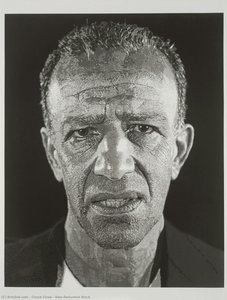 Alex/Redução Bloc1993
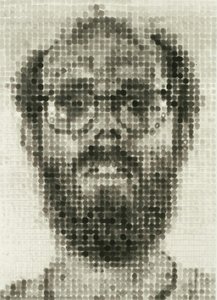 Self-Portrait1988
Ensaios sobre Big Self-Portrait
 The Introspective Gaze: Tracing the Evolution and Psychological Depth of the Self-PortraitExplore the psychological evolution of self-portraiture from Dürer to modern masters. Trace the history of the human gaze with us.
 Polish artworks of the 1900sPolish Symbolism in the 1900s features masterpieces by Jacek Malczewski, Olga Boznańska, and Józef Mehoffer. View the full collection at Or…
 Precision in Portraiture: The Technical Rigor of Anatomical Mastery and Hyper-RealismMaster the technical rigor of hyper-realism and anatomical precision. Explore the evolution of portraiture mastery now.