

 Visualizar em escala
 Enviar
 Compartilhar
 Ver detalhes
 Guia de Obras do Aluno

 Baixar imagem
 Semelhantes
 Raio X
 Apresentação de slides
 Estatísticas
Boy Sleeping
 Acrylic On Canvas
- WallArt
- Romanticism
 1802
1802- Early Medieval
 18.0 x 11.0 cm
 Kunsthalle Bremen
 Ver mais
Reprodução em Óleo Feita à Mão
Óleo sobre tela pintado à mão no tamanho e moldura de sua escolha, feito sob encomenda pelos nossos artistas. ( Alternar para Impressão Ver Imagem Digital)




P118B €10

P118H €10

P118W €10

P438Z €10

P508JH €12

P508YH €12

P805H €10

P805Z €10

P919BZ €10

P919G €10

P919XJ €10

P959ZH €10

P968JZ €12

W106C €8

W218G €10

W218JH €8

W218Y €10

W307PJ €10

W316G €10

W316PJ €8

W316Y €10

W398PJ €8

W4111J €10

W500HY €15

W500JH €15

W692G €12

W849H €8

W940BG €15

W953PJ €8




Escolha entre os nossos tamanhos pré-definidos que respeitam as proporções originais da obra de arte.

Digite a largura e a altura de que necessita, para se ajustar à sua moldura ou à sua parede. Esta obra é pintada à mão, por isso, para um tamanho com uma proporção diferente, o artista pode pintar um pouco mais ao redor da imagem ou cortar um pouco — você escolhe. Enviamos-lhe uma maquete digital para aprovação antes de a pintura começar. A imagem exibida nesta página não mostra o resultado real — apenas a maquete mostra.
Após o pedido, a equipa OriginalUniqueArt.com enviará um e-mail ao cliente para solicitar instruções e fornecer uma prévia do esboço.
Entrega mundial () em 3 a 4 semanas, em vez das 5 semanas padrão. (23 Outubro). Sem comprometer a qualidade.

Envio expresso gratuito para todo o mundo

Tela de Linho Premium

Seguro de transporte total

Garantia de Reembolso de Impostos Alfandegários

Garantia de Fidelidade de Cor

Política de Devolução em 100 Dias (Apenas para Defeitos)

Garantia de reembolso de 100%

Desconto para múltiplas unidades
 A opção de vidro está disponível apenas para tamanhos inferiores a 110 cm

Boy Sleeping
Técnica de Reprodução
Dimensões da Reprodução
-


Preço Total
€ 264
A Moment Frozen in Time: Caspar David Friedrich’s ‘Boy Sleeping’
Caspar David Friedrich's “Boy Sleeping,” created in 1802, is more than just a depiction of childhood repose; it’s a profound meditation on the cyclical nature of life and death, rendered with an almost unsettling stillness. This intimate drawing, originating from the Small Mannheim Sketchbook, offers a glimpse into the artist’s deeply personal and often melancholic worldview – a perspective shaped by early loss and a persistent questioning of existence. Friedrich masterfully employs a restrained palette of charcoal and graphite on paper, favoring subtle tonal shifts to build atmosphere rather than relying on bold color. The technique is remarkably delicate, revealing the meticulous hand of an artist obsessed with capturing fleeting moments and conveying complex emotional states through nuanced shading.
Symbolism Woven into the Landscape
The scene itself is deceptively simple: a young boy slumbering against a weathered tree stump beneath the watchful gaze of a raven perched above. However, each element within this composition carries significant symbolic weight. The raven, a frequent motif in Friedrich’s work, isn't merely a bird; it embodies death and decay, its presence directly linked to the concept of sleep – the brother of mortality. The tree branch arching over the boy mirrors his posture, creating a visual echo that reinforces the theme of interconnectedness between man and nature, life and death. The inclusion of an unusual, angular axe, added later, introduces a jarring element of disruption, suggesting the potential for violence and destruction within this otherwise serene tableau – a subtle reminder of humanity’s capacity for both creation and ruin.
From Sketch to Woodcut: A Transformation of Meaning
“Boy Sleeping” began as a preparatory drawing, meticulously traced with a sharp pencil on the reverse side of the page, revealing the artist's process. This tracing served as the basis for a woodcut (Inv. No. 1933/19), where Friedrich subtly altered the imagery to shift its focus. While retaining the sleeping boy and the raven, he replaced the tree with a grave and added a crucifix, transforming the scene from an allegory of natural cycles into one imbued with Christian symbolism – specifically, the promise of resurrection. This deliberate change highlights Friedrich’s evolving spiritual concerns and his desire to imbue his landscapes with layers of meaning beyond mere visual representation. The woodcut demonstrates a careful consideration of how imagery translates across different mediums, each carrying its own distinct expressive potential.
An Emotional Resonance – A Study in Quiet Contemplation
“Boy Sleeping” possesses an undeniable emotional power, stemming from Friedrich’s ability to capture a profound sense of vulnerability and introspection. The boy's peaceful slumber evokes feelings of tranquility and innocence, yet the presence of the raven casts a subtle shadow of mortality over the scene. The overall effect is one of quiet contemplation – a moment suspended in time, inviting viewers to reflect on their own existence and the transient nature of life. This drawing isn’t simply a portrait; it's an invitation to engage with fundamental questions about humanity’s place within the vastness of the natural world. OriginalUniqueArt offers exquisite hand-painted reproductions that faithfully capture the delicate beauty and evocative symbolism of this iconic work, allowing you to bring its profound message into your home or studio.
- Size: 18 x 11 cm
- Date: 1802
- Artist: Caspar David Friedrich
Perguntas e Respostas
Quão saturada é a paleta de "Boy Sleeping"?
"Boy Sleeping" de Caspar David Friedrich é registrado com uma saturação de Subtle Color.
"Boy Sleeping" de Caspar David Friedrich utiliza contrastes fortes ou harmonias suaves?
A análise cromática de "Boy Sleeping" de Caspar David Friedrich registra um contraste Serene e uma harmonia Unified Palette.
Quão harmoniosas são as cores de "Boy Sleeping" de Caspar David Friedrich?
"Boy Sleeping" de Caspar David Friedrich apresenta uma harmonia de cores Unified Palette.
Biografia do Artista
A Solitary Vision: The Life and Art of Caspar David Friedrich
Born in the Baltic port city of Greifswald in 1774, Caspar David Friedrich’s life was steeped in a melancholic atmosphere that would profoundly shape his artistic vision. His early years were marked by loss – the deaths of his mother and siblings cast a long shadow, fostering a sensitivity to mortality and transience that became central themes in his work. Initially educated by his older brother Christian in drawing, Friedrich’s formal training began at the University of Leipzig, where he pursued both art and theology, though neither degree was completed. This dual interest – a fascination with the visual world alongside a deep spiritual questioning – would prove crucial to his development as an artist. Further studies in Copenhagen honed his technical skills, exposing him to landscape painting traditions that would serve as a foundation for his unique style, yet it was not imitation he sought but rather expression—a means of conveying inner emotional states through the language of nature.The Birth of Romantic Landscape
Friedrich’s artistic journey wasn't merely about depicting scenery; it was about imbuing landscapes with profound symbolic meaning. He moved away from the meticulous detail favored by earlier artists, embracing a more personal and expressive approach. His paintings are characterized by an emphasis on the sublime – evoking feelings of awe, terror, and spiritual connection in the face of nature’s grandeur. The use of *Rückenfiguren*, figures seen from behind, became a signature element, inviting viewers to step into the scene and share in the contemplative experience. Natural elements like ancient trees, towering mountains, swirling fog, and crumbling ruins weren't simply picturesque details; they were potent symbols representing life’s cycles, spiritual longing, and the weight of history. His palette, often muted with blues, grays, and browns, further enhanced the mood of introspection and solemnity that pervades his work. He pioneered a way to depict landscapes not as mere views but as reflections of the human soul—a revolutionary concept for its time.Iconic Works and Enduring Themes
Several paintings stand out as defining examples of Friedrich’s artistic achievement. “The Abbey in the Oakwood” (1809-1810), a haunting image of a ruined churchyard enveloped by bare trees, speaks powerfully to themes of mortality and spiritual decay. It portrays a desolate landscape dominated by decaying structures—a deliberate contrast to idealized depictions of pastoral beauty—and invites contemplation on the passage of time and the inevitability of ruin. Perhaps his most famous work, “Wanderer Above the Sea of Fog” (c. 1818), encapsulates the Romantic ideal of the individual confronting the vastness and mystery of existence. The figure, silhouetted against a swirling sea of mist, embodies both human aspiration and insignificance—a poignant reminder of our vulnerability in the face of overwhelming natural forces. “Chalk Cliffs on Rügen” (1818) demonstrates his mastery of atmospheric effects and subtly conveys a sense of national identity—a growing concern in the fragmented political landscape of early 19th-century Germany. The dramatic interplay of light and shadow captures the rugged beauty of the Baltic coast, symbolizing resilience and fortitude amidst challenging circumstances. Even more evocative is “The Sea of Ice” (1824), a chilling depiction of an Arctic wasteland, representing nature’s immense power and indifference to human fate. Friedrich's meticulous attention to detail—the icy textures, the desolate expanse—creates a visceral experience for the viewer, prompting reflection on humanity’s insignificance in comparison to the forces of geological time. Recurring throughout his oeuvre are themes of nature as a manifestation of the divine, the fragility of humanity in the face of cosmic forces, melancholy, solitude, spiritual yearning, and a burgeoning sense of German nationalism.Influences and Artistic Style
Friedrich’s artistic style was profoundly shaped by several influences—primarily Dutch Golden Age landscape painting, particularly the works of Jacob van Ruisdael, which instilled in him a commitment to capturing atmospheric effects and conveying emotional depth. He also drew inspiration from the philosophical writings of Immanuel Kant, whose concept of transcendental idealism challenged conventional notions of perception and encouraged Friedrich to explore subjective experience as a pathway to spiritual understanding. Furthermore, his own personal experiences with loss—the premature deaths of his family members—fueled his artistic preoccupation with mortality and imbued his paintings with an unmistakable sense of melancholy. He rejected the academic conventions of his time, prioritizing expressive brushwork and tonal modulation over precise representation. His technique involved layering thin washes of color to create luminous surfaces that subtly suggest depth and texture—a method he honed during his studies in Copenhagen.Legacy and Rediscovery
Friedrich’s art resonated deeply with audiences throughout his lifetime, though its popularity waned after his death in Dresden in 1840. However, he experienced a significant rediscovery in the late 20th century, becoming widely recognized as one of the most important figures in German Romanticism—a movement that championed emotion, imagination, and individualism as alternatives to Enlightenment rationalism. His pioneering approach to landscape painting influenced generations of artists who sought to express inner feelings through visual means—particularly Symbolists and Surrealists—and continues to inspire contemplation on the relationship between humanity and nature. He remains a pivotal figure whose work transcends time, reminding us of the enduring power of art to evoke wonder, sorrow, and profound spiritual insight.
Caspar David Friedrich
1774 - 1840 , Alemanha
Informações Rápidas
- Artistic Movement Or Style: Romantismo
- Artists Or Movements Influenced By This Artist:
- Simbolistas
- Surrealistas
- Artists Who Influenced This Artist:
- Pintores Holandeses
- J.C. Dahl
- Date Of Birth: 5 setembro 1774
- Full Name: Caspar David Friedrich
- Nationality: Alemão
- Notable Artworks:
- Abbey na Oliveira
- Peregrino sobre o Mar de Névoa
- Falésias Calcárias em Rüügen
- O Mar de Gelo
- Place Of Birth: Greifswald, Alemanha
Artigos Relacionados

The Sublime and the Picturesque: Exploring Emotion & Nature in Romantic Landscape Painting
Explore the emotional power of Romantic landscape painting! Discover the sublime & picturesque traditions, key artists like Friedrich & Cole, and find your perfect artwork at OriginalUniqueArt.

Capturing the Sublime: A Guide to Romantic Landscape Art & Its Emotional Power
Explore the profound emotional power of Romantic landscape art. Discover how masters like Friedrich captured the sublime through breathtaking nature, and learn to curate these evocative masterpieces for your luxury interior collection.

Caspar David Friedrich: Romanticism's Master of Landscape & the Sublimity of Inner Experience
Explore the profound landscapes of Caspar David Friedrich, a master of German Romanticism. Discover the symbolism, themes & enduring influence of this iconic artist. A deep dive into his life and work.

Os 10 Mestres da Paisagem Romântica: Arte para Inspirar a Sua Casa
Descubra os 10 quadros mais emblemáticos da Paisagem Romântica! Explore a história de Turner, Friedrich e outros mestres. Encontre reproduções de arte exclusivas para inspirar sua decoração em OriginalUniqueArt.com.
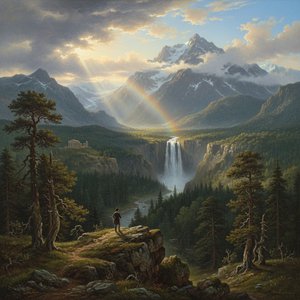
Evoking Nature's Sublime: A Comprehensive Exploration of 19th-Century Landscape Painting
Explore the captivating world of 19th-century landscape painting! Discover renowned artists like Friedrich & Monet, key movements, and find the perfect artwork to bring nature's serenity into your home. Expert insights at OriginalUniqueArt.


