

 Visualizar na parede
 Compartilhar
 Compartilhar
 Detalhes

 Baixar imagem
 Semelhantes
 Raio X
 Slideshow
The Lost Trail
 1856
1856 50.0 x 78.0 cm
 Museo Thyssen-Bornemisza
 Ler mais
Adquira uma imagem digital de alta resolução e aprimorada, muito superior à prévia online.
Cada arquivo é meticulosamente preparado por nossos especialistas internos, utilizando ferramentas avançadas e retoques manuais de alta precisão. Garantimos que cada imagem apresente clareza excepcional, fidelidade de cores e detalhes minuciosos.
O arquivo final é entregue por e-mail em até 72 horas, otimizado para uso imediato em ambientes profissionais, editoriais e de impressão. Esta é a mesma qualidade utilizada por estúdios de design de alto nível, editoras e galerias.
Imagem Digital
Baixe um arquivo de alta resolução para exibição pessoal, impressão e projetos criativos. ( Comprar impressão Comprar pintura feita à mão)
Incluído em cada compra de imagem digital
Entrega Digital Especializada e Garantida
Ao escolher o OriginalUniqueArt.com, você não está apenas adquirindo uma imagem — você está recebendo uma obra de arte digital profissionalmente aprimorada, elaborada com precisão e com garantia de satisfação. Aqui está tudo o que acompanha seu pedido, automaticamente:

Entrega rápida por e-mail
O seu arquivo de imagem digital em alta resolução será enviado por e-mail em até 72 horas após o pedido — pronto para uso imediato.

Arquivo Digital com IA Otimizado
Sua obra de arte é otimizada profissionalmente por meio de ferramentas avançadas de IA e edição manual, garantindo o máximo de detalhes, clareza e precisão de cores.

Reenvio gratuito vitalício
Apagou ou perdeu o seu ficheiro acidentalmente? Não se preocupe – nós reenviamos para si a qualquer momento, gratuitamente.

Sem Taxas de Importação - Sempre
Desfrute da sua obra de arte instantaneamente, sem taxas alfandegárias, impostos ou custos de entrega — downloads digitais são sempre isentos de taxas.

Garantia de Fidelidade de Cores
Garantimos que sua imagem digital reflita as cores originais com a maior fidelidade possível, utilizando ferramentas profissionais e gerenciamento de cores.

Garantia de Satisfação de 60 Dias
Se você não estiver satisfeito com sua imagem digital, nós a revisaremos ou reembolsaremos 100% dentro de 60 dias — sem perguntas.

Garantia de Reembolso 100%
Não está satisfeito? Receba o reembolso total em até 60 dias após o recebimento do seu arquivo digital — sem perguntas.

Descontos para pedidos em lote
Compre 3 imagens, economize 10% - Compre 5, economize 15% - Compre 10+, economize 20%. Ideal para projetos criativos, galerias e agências.
Biografia do Artista
The Chronicler of the American Frontier: The Life and Vision of Carl Wimar
Karl Ferdinand Wimar, known to many as Charles Wimar, occupied a unique and vital space in the mid-19th-century art world, acting as a visual bridge between the disciplined traditions of European academies and the raw, untamed spirit of the American West. Born in 1828 in Siegburg, Prussia, Wimar’s journey was one of profound geographical and artistic transformation. After emigrating to St. Louis at the tender age of fifteen, he found himself immersed in the burgeoning frontier culture of Missouri. This early exposure to the vastness of the American landscape would later become the heartbeat of his creative output. His formal education, however, remained deeply rooted in the prestigious traditions of the Old World. By enrolling at the Düsseldorf Academy in 1852, Wimar placed himself under the tutelage of Emanuel Leutze, a master of Romanticism. This mentorship was transformative, instilling in him a rigorous dedication to realism and a penchant for dramatic, narrative-driven compositions that would define his later masterpieces.Expeditions into the Heart of the Great Plains
The true essence of Wimar’s artistry was forged not in the quiet studios of Germany, but along the winding currents of the Missouri and Mississippi Rivers. During the pivotal expeditions of 1858 and 1859, Wimar transitioned from a student of technique to an intrepid observer of life. Driven by an insatiable curiosity, he ventured deep into the Great Plains, documenting the rhythmic, nomadic existence of Native American tribes with an eye for both ethnographic detail and emotional resonance. He did not merely paint landscapes; he captured the pulse of a disappearing era. His canvases became windows into the daily rituals of indigenous peoples, the thunderous movement of massive buffalo herds, and the precarious encounters between migrating pioneer wagon trains and the original inhabitants of the land. Through his meticulous observation, Wimar imbued his subjects with a dignity and vitality that transcended simple documentation, elevating frontier life to the realm of high art.Legacy and Artistic Significance
Wimar’s body of work is characterized by a remarkable synthesis of Realism and Symbolism. While his technical execution relied on the precision learned at Düsseldorf, his thematic focus often touched upon the profound tensions of the colonial era. One of his most celebrated early achievements, The Abduction of Boone's Daughter by the Indians, serves as a hauntingly beautiful example of his ability to weave historical incident with dramatic tension. Beyond his individual canvases, Wimar’s contribution to American visual identity was cemented through large-scale projects, such as the magnificent murals he painted in 1861 for the Rotunda of the St. Louis Court House. Though his life was tragically short, ending in 1862, the impact of his vision remains indelible. He remains a foundational figure for anyone seeking to understand the complex, often turbulent, beauty of the American frontier through the lens of a master painter who saw both the majesty and the tragedy of a changing world.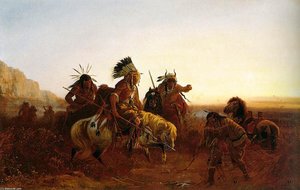
carl wimar
1828 - 1862 , Germany
Breve Biografia
- Artistic Movement Or Style: Romanticism
- Artists Or Movements Influenced By This Artist: ['Düsseldorf School']
- Artists Who Influenced This Artist: ['Emanuel Leutze']
- Date Of Birth: February 20, 1828
- Full Name: Karl Ferdinand Wimar
- Nationality: German-American
- Notable Artworks:
- The Abduction of Boone's Daughter by the Indians
- The Lost Trail
- Place Of Birth: Siegburg, Germany

