

 Enviar
 Compartilhar
 Ver detalhes
 Guia de Obras do Aluno

 Baixar imagem
 Semelhantes
 Apresentação de slides
 Estatísticas
Pierced Hemisphere I
 Marble
- Sculpture
- Modernism
 1937
1937 35.0 x 38.0 cm
 The Hepworth Wakefield
 Ver mais
A obra de arte exibida nesta página é protegida por leis de direitos autorais, o que significa que não podemos criar ou vender legalmente uma reprodução idêntica. Esta proteção é aplicada por meio de acordos internacionais, tais como a Convenção de Berna e pelas leis nacionais, incluindo as estabelecidas por Lei de Direitos Autorais dos EUA - Título 17.
Este método cumpre plenamente as regulamentações de direitos autorais, pois não envolve a cópia ou duplicação da obra protegida. Em vez disso, trata-se de uma reinterpretação criativa — uma nova pintura que é influenciada pela original, mas não idêntica a ela.
Giclée / Impressão de Arte
Impressão giclée ou em tela de qualidade de museu, com produção rápida e opções flexíveis de acabamento. ( Encomendar reprodução pintada à mão Ver Imagem Digital)




































Escolha entre os nossos tamanhos pré-definidos que respeitam as proporções originais da obra de arte.

Digite a largura e a altura de que necessita, para se ajustar à sua moldura ou à sua parede. Uma impressão só pode ser cortada, nunca ampliada além da imagem original, pelo que um tamanho com uma proporção diferente perderá parte da imagem. Enviamos-lhe uma maquete digital para aprovação antes de imprimirmos qualquer coisa. A imagem apresentada nesta página não mostra o corte real — apenas a maquete o faz.
Entrega mundial () em 2 semanas, em vez das 4/5 semanas padrão. (23 Outubro)

Envio expresso gratuito para todo o mundo

Tela de Linho Premium

Seguro de transporte total

Garantia de Reembolso de Impostos Alfandegários

Garantia de Fidelidade de Cor

Política de Devolução em 100 Dias (Apenas para Defeitos)

Garantia de reembolso de 100%

Desconto para múltiplas unidades
 A opção de vidro está disponível apenas para tamanhos inferiores a 110 cm

Pierced Hemisphere I
Giclée / Impressão de Arte
Dimensões da Reprodução
-


Preço Total
€ 70
A Fragmented Sphere: Barbara Hepworth’s Pierced Hemisphere I
Barbara Hepworth's "Pierced Hemisphere I," crafted in 1937 from pristine white marble, isn’t merely a sculpture; it’s an invitation to contemplate the delicate balance between wholeness and disruption. This arresting piece, currently housed at The Hepworth Wakefield, embodies the core tenets of Hepworth’s modernist approach – a profound exploration of form, texture, and the inherent dynamism within static materials. It speaks to a world grappling with change, mirroring both the beauty of natural processes and the unsettling implications of fragmentation.
The sculpture itself presents as a subtly distorted hemisphere, its surface punctuated by a decisive, almost violent, incision. This ‘piercing’ isn't destructive in the traditional sense; rather, it reveals an inner structure, suggesting a hidden geometry beneath the apparent solidity of the stone. The curve is not perfectly smooth – instead, it possesses a gentle undulation, hinting at movement and echoing the rhythms found in nature. The choice of white marble is crucial, lending an ethereal quality to the work. Marble’s inherent translucence allows light to penetrate and play across its surface, creating a shifting interplay of shadows that further emphasize the sculpture's three-dimensional form.
The Context of Modernism and Abstraction
To fully appreciate "Pierced Hemisphere I," it’s essential to situate it within the broader context of early 20th-century art. Hepworth, along with figures like Ben Nicholson and Paul Nash, was a pivotal member of the Unit One group – an avant-garde collective dedicated to forging a distinctly British approach to modernism. Unit One sought to move beyond representational art, embracing abstraction and exploring new ways of expressing form and space. This period witnessed a significant shift away from traditional sculptural techniques, with artists experimenting with materials like wood, metal, and, crucially for Hepworth, stone.
Hepworth’s work during this time was deeply influenced by the principles of Cubism and Constructivism – movements that emphasized geometric forms and explored the relationship between two-dimensional and three-dimensional space. However, she resisted rigid adherence to these styles, developing a uniquely personal language characterized by flowing lines, subtle curves, and an intuitive understanding of material properties. The influence of Surrealism is also evident in her exploration of subconscious imagery and the evocative power of abstract forms.
Symbolic Resonance: Wholeness and Disruption
The symbolism embedded within "Pierced Hemisphere I" is layered and open to interpretation. The hemisphere itself represents wholeness, a complete form – a symbol often associated with the cosmos or the human psyche. Yet, the incision disrupts this perfect unity, suggesting a loss of innocence, a confrontation with reality, or perhaps even an acknowledgement of inherent imperfection. It’s not simply a break; it's a revelation, exposing a new dimension within the original shape.
Some art historians have linked the pierced form to Hepworth’s personal experiences – her divorce and subsequent move to St Ives, where she found inspiration in the rugged Cornish coastline. The sculpture can be seen as a metaphor for navigating life's challenges, embracing both beauty and sorrow, and finding strength in resilience. The subtle variations in tone within the marble further contribute to this sense of complexity, mirroring the nuances of human emotion.
Craftsmanship and Technique
Hepworth’s mastery of her chosen medium – white marble – is undeniable. The sculpture demonstrates a remarkable sensitivity to material properties; she skillfully exploited the stone's natural veining and grain to create a surface that is both smooth and tactile. The precision of the incision itself speaks volumes about Hepworth’s technical skill, requiring immense control and an intimate understanding of how marble responds to tools.
The piece was created using traditional carving techniques, yet with a distinctly modern sensibility. The artist's hand is evident in the subtle imperfections and irregularities that add character and depth to the work. "Pierced Hemisphere I" stands as a testament to Hepworth’s ability to transform raw material into a powerful and enduring statement of artistic vision. It remains a compelling example of how sculpture can engage with fundamental questions about form, space, and the human condition.
Perguntas e Respostas
Qual nível de contraste apresenta "Pierced Hemisphere I" de Barbara Hepworth?
O nível de contraste de "Pierced Hemisphere I" de Barbara Hepworth é Statement.
"Pierced Hemisphere I" de Barbara Hepworth é uma boa opção de presente? E para quem?
A recomendação de presente para "Pierced Hemisphere I" de Barbara Hepworth combina Birthday com Reflective.
Que harmonia de cores apresenta "Pierced Hemisphere I" de Barbara Hepworth?
As cores de "Pierced Hemisphere I" de Barbara Hepworth apresentam uma harmonia Balanced Harmony. A harmonia descreve como as cores se relacionam entre si.
Biografia do Artista
Barbara Hepworth: A Pioneer of Modern Sculpture
Barbara Hepworth (Wakefield, Yorkshire, 10 January 1903 — Saint Ives, Cornwall, 20 May 1975), was an English artist and sculptor whose groundbreaking approach to abstraction revolutionized the art world in the mid-20th century. Born into a family of engineers—her father, Herbert Hepworth, worked for West Riding County Council—Jocelyn Barbara Hepworth’s early life instilled in her a fascination with precision and form, influences that would permeate her artistic vision throughout her career.- Early Influences & Education: Hepworth's formative years were marked by exposure to the landscapes of Yorkshire and the encouragement of Miss McCroben, headteacher at Wakefield Girls’ High School, who recognized Hepworth’s talent for drawing and encouraged her ambition to pursue higher education. She excelled academically, securing a scholarship to Leeds School of Art in 1920 where she encountered Henry Moore—a friendship that would endure for decades and profoundly shape their artistic trajectories.
- Royal College of Art & The Birth of Modern Sculpture: Hepworth’s studies at the Royal College of Art from 1921 to 1924 proved pivotal. Alongside Moore, she embraced a radical new aesthetic—direct carving—rejecting traditional modeling techniques in favor of working directly with stone and wood. This method allowed for an unprecedented level of spontaneity and responsiveness to material qualities, establishing Hepworth as one of the foremost figures in the burgeoning movement of abstraction-création.
The Surrealist Years & Collaboration with Ben Nicholson
Hepworth’s artistic journey gained momentum during her involvement with the Hampstead Circle group—a collective of avant-garde artists united by a shared commitment to exploring subconscious imagery and geometric abstraction. Her relationship with Ben Nicholson blossomed in 1931, culminating in marriage shortly thereafter. Together they established a studio in St Ann's Terrace, Hampstead, where Hepworth honed her craft and experimented with new materials—particularly stringed sculptures that captured the essence of natural forms through rhythmic repetition and textural interplay.Monumental Sculpture & Recognition
The Second World War brought Hepworth and Nicholson to St Ives, Cornwall, where they found inspiration in the rugged Cornish coastline. During this period, Hepworth undertook ambitious commissions—most notably Winged Figure (1961–3), a monumental sculpture commissioned by John Lewis for their Oxford Street flagship store—demonstrating her mastery of scale and materiality. Her work gained international acclaim, securing prestigious awards and cementing her place as one of the most influential sculptors of her time.Legacy & Artistic Significance
Barbara Hepworth’s enduring legacy resides in her unwavering dedication to exploring the fundamental principles of form and space—a pursuit that transcended stylistic conventions and established her as a visionary pioneer of modern sculpture. Her sculptures continue to inspire artists worldwide, serving as testament to her artistic genius and her profound contribution to the history of art.
Barbara Hepworth
1903 - 1975 , Reino Unido
Informações Rápidas
- Artistic Movement Or Style: Modernismo
- Artists Or Movements Influenced By This Artist: ['Unit One']
- Artists Who Influenced This Artist: ['Henry Moore']
- Date Of Birth: 10 janeiro 1903
- Full Name: Jocelyn Barbara Hepworth
- Nationality: Inglesa
- Notable Artworks:
- Oval Form
- Two Forms
- Totem
- Place Of Birth: Wakefield, Inglaterra
Artigos Relacionados

Esculturas em Bronze Icônicas: 10 Obras que Revolucionaram a Arte | OriginalUniqueArt
Descubra as 10 esculturas em bronze mais icônicas da história! Explore a arte de Rodin, Michelangelo e outros mestres. Encontre reproduções de alta qualidade para sua casa em OriginalUniqueArt.com.

The Enduring Form: Sculpture Across History, Technique & Emotional Resonance
Explore the rich history of sculpture with OriginalUniqueArt. Discover key techniques, influential artists & investment potential for discerning collectors. Expert insights into valuing and collecting timeless masterpieces.
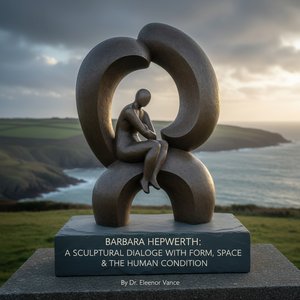
Barbara Hepworth: A Sculptural Dialogue with Form, Space & the Human Condition
Explore the profound world of Barbara Hepworth's sculpture. Discover her artistic evolution, iconic forms, and lasting influence on modern art. A guide for collectors & enthusiasts.

Abstração Geométrica: 10 Obras-Primas que Moldaram a Arte Moderna | OriginalUniqueArt.com
Descubra as 10 obras-primas da Abstração Geométrica que revolucionaram a arte moderna! Explore Kandinsky, Mondrian e outros artistas icônicos. Encontre reproduções de alta qualidade para decorar sua casa com OriginalUniqueArt.com.

The Enduring Allure of Marble in Art History: From Classical Sculpture to Modern Abstraction
Explore the captivating history of marble sculpture from ancient Greece to modern art. Discover renowned artists like Canova & Michelangelo, carving techniques, and investment insights at OriginalUniqueArt.


