Menu
Consultoria de arte gratuita
PreviewPreview Comprar impressão Comprar impressãoComprar imagem em alta resolução Comprar imagem em alta resolução EnviarEnviar
Detalhes da obraDetalhes da obra Adicionar aos favoritos Adicionar aos favoritos BaixarBaixar SemelhantesSemelhantes Raio XRaio X SlideshowSlideshow

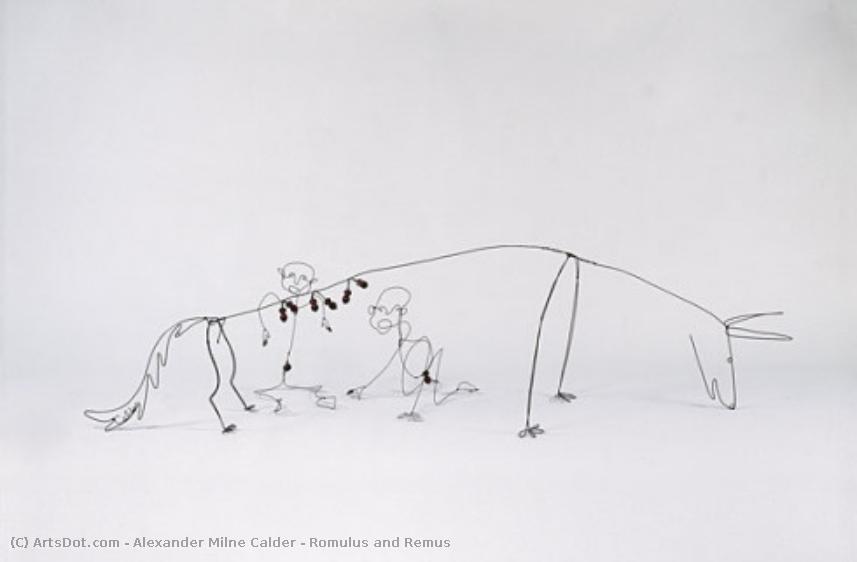
Romulus and Remus

Alexander Calder's 'Romulus and Remus' (1928) is a striking wire sculpture embodying Roman mythology with minimalist elegance. Explore its abstract form, symbolic meaning, and connection to Calder’s artistic legacy.

Alexander Milne Calder foi um escultor escocês-americano conhecido por suas obras arquitetônicas icônicas, como a Philadelphia City Hall e o monumento a William Penn, além de seus inovadores mobiles que desafiam a gravidade e exploram o movimento.

Reprodução em Óleo Feita à Mão

Óleo sobre tela pintado à mão no seu tamanho e moldura, feito sob encomenda pelos nossos artistas.

P118B $10
P118H $10
P118W $10
P438Z $10
P508JH $12
P508YH $12
P805H $10
P805Z $10
P919BZ $10
P919G $10
P919XJ $10
P959ZH $10
P968JZ $12
W106C $8
W218G $10
W218JH $8
W218Y $10
W307PJ $10
W316G $10
W316PJ $8
W316Y $10
W398PJ $8
W4111J $10
W500HY $15
W500JH $15
W692G $12
W849H $8
W940BG $15
W953PJ $8

Standard
custom
CM
INCH

Escolha entre os nossos tamanhos pré-definidos que respeitam as proporções originais da obra de arte.

largura
altura

Pode inserir as suas próprias dimensões para se adequar a uma moldura ou espaço específico. Se o tamanho selecionado não corresponder às proporções da imagem original, iremos cortar a obra de arte ou estender a pintura com elementos adicionais pintados à mão. Um esboço digital será enviado para sua aprovação antes do início da produção.
Tenha em atenção que a pré-visualização no ecrã não reflete o corte ou extensão real. Apenas o esboço mostrará com precisão a composição final.
Embora tamanhos personalizados estejam disponíveis, recomendamos selecionar uma dimensão da lista predefinida para preservar as proporções originais.

Exemplos do que pode ser alterado: Substituir o rosto pela foto do cliente; Adicionar um animal de estimação (ex: substituir gato por cão); Incluir uma mensagem oculta no fundo; Alterar a paisagem ou elementos do fundo.
Após o pedido, a equipa OriginalUniqueArt.com enviará um e-mail ao cliente para solicitar instruções e fornecer uma prévia do esboço.

Entrega Mundial () em 3 a 4 semanas, em vez das 5 semanas padrão. (25 Julho). Sem comprometer a qualidade.

why_choose_icon
Envio Expresso Gratuito para todo o Mundo
why_choose_icon
Tela de Linho Premium
why_choose_icon
Seguro de envio completo
why_choose_icon
Garantia de Reembolso de Impostos Alfandegários
why_choose_icon
Garantia de Fidelidade de Cores
why_choose_icon
Política de Devolução de 60 Dias (Apenas para Defeitos)
why_choose_icon
Garantia de 100% de Reembolso
why_choose_icon
Desconto para múltiplas unidades

Preço Total

-

reproduction

Romulus and Remus

Técnica de Reprodução

Dimensões da Reprodução

-

Preço Total Final

-

Dados Rápidos

  • Dimensions: 30 1⁄2" × 124 1⁄2"
  • Title: Romulus and Remus
  • Notable elements: Minimalist wire form
  • Subject or theme: Roman Mythology
  • Medium: Wire & Wood
  • Influences:
    • Chance
    • Modernism
  • Movement: Constructivism

Teste de Arte

Cada pergunta possui apenas uma resposta correta.

Pergunta 1:
What is the primary material used in Alexander Calder’s ‘Romulus and Remus’?
Pergunta 2:
When was Alexander Calder’s ‘Romulus and Remus’ created?
Pergunta 3:
The artwork ‘Romulus and Remus’ is an example of which artistic movement?
Pergunta 4:
What does the she-wolf depicted in ‘Romulus and Remus’ symbolize?
Pergunta 5:
Which of the following best describes the style of ‘Romulus and Remus’?

Descrição da Obra

A Moment Frozen in Steel: Exploring Calder’s “Romulus and Remus”

Alexander Milne Calder's "Romulus and Remus," crafted in 1928, isn’t merely a sculpture; it’s a distilled essence of myth rendered in delicate wire. This piece, a testament to the artist’s pioneering approach to three-dimensional form, transcends its subject matter – the legendary founders of Rome – to become a profound meditation on beginnings, brotherhood, and the very act of creation itself. Calder, deeply influenced by Constructivism and early Modernism, sought to liberate sculpture from the constraints of traditional materials, embracing the inherent qualities of industrial wire as both medium and metaphor.

The sculpture’s stark simplicity is its most arresting feature. Two figures, rendered with astonishing grace despite their skeletal construction, stand beneath a subtly arching structure that evokes a horizon line or perhaps a stylized landscape. The color palette – a resolute black and white punctuated by subtle grays – amplifies the work's austerity, forcing the viewer to focus entirely on form and movement. The lines themselves are paramount; thin, almost impossibly delicate wires define every contour, creating an illusion of both fragility and strength. This deliberate reductionist approach mirrors Calder’s broader philosophy: to strip away the superfluous and reveal the fundamental elements of a subject.

The Poetics of Chance and Kinetic Form

Calder's work in this period – particularly his “Cirque Calder” series – exemplifies his fascination with chance and spontaneity. He didn’t meticulously plan every curve or angle; instead, he allowed the wire to guide him, embracing the unpredictable nature of the material. This process is vividly captured in "Romulus and Remus," where the figures appear to be caught mid-action, poised on the precipice of a narrative yet undefined. The slight wobble inherent in the sculpture’s construction – a subtle consequence of its wire composition – hints at a kinetic energy, suggesting that even stillness can hold a dynamic potential.

The technique itself is deceptively complex. Calder skillfully bent and assembled hundreds of individual wires, creating a surprisingly robust structure despite its delicate appearance. The varying thicknesses of the wire contribute to the sculpture’s textural richness, offering subtle shifts in sheen as light catches the metal. This careful manipulation of material speaks to Calder's mastery of his chosen medium – a testament to his ability to transform industrial components into objects of profound beauty and intellectual resonance.

Myth, Brotherhood, and the Dawn of Rome

The subject matter—the story of Romulus and Remus—is deeply rooted in Roman mythology. The legend of the twins suckled by a she-wolf is an enduring symbol of resilience, survival, and the founding of civilization. Calder’s sculpture doesn't simply depict this narrative; it captures its essence – the primal struggle for existence, the bond between brothers, and the birth of a new order. The wire itself can be interpreted as representing the threads that connect us to our past, shaping our present and influencing our future.

Created in 1928, “Romulus and Remus” stands as a pivotal work in Calder’s oeuvre, marking a significant shift towards abstraction while retaining a powerful connection to his artistic roots. It's a sculpture that invites contemplation, prompting viewers to consider the interplay of form, material, and narrative – a timeless meditation on the foundations of human experience.


Biografia do Artista

Introduction to Alexander Milne Calder

Alexander Milne Calder (MILL-nee) was a Scottish-American sculptor born in Aberdeen, Scotland, on August 23, 1846. He is best known for his architectural sculpture of Philadelphia City Hall and both his son, Alexander Stirling Calder, and grandson, Alexander ‘sandy’ Calder, became significant sculptors in the 20th century. Calder's artistic journey began with a formative influence from his father, sculptor John Rhind, who instilled in him an appreciation for meticulous craftsmanship while attending the Royal Academy in Edinburgh. Seeking broader horizons, he moved to London and honed his skills at the South Kensington School alongside Thomas Eakins at the Pennsylvania Academy of Fine Arts.

Early Life and Education

Calder’s upbringing was marked by a profound connection to art from a young age. At three years old, he posed nude for his father's sculpture *Man Cub*, a cast of which resides in the Metropolitan Museum of Art in New York City—a testament to Calder’s early engagement with sculptural representation. His fascination continued as he studied at Stevens Institute of Technology, Hoboken, New Jersey, where he pursued a degree in mechanical engineering alongside foundational artistic disciplines like chemistry and drawing. Notably, his mother, Nanette Lederer Calder, was herself a painter who had honed her technique at the Académie Julian and the Sorbonne in Paris. This familial artistic heritage undoubtedly shaped Calder’s worldview and nurtured his innate talent for visual expression.

Career Highlights

Calder's professional life unfolded with remarkable achievements, beginning with his pivotal role in designing the sculptures adorning Philadelphia City Hall—a monumental undertaking that spanned over two decades and involved crafting more than 250 pieces of marble and bronze. This ambitious project solidified his reputation as a visionary architect and sculptor. Furthermore, he captivated audiences with his creation of William Penn, a colossal bronze statue commemorating Pennsylvania’s founding father, which stands proudly atop City Hall's tower—a symbol of civic pride and artistic grandeur. Calder’s dedication to innovation extended beyond monumental sculptures; he pioneered the development of kinetic art, specifically mobiles—suspended sculptures propelled by air currents or motors—that embrace chance and spontaneity as core aesthetic principles.

Legacy and Influence

Alexander Milne Calder’s impact on the art world transcends his own creations, resonating through generations of sculptors and artists who have drawn inspiration from his pioneering approach to form and movement. His son, Alexander Stirling Calder, followed in his father's footsteps, establishing himself as a celebrated sculptor known for his distinctive stabiles—stationary sculptures that defy gravity with elegant balance. Similarly, Alexander ‘sandy’ Calder continued the family tradition of artistic excellence, producing captivating works that cemented Calder’s place among the most influential sculptors of the 20th century. His enduring legacy serves as a reminder of the transformative power of creativity and the lasting impact of artistic vision.
Alexander Calder

Alexander Calder

1898 - 1976 , Escócia

Informações Rápidas

  • Artistic Movement Or Style: Architectural sculpture
  • Artists Who Influenced This Artist: ['John Rhind']
  • Date Of Birth: August 23, 1846
  • Date Of Death: June 14, 1923
  • Full Name: Alexander Milne Calder
  • Nationality: Scottish-American
  • Notable Artworks:
    • Philadelphia City Hall
    • William Penn statue
  • Place Of Birth: Aberdeen, Scotland
Explore obras de arte organizadas por temas, estilos e características.