W skrócie
Self-portrait with extra large paper hat (1955) to obraz autorstwa Red Grooms, który przyciąga najwięcej spojrzeń. Następnie wzrok kieruje się na Derain and Poiret (1998) i (Constantine) Guys (1972). Spośród 41 dzieł Red Grooms w naszym katalogu, tych 40 jest najbardziej znanych – każde z nich to unikatowy oryginał, przedstawiony wraz z rokiem powstania, muzeum oraz powodem, dla którego przetrwało próbę czasu.
10 najlepszych obrazów autorstwa Red Grooms według oka galerii
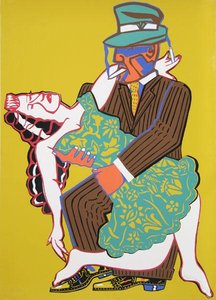
Derain and Poiret
The work known as Derain and Poiret emerges from the creative mind of Red Grooms, an artist whose origins trace back to Nashville, Tennessee, in 1937. In this piece, the artist captures a specific moment of visual inquiry, bringing together names and ideas through a unique lens. The piece dates to 1998, a time when the artist's hand was already deeply engaged with the textures of modern existence.
Słynne obrazy artysty Red Grooms, od 11 do 40
Tematy, które przyciągnęły wzrok Red Grooms
Cztery motywy najczęściej powracające w tych oryginałach, z których każdy doczekał się swojego najdoskonalszego przykładu.
Urban life 2 dzieł
Muzea przechowujące oryginały Red Grooms
Muzeum, w którym znajduje się najwięcej obrazów prezentowanych na tej stronie.
| Muzea | Miasto | Dzieła artysty Red Grooms | Obrazy z tej listy |
|---|---|---|---|
| Nowy Jork | 1 | Derain and Poiret |
Red Grooms na przestrzeni dekad: jeden unikatowy oryginał dla każdego
Dzieła według dekad
Wybierz dekadę, aby zobaczyć dzieło, które ją definiuje.
Derain and Poiret
The work known as Derain and Poiret emerges from the creative mind of Red Grooms, an artist whose origins trace back to Nashville, Tennessee, in 1937. In this piece, the artist captures a specific moment of visual inquiry, bringing together names and ideas through a unique lens. The piece dates to 1998, a time when the artist's hand was already deeply engaged with the textures of modern existence.
Obrazy artysty Red Grooms: pytania do galerii
Jakie jest najsłynniejsze dzieło artysty Red Grooms?Odkryj odpowiedź
Self-portrait with extra large paper hat (1955). Następne są Derain and Poiret (1998) oraz (Constantine) Guys (1972).
W jakim wieku Red Grooms stworzył/a Self-portrait with extra large paper hat?Odkryj odpowiedź
18 lat: Self-portrait with extra large paper hat pochodzi z 1955, a Red Grooms urodził(a) się w 1937.
Które dziesięć obrazów Red Grooms jest najbardziej znanych?Odkryj odpowiedź
Self-portrait with extra large paper hat, Derain and Poiret, (Constantine) Guys, Blewy, Baudelaire, Degas, Wounded Bird, Goal Posts, Charlie Chaplin i Lumberjack. Powyższy ranking zawiera rok powstania oraz muzeum dla każdego z nich.
Ile znanych dzieł stworzył Red Grooms?Odkryj odpowiedź
Nasz katalog zawiera 41 dzieł artysty Red Grooms, datowanych od 1955 do 2017.
Gdzie można zobaczyć najsłynniejsze oryginały Red Grooms?Odkryj odpowiedź
W większości znajdują się w Metropolitan Museum of Art (Nowy Jork). Powyższa tabela muzeów zawiera ich pełną listę.
W jakim okresie Red Grooms stworzył/a swoje najsłynniejsze obrazy?Odkryj odpowiedź
W 1980s: 9 z 40 dzieł na tej stronie powstało w tym czasie, w tym Goal Posts.
Który z najsłynniejszych obrazów artysty Red Grooms powstał najwcześniej, a który najpóźniej?Odkryj odpowiedź
Na tej stronie najwcześniejszy to Self-portrait with extra large paper hat (1955), a najpóźniejszy The Strand (2017).
Do jakiego nurtu należy twórczość Red Grooms?Odkryj odpowiedź
Pop art, sądząc po oryginałach na tej stronie.
Red Grooms: portret artysty
A Life Painted in Motion: The World of Red Grooms
Born Charles Rogers Grooms in Nashville, Tennessee, in 1937, the artist known as Red Grooms has spent a lifetime translating the vibrant energy and often chaotic beauty of modern life into a uniquely personal visual language. From his early days absorbing the sights and sounds of mid-century America to his groundbreaking experiments with multimedia installations, Grooms’ work is characterized by an irrepressible spirit of playfulness and a keen eye for social commentary. The nickname “Red,” bestowed upon him during his time as a dishwasher in Provincetown while studying with Hans Hofmann, stuck—a fitting moniker for an artist whose palette would forever be defined by bold, saturated hues. His father’s profession as a coppersmith may have subtly influenced Grooms' later inclination towards assemblage and construction, fostering an appreciation for the tactile qualities of materials and the art of building form from disparate parts.From Happenings to ‘Sculpto-Pictoramas’: Forging a New Artistic Path
Grooms’ artistic journey was anything but conventional. After initial studies at the Art Institute of Chicago and Peabody College, he gravitated towards the burgeoning avant-garde scene in New York City, immersing himself in the experimental atmosphere of the New School for Social Research and the Hans Hofmann School. It was a period defined by collaboration and innovation—a rejection of traditional artistic boundaries. He quickly became involved with “happenings,” those ephemeral performance events that blurred the lines between art and life, working alongside figures like Allan Kaprow, Claes Oldenburg, and Jim Dine. These experiences were formative, instilling in Grooms a desire to create immersive artworks that actively engaged the viewer. This impulse led him to co-found City Gallery in New York, providing a platform for emerging artists pushing the boundaries of artistic expression. His early films, such as “Shoo” and “The Big Sneeze,” further demonstrated his willingness to experiment with different media and challenge conventional notions of artmaking. But it was the development of his signature ‘sculpto-pictoramas’ that truly cemented his reputation as a visionary artist. These large-scale, walk-through installations—like *City of Chicago* (1967) and *Ruckus Manhattan* (1975)—were not merely representations of urban environments; they were vibrant, chaotic recreations, teeming with life and brimming with satirical detail.Influences and Artistic Kinships
While firmly rooted in the Pop Art movement of his time, Grooms’ artistic lineage extends far beyond Warhol and Lichtenstein. He openly acknowledges a debt to earlier masters of social satire—artists like William Hogarth and Honoré Daumier, whose works offered biting critiques of their respective societies through visual storytelling. He also admired Marcel Duchamp's willingness to challenge the very definition of art, embracing an openness that resonated with Grooms’ own experimental spirit. His work shares a comic sensibility with Bob and Ray, reflecting a shared ability to find humor in the mundane absurdities of everyday life. However, Grooms wasn’t simply mimicking these influences; he was synthesizing them into something entirely new—a distinctly American form of Pop Art that celebrated (and often gently mocked) the energy and contradictions of modern urban existence. He frequently incorporates stylistic nods to other artists as both homage and critique, demonstrating a deep understanding of art history and a playful disregard for artistic dogma.A Legacy of Immersive Storytelling
Red Grooms’ impact on contemporary art is profound. He pioneered site-specific sculpture and installation art, creating immersive experiences that invited viewers to step inside his vibrant worlds. His work challenged the traditional passive role of the art spectator, fostering a sense of participation and encouraging audiences to actively engage with the artwork. Beyond the ‘sculpto-pictoramas,’ Grooms continued to explore diverse artistic avenues—from films and paintings to assemblages and carousel designs, such as the *Tennessee Fox Trot Carousel* commissioned for downtown Nashville in 1998. This commission exemplifies his ability to bring art into public spaces, making it accessible and engaging for a wider audience. His satirical commentary on consumerism, urban life, and societal conventions remains relevant today, offering a timeless reflection of the human condition. Red Grooms continues to live and work in New York City, constantly evolving his artistic practice and inspiring new generations of artists with his boundless creativity and unwavering commitment to pushing boundaries.Key Works
- City of Chicago (1967): A monumental sculpture-environment depicting the frenetic energy of a major American city, filled with recognizable landmarks and stylized figures.
- Ruckus Manhattan (1975): Another sprawling ‘sculpto-pictorama,’ this time capturing the chaotic beauty of New York City’s streets and buildings.
- Tennessee Fox Trot Carousel (1998): A whimsical carousel commissioned for Nashville, featuring iconic figures from Tennessee history and culture.
- Shoo (Film, 1960): An early experimental film showcasing Grooms’ innovative approach to cinematic storytelling.