Pop Art
Mango mango (Red Grooms)
Red Grooms (1937) stworzył Mango mango. Należy do nurtu Pop Art.

 Podgląd w skali 1:1

 Ręcznie malowany obraz olejny
 Wyślij jako kartkę
 Udostępnij
 Karta informacyjna


 Pobierz obraz
 Podobne obiekty
 RTG
 Pokaz slajdów
 Pytania i odpowiedzi

 Statystyki
Mango mango w skrócie
- Tytuł
- Mango mango
- Artysta
- Red Grooms (1937)
- Miejsce urodzenia artysty
- Nashville, Stany Zjednoczone
- Ruch
- Pop Art
Zdjęcia w wysokiej rozdzielczości dzieła Mango mango
Chronione prawem autorskim: pliki te służą wyłącznie do osobistego wglądu i nie stanowią licencji na ich powielanie.
Red Grooms, Mango mango.
Odpowiedzi na pytania dotyczące Mango mango
Czy obraz „Mango mango” – Red Grooms można swobodnie reprodukować?
„Mango mango” – Red Grooms znajduje się w domenie publicznej (nadal objęte ochroną prawa autorskiego). Status ten określa zasady reprodukcji obrazu tego dzieła.
Któremu artyście przypisuje się "Mango mango"?
Autorem dzieła „Mango mango” jest Red Grooms. Praca ta figuruje w katalogu pod nazwiskiem Red Grooms.
Do jakiego nurtu w sztuce należy „Mango mango” – Red Grooms?
„Mango mango” – Red Grooms należy do nurtu Pop Art. Nurt ten stanowi stylistyczny kontekst dzieła.
O artyście: Red Grooms

1937, Stany Zjednoczone
Red Grooms
A Life Painted in Motion: The World of Red Grooms Born Charles Rogers Grooms in Nashville, Tennessee, in 1937, the artist known as Red Grooms has spent a lifetime translating the vibrant energy and often chaotic beauty of modern life into a uniquely personal visual language. From his early days absorbing the sights and sounds of mid-century America to his groundbreaking experiments with multimedia installations, Grooms’ work is characterized by an irrepressible spirit of playfulness and a keen eye for social commentary. The nickname “Red,” bestowed upon him during his time as a dishwasher in Provincetown while studying with Hans Hofmann, stuck—a fitting moniker for an artist whose palette would forever be defined by bold, saturated hues. His father’s profession as a coppersmith may have subtly influenced Grooms' later inclination towards assemblage and construction, fostering an appreciation for the tactile qualities of materials and the art of building form from disparate parts.
Inne prace Red Grooms
 Self-portrait with extra large paper hat1955
 Blewy1972
 (Constantine) Guys1972
 Baudelaire1976
Eseje o Mango mango
 Beyond the Canvas: The Bold Evolution of Humanism in Contemporary & Pop ArtExplore the bold intersection of Humanism and Pop Art. From Renaissance ideals to Neo-Pop icons, discover how contemporary artists redefine…
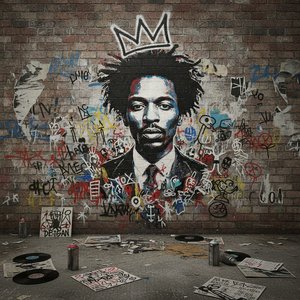 Basquiat & Raw Pop: The Unfiltered Energy of Neo-Expressionism and the Legacy of Urban RebellionExplore the raw energy of Jean-Michel Basquiat and Neo-Expressionism. Discover how urban rebellion redefined modern art through a lens of l…
 The Mass Media Muse: How Pop Art Shattered the Masterpiece MythExplore how Pop Art revolutionized the art world by turning mass media into masterpieces. Discover the bold legacy of Warhol and Lichtenste…