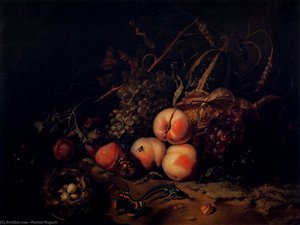
Portret Rachel Ruysch

80 najsłynniejszych obrazów artysty Rachel Ruysch, każdy niepowtarzalny

Aktualizacja: Listopad 2026 · ranking według naszego wskaźnika popularności (liczba wyszukiwań, wizyt i zamówień dla każdego dzieła) · 81 dzieł Rachel Ruysch w naszym katalogu

W skrócie

Martwa natura z kwiatami (1726) to obraz autorstwa Rachel Ruysch, który przyciąga najwięcej spojrzeń; oryginał znajduje się w Toledo Museum of Art, Toledo. Następnie wzrok kieruje się na Still-Life with Fruit and Insects (1711) i Still Life with Flowers in a Glass Vase (1700). Spośród 81 dzieł Rachel Ruysch w naszym katalogu, tych 80 jest najbardziej znanych – każde z nich to unikatowy oryginał, przedstawiony wraz z rokiem powstania, muzeum oraz powodem, dla którego przetrwało próbę czasu.

1664 – 1750, Haga Baroque Najwięcej dzieł: Fitzwilliam Museum

10 najlepszych obrazów autorstwa Rachel Ruysch według oka galerii

1
Martwa natura z kwiatami (1726) autorstwa Rachel Ruysch

Martwa natura z kwiatami

1726 · Akryl na płótnie · Toledo Museum of Art, Toledo

„Martwa natura z kwiatami” autorstwa Rachel Ruysch, namalowana w 1726 roku, to coś więcej niż tylko przedstawienie rozkwitających pąków; to pieczołowicie skonstruowana medytacja nad pięknem, śmiertelnością i rodzącą się fascynacją światem przyrody, która definiowała Złoty Wiek Holandii. To wybitne dzieło, znajdujące się obecnie w Toledo Museum of Art, oferuje rzadki wgląd w pracownię jednej z najbardziej cenionych artystek swoich czasów – kobiety, która rzuciła wyzwanie konwencjom, by zapisać się w…

2
Still-Life with Fruit and Insects (1711) autorstwa Rachel Ruysch

Still-Life with Fruit and Insects

1711 · Oil On Canvas · Galleria degli Uffizi, Florencja

To gaze upon Rachel Ruysch's Still-Life with Fruit and Insects is to step into a meticulously curated moment of nature’s opulent generosity. This painting, dating from 1711, transcends mere depiction; it is a profound meditation on life itself—its vibrant peak, its inevitable decay, and the exquisite beauty found in every transient detail. The composition bursts forth with an almost overwhelming sense of abundance. Here, apples blush alongside the deep tones…

3
Still Life with Flowers in a Glass Vase (1700) autorstwa Rachel Ruysch

Still Life with Flowers in a Glass Vase

1700 · Oil · Rijksmuseum, Amsterdam

A dense arrangement of flowers occupies the center of this oil painting, spilling from a clear glass vase. The bouquet follows a pyramidal structure, with stems and petals extending toward the upper right and cascading downward toward the left. Various species are present, including peonies with rounded, heavy heads and tulips with pointed petals. The color palette consists of creamy whites, soft pinks, and deep reds, which contrast against yellows,…

4
Vase with Flowers (1706) autorstwa Rachel Ruysch

Vase with Flowers

1706 · Oil On Canvas · Kunsthistorisches Museum, Wiedeń

Step closer to observe the way the light catches the edge of a peach petal. In this 1706 composition, Rachel Ruysch presents an arrangement that feels less like a static object and more like a living, breathing moment captured in shadow. The bouquet rises vertically, a pyramidal structure of tulips, roses, poppies, and carnations emerging from a deep, near-black background. This use of chiaroscuro pulls the viewer into an intimate…

5
Basket of Flowers (1711) autorstwa Rachel Ruysch

Basket of Flowers

1711 · Oil On Canvas · Galleria degli Uffizi, Florencja

In the quiet splendor of 1711, Rachel Ruysch captured more than just a collection of flora; she bottled the very essence of life and its fleeting vitality. Her masterpiece, "Basket of Flowers," stands as an unparalleled testament to Baroque artistry and a profound meditation on the natural world. Created during the height of Amsterdam’s Golden Age—a period where scientific discovery danced alongside artistic flourishing—this monumental still life transcends mere representation.…

6
Flowers in a Glass Vase autorstwa Rachel Ruysch

Flowers in a Glass Vase

Oil On Canvas · Detroit Institute of Arts, Detroit

In the quiet splendor of Rachel Ruysch’s “Flowers in a Glass Vase,” the viewer is invited into a world where the boundaries between scientific precision and poetic beauty dissolve. This masterpiece, emerging from the golden age of Dutch Baroque, serves as much more than a mere arrangement of flora; it is a breathtaking window into a period defined by an insatiable curiosity about the natural world. As the eye wanders…

7
Rachel Ruysch (1664–1750) (1692) autorstwa Rachel Ruysch

Rachel Ruysch (1664–1750)

1692 · Oil On Canvas · Metropolitan Museum of Art, Nowy Jork

To step into the world of Rachel Ruysch is to enter a realm where the boundaries between scientific precision and poetic beauty dissolve entirely. A true pioneer of the Dutch Golden Age, Ruysch did not merely paint flowers; she orchestrated them. Born into a household defined by the wonders of the natural sciences—the daughter of the renowned anatomist Frederik Ruysch—her early life was an immersion in a living cabinet of…

8
Kwiaty na gałęzi drzewnej autorstwa Rachel Ruysch

Kwiaty na gałęzi drzewnej

Obraz olejny na płótnie · Staatliche Museen, Kassel

Flowers on a Tree Trunk is a still life painting by Rachel Ruysch. Born in 1664 in The Hague, Netherlands, Ruysch lived until 1750, leaving a significant body of work within the Dutch Golden Age. This specific composition focuses on a central tree trunk that functions as a natural vessel for various floral species.

9
A Vase of Flowers (1706) autorstwa Rachel Ruysch

A Vase of Flowers

1706 · Oil · Kunsthistorisches Museum, Wiedeń

Created in 1706, this still life captures an arrangement of blossoms with scientific precision. The composition centers on a primary vase, accompanied by a smaller vessel positioned to the right, creating a sense of depth through staggered placement. Various flower types populate the scene, each rendered with distinct textures and colors. A dark background provides a stark contrast, pushing the luminous petals forward and directing focus toward the intricate details…

10
Flowers in a glass vase, on a marble ledge (1715) autorstwa Rachel Ruysch

Flowers in a glass vase, on a marble ledge

1715 · Oil On Panel · Staatliche Kunsthalle Karlsruhe, Karlsruhe

In this 1715 oil on panel, we find ourselves drawn into a quiet, shadowed space where a lush bouquet emerges from the darkness. The arrangement, held within a clear glass vase, rests upon a cold marble ledge, creating a tension between the organic softness of the petals and the hard, unyielding stone. Light enters from the upper left, casting a sharp chiaroscuro that illuminates the creamy whites and soft pinks…

Słynne obrazy artysty Rachel Ruysch, od 11 do 80

11Still life with flowers and fruit (1707) autorstwa Rachel RuyschStill life with flowers and fruit1707 · Museum der bildenden Künste 12Still life of carnations, hibiscus, morning glories, and other other flowers on a ledge, with a butterfly (1749) autorstwa Rachel RuyschStill life of carnations, hibiscus, morning glories, and other other flowers on a ledge, with a butterfly1749 · Minneapolis Institute of Art 13Fruit, a nest, a lizard and insects in a wood (1717) autorstwa Rachel RuyschFruit, a nest, a lizard and insects in a wood1717 · Staatliche Kunsthalle Karlsruhe 14Still Life, Flowers and Insects (1725) autorstwa Rachel RuyschStill Life, Flowers and Insects1725 · Kelvingrove Art Gallery and Museum 15A Vase of Flowers (1750) autorstwa Rachel RuyschA Vase of Flowers1750 · Ashmolean Museum 16An Arrangement of Flowers by a Tree Trunk (1683) autorstwa Rachel RuyschAn Arrangement of Flowers by a Tree Trunk1683 · Kelvingrove Art Gallery and Museum 17A spray of flowers (1690) autorstwa Rachel RuyschA spray of flowers1690 · National Gallery 18Festoon with Flowers (1683) autorstwa Rachel RuyschFestoon with Flowers1683 · Staatliches Museum Schwerin 19Still Life of Flowers (1683) autorstwa Rachel RuyschStill Life of Flowers1683 · Bawarskie Państwowe Zbiory Malarstwa 20Nosegay on a Marble Plinth (1695) autorstwa Rachel RuyschNosegay on a Marble Plinth1695 · Norton Simon Museum 21A 'Forest Floor' Still Life of Flowers (1720) autorstwa Rachel RuyschA 'Forest Floor' Still Life of Flowers1720 · Ashmolean Museum 22Vase of flowers (1700) autorstwa Rachel RuyschVase of flowers1700 · Mauritshuis 23Festoon of Flowers and Fruit (1682) autorstwa Rachel RuyschFestoon of Flowers and Fruit1682 · National Gallery Prague 24A still-life with a spray of flowers (1690) autorstwa Rachel RuyschA still-life with a spray of flowers1690 · Victoria and Albert Museum 25Tree trunk surrounded by flowers, butterflies and animals (1685) autorstwa Rachel RuyschTree trunk surrounded by flowers, butterflies and animals1685 · Museum Boijmans Van Beuningen 26Still-Life with Flowers autorstwa Rachel RuyschStill-Life with FlowersHallwyl Museum 27Fruit on a Forest Floor (1709) autorstwa Rachel RuyschFruit on a Forest Floor1709 · Bawarskie Państwowe Zbiory Malarstwa 28A swag of fruit and flowers suspended before a stone arch (1681) autorstwa Rachel RuyschA swag of fruit and flowers suspended before a stone arch1681 29Forest floor still-life with flowers, insects and butterflies on a mossy bank (1683) autorstwa Rachel RuyschForest floor still-life with flowers, insects and butterflies on a mossy bank1683 · Rafael Valls Limited 30Bouquet of Flowers (1680) autorstwa Rachel RuyschBouquet of Flowers1680 · Narodowe Muzeum Sztuki w Rumunii 31Flowers in a glass vase (1685) autorstwa Rachel RuyschFlowers in a glass vase1685 · Groeningemuseum 32Fruit still life with insects on a marble slab (1683) autorstwa Rachel RuyschFruit still life with insects on a marble slab1683 33Insects and a lizard in a wood (1684) autorstwa Rachel RuyschInsects and a lizard in a wood1684 · Fitzwilliam Museum 34Flowerpiece (1680) autorstwa Rachel RuyschFlowerpiece1680 · Gemäldegalerie 35Still life of flowers, with butterflies, insects, a lizard and toads, beside a pool (1687) autorstwa Rachel RuyschStill life of flowers, with butterflies, insects, a lizard and toads, beside a pool1687 36Forest recess with flowers (1686) autorstwa Rachel RuyschForest recess with flowers1686 · National Gallery Prague 37Still life of flowers with a nosegay of roses, marigolds, larkspur, a bumblebee and other insects (1695) autorstwa Rachel RuyschStill life of flowers with a nosegay of roses, marigolds, larkspur, a bumblebee and other insects1695 38Flowers in a vase, with butterflies, on a stone parapet (1693) autorstwa Rachel RuyschFlowers in a vase, with butterflies, on a stone parapet1693 · Rheinisches Landesmuseum 39A Still Life with Devil's Trumpet, a Cactus, a Fig Branch, Honeysuckle and Other Flowers in a Blue Glass Vase (1690) autorstwa Rachel RuyschA Still Life with Devil's Trumpet, a Cactus, a Fig Branch, Honeysuckle and Other Flowers in a Blue Glass Vase1690 · Richard Green Fine Paintings 40Posy of roses and other flowers on a marble ledge (1691) autorstwa Rachel RuyschPosy of roses and other flowers on a marble ledge1691 · Hamburger Kunsthalle 41Still Life of Flowers (1690) autorstwa Rachel RuyschStill Life of Flowers1690 42Posy of flowers, with a red admiral butterfly, on a marble ledge (1695) autorstwa Rachel RuyschPosy of flowers, with a red admiral butterfly, on a marble ledge1695 43Flowers in a glass vase on a balustrade with colonnade (1689) autorstwa Rachel RuyschFlowers in a glass vase on a balustrade with colonnade1689 · San Diego Museum of Art 44Spray of flowers with insects and butterflies on a marble slab (1693) autorstwa Rachel RuyschSpray of flowers with insects and butterflies on a marble slab1693 · Fitzwilliam Museum 45Still Life with Fruit, Bird's Nest and Insects (1710) autorstwa Rachel RuyschStill Life with Fruit, Bird's Nest and Insects1710 · Dudmaston Hall 46Roses, tulips and other flowers in a glass vase on a marble ledge (1709) autorstwa Rachel RuyschRoses, tulips and other flowers in a glass vase on a marble ledge1709 · Rose-Marie and Eijk van Otterloo Collection 47Still life of flowers (1708) autorstwa Rachel RuyschStill life of flowers1708 · Bawarskie Państwowe Zbiory Malarstwa 48Flowers in a glass vase on a marble slab (1710) autorstwa Rachel RuyschFlowers in a glass vase on a marble slab1710 · The Wilson: Cheltenham Art Gallery And Museum 49Still life of roses, tulips, a sunflower and other flowers in a glass vase with a bee, butterfly and other insects upon a marble ledge (1710) autorstwa Rachel RuyschStill life of roses, tulips, a sunflower and other flowers in a glass vase with a bee, butterfly and other insects upon a marble ledge1710 50Still-life with fruit, a nest and a lizard (1710) autorstwa Rachel RuyschStill-life with fruit, a nest and a lizard1710 51Flowers in a terracotta vase (1700) autorstwa Rachel RuyschFlowers in a terracotta vase1700 · Fitzwilliam Museum 52Flowers in a glass vase, on a stone table (1701) autorstwa Rachel RuyschFlowers in a glass vase, on a stone table1701 · Fitzwilliam Museum 53Flowers in a glass vase, with insects and peaches, on a marble tabletop (1701) autorstwa Rachel RuyschFlowers in a glass vase, with insects and peaches, on a marble tabletop1701 · Fitzwilliam Museum 54Still life of flowers and small animals at the edge of a forest (1703) autorstwa Rachel RuyschStill life of flowers and small animals at the edge of a forest1703 · Museum Mayer van den Bergh 55Bouquet of Flowers (1705) autorstwa Rachel RuyschBouquet of Flowers1705 · Gemäldegalerie 56Spray of Flowers (1716) autorstwa Rachel RuyschSpray of Flowers1716 · Richard Green Fine Paintings 57Fruit still life with a bird's nest and lizard (1712) autorstwa Rachel RuyschFruit still life with a bird's nest and lizard1712 58Flowers and fruit in a forest (1714) autorstwa Rachel RuyschFlowers and fruit in a forest1714 59Flower still-life (1715) autorstwa Rachel RuyschFlower still-life1715 · Bawarskie Państwowe Zbiory Malarstwa 60Basket of Flowers (1711) autorstwa Rachel RuyschBasket of Flowers1711 61Still-Life with Fruit and Insects (1711) autorstwa Rachel RuyschStill-Life with Fruit and Insects1711 62Stillife- fruits (1715) autorstwa Rachel RuyschStillife- fruits1715 63flower stilllife (1714) autorstwa Rachel Ruyschflower stilllife1714 64Still-Life with Flowers (1716) autorstwa Rachel RuyschStill-Life with Flowers1716 · Galleria Palatina 65Flowers, Fruit, and Insects (1716) autorstwa Rachel RuyschFlowers, Fruit, and Insects1716 · Narodowe Muzeum Sztuki Dekoracyjnej 66Still Life of Exotic Flowers on a Marble Ledge (1735) autorstwa Rachel RuyschStill Life of Exotic Flowers on a Marble Ledge1735 · The Nelson-Atkins Museum of Art 67Flower still life (1742) autorstwa Rachel RuyschFlower still life1742 68Spray of flowers, with a beetle on a stone balustrade (1741) autorstwa Rachel RuyschSpray of flowers, with a beetle on a stone balustrade1741 · Kunstmuseum Basel 69Roses and Tulips on a Marble Slab (1747) autorstwa Rachel RuyschRoses and Tulips on a Marble Slab1747 · Palais des Beaux-Arts de Lille 70Flower bouquet on a marble table (1746) autorstwa Rachel RuyschFlower bouquet on a marble table1746 · Kurpfälzisches Museum 71Flowers in a Terracotta Vase (1723) autorstwa Rachel RuyschFlowers in a Terracotta Vase1723 · Kelvingrove Art Gallery and Museum 72Flowers in a Vase autorstwa Rachel RuyschFlowers in a VaseMuzeum Narodowe w Warszawie 73Still Life with Bouquet of Flowers, 1698 (1698) autorstwa Rachel RuyschStill Life with Bouquet of Flowers, 16981698 · Städel Museum 74Bouquet in a Glass Vase (1703) autorstwa Rachel RuyschBouquet in a Glass Vase1703 · Academy of Fine Arts Vienna 75Flower Still-Life autorstwa Rachel RuyschFlower Still-LifeStaatliche Kunsthalle Karlsruhe 76Roses, Convolvulus, Poppies, and other Flowers in an Urn on a Stone Ledge (1680) autorstwa Rachel RuyschRoses, Convolvulus, Poppies, and other Flowers in an Urn on a Stone Ledge1680 · National Museum of Women in the Arts 77Flowers autorstwa Rachel RuyschFlowersMuzeum Narodowe w Warszawie 78Still life with flowers in a vase on a ledge with a dragonfly, caterpillar, and butterfly autorstwa Rachel RuyschStill life with flowers in a vase on a ledge with a dragonfly, caterpillar, and butterfly 79Still-Life with Bouquet of Flowers and Plums autorstwa Rachel RuyschStill-Life with Bouquet of Flowers and PlumsMusées Royaux des Beaux-Arts 80Still Life with Flowers on a Marble Tabletop, Rachel Ruysch, 1716 (1716) autorstwa Rachel RuyschStill Life with Flowers on a Marble Tabletop, Rachel Ruysch, 17161716 · Rijksmuseum

Słynne obrazy Rachel Ruysch epoka po epoce

Tematy, które przyciągnęły wzrok Rachel Ruysch

Cztery motywy najczęściej powracające w tych oryginałach, z których każdy doczekał się swojego najdoskonalszego przykładu.

Muzea przechowujące oryginały Rachel Ruysch

8 muzeów, w których znajduje się najwięcej obrazów z tej strony.

Muzea Miasto Dzieła artysty Rachel Ruysch Obrazy z tej listy
Fitzwilliam MuseumFitzwilliam Museum 5 Insects and a lizard in a wood, Spray of flowers with insects and butterflies on a marble slab, Flowers in a terracotta vase
Bawarskie Państwowe Zbiory Malarstwa, MonachiumBawarskie Państwowe Zbiory Malarstwa Monachium 4 Still Life of Flowers, Fruit on a Forest Floor, Still life of flowers
Kelvingrove Art Gallery and Museum, GlasgowKelvingrove Art Gallery and Museum Glasgow 3 Still Life, Flowers and Insects, An Arrangement of Flowers by a Tree Trunk, Flowers in a Terracotta Vase
Galleria degli Uffizi, FlorencjaGalleria degli Uffizi Florencja 2 Still-Life with Fruit and Insects, Basket of Flowers
Rijksmuseum, AmsterdamRijksmuseum Amsterdam 2 Still Life with Flowers in a Glass Vase, Still Life with Flowers on a Marble Tabletop, Rachel Ruysch, 1716
Kunsthistorisches Museum, WiedeńKunsthistorisches Museum Wiedeń 2 Vase with Flowers, A Vase of Flowers
Staatliche Kunsthalle Karlsruhe, KarlsruheStaatliche Kunsthalle Karlsruhe Karlsruhe 2 Flowers in a glass vase, on a marble ledge, Fruit, a nest, a lizard and insects in a wood
Ashmolean Museum, OksfordAshmolean Museum Oksford 2 A Vase of Flowers, A 'Forest Floor' Still Life of Flowers

Rachel Ruysch na przestrzeni dekad: jeden unikatowy oryginał dla każdego

Dzieła według dekad

Wybierz dekadę, aby zobaczyć dzieło, które ją definiuje.

Obrazy artysty Rachel Ruysch: pytania do galerii

Jakie jest najsłynniejsze dzieło artysty Rachel Ruysch?Odkryj odpowiedź

Martwa natura z kwiatami (1726), Toledo Museum of Art, Toledo. Następne są Still-Life with Fruit and Insects (1711) oraz Still Life with Flowers in a Glass Vase (1700).

W jakim wieku Rachel Ruysch stworzył/a Martwa natura z kwiatami?Odkryj odpowiedź

62 lat: Martwa natura z kwiatami pochodzi z 1726, a Rachel Ruysch urodził(a) się w 1664.

Które dziesięć obrazów Rachel Ruysch jest najbardziej znanych?Odkryj odpowiedź

Martwa natura z kwiatami, Still-Life with Fruit and Insects, Still Life with Flowers in a Glass Vase, Vase with Flowers, Basket of Flowers, Flowers in a Glass Vase, Rachel Ruysch (1664–1750), Kwiaty na gałęzi drzewnej, A Vase of Flowers i Flowers in a glass vase, on a marble ledge. Powyższy ranking zawiera rok powstania oraz muzeum dla każdego z nich.

Ile znanych dzieł stworzył Rachel Ruysch?Odkryj odpowiedź

Nasz katalog zawiera 81 dzieł artysty Rachel Ruysch, datowanych od 1680 do 1750.

Gdzie można zobaczyć najsłynniejsze oryginały Rachel Ruysch?Odkryj odpowiedź

W większości znajdują się w Fitzwilliam Museum, Bawarskie Państwowe Zbiory Malarstwa (Monachium) i Kelvingrove Art Gallery and Museum (Glasgow). Powyższa tabela muzeów zawiera ich pełną listę.

W jakim okresie Rachel Ruysch stworzył/a swoje najsłynniejsze obrazy?Odkryj odpowiedź

W 1710s: 19 z 80 dzieł na tej stronie powstało w tym czasie, w tym Still-Life with Fruit and Insects.

Który z najsłynniejszych obrazów artysty Rachel Ruysch powstał najwcześniej, a który najpóźniej?Odkryj odpowiedź

Na tej stronie najwcześniejszy to Bouquet of Flowers (1680), a najpóźniejszy A Vase of Flowers (1750).

Jakie tematy preferował Rachel Ruysch?Odkryj odpowiedź

Flowers (61), Leaves (53) i Petals (32), w ramach 80 dzieł na tej stronie.

Jakich materiałów Rachel Ruysch używał najczęściej?Odkryj odpowiedź

Oil On Canvas, dla 58 z 80 dzieł na tej stronie.

Do jakiego nurtu należy twórczość Rachel Ruysch?Odkryj odpowiedź

Baroque, sądząc po oryginałach na tej stronie.

Jakie oryginały Rachel Ruysch można zobaczyć w Fitzwilliam Museum?Odkryj odpowiedź

Insects and a lizard in a wood, Spray of flowers with insects and butterflies on a marble slab i Flowers in a terracotta vase: Fitzwilliam Museum posiada 5 dzieł widocznych na tej stronie.

Rachel Ruysch: portret artysty

Rachel Ruysch: Kwiaty, Życie i Dziedzictwo

Rachel Ruysch, urodzona w Hadze w 1664 roku, była holenderską malarką, której imię na stałe wpisane jest do historii sztuki jako synonim niezwykłego talentu i innowacji w dziedzinie martwych natur. Jej życie było nierozerwalnie związane z bogatym środowiskiem naukowym i artystycznym, które ukształtowało jej wyjątkową wrażliwość na piękno natury. Ojciec Rachel, Frederik Ruysch, wybitny profesor anatomii i botaniki, prowadził w swoim domu prawdziwe laboratorium, gromadząc niezwykłe zbiory okazów roślinnych, szkieletów zwierzęcych i minerałów. To właśnie w tym otoczeniu młoda Rachel po raz pierwszy zetknęła się z fascynującym światem przyrody, który stał się nie tylko inspiracją dla jej twórczości, ale również fundamentem jej wiedzy botanicznej – wiedzy, która później przełożyła się na niezwykłą precyzję i realizm w przedstawianiu kwiatów. W wieku piętnastu lat Rachel rozpoczęła formalne studia pod kierunkiem Willema van Aelsta, uznanego malarza martwych natur z Delftu, gdzie doskonaliła swoje umiejętności techniczne i uczyła się sztuki komponowania bukietów o niezwykłej harmonii i naturalnym wdzięku.

Ewolucja Stylu: Od Tradycji do Innowacji

Ruysch nie ograniczała się jednak do naśladowania tradycji, lecz z determinacją kroczyła własną ścieżką artystyczną, tworząc styl rozpoznawalny dzięki niezwykłej dbałości o szczegóły, bogatej palecie barw i dynamicznej asymetrii. W przeciwieństwie do wielu ówczesnych malarzy martwych natur, którzy preferowali symetryczne kompozycje, Ruysch z zamiłowaniem przedstawiała kwiaty w naturalnej, często chaotycznej formie – z opadającymi płatkami i dzikimi pędami, co nadawało jej obrazom niezwykłą dynamikę i życie. Jej mistrzostwo polegało na umiejętności oddania tekstury i subtelnych odcieni każdego kwiatu, tworząc iluzję niemalże dotykalnej rzeczywistości. Ciemne tła charakterystyczne dla jej prac nie były jedynie elementem dekoracyjnym; służyły do dramatycznego podkreślenia blasku i delikatnych kształtów kwiatowych motywów, tworząc fascynującą grę światłocienia. Wpływy Otto Marseus van Schriecka widać w jej późniejszych kompozycjach, gdzie malarka z wdziękiem wprowadzała elementy krajobrazu leśnego podłoża, dodając wśród bujnej roślinności owady i małe gady – co jeszcze bardziej podkreślało naturalizm jej dzieł.

Uznanie i Patronat Królewski

Talent Rachel Ruysch zyskał uznanie na całym kontynencie europejskim, przyciągając do niej patronów z kręgów arystokratycznych, w tym członków rodziny Medyceuszy. Jej obrazy cieszyły się ogromną popularnością, co było dowodem nie tylko na jej artystyczne umiejętności, ale również na determinację i ciężką pracę. W 1701 roku Ruysch dokonała przełomu, zostając pierwszą kobietą przyjętą w poczet Pictura – prestiżowego stowarzyszenia artystów z Hadze – co stanowiło bezprecedensowe uznanie jej talentu przez środowisko męskich twórców. Kulminacyjnym momentem kariery Ruysch było zaproszenie na dwór elektora Palatynatu Jana Wilhelma w Düsseldorfie, gdzie służyła jako malarka nadworna w latach 1708-1716. Pobyt ten zaowocował powstaniem licznych dzieł, które umocniły jej reputację w całej Europie. Pomimo sukcesów zawodowych, Ruysch zdołała połączyć karierę artystyczną z życiem rodzinnym – w 1693 roku wyszła za mąż za malarza portretowego Jurriena Poola i wspólnie wychowali dziesięcioro dzieci. Świadectwem wpływu, jaki wywarła na kulturę swoich czasów, było wydanie zbioru poezji poświęconych jej obrazom – rzadki zaszczyt dla każdego artysty, niezależnie od płci.

Dziedzictwo: Kwiaty Przemawiających o Piękności i Trwania

Rachel Ruysch włożyła ogromny wkład w sztukę holenderskiego Złotego Wieku, wykraczając poza swoje techniczne umiejętności i artystyczną innowacyjność. Wyzwała obowiązujące normy społeczne, udowadniając, że kobiety mogą osiągnąć znaczący sukces jako profesjonalne artystki w dziedzinie zdominowanej przez mężczyzn. Jej niezwykła dbałość o szczegóły, innowacyjne kompozycje i umiejętność uchwycenia ulotnej piękności kwiatów wpłynęły na pokolenia malarzy martwych natur, którzy po niej tworzyli. Dziś jej obrazy są cenione przez kolekcjonerów z całego świata i znajdują się w prestiżowych muzeach, takich jak National Museum of Women in the Arts, Toledo Museum of Art oraz Mauritshuis. Rachel Ruysch zmarła w 1750 roku w wieku osiemdziesiąt sześciu lat, pozostawiając po sobie bogate dziedzictwo artystyczne, które nadal inspiruje podziw i zachwyt. Jej spuścizna to nie tylko malarstwo kwiatów, ale przede wszystkim historia pionierki, która rozkwitła w świecie, który często próbował ją ograniczyć. Jej życie jest potężnym przypomnieniem o trwałej sile wizji artystycznej i znaczeniu kwestionowania społecznych oczekiwań. Pozostaje jedną z najbardziej utalentowanych malarek martwych natur w historii, której wykwintne bukiety nadal urzekają odbiorców wieki po ich powstaniu.