Portret Mikołaj Ge

95 najsłynniejszych obrazów artysty Mikołaj Ge – wybór z galerii

Aktualizacja: Listopad 2026 · ranking według naszego wskaźnika popularności (liczba wyszukiwań, wizyt i zamówień dla każdego dzieła) · 95 dzieł Mikołaj Ge w naszym katalogu

W skrócie

Spośród wszystkich dzieł oryginalnych, które pozostawił Mikołaj Ge, najsłynniejszym jest Piotr Wielki przesłuchujący carewicza Alekseja Petrovicza w Peterhofie (1871), znajdujący się w kolekcji Galeria Tratykowa w Moskwa. Tuż za nimi znajdują się Christ and his disciples entered the Garden of Gethsemane (1888) oraz Harbingers of the Resurrection (1867). Nasz katalog zawiera 95 dzieł autorstwa Mikołaj Ge; galeria zachowała 95 najbardziej podziwianych na świecie prac, z których każda została przedstawiona wraz z datą powstania, informacją o muzeum oraz jej historią.

1831 – 1894, Woroneż Realism Najwięcej dzieł: Galeria Tratykowa

10 najlepszych obrazów artysty Mikołaj Ge: wybór galerii

1
Piotr Wielki przesłuchujący carewicza Alekseja Petrovicza w Peterhofie (1871) autorstwa Mikołaj Ge

Piotr Wielki przesłuchujący carewicza Alekseja Petrovicza w Peterhofie

1871 · Obraz olejny na płótnie · Galeria Tratykowa, Moskwa

To olejne płótno przedstawia ponurą scenę historyczną osadzoną we wnętrzach Pałacu Monplaisir w Peterhofie. Kompozycja ogniskuje się wokół dwóch postaci umieszczonych po przeciwnych stronach dużego, zdobnego stołu. Po prawej stronie Piotr I siedzi w tapicerowanym fotelu wykończonym czerwonym aksamitem, pochylając się lekko do przodu z autorytarnym spojrzeniem. Po lewej stronie carewicz Aleksej Petrovicz stoi wyprostowany z pochyloną głową i przygnębionym wyrazem twarzy. Jest ubrany w aksamitną kamizelkę, wysokie jedwabne pończochy…

2
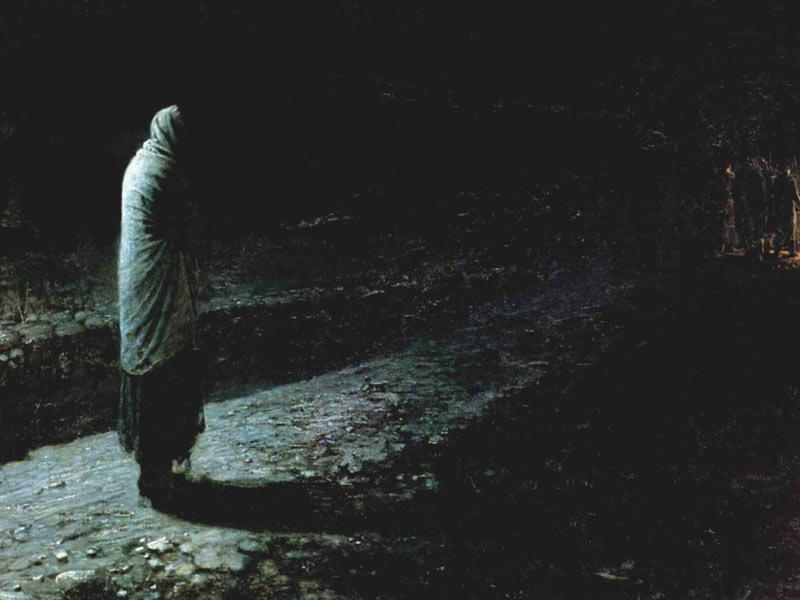
Christ and his disciples entered the Garden of Gethsemane (1888) autorstwa Mikołaj Ge

Christ and his disciples entered the Garden of Gethsemane

1888 · Oil On Canvas

Nikolai Ge’s Christ and his disciples entered the Garden of Gethsemane, painted about 1888, captures a pivotal moment from the New Testament. The religious subject matter focuses on the group of figures gathered in the garden. Christ stands prominently with outstretched arms, a gesture suggesting sacrifice and the acceptance of fate. Around him, the disciples are clustered in a solemn assembly. Their somber expressions convey a sense of anxiety and…

3
Harbingers of the Resurrection (1867) autorstwa Mikołaj Ge

Harbingers of the Resurrection

1867 · Oil

In the painting Harbingers of the Resurrection, created by Nikolai Ge about 1867, the central figure is Jesus Christ. He is positioned in the middle of the composition, flanked by two men. These two figures on either side of Christ appear to be angels or messengers. Each of these men holds a staff, an object that may symbolize their functions as protectors or guides. The presence of these figures establishes…

4
Portrait of Nikolai Nekrasov (1872) autorstwa Mikołaj Ge

Portrait of Nikolai Nekrasov

1872 · Oil On Canvas · Ermitaż, Sankt Petersburg

An elderly man sits within the heavy embrace of a patterned armchair. The fabric of his suit carries a palpable weight, rendered in deep blacks and muted earth tones that seem to absorb the surrounding light. His face, pale against the dark void of the background, holds a quiet melancholy. Light falls sharply across his forehead and eyes, catching the texture of skin and the silvered strands of facial hair.…

5
Leila and Khaji-Abrek (1852) autorstwa Mikołaj Ge

Leila and Khaji-Abrek

1852 · Oil

In the painting Leila and Khaji-Abrek by Nikolai Ge, two figures occupy the central space of the composition. Created about 1852, the work depicts a woman and a man in a specific physical arrangement. The woman is positioned kneeling on the ground, facing the man. He is situated before her, appearing as a soldier or a leader in stature and presence. Both individuals are dressed in traditional clothing that covers…

6
Bridge in Viko (1858) autorstwa Mikołaj Ge

Bridge in Viko

1858 · Oil On Paper

We are looking at Bridge in Viko, a work from 1858 by the Russian artist Nikolai Ge. This piece belongs to the Realism movement, a period where the focus shifted toward a more direct and unadorned representation of the world. It is a quiet study of landscape and structure, captured during a formative time in the artist's career.

7
Returning from the burial of Christ (1859) autorstwa Mikołaj Ge

Returning from the burial of Christ

1859 · Oil

In this quiet composition titled Returning from the burial of Christ, we encounter a profound moment of transition. The work is attributed to the Russian artist Nikolai Ge and dates to 1859. It captures a solemn procession of figures moving through a natural landscape, their presence marked by the heavy folds of their long robes. There is a stillness here that invites a closer look at the gravity of the…

8
Portrait of Leo Tolstoy (1884) autorstwa Mikołaj Ge

Portrait of Leo Tolstoy

1884 · Oil On Canvas · Galeria Tratykowa, Moskwa

In the quiet, amber-hued atmosphere of a Moscow study, time seems to suspend itself within Nikolai Ge’s 1884 masterpiece, Portrait of Leo Tolstoy. This is not merely a depiction of a man at work; it is an intimate window into the very soul of Russian literature. The painting captures the legendary author seated at his desk, enveloped by the weight of his own profound thoughts. As he leans over his…

9
Portrait of Alexander Herzen (1867) autorstwa Mikołaj Ge

Portrait of Alexander Herzen

1867 · Oil On Canvas · Ermitaż, Sankt Petersburg

This oil painting is a somber and intense psychological portrait of an older man, presented as an oval-shaped bust-length figure. Set against a dark, indistinct background, the subject is illuminated by directional lighting coming from the upper left, which casts one side of his face and much of his clothing into deep shadow. This technique creates a sense of depth and three-dimensionality through dramatic chiaroscuro. The color palette is dominated…

10
Catherine II at the Coffin of Empress Elizabeth (1709) autorstwa Mikołaj Ge

Catherine II at the Coffin of Empress Elizabeth

1709 · Oil

In Catherine II at the Coffin of Empress Elizabeth, Nikolai Ge constructs a grand hall where history feels heavy and crowded. The composition is a dense gathering of figures, a chaotic assembly of dignitaries and attendants that fills the space with ceremonial weight. Amidst this throng, the eye is drawn to Catherine II, positioned slightly off-center. She exists within a shallow perspective that pushes the solemnity of the court toward…

Kontynuacja zestawienia Mikołaj Ge, od 11 do 95

11Achilles and the body of Patroclus autorstwa Mikołaj GeAchilles and the body of PatroclusNational Art Museum of The Republic of Belarus 12Mary, sister of Lazarus, Greets Jesus (1863) autorstwa Mikołaj GeMary, sister of Lazarus, Greets Jesus1863 13Portrait of Russian baritone opera singer Gennady Kondratiev (1863) autorstwa Mikołaj GePortrait of Russian baritone opera singer Gennady Kondratiev1863 14Portrait of V.N.Rostovtseva (1861) autorstwa Mikołaj GePortrait of V.N.Rostovtseva1861 15Portrait of Joseph Daumang (1868) autorstwa Mikołaj GePortrait of Joseph Daumang1868 16Portrait of Princess Olga Volkonskaya (nee Kleinmichel) (1882) autorstwa Mikołaj GePortrait of Princess Olga Volkonskaya (nee Kleinmichel)1882 · Ermitaż 17Conscience, Judas (1891) autorstwa Mikołaj GeConscience, Judas1891 18Portrait of P.A. Kostichev (1892) autorstwa Mikołaj GePortrait of P.A. Kostichev1892 19Portrait of Yelena Likhachova (1892) autorstwa Mikołaj GePortrait of Yelena Likhachova1892 20Portrait of Yekaterina Ge, the Artist's Daughter-in-Law (1880) autorstwa Mikołaj GePortrait of Yekaterina Ge, the Artist's Daughter-in-Law1880 · Ermitaż 21Crucifixion autorstwa Mikołaj GeCrucifixion 22Portrait of Evdokiya Nikolaevna Kostycheva (1845) autorstwa Mikołaj GePortrait of Evdokiya Nikolaevna Kostycheva1845 23Portrait of Yakov Merkulov (1855) autorstwa Mikołaj GePortrait of Yakov Merkulov1855 24Portrait of Nikolay O.Ge, Artist's Father (1854) autorstwa Mikołaj GePortrait of Nikolay O.Ge, Artist's Father1854 25Frascati Clouds (1859) autorstwa Mikołaj GeFrascati Clouds1859 26The view from Santo Terenzo at Lerici by night (1862) autorstwa Mikołaj GeThe view from Santo Terenzo at Lerici by night1862 27Portrait of Piotr Zabela (1856) autorstwa Mikołaj GePortrait of Piotr Zabela1856 28Bay in Livorno. sunset (1862) autorstwa Mikołaj GeBay in Livorno. sunset1862 29Death of Imelda Lambertatstsi (1860) autorstwa Mikołaj GeDeath of Imelda Lambertatstsi1860 30Death of Virginia, Study (1857) autorstwa Mikołaj GeDeath of Virginia, Study1857 31Witch of Endor (1857) autorstwa Mikołaj GeWitch of Endor1857 32The destruction of the Temple in Jerusalem (1859) autorstwa Mikołaj GeThe destruction of the Temple in Jerusalem1859 33love of Vestal (1857) autorstwa Mikołaj Gelove of Vestal1857 34Portrait of the Artist's Wife Anna Ge (1858) autorstwa Mikołaj GePortrait of the Artist's Wife Anna Ge1858 · Kijowska Narodowa Galeria Obrazów 35Portrait of Shestova with daughter (1859) autorstwa Mikołaj GePortrait of Shestova with daughter1859 36Death of Virginia, Study (1857) autorstwa Mikołaj GeDeath of Virginia, Study1857 37Vineyard at Vico (1858) autorstwa Mikołaj GeVineyard at Vico1858 38Death of Virginia, Study (1857) autorstwa Mikołaj GeDeath of Virginia, Study1857 39Livorno. Road to the Sea at Antiniano near Livorno (1862) autorstwa Mikołaj GeLivorno. Road to the Sea at Antiniano near Livorno1862 40Sorrento (1869) autorstwa Mikołaj GeSorrento1869 41Oaks in the mountains of Carrara (1868) autorstwa Mikołaj GeOaks in the mountains of Carrara1868 42Marble Saw in Carrara (1868) autorstwa Mikołaj GeMarble Saw in Carrara1868 43Loading marble (1868) autorstwa Mikołaj GeLoading marble1868 44Portrait of the Author Alexander Herzen (1867) autorstwa Mikołaj GePortrait of the Author Alexander Herzen1867 45The Transportation of Marble at Carrara (1868) autorstwa Mikołaj GeThe Transportation of Marble at Carrara1868 46Christ in front of Annas (1868) autorstwa Mikołaj GeChrist in front of Annas1868 47Portrait of an Unknown Woman in a blue blouse (1868) autorstwa Mikołaj GePortrait of an Unknown Woman in a blue blouse1868 48Christ in the synagogue (1868) autorstwa Mikołaj GeChrist in the synagogue1868 49Portrait of A.N.Pypin (1871) autorstwa Mikołaj GePortrait of A.N.Pypin1871 50Florence. The Cascina Park (1868) autorstwa Mikołaj GeFlorence. The Cascina Park1868 51Portrait of the Poet Nikolay Nekrasov (1872) autorstwa Mikołaj GePortrait of the Poet Nikolay Nekrasov1872 52Tsar Boris and the Queen Martha (1874) autorstwa Mikołaj GeTsar Boris and the Queen Martha1874 53Portrait of Alexei Antipowitsch Potechin (1876) autorstwa Mikołaj GePortrait of Alexei Antipowitsch Potechin1876 54Portrait of Anna Olsufyeva (1881) autorstwa Mikołaj GePortrait of Anna Olsufyeva1881 55An Old Peasant (1880) autorstwa Mikołaj GeAn Old Peasant1880 56Portrait of Adam Olsufyev (1881) autorstwa Mikołaj GePortrait of Adam Olsufyev1881 57On the Mount of Olives (1880) autorstwa Mikołaj GeOn the Mount of Olives1880 58Portrait of Natalia Petrunkevich (1892) autorstwa Mikołaj GePortrait of Natalia Petrunkevich1892 59Self-Portrait (1892) autorstwa Mikołaj GeSelf-Portrait1892 · Kijowska Narodowa Galeria Obrazów 60Sophia Tolstaya (1886) autorstwa Mikołaj GeSophia Tolstaya1886 61Portrait of Maria Gabayeva (1886) autorstwa Mikołaj GePortrait of Maria Gabayeva1886 62Portrait of Tatyana Tolstaya, Leo Tolstoy's Daughter (1887) autorstwa Mikołaj GePortrait of Tatyana Tolstaya, Leo Tolstoy's Daughter1887 63Portrait of Nikolay Ge, the Artist's Grandson (1889) autorstwa Mikołaj GePortrait of Nikolay Ge, the Artist's Grandson1889 64Old Park (1893) autorstwa Mikołaj GeOld Park1893 65Crusifixion autorstwa Mikołaj GeCrusifixion 66Mother at the funeral of her child autorstwa Mikołaj GeMother at the funeral of her child 67Portrait of Barbara Kochubey autorstwa Mikołaj GePortrait of Barbara Kochubey 68Portrait of Olga Kostycheva autorstwa Mikołaj GePortrait of Olga Kostycheva 69Return of Tobias autorstwa Mikołaj GeReturn of Tobias 70Carrara autorstwa Mikołaj GeCarrara 71Judah autorstwa Mikołaj GeJudah 72The Temptation of Christ autorstwa Mikołaj GeThe Temptation of Christ 73Pushkin in the village Mihaylovskoye autorstwa Mikołaj GePushkin in the village Mihaylovskoye 74Ruslan and Lyudmila autorstwa Mikołaj GeRuslan and Lyudmila 75The road into the forest autorstwa Mikołaj GeThe road into the forest 76Bay in Livorno autorstwa Mikołaj GeBay in Livorno 77Boys at the beach. Study autorstwa Mikołaj GeBoys at the beach. Study 78Bay. Vyko autorstwa Mikołaj GeBay. Vyko 79Portrait of Historian M.Kostomarov autorstwa Mikołaj GePortrait of Historian M.Kostomarov 80Gorge in the mountains of Carrara autorstwa Mikołaj GeGorge in the mountains of Carrara 81Portrait of M.P.Svet autorstwa Mikołaj GePortrait of M.P.Svet 82Portrait of the Author Mikhail Saltykov-Shchedrin autorstwa Mikołaj GePortrait of the Author Mikhail Saltykov-Shchedrin 83Christ Head autorstwa Mikołaj GeChrist HeadKijowska Narodowa Galeria Obrazów 84Portrait of the Ukrainian boy autorstwa Mikołaj GePortrait of the Ukrainian boy 85The head of John the Apostle autorstwa Mikołaj GeThe head of John the Apostle 86Katerina Ivanovna Zabello autorstwa Mikołaj GeKaterina Ivanovna Zabello 87Portrait of Maria Tolstaya, Leo Tolstoy's Daughter autorstwa Mikołaj GePortrait of Maria Tolstaya, Leo Tolstoy's Daughter 88Portrait of M.V. Alekhin autorstwa Mikołaj GePortrait of M.V. Alekhin 89Christand Robber autorstwa Mikołaj GeChristand Robber 90Peter I interrogates Tsarevich Alexei autorstwa Mikołaj GePeter I interrogates Tsarevich Alexei 91The Judgment of King Solomon autorstwa Mikołaj GeThe Judgment of King Solomon 92Last Supper (1863) autorstwa Mikołaj GeLast Supper1863 · Państwowy Rosyjski Muzeum w Sankt Petersburgu 93What is Truth. Christ and Pilate (1890) autorstwa Mikołaj GeWhat is Truth. Christ and Pilate1890 · Galeria Tratykowa 94Golgotha (1893) autorstwa Mikołaj GeGolgotha1893 · Galeria Tratykowa 95The Judgment of the Sanhedrin (1892) autorstwa Mikołaj GeThe Judgment of the Sanhedrin1892 · Galeria Tratykowa

Słynne obrazy Mikołaj Ge epoka po epoce

Tematy, które przyciągnęły wzrok Mikołaj Ge

Cztery motywy najczęściej powracające w tych oryginałach, z których każdy doczekał się swojego najdoskonalszego przykładu.

Muzea przechowujące oryginały Mikołaj Ge

5 muzeów, w których znajduje się najwięcej obrazów z tej strony.

Muzea Miasto Dzieła artysty Mikołaj Ge Obrazy z tej listy
Galeria Tratykowa, MoskwaGaleria Tratykowa Moskwa 5 Piotr Wielki przesłuchujący carewicza Alekseja Petrovicza w Peterhofie, Portrait of Leo Tolstoy, What is Truth. Christ and Pilate
Ermitaż, Sankt PetersburgErmitaż Sankt Petersburg 4 Portrait of Nikolai Nekrasov, Portrait of Alexander Herzen, Portrait of Princess Olga Volkonskaya (nee Kleinmichel)
Kijowska Narodowa Galeria Obrazów, KijówKijowska Narodowa Galeria Obrazów Kijów 3 Portrait of the Artist's Wife Anna Ge, Self-Portrait, Christ Head
National Art Museum of The Republic of Belarus, MinskNational Art Museum of The Republic of Belarus Minsk 1 Achilles and the body of Patroclus
Państwowy Rosyjski Muzeum w Sankt Petersburgu, Sankt PetersburgPaństwowy Rosyjski Muzeum w Sankt Petersburgu Sankt Petersburg 1 Last Supper

Mikołaj Ge dekada po dekadzie: oryginały definiujące każdy okres

Dzieła według dekad

Wybierz dekadę, aby zobaczyć dzieło, które ją definiuje.

Pytania kolekcjonerów o obrazy Mikołaj Ge

Z jakiego dzieła najbardziej znany jest Mikołaj Ge?Odkryj odpowiedź

Piotr Wielki przesłuchujący carewicza Alekseja Petrovicza w Peterhofie (1871), Galeria Tratykowa, Moskwa. Następne są Christ and his disciples entered the Garden of Gethsemane (1888) oraz Harbingers of the Resurrection (1867).

W jakim wieku był Mikołaj Ge, gdy powstało Piotr Wielki przesłuchujący carewicza Alekseja Petrovicza w Peterhofie?Odkryj odpowiedź

40 lat: Piotr Wielki przesłuchujący carewicza Alekseja Petrovicza w Peterhofie pochodzi z 1871, a Mikołaj Ge urodził(a) się w 1831.

Jakie są dziesięć najsłynniejszych obrazów, których autorem jest Mikołaj Ge?Odkryj odpowiedź

Piotr Wielki przesłuchujący carewicza Alekseja Petrovicza w Peterhofie, Christ and his disciples entered the Garden of Gethsemane, Harbingers of the Resurrection, Portrait of Nikolai Nekrasov, Leila and Khaji-Abrek, Bridge in Viko, Returning from the burial of Christ, Portrait of Leo Tolstoy, Portrait of Alexander Herzen i Catherine II at the Coffin of Empress Elizabeth. Powyższy ranking zawiera rok powstania oraz muzeum dla każdego z nich.

Ile obrazów pozostawił po sobie Mikołaj Ge?Odkryj odpowiedź

Nasz katalog zawiera 95 dzieł artysty Mikołaj Ge, datowanych od 1845 do 1893.

W których muzeach znajdują się arcydzieła Mikołaj Ge?Odkryj odpowiedź

W większości znajdują się w Galeria Tratykowa (Moskwa), Ermitaż (Sankt Petersburg) i Kijowska Narodowa Galeria Obrazów (Kijów). Powyższa tabela muzeów zawiera ich pełną listę.

W których latach Mikołaj Ge namalował swoje najsłynniejsze dzieła?Odkryj odpowiedź

W 1860s: 21 z 95 dzieł na tej stronie powstało w tym czasie, w tym Harbingers of the Resurrection.

Jakie są pierwsze i ostatnie słynne oryginały Mikołaj Ge?Odkryj odpowiedź

Na tej stronie najwcześniejszy to Portrait of Evdokiya Nikolaevna Kostycheva (1845), a najpóźniejszy Old Park (1893).

Jakie tematy Mikołaj Ge wybierał najczęściej?Odkryj odpowiedź

Portraits (22), Men (16) i Events (11), w ramach 95 dzieł na tej stronie.

Której techniki Mikołaj Ge używał najczęściej?Odkryj odpowiedź

Oil On Canvas, dla 12 z 95 dzieł na tej stronie.

Do jakiego nurtu artystycznego należy Mikołaj Ge?Odkryj odpowiedź

Realism, sądząc po oryginałach na tej stronie.

Które dzieła Mikołaj Ge znajdują się w Galeria Tratykowa?Odkryj odpowiedź

Piotr Wielki przesłuchujący carewicza Alekseja Petrovicza w Peterhofie, Portrait of Leo Tolstoy i What is Truth. Christ and Pilate: Galeria Tratykowa, Moskwa posiada 5 dzieł widocznych na tej stronie.

Mikołaj Ge: życie i twórczość

Nikolai Ge: A Life Dedicated to Art and Philosophy

Nikolai Nikolaevich Ge (1831-1894) occupies a unique and fascinating position in the history of Russian art. Born into a family of French nobility in Voronezh, his life unfolded as a remarkable journey from scientific pursuits to becoming a pivotal figure in the development of Realism and, crucially, early Russian Symbolism. Ge’s artistic trajectory wasn't simply about mastering technique; it was marked by a profound engagement with philosophical ideas, social commentary, and an unprecedented willingness to experiment with new mediums – most notably, photography.

Early Years and Artistic Foundations

Ge’s childhood, shaped by the loss of his mother at a young age and the subsequent care provided by his grandmother, instilled in him a deep appreciation for family and tradition. He initially pursued studies in physics and mathematics at Kiev University and Saint Petersburg University, demonstrating an aptitude for logical reasoning and scientific inquiry. However, it was during his time at the Imperial Academy of Arts in Saint Petersburg that Ge’s artistic destiny truly began to take shape. Under the guidance of Pyotr Basin, a leading academic painter, he honed his skills in traditional techniques, earning a gold medal in 1857 for his powerful depiction of “The Witch of Endor Invoking the Spirit of the Prophet Samuel.” This early success showcased Ge’s ability to capture dramatic narratives and evoke strong emotional responses through meticulous detail and skillful composition.

Crucially, Ge's formative years were also influenced by the work of Karl Bryullov, a prominent Russian academic painter known for his grand historical scenes. Bryullov’s emphasis on theatricality and narrative depth resonated deeply with Ge, shaping his approach to storytelling within his paintings. Furthermore, a scholarship afforded him after graduation provided an invaluable opportunity to broaden his artistic horizons through extensive travels across Europe – Germany, Switzerland, and France – exposing him to diverse artistic movements and techniques.

A Revolutionary Approach: Photography and Controversy

Ge’s most significant contribution to the art world lay in his pioneering use of photography. In 1861, he created “The Last Supper,” a painting that irrevocably altered the landscape of Russian art. Instead of relying on traditional models or sketches, Ge utilized a photograph by Sergei Lvovich Levitsky depicting Aleksandr Ivanovich Herzen, a prominent political thinker and revolutionary, as the central figure in Christ’s place at the table. This bold decision sparked immediate controversy within artistic circles. Critics accused him of promoting materialism and nihilism, arguing that his reliance on a photographic image diminished the spiritual significance of the biblical scene. The painting became a focal point for debate about the role of photography in art and its potential to challenge traditional notions of representation.

The controversy surrounding “The Last Supper” highlighted the shifting cultural landscape of 19th-century Russia, where rapid industrialization and social change were prompting artists to question established norms. Ge’s willingness to embrace new technologies and explore unconventional approaches signaled a departure from the conservative traditions of academic painting.

Historical Narratives and Philosophical Alignment

Despite the initial criticism, Ge continued to produce powerful historical paintings that garnered critical acclaim. He achieved particular success with “Peter the Great Interrogates Tsarevich Alexei at Peterhof” (1871), a meticulously rendered depiction of a pivotal moment in Russian history. His artistic style evolved over time, reflecting his growing interest in philosophical ideas and social commentary. In the 1880s, he turned to religious subjects, but his interpretations often diverged from traditional biblical narratives, aligning with the evolving philosophies of thinkers like Ernest Renan. Works such as “Quid Est Veritas? Christ and Pilate” (1890) faced censorship due to their unconventional approach to religious themes.

Ge’s engagement with Leo Tolstoy, a prominent Russian philosopher and writer, profoundly influenced his artistic choices. Tolstoy's emphasis on simplicity, sincerity, and social justice resonated deeply with Ge, shaping his commitment to portraying humanity with honesty and compassion. He famously agreed to paint portraits for whatever commission the subject could afford, believing that everyone deserved representation in art.

Rediscovery and Legacy

For decades after his death in 1894, many of Ge’s works were lost or scattered across Europe. It wasn't until 1974 that a collection of his drawings was rediscovered in second-hand stores in Switzerland, marking the beginning of a renewed interest in his art. In 2011, a significant portion of his paintings returned to Russia and were exhibited at the Tretyakov Gallery, solidifying his place as a key figure in Russian artistic history. Nikolai Ge’s legacy lies not only in his masterful technique and compelling narratives but also in his pioneering spirit – his willingness to challenge conventions, embrace new technologies, and engage with profound philosophical questions. His work continues to inspire artists and viewers alike, reminding us of the power of art to reflect and shape our understanding of the world.