Portret Jan Asselijn

Obrazy: 84 najsłynniejszych dzieł artysty Jan Asselijn – spojrzenie galerii

Aktualizacja: Październik 2026 · ranking według naszego wskaźnika popularności (liczba wyszukiwań, wizyt i zamówień dla każdego dzieła) · 84 dzieł Jan Asselijn w naszym katalogu

W skrócie

Według opinii kuratorów galerii, najsłynniejszym obrazem Jan Asselijn jest The Threatened Swan (1652), którego oryginał znajduje się w Rijksmuseum w Amsterdam. The Threatened Swan (1650) i King Gustav Adolf II of Sweden in the Battle of Lutzen, 1632 (1634) dopełniają trio, które zna każde oko. Z 84 dzieł Jan Asselijn w naszym katalogu, galeria prezentuje poniżej 84 najsłynniejszych prac – każda z nich jest oryginałem z podaniem roku powstania, muzeum oraz cech wyróżniających ją na tle innych.

1610 – 1652, Dieppe Dutch golden age Najwięcej dzieł: Rijksmuseum

10 najlepszych obrazów artysty Jan Asselijn w galerii

1
The Threatened Swan (1652) autorstwa Jan Asselijn

The Threatened Swan

1652 · Rijksmuseum, Amsterdam

Jan Asselijn’s “The Threatened Swan,” completed around 1650, stands as a testament to the artistic fervor of the Dutch Golden Age and embodies a profound symbolic message rooted in political turmoil. More than just a depiction of avian behavior, this monumental oil painting on canvas is an intricate allegory reflecting the anxieties surrounding Johan de Witt’s leadership during a period marked by internal dissent and external threats.

2
The Threatened Swan (1650) autorstwa Jan Asselijn

The Threatened Swan

1650 · Oil On Canvas · Rijksmuseum, Amsterdam

Jan Asselijn’s “The Threatened Swan,” painted around 1650, is more than just a beautiful depiction of a majestic bird; it's a meticulously crafted political allegory that offers a fascinating glimpse into the turbulent world of 17th-century Holland. This oil on canvas masterpiece, currently residing in the Rijksmuseum in Amsterdam, immediately captivates with its dynamic composition and dramatic lighting, hallmarks of the Dutch Golden Age’s artistic prowess. The painting depicts a…

3
King Gustav Adolf II of Sweden in the Battle of Lutzen, 1632 (1634) autorstwa Jan Asselijn

King Gustav Adolf II of Sweden in the Battle of Lutzen, 1632

1634 · Oil On Canvas · Statens Museum for Kunst, Kopenhaga

Jan Asselijn's “King Gustav Adolf II of Sweden in the Battle of Lutzen, 1632” isn’t merely a painting; it’s a visceral plunge into the heart of a pivotal moment in European history. Completed in 1634, this monumental work captures the chaotic fury and strategic brilliance of the Battle of Lutzen, fought on August 17th of that year, a clash that cemented Gustav Adolf II's reputation as a military genius and…

4
Landscape with a Bridge in the Italian Countryside (1652) autorstwa Jan Asselijn

Landscape with a Bridge in the Italian Countryside

1652 · Oil On Canvas · Cannon Hall Museum, Barnsley

A stone bridge with arched spans anchors this serene landscape, crossing a calm body of water that reflects the soft, overcast sky. To the left, a solitary figure sits upon a barrel, watching the quiet movement of the scene. On the right, the composition gathers around a horse and carriage; a person guides the animal toward the water's edge while another observer stands nearby. A dog occupies the foreground, grounding…

5
King Gustav Adolf II in the Battle of Lutzen on November 6,1632 (1632) autorstwa Jan Asselijn

King Gustav Adolf II in the Battle of Lutzen on November 6,1632

The air is thick with the scent of wet earth and sulfur. In the center of the chaos, King Gustav Adolf II of Sweden rides a horse through the fray, his sword a flash of cold light against the darkening sky. The Battle of Lutzen is not a quiet affair; it is a collision of muscle and metal. Soldiers on foot and mounted on horseback press against one another in…

8
The Tiber River with the Ponte Molle at Sunset (1650) autorstwa Jan Asselijn

The Tiber River with the Ponte Molle at Sunset

1650 · Oil · National Gallery of Art, Waszyngton

The sun hangs low over the horizon, casting a sharp, golden light through the four massive stone arches of the Ponte Molle. This light slices through the atmosphere, painting the sky in a gradient that shifts from a warm, glowing amber on the right to a pale, tranquil aquamarine as the eye moves toward the left. The river below remains placid, reflecting the changing colors of the sky, while the…

Obrazy artysty Jan Asselijn, uszeregowane od 11 do 84 miejsca

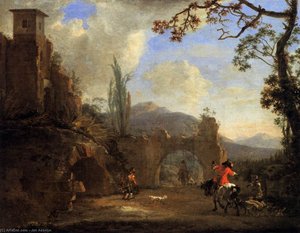
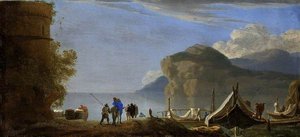
11Fight against Robbers (1638) autorstwa Jan AsselijnFight against Robbers1638 · Statens Museum for Kunst 12Lion Hunting (1640) autorstwa Jan AsselijnLion Hunting1640 · Musée Fabre 13Italianate landscape with travellers by a stream with cattle (1652) autorstwa Jan AsselijnItalianate landscape with travellers by a stream with cattle1652 14Italian Landscape with a view from a Grotto (1639) autorstwa Jan AsselijnItalian Landscape with a view from a Grotto1639 · Nationalmuseum 15Landscape with Ruins and Hunting Party (1645) autorstwa Jan AsselijnLandscape with Ruins and Hunting Party1645 · Academy of Fine Arts Vienna 16PAYSAGE AVEC UN TROUPEAU TRAVERSANT UNE RIVIERE autorstwa Jan AsselijnPAYSAGE AVEC UN TROUPEAU TRAVERSANT UNE RIVIERELuwr 17River Bank with Herdsmen (1650) autorstwa Jan AsselijnRiver Bank with Herdsmen1650 · Academy of Fine Arts Vienna 18Coastal Scene with Resting Riders (detail) (1652) autorstwa Jan AsselijnCoastal Scene with Resting Riders (detail)1652 · Academy of Fine Arts Vienna 19Imaginary Italian Landscape (1652) autorstwa Jan AsselijnImaginary Italian Landscape1652 · Mauritshuis 20Landscape with a Cowherd (1594) autorstwa Jan AsselijnLandscape with a Cowherd1594 21Italianate Landscape (1631) autorstwa Jan AsselijnItalianate Landscape1631 · Bawarskie Państwowe Zbiory Malarstwa 22Cavalry Engagement (1635) autorstwa Jan AsselijnCavalry Engagement1635 23Peasants by a River Bank (1639) autorstwa Jan AsselijnPeasants by a River Bank1639 · Yale University Art Gallery 24Mountain - landscape (1639) autorstwa Jan AsselijnMountain - landscape1639 25Riders Gallopping towards the Gates of the Fortress (1645) autorstwa Jan AsselijnRiders Gallopping towards the Gates of the Fortress1645 · Ermitaż 26Winter Landscape (1645) autorstwa Jan AsselijnWinter Landscape1645 · Ermitaż 27Nocturnal Crayfishing (1638) autorstwa Jan AsselijnNocturnal Crayfishing1638 · Statens Museum for Kunst 28Vesuvius Erupting at Nightfall (1638) autorstwa Jan AsselijnVesuvius Erupting at Nightfall1638 · Statens Museum for Kunst 29Head of an Ox (1647) autorstwa Jan AsselijnHead of an Ox1647 · Musée des Beaux-Arts 30Catching Crayfish (1645) autorstwa Jan AsselijnCatching Crayfish1645 · Muzeum Palacu Króla Jana Iii w Wilanowie 31Ford between High Cliffs (1644) autorstwa Jan AsselijnFord between High Cliffs1644 · National Gallery Prague 32Peasants and Cattle beside a Tower (1646) autorstwa Jan AsselijnPeasants and Cattle beside a Tower1646 33Winter landscape with huntsmen on a bridge (1647) autorstwa Jan AsselijnWinter landscape with huntsmen on a bridge1647 · Fondation Custodia 34A rocky mountain valley with shepherds and cattle (1645) autorstwa Jan AsselijnA rocky mountain valley with shepherds and cattle1645 · Staatliche Kunsthalle Karlsruhe 35Italian Landscape (1640) autorstwa Jan AsselijnItalian Landscape1640 · Państwowe Muzeum Sztuki Dawnej im. A.S. Puškina 36Frozen Moat outside City Walls (1647) autorstwa Jan AsselijnFrozen Moat outside City Walls1647 · Worcester Art Museum 37Mountainous Landscape with Traveling Herdsmen (1647) autorstwa Jan AsselijnMountainous Landscape with Traveling Herdsmen1647 · Academy of Fine Arts Vienna 38Italianate Landscape with Drovers, Cattle and Sheep beside Ruins (1647) autorstwa Jan AsselijnItalianate Landscape with Drovers, Cattle and Sheep beside Ruins1647 · Fogg Museum of Art 39Italianate Landscape with a River and an Arched Bridge (1648) autorstwa Jan AsselijnItalianate Landscape with a River and an Arched Bridge1648 · Staatsgalerie Schleissheim 40Mountainous Landscape with Traveling Herdsmen (1648) autorstwa Jan AsselijnMountainous Landscape with Traveling Herdsmen1648 · Akademie Der Bildenden Künste Wien 41Landscape with Ruins and a Hunting Party (1645) autorstwa Jan AsselijnLandscape with Ruins and a Hunting Party1645 · Akademie Der Bildenden Künste Wien 42Southern Landscape with Cattle near Ruins (1650) autorstwa Jan AsselijnSouthern Landscape with Cattle near Ruins1650 · National Museum in Wrocław 43View of the Solario Bridge on the Teverone (1650) autorstwa Jan AsselijnView of the Solario Bridge on the Teverone1650 44Landscape with Swans and a Swimming Dog (1650) autorstwa Jan AsselijnLandscape with Swans and a Swimming Dog1650 · Gemäldegalerie 45Head of a lowing Ox (1650) autorstwa Jan AsselijnHead of a lowing Ox1650 · Staatliches Museum Schwerin 46Italianate landscape with bridge near Tivoli (1649) autorstwa Jan AsselijnItalianate landscape with bridge near Tivoli1649 47River Landscape with the Fort Saint-Jean and the Chateau Pierre-Scize in Lyon (1650) autorstwa Jan AsselijnRiver Landscape with the Fort Saint-Jean and the Chateau Pierre-Scize in Lyon1650 · Yale University Art Gallery 48The restoration of the Diemerdijk or Muiderdijk near Amsterdam in 1651 (1651) autorstwa Jan AsselijnThe restoration of the Diemerdijk or Muiderdijk near Amsterdam in 16511651 · Gemäldegalerie 49Breach of a Dyke by Storm Surge on March 5 1651 (1651) autorstwa Jan AsselijnBreach of a Dyke by Storm Surge on March 5 16511651 · Gemäldegalerie 50The Breach of the Sint Anthonisdijk in 1651 (1652) autorstwa Jan AsselijnThe Breach of the Sint Anthonisdijk in 16511652 · Amsterdam Museum 51The Breach of the Saint Anthony’s Dike near Amsterdam, Jan Asselijn, 1651 (1651) autorstwa Jan AsselijnThe Breach of the Saint Anthony’s Dike near Amsterdam, Jan Asselijn, 16511651 52Drovers with Cattle under an Arch of the Colosseum in Rome, Jan Asselijn, 1640 - 1652 (1652) autorstwa Jan AsselijnDrovers with Cattle under an Arch of the Colosseum in Rome, Jan Asselijn, 1640 - 16521652 · Rijksmuseum 53A Mediterranean Coastal View with Shipping and Mariners by a Fort (1650) autorstwa Jan AsselijnA Mediterranean Coastal View with Shipping and Mariners by a Fort1650 54A Mediterranean Coastal View with Shipping and Mariners by a Fort (1650) autorstwa Jan AsselijnA Mediterranean Coastal View with Shipping and Mariners by a Fort1650 55River Landscape with the Church of Santi Giovanni e Paolo (1650) autorstwa Jan AsselijnRiver Landscape with the Church of Santi Giovanni e Paolo1650 56The Breach of the Sint Anthonisdijk (1651) autorstwa Jan AsselijnThe Breach of the Sint Anthonisdijk1651 57Landscape with a Drover (1649) autorstwa Jan AsselijnLandscape with a Drover1649 · Holburne Museum 58Landscape with a Bridge in the Italian Countryside (1652) autorstwa Jan AsselijnLandscape with a Bridge in the Italian Countryside1652 · Cannon Hall Museum 59Coastal Scene with Resting Riders (1652) autorstwa Jan AsselijnCoastal Scene with Resting Riders1652 · Academy of Fine Arts Vienna 60PAYSAGE AVEC UNE TOUR autorstwa Jan AsselijnPAYSAGE AVEC UNE TOURLuwr 61RUINE ET CABANE DE BERGERS autorstwa Jan AsselijnRUINE ET CABANE DE BERGERSLuwr 62LANDSCAPE WITH A DEPARTURE FOR A HUNT autorstwa Jan AsselijnLANDSCAPE WITH A DEPARTURE FOR A HUNT 63Muleteers beside an Italian Ruin (1650) autorstwa Jan AsselijnMuleteers beside an Italian Ruin1650 · Rijksmuseum 64Hangout in Italy (1620) autorstwa Jan AsselijnHangout in Italy1620 · Rijksmuseum 65Herders with Their Animals under an Arch of the Colosseum in Rome (1652) autorstwa Jan AsselijnHerders with Their Animals under an Arch of the Colosseum in Rome1652 · Rijksmuseum 66Hunting Company out of Rome (1652) autorstwa Jan AsselijnHunting Company out of Rome1652 · Rijksmuseum 67Bękasy przed cegielnią rzymską (1638) autorstwa Jan AsselijnBękasy przed cegielnią rzymską1638 · Academy of Fine Arts Vienna 68Asselijn - (50Riverbank) autorstwa Jan AsselijnAsselijn - (50Riverbank) 69Asselijn ruin autorstwa Jan AsselijnAsselijn ruinRijksmuseum 70Italian Coast Scene autorstwa Jan AsselijnItalian Coast Scene 71A Landscape with Peasants (Landscape with Herdsmen Fording a River) autorstwa Jan AsselijnA Landscape with Peasants (Landscape with Herdsmen Fording a River)Ascott House 72Italian Landscape with Two Horsemen and Figures on a Road autorstwa Jan AsselijnItalian Landscape with Two Horsemen and Figures on a Road 73Italian Landscape with the Church of Sts. Giovanni e Paolo in Rome autorstwa Jan AsselijnItalian Landscape with the Church of Sts. Giovanni e Paolo in RomeSzépművészeti Múzeum 74The breach of the Sint Anthonisdijk on the night of 5 6 March 1651 autorstwa Jan AsselijnThe breach of the Sint Anthonisdijk on the night of 5 6 March 1651Rijksmuseum 75Mountainous Landscape autorstwa Jan AsselijnMountainous Landscape 76A rocky river landscape with travellers in the foreground and ships beyond autorstwa Jan AsselijnA rocky river landscape with travellers in the foreground and ships beyond 77A Landscape with Peasants (also known as Landscape with Herdsmen Fording a River) autorstwa Jan AsselijnA Landscape with Peasants (also known as Landscape with Herdsmen Fording a River)Ascott House 78A Cavalier on Horseback Before a Landscape autorstwa Jan AsselijnA Cavalier on Horseback Before a Landscape 79Landscape with shepherds and their flock crossing the Ponte Acquoria near Tivoli autorstwa Jan AsselijnLandscape with shepherds and their flock crossing the Ponte Acquoria near Tivoli 80an italianate river landscape with herders on a path with their flock and donkeys, classical ruins on a hilltop beyond autorstwa Jan Asselijnan italianate river landscape with herders on a path with their flock and donkeys, classical ruins on a hilltop beyondMinneapolis Institute of Art 81Italian Coast Scene autorstwa Jan AsselijnItalian Coast SceneFitzwilliam College 82Italian Landscape autorstwa Jan AsselijnItalian LandscapeFitzwilliam College 83Italian Landscape with the Ruins of a Roman Bridge and Aqueduct autorstwa Jan AsselijnItalian Landscape with the Ruins of a Roman Bridge and AqueductRijksmuseum 84Cavalry Attack at Sunset, Jan Asselijn, 1646 (1646) autorstwa Jan AsselijnCavalry Attack at Sunset, Jan Asselijn, 16461646 · Rijksmuseum

Słynne obrazy Jan Asselijn epoka po epoce

Tematy, które przyciągnęły wzrok Jan Asselijn

Cztery motywy najczęściej powracające w tych oryginałach, z których każdy doczekał się swojego najdoskonalszego przykładu.

Muzea przechowujące oryginały Jan Asselijn

8 muzeów, w których znajduje się najwięcej obrazów z tej strony.

Muzeum Miasto Dzieła artysty Jan Asselijn Obrazy z tej listy
Rijksmuseum, AmsterdamRijksmuseum Amsterdam 11 The Threatened Swan, The Threatened Swan, Drovers with Cattle under an Arch of the Colosseum in Rome, Jan Asselijn, 1640 - 1652
Academy of Fine Arts Vienna, WiedeńAcademy of Fine Arts Vienna Wiedeń 6 Landscape with Ruins and Hunting Party, River Bank with Herdsmen, Coastal Scene with Resting Riders (detail)
Statens Museum for Kunst, KopenhagaStatens Museum for Kunst Kopenhaga 5 King Gustav Adolf II of Sweden in the Battle of Lutzen, 1632, Italian Landscape, Fight against Robbers
Gemäldegalerie, BerlinGemäldegalerie Berlin 4 King Gustav Adolf II of Sweden, Battle near Lutzen 1632, Landscape with Swans and a Swimming Dog, The restoration of the Diemerdijk or Muiderdijk near Amsterdam in 1651
Luwr, ParyżLuwr Paryż 3 PAYSAGE AVEC UN TROUPEAU TRAVERSANT UNE RIVIERE, PAYSAGE AVEC UNE TOUR, RUINE ET CABANE DE BERGERS
Cannon Hall Museum, BarnsleyCannon Hall Museum Barnsley 2 Landscape with a Bridge in the Italian Countryside, Landscape with a Bridge in the Italian Countryside
Yale University Art Gallery, Nowe HavaneYale University Art Gallery Nowe Havane 2 Peasants by a River Bank, River Landscape with the Fort Saint-Jean and the Chateau Pierre-Scize in Lyon
Ermitaż, Sankt PetersburgErmitaż Sankt Petersburg 2 Riders Gallopping towards the Gates of the Fortress, Winter Landscape

Jan Asselijn, jedno kultowe dzieło na dekadę

Dzieła według dekad

Wybierz dekadę, aby zobaczyć dzieło, które ją definiuje.

Obrazy artysty Jan Asselijn: odpowiedzi galerii

Który obraz Jan Asselijn jest najsłynniejszy ze wszystkich?Odkryj odpowiedź

The Threatened Swan (1652), Rijksmuseum, Amsterdam. Następne są The Threatened Swan (1650) oraz King Gustav Adolf II of Sweden in the Battle of Lutzen, 1632 (1634).

Ile lat miał Jan Asselijn, gdy ukończył The Threatened Swan?Odkryj odpowiedź

42 lat: The Threatened Swan pochodzi z 1652, a Jan Asselijn urodził(a) się w 1610.

Które to 10 najlepszych obrazów Jan Asselijn?Odkryj odpowiedź

The Threatened Swan, The Threatened Swan, King Gustav Adolf II of Sweden in the Battle of Lutzen, 1632, Landscape with a Bridge in the Italian Countryside, King Gustav Adolf II in the Battle of Lutzen on November 6,1632, Four Figures, King Gustav Adolf II of Sweden, Battle near Lutzen 1632, The Tiber River with the Ponte Molle at Sunset, Ruined Building with Shepherd and Sheep i Italian Landscape. Powyższy ranking zawiera rok powstania oraz muzeum dla każdego z nich.

Ile dzieł stworzył/a Jan Asselijn?Odkryj odpowiedź

Nasz katalog zawiera 84 dzieł artysty Jan Asselijn, datowanych od 1620 do 1652.

Gdzie można znaleźć najsłynniejsze oryginały autorstwa Jan Asselijn?Odkryj odpowiedź

W większości znajdują się w Rijksmuseum (Amsterdam), Academy of Fine Arts Vienna (Wiedeń) i Statens Museum for Kunst (Kopenhaga). Powyższa tabela muzeów zawiera ich pełną listę.

Kiedy Jan Asselijn stworzył swoje najsłynniejsze obrazy?Odkryj odpowiedź

W 1650s: 27 z 84 dzieł na tej stronie powstało w tym czasie, w tym The Threatened Swan.

Które z najsłynniejszych dzieł Jan Asselijn należą do jego najwcześniejszych i najpóźniejszych prac?Odkryj odpowiedź

Na tej stronie najwcześniejszy to Hangout in Italy (1620), a najpóźniejszy The Threatened Swan (1652).

Do jakich tematów Jan Asselijn powracał najczęściej?Odkryj odpowiedź

Landscape (27), Figures (5) i Italy (5), w ramach 84 dzieł na tej stronie.

W jakiej technice najczęściej tworzył Jan Asselijn?Odkryj odpowiedź

Oil On Canvas, dla 11 z 84 dzieł na tej stronie.

Z jakim nurtem związany jest Jan Asselijn?Odkryj odpowiedź

Dutch golden age i Baroque, sądząc po oryginałach na tej stronie.

Które oryginały artysty Jan Asselijn znajdują się w zbiorach Rijksmuseum?Odkryj odpowiedź

The Threatened Swan, The Threatened Swan i Drovers with Cattle under an Arch of the Colosseum in Rome, Jan Asselijn, 1640 - 1652: Rijksmuseum, Amsterdam posiada 11 dzieł widocznych na tej stronie.

Czy mogę zamówić ręczną kopię obrazu autorstwa Jan Asselijn?Odkryj odpowiedź

Tak, jako reprodukcja: oryginał pozostaje w muzeum, ale każdy obraz na tej stronie może zostać namalowany ręcznie specjalnie dla Ciebie, na zamówienie, z poziomu strony danego dzieła.

Jan Asselijn: artysta

A Life Forged in Landscape: The World of Jan Asselijn

Born Jean Asselin around 1610 in Dieppe, France, Jan Asselijn’s life unfolded against the backdrop of religious upheaval and artistic transformation—a formative experience that would ultimately define his distinctive contribution to the Dutch Golden Age. His family, Huguenots fleeing persecution, relocated to Amsterdam in 1621, a vibrant epicenter of commerce and burgeoning artistic innovation during this period. This pivotal move immersed young Jean into an environment where landscape painting was undergoing a profound metamorphosis, surpassing traditional representations toward scenes imbued with heightened atmospheric intensity and emotional resonance. Initially apprenticed under Jan Martszen the Younger, Asselijn honed his skills in battle paintings before discovering his true vocation—the art of capturing the splendor and drama inherent in both natural vistas and animal life. The Dutch light – expansive skies brimming with color and luminosity – swiftly became a cornerstone of his artistic vision, an element that would permeate his oeuvre throughout his career.

The Italianate Embrace & The Bentvueghels

Like many ambitious Northern European painters of the era, Asselijn recognized the importance of refinement in Italy, likely arriving sometime after 1635. This journey proved transformative, propelling him into the orbit of the *Bentvueghels*, a remarkable society comprised of Dutch and Flemish artists operating in Rome. These “Birds of a Feather,” as they affectionately termed themselves, defied convention with their unorthodox behavior—characterized by spirited nicknames and unwavering dedication to painting directly from observation—rejecting the constraints imposed by studio practice. Within this lively community, Asselijn earned the moniker "Krabbetje" (little crab) due to a congenital deformity affecting his left hand, yet he persevered creatively, absorbing influences from luminaries such as Pieter van Laer (Bamboccio), whose depictions of Roman peasant life and landscapes resonated deeply with Asselijn’s evolving aesthetic sensibilities. This period solidified his mastery of capturing light and color—a technique that would become synonymous with the Italianate style and distinguish his work from many contemporaries.

Mastering Light & Symbolism: Key Works

Asselijn's artistic output reflected a profound engagement with both formal innovation and symbolic interpretation. His paintings are distinguished by remarkable clarity of execution and an unparalleled sensitivity to light—qualities that swiftly garnered him acclaim among fellow artists and critics alike. While he produced historical and battle scenes, it was his landscapes and animal paintings that truly cemented his reputation as one of the era’s foremost practitioners. The Threatened Swan, completed around 1645-1652, stands as Asselijn's most celebrated masterpiece—a work that transcends mere visual representation to embody a powerful allegory of Dutch national resilience against external pressures. More than simply depicting a bird defending its nest against a predator, this painting became a poignant emblem of Johan de Witt’s leadership during the siege of Dunkirk—a moment of crisis that galvanized patriotic fervor. The swan's defiant posture and unwavering determination mirrored the spirit of resistance prevalent throughout the Netherlands at the time, prompting scholarly debate regarding its symbolic significance. Further exemplifying his artistic prowess is Cavalry Charge at Sunset, showcasing his formative training in battle painting with dramatic flair—a testament to his ability to convey movement and emotion through meticulous detail. Asselijn’s explorations of rural life extended beyond mere topographical accuracy; he sought to infuse his canvases with a sense of atmosphere and narrative—characteristics that elevated his work above the commonplace and imbued it with enduring artistic merit. Notable among his landscapes are depictions of serene waterways, expansive meadows dotted with wildflowers, and dramatic mountain vistas—each rendered with meticulous observation and infused with subtle tonal harmonies.

Influence & Legacy: A Lasting Impression

Jan Asselijn’s influence extended far beyond his own prolific output, shaping the artistic landscape of his time and inspiring subsequent generations of painters. He was particularly admired by Rembrandt van Rijn, who even created an etching portraying Asselijn at work—a gesture that subtly acknowledged the artist's physical disability while simultaneously recognizing his exceptional talent. Furthermore, Asselijn served as a mentor to Frederik de Moucheron, another prominent Dutch landscape painter whose style mirrored Asselijn’s own distinctive approach. His unwavering commitment to capturing the beauty and drama of nature established him as a pivotal figure within the Italianate tradition—a movement that championed idealized vistas and luminous color palettes. Today, Asselijn's paintings reside in prestigious collections worldwide—most notably the Rijksmuseum in Amsterdam—ensuring his legacy endures as a cornerstone of Dutch Golden Age art and cementing his place among the most accomplished artists of his era.

Wszystkie 84 dzieła artysty Jan Asselijn →