Portret Rowland Suddaby

26 najsłynniejszych obrazów artysty Rowland Suddaby, każdy niepowtarzalny

Aktualizacja: Listopad 2026 · ranking według naszego wskaźnika popularności (liczba wyszukiwań, wizyt i zamówień dla każdego dzieła) · 26 dzieł Rowland Suddaby w naszym katalogu

W skrócie

Poplars to obraz autorstwa Rowland Suddaby, który przyciąga najwięcej spojrzeń. Następnie wzrok kieruje się na Fishing Boats at Staithes, Yorkshire (1938) i Coast Scene near the Stour Estuary, Suffolk (1946). Spośród 26 dzieł Rowland Suddaby w naszym katalogu, tych 26 jest najbardziej znanych – każde z nich to unikatowy oryginał, przedstawiony wraz z rokiem powstania, muzeum oraz powodem, dla którego przetrwało próbę czasu.

1912 – 1972 Impressionism Najwięcej dzieł: Walker Art Gallery

10 najlepszych obrazów autorstwa Rowland Suddaby według oka galerii

1
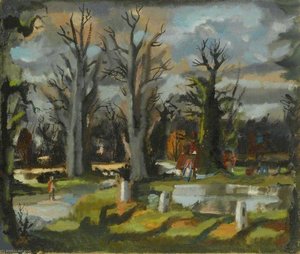
Poplars autorstwa Rowland Suddaby

Poplars

Oil

In Poplars, Rowland Suddaby captures a quiet corner of the countryside. The scene centers on a country road, a path cutting through grassy fields and bordered by trees. A white house sits nestled within the greenery, a steady presence amidst the scattered cows that graze in the distance. A lone figure stands near the center, a silent observer of the rural rhythm.

2
Fishing Boats at Staithes, Yorkshire (1938) autorstwa Rowland Suddaby

Fishing Boats at Staithes, Yorkshire

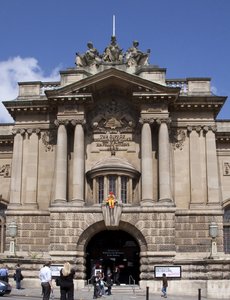
1938 · Oil On Canvas · Bristol Museum - Art Gallery, Bristol

In the oil painting Fishing Boats at Staithes, Yorkshire by Rowland Suddaby, the composition focuses on a small blue fishing boat positioned within a choppy seascape. Created about 1938, the work centers on maritime life and the specific challenges faced by fishermen. The boat is the primary subject, surrounded by turbulent water and an overcast sky. The perspective is set at a slightly low angle, which places the viewer near…

3
Coast Scene near the Stour Estuary, Suffolk (1946) autorstwa Rowland Suddaby

Coast Scene near the Stour Estuary, Suffolk

1946 · Oil On Canvas

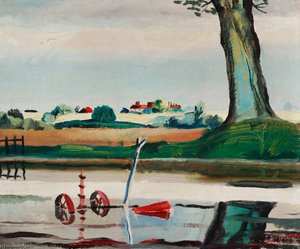
The meeting of land and sea near the Stour Estuary is captured in this 1946 oil painting, rendered with a focus on the quietude of the Suffolk coastline. A single sailing boat occupies the mid-ground, its mast providing a sharp vertical counterpoint to the dominant horizontal planes of the shoreline and the distant horizon. The composition relies on a layered perspective, moving from the textured, weathered wooden structures in the…

Słynne obrazy artysty Rowland Suddaby, od 11 do 26

Słynne obrazy Rowland Suddaby epoka po epoce

Tematy, które przyciągnęły wzrok Rowland Suddaby

Cztery motywy najczęściej powracające w tych oryginałach, z których każdy doczekał się swojego najdoskonalszego przykładu.

Muzea przechowujące oryginały Rowland Suddaby

8 muzeów, w których znajduje się najwięcej obrazów z tej strony.

Muzea Miasto Dzieła artysty Rowland Suddaby Obrazy z tej listy
Walker Art Gallery, LiverpoolWalker Art Gallery Liverpool 2 Flowers in a Hall, Landscape
Government Art Collection, LondynGovernment Art Collection Londyn 2 Stoke by Nayland, Millpond, Bures, Suffolk
Bristol Museum - Art Gallery, BristolBristol Museum - Art Gallery Bristol 1 Fishing Boats at Staithes, Yorkshire
Arts Council Collection, LondynArts Council Collection Londyn 1 Winter Landscape, near Lavenham
Nottingham Castle Museum And Art Gallery, NottinghamNottingham Castle Museum And Art Gallery Nottingham 1 Hedging at Cornard Tye, Suffolk
The Hepworth Wakefield, WakefieldThe Hepworth Wakefield Wakefield 1 Floods
Wolverhampton Art Gallery, WolverhamptonWolverhampton Art Gallery Wolverhampton 1 Stour Valley, Suffolk
Alfred East Art Gallery, KetteringAlfred East Art Gallery Kettering 1 Sunflowers and Fruit

Rowland Suddaby na przestrzeni dekad: jeden unikatowy oryginał dla każdego

Dzieła według dekad

Wybierz dekadę, aby zobaczyć dzieło, które ją definiuje.

Obrazy artysty Rowland Suddaby: pytania do galerii

Jakie jest najsłynniejsze dzieło artysty Rowland Suddaby?Odkryj odpowiedź

Poplars. Następne są Fishing Boats at Staithes, Yorkshire (1938) oraz Coast Scene near the Stour Estuary, Suffolk (1946).

Które dziesięć obrazów Rowland Suddaby jest najbardziej znanych?Odkryj odpowiedź

Poplars, Fishing Boats at Staithes, Yorkshire, Coast Scene near the Stour Estuary, Suffolk, Fishing Village, Flowers and Still Life, Scholes, Yorkshire, Still Life, Window at No.5 Portland Place, Flowers in a Hall i Flower Piece. Powyższy ranking zawiera rok powstania oraz muzeum dla każdego z nich.

Ile znanych dzieł stworzył Rowland Suddaby?Odkryj odpowiedź

Nasz katalog zawiera 26 dzieł artysty Rowland Suddaby, datowanych od 1931 do 1950.

Gdzie można zobaczyć najsłynniejsze oryginały Rowland Suddaby?Odkryj odpowiedź

W większości znajdują się w Walker Art Gallery (Liverpool), Government Art Collection (Londyn) i Bristol Museum - Art Gallery (Bristol). Powyższa tabela muzeów zawiera ich pełną listę.

W jakim okresie Rowland Suddaby stworzył/a swoje najsłynniejsze obrazy?Odkryj odpowiedź

W 1930s: 8 z 26 dzieł na tej stronie powstało w tym czasie, w tym Fishing Boats at Staithes, Yorkshire.

Który z najsłynniejszych obrazów artysty Rowland Suddaby powstał najwcześniej, a który najpóźniej?Odkryj odpowiedź

Na tej stronie najwcześniejszy to Fishing Village (1931), a najpóźniejszy Hedging at Cornard Tye, Suffolk (1950).

Jakie tematy preferował Rowland Suddaby?Odkryj odpowiedź

Still life (2), English landscape (2) i Traditional painting (2), w ramach 26 dzieł na tej stronie.

Jakich materiałów Rowland Suddaby używał najczęściej?Odkryj odpowiedź

Oil On Canvas, dla 2 z 26 dzieł na tej stronie.

Do jakiego nurtu należy twórczość Rowland Suddaby?Odkryj odpowiedź

Impressionism i Realism, sądząc po oryginałach na tej stronie.

Jakie oryginały Rowland Suddaby można zobaczyć w Walker Art Gallery?Odkryj odpowiedź

Flowers in a Hall i Landscape: Walker Art Gallery, Liverpool posiada 2 dzieł widocznych na tej stronie.

Rowland Suddaby: portret artysty

A Quiet Observer of Rural England

Rowland Suddaby (1912–1972) remains a poignant voice in the history of British mid-century art, serving as a dedicated chronicler of the English landscape. Born in Kimberworth, Yorkshire, his artistic sensibilities were forged through a rigorous academic journey that began with a prestigious scholarship to the Sheffield College of Art in 1926. This foundational period provided him with the technical precision that would later allow him to capture the subtle nuances of light and atmosphere. His subsequent training at the Royal College of Art further refined his craft, placing him within a lineage of artists who sought to balance formal excellence with an intimate connection to the natural world. Suddaby’s early life was not merely a period of study but a deep immersion into the textures of the British countryside, a theme that would resonate through every canvas he produced.

The transition to London in 1931 acted as a catalyst for his professional evolution, thrusting him into the vibrant heart of the nation's artistic commerce. During this era, Suddaby demonstrated a remarkable versatility, securing work designing film titles for the studios of Wardour Street—a role that required a keen eye for composition and visual storytelling. This commercial success provided a stable foundation for his more personal explorations in fine art. His emergence into the prestigious London gallery scene, with exhibitions at the Wertheim Gallery and the Redfern Gallery, signaled his arrival as a significant talent. Through these venues, he engaged with the contemporary dialogues of his time, often finding himself aligned with the sensibilities of the New English Art Club, where the pursuit of capturing fleeting moments through light and color was paramount.

The Poetics of Landscape and Still Life

Suddaby’s oeuvre is characterized by a profound ability to elevate the mundane into the monumental. Whether he was painting the rolling hills of Yorkshire or the serene vistas of Suffolk, his work possessed an evocative quality that transcended simple topography. His landscapes often feel like quiet meditations; in works such as Winter Landscape, near Lavenham, one can sense the stillness of a frost-covered morning, where the weight of the atmosphere is rendered with masterful sensitivity. His technique frequently leaned toward an Impressionistic approach, utilizing loose, visible brushstrokes to prioritize the emotional resonance of a scene over rigid realism. This method allowed him to capture the diffused light and soft shadows that define the English countryside, creating a sense of warmth and abundance even in more somber settings.

Beyond the expansive horizon, Suddaby found equal inspiration in the intimate arrangements of his still lifes. In masterpieces like Still Life with Fruit and Flowers, he utilized a vibrant palette of reds, blues, and yellows to breathe life into inanimate objects. These compositions were far more than mere studies of form; they were celebrations of texture and light. The contrast between the smooth surface of a vase and the rough skin of ripening fruit served to ground his more expressive brushwork in a tangible reality. This duality—the ability to move seamlessly from the sweeping vistas of Scholes, Yorkshire to the delicate intimacy of a tabletop arrangement—demonstrates a technical breadth that made him a truly versatile observer of the world around him.

Legacy and Historical Significance

The later years of Suddaby’s life saw him returning to the very landscapes that had shaped his soul. Moving near Sudbury, Suffolk, during the onset of World War II, he found a sanctuary in the rural landscape alongside his family. This period of relative seclusion allowed for a deepening of his connection to the land, a sentiment reflected in his involvement with the Recording Britain project commissioned by Sir Kenneth Clarke. This monumental effort to document the changing face of the British landscape ensured that Suddaby’s vision was woven into the historical fabric of the nation. His later appointment as the curator of Gainsborough's House in Sudbury from 1968 until his death in 1972 further solidified his role as a custodian of British artistic heritage.

Today, the significance of Rowland Suddaby’s work is preserved within the collections of numerous esteemed institutions, including the Victoria and Albert Museum and the Government Art Collection. His legacy is defined by several key contributions to British art:

  • Documentary Value: His meticulous yet emotive depictions provide a vital visual record of mid-century English rural life and landscapes that have since been altered by time.
  • Technical Mastery: He successfully bridged the gap between commercial graphic design and fine art, bringing a unique sense of composition to both mediums.
  • Emotional Depth: Through his use of light and color, he moved beyond mere representation to capture the "feeling" of the English atmosphere, making his work timelessly relatable.

Suddaby remains a celebrated figure for those who seek beauty in the quiet corners of the world, reminding us that there is profound art to be found in the simple observation of nature's enduring rhythms.