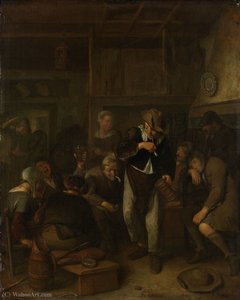
Portret Richard Brakenburg

45 najsłynniejszych obrazów artysty Richard Brakenburg – wybór z galerii

Aktualizacja: Listopad 2026 · ranking według naszego wskaźnika popularności (liczba wyszukiwań, wizyt i zamówień dla każdego dzieła) · 46 dzieł Richard Brakenburg w naszym katalogu

W skrócie

Spośród wszystkich dzieł oryginalnych, które pozostawił Richard Brakenburg, najsłynniejszym jest Tavern Scene (1692), znajdujący się w kolekcji Nationalmuseum w Stockholm. Tuż za nimi znajdują się Tavern interior with dancing peasants, (1690) oraz Interior with a company celebrating Twelfth Night, the Feast of Epiphany (1690). Nasz katalog zawiera 46 dzieł autorstwa Richard Brakenburg; galeria zachowała 45 najbardziej podziwianych na świecie prac, z których każda została przedstawiona wraz z datą powstania, informacją o muzeum oraz jej historią.

1650 – 1702, Haarlem Dutch golden age Najwięcej dzieł: Bawarskie Państwowe Zbiory Malarstwa

10 najlepszych obrazów artysty Richard Brakenburg: wybór galerii

1
Tavern Scene (1692) autorstwa Richard Brakenburg

Tavern Scene

1692 · Oil On Canvas · Nationalmuseum, Stockholm

A single light source, perhaps a guttering candle, strikes the scene from the left. It catches the white fabric of a woman’s garment in the foreground, turning her into a bright anchor amidst a sea of ochre and deep brown. Around her, the tavern breathes with a heavy, crowded energy. Figures lean into one another, their postures shaped by the weight of conversation and the pull of drink. The air…

2
Tavern interior with dancing peasants, (1690) autorstwa Richard Brakenburg

Tavern interior with dancing peasants,

1690 · Oil On Canvas · Kunsthistorisches Museum, Wiedeń

Step into the warmth of this 1690 tavern scene, where the air seems thick with the scent of spilled ale and the sound of rhythmic footsteps. Richard Brakenburgh has captured a fleeting moment of celebration among the peasantry, drawing us into a crowded, lively interior. The composition pulls the viewer through a deep perspective, moving from the immediate, tactile details of the foreground into a shadowy, bustling crowd that recedes…

3
Interior with a company celebrating Twelfth Night, the Feast of Epiphany (1690) autorstwa Richard Brakenburg

Interior with a company celebrating Twelfth Night, the Feast of Epiphany

1690 · Oil On Canvas · Kunsthistorisches Museum, Wiedeń

In this work, titled Interior with a company celebrating Twelfth Night, the Feast of Epiphany, we find ourselves observing a quiet moment of communal gathering. Painted by Richard Brakenburgh in 1690, the scene captures a specific social ritual. It is a fine example of genre art, focusing on the everyday interactions and festivities of the period. The subject matter centers on a group of people gathered for the Twelfth Night…

4
Réunion dans un cabaret autorstwa Richard Brakenburg

Réunion dans un cabaret

Oil On Canvas

The air inside the cabaret feels thick, heavy with the scent of spilled ale and the warmth of too many bodies gathered in a single room. Light flickers from candles, casting long, dancing shadows that stretch across the floor and climb the walls. In the center of this swirling chaos, a group of figures moves in a rhythmic dance, their forms blurring slightly as they spin. Around them, the tavern…

5
Merry Company (1676) autorstwa Richard Brakenburg

Merry Company

1676 · Oil · Bawarskie Państwowe Zbiory Malarstwa, Monachium

Richard Brakenburgh's Merry Company captures a lively social gathering, likely situated within a tavern or a domestic setting. The scene focuses on a group of people engaged in conversation and leisure, embodying the 'Merry Company' theme prevalent in Dutch Golden Age painting. This subject matter reflects the communal spirit and social interactions of the seventeenth century.

6
The Resurrection of Christ and the Visit of the Women to the Tomb (1676) autorstwa Richard Brakenburg

The Resurrection of Christ and the Visit of the Women to the Tomb

1676 · Oil · Bawarskie Państwowe Zbiory Malarstwa, Monachium

In The Resurrection of Christ and the Visit of the Women to the Tomb, Richard Brakenburgh orchestrates a scene of intense, sudden movement. The composition follows a dynamic pyramidal structure that draws the eye upward toward a burst of light in the upper center. From this celestial radiance, a luminous, winged angelic figure descends, gesturing toward the earthly events unfolding below. The perspective is set slightly from below, which lends…

7
Drinkers and Musicians in a Cabaret, with Child with a Hoop (1675) autorstwa Richard Brakenburg

Drinkers and Musicians in a Cabaret, with Child with a Hoop

1675 · Oil On Canvas

The air in the room feels heavy with the scent of spilled ale and the low hum of conversation. Light spills from a large window on the left, cutting through the dimness to strike the faces of men gathered around a table. They are lost in the rhythm of the moment, some leaning into a drink, others lost to the music. In the corner, a child moves with a hoop,…

8
Monk's Entertainment in a Roman Cloister (1680) autorstwa Richard Brakenburg

Monk's Entertainment in a Roman Cloister

1680 · Oil On Canvas · Słowacka Galeria Narodowa w Bratysławie, Bratysława

In Monk's Entertainment in a Roman Cloister, Richard Brakenburgh employs a sophisticated chiaroscuro technique to define the cavernous interior. A single, unseen light source from the left casts strong highlights onto faces and hands, allowing them to emerge from deep, atmospheric shadows. This dramatic interplay of light and dark creates a sense of depth and bustling activity within the crowded space. Through precise perspective, the artist organizes the overlapping clusters…

9
Portrait of a young woman (1683) autorstwa Richard Brakenburg

Portrait of a young woman

1683 · Oil

In "Portrait of a young woman" by Richard Brakenburgh, the subject is captured in a three-quarter length pose. She sits centrally, anchored against a dark and atmospheric background that recedes into shadow. The color palette relies on deep blacks and browns, creating a somber foundation for the figure. This darkness pushes the subject forward, making her presence feel immediate and singular.

10
merry party (1686) autorstwa Richard Brakenburg

merry party

1686 · Oil · Museum Gouda, Gouda

The air in the room feels heavy with the scent of spilled ale and uninhibited laughter. A dense crowd of figures presses together in a crowded interior, their bodies caught in a moment of boisterous social indulgence. To the right, a large, heavy curtain hangs in deep folds, framing the scene like a stage set for a play that has already reached its climax. Light spills from the upper left,…

Kontynuacja zestawienia Richard Brakenburg, od 11 do 45

11A Game of Cards at an Inn (1683) autorstwa Richard BrakenburgA Game of Cards at an Inn1683 · Statens Museum for Kunst 12Tavern Interior with a Maidservant and Drinkers (1680) autorstwa Richard BrakenburgTavern Interior with a Maidservant and Drinkers1680 · Hallwyl Museum 13Adoration of the Shepherds (1694) autorstwa Richard BrakenburgAdoration of the Shepherds1694 · Bawarskie Państwowe Zbiory Malarstwa 14An Interior with Figures (1689) autorstwa Richard BrakenburgAn Interior with Figures1689 · National Gallery of Ireland 15The Eve of Saint Nicholas (1690) autorstwa Richard BrakenburgThe Eve of Saint Nicholas1690 · Muzeum Fransa Halsa 16Dance in a Cottage (1699) autorstwa Richard BrakenburgDance in a Cottage1699 · Nationalmuseum 17merry party (1691) autorstwa Richard Brakenburgmerry party1691 · Muzeum Fransa Halsa 18A family on a terrace. (1691) autorstwa Richard BrakenburgA family on a terrace.1691 19The Feast of St. Nicholas (1698) autorstwa Richard BrakenburgThe Feast of St. Nicholas1698 20Family Scene (1680) autorstwa Richard BrakenburgFamily Scene1680 · Fitzwilliam College 21May Queen Festival (1700) autorstwa Richard BrakenburgMay Queen Festival1700 · Szépművészeti Múzeum 22Dutch Merchants Trading in a Chinese Harbor (1683) autorstwa Richard BrakenburgDutch Merchants Trading in a Chinese Harbor1683 · Groninger Museum 23Celebration of a Birth (1683) autorstwa Richard BrakenburgCelebration of a Birth1683 24Interior of a Farmhouse (1699) autorstwa Richard BrakenburgInterior of a Farmhouse1699 · Fitzwilliam College 25Intérieur d'auberge autorstwa Richard BrakenburgIntérieur d'aubergeLuwr 26Cabaret Interior autorstwa Richard BrakenburgCabaret InteriorPetit Palais 27Jolly Company autorstwa Richard BrakenburgJolly CompanyKrólewskie Muzeum Sztuk Pięknych Antwerpia 28Figural scene against architecture autorstwa Richard BrakenburgFigural scene against architectureMuzeum Narodowe w Warszawie 29INTERIEUR D'UN ESTAMINET autorstwa Richard BrakenburgINTERIEUR D'UN ESTAMINET 30SCENE GALANTE autorstwa Richard BrakenburgSCENE GALANTE 31LE LEVER DE LA MARIEE autorstwa Richard BrakenburgLE LEVER DE LA MARIEE 32Feast of St Nicholas autorstwa Richard BrakenburgFeast of St NicholasSzépművészeti Múzeum 33Family Portrait (1670) autorstwa Richard BrakenburgFamily Portrait1670 · Art Museum RIGA BOURSE 34St Nicholas Eve (1685) autorstwa Richard BrakenburgSt Nicholas Eve1685 · Amstelkring Museum 35The doctor's visit. autorstwa Richard BrakenburgThe doctor's visit.Museum Boijmans Van Beuningen 36Moines et religieuses en goguette autorstwa Richard BrakenburgMoines et religieuses en goguette 37In the tavern. autorstwa Richard BrakenburgIn the tavern. 38Family Having Breakfast autorstwa Richard BrakenburgFamily Having Breakfast 39Merry company. autorstwa Richard BrakenburgMerry company.Museum Boijmans Van Beuningen 40Gallant scene at Palais des Beaux-Arts de Lille. autorstwa Richard BrakenburgGallant scene at Palais des Beaux-Arts de Lille. 41Celebration of a Birth autorstwa Richard BrakenburgCelebration of a BirthGaleria Dulwich 42Merry company autorstwa Richard BrakenburgMerry companySzépművészeti Múzeum 43The Feast of St. Nicholas autorstwa Richard BrakenburgThe Feast of St. NicholasRijksmuseum 44A Medical Practitioner Taking a Girl's Pulse and Holding a Flask of Her Urine autorstwa Richard BrakenburgA Medical Practitioner Taking a Girl's Pulse and Holding a Flask of Her Urine 45Peasant's inn autorstwa Richard BrakenburgPeasant's innRijksmuseum

Tematy, które przyciągnęły wzrok Richard Brakenburg

Cztery motywy najczęściej powracające w tych oryginałach, z których każdy doczekał się swojego najdoskonalszego przykładu.

Muzea przechowujące oryginały Richard Brakenburg

8 muzeów, w których znajduje się najwięcej obrazów z tej strony.

Muzea Miasto Dzieła artysty Richard Brakenburg Obrazy z tej listy
Bawarskie Państwowe Zbiory Malarstwa, MonachiumBawarskie Państwowe Zbiory Malarstwa Monachium 3 Merry Company, The Resurrection of Christ and the Visit of the Women to the Tomb, Adoration of the Shepherds
Szépművészeti Múzeum, BudapesztSzépművészeti Múzeum Budapeszt 3 May Queen Festival, Feast of St Nicholas, Merry company
Nationalmuseum, StockholmNationalmuseum Stockholm 2 Tavern Scene, Dance in a Cottage
Kunsthistorisches Museum, WiedeńKunsthistorisches Museum Wiedeń 2 Tavern interior with dancing peasants,, Interior with a company celebrating Twelfth Night, the Feast of Epiphany
Muzeum Fransa Halsa, HarenMuzeum Fransa Halsa Haren 2 The Eve of Saint Nicholas, merry party
Fitzwilliam College, CambridgeFitzwilliam College Cambridge 2 Family Scene, Interior of a Farmhouse
Museum Boijmans Van Beuningen, RotterdamMuseum Boijmans Van Beuningen Rotterdam 2 The doctor's visit., Merry company.
Rijksmuseum, AmsterdamRijksmuseum Amsterdam 2 The Feast of St. Nicholas, Peasant's inn

Richard Brakenburg dekada po dekadzie: oryginały definiujące każdy okres

Dzieła według dekad

Wybierz dekadę, aby zobaczyć dzieło, które ją definiuje.

Pytania kolekcjonerów o obrazy Richard Brakenburg

Z jakiego dzieła najbardziej znany jest Richard Brakenburg?Odkryj odpowiedź

Tavern Scene (1692), Nationalmuseum, Stockholm. Następne są Tavern interior with dancing peasants, (1690) oraz Interior with a company celebrating Twelfth Night, the Feast of Epiphany (1690).

W jakim wieku był Richard Brakenburg, gdy powstało Tavern Scene?Odkryj odpowiedź

42 lat: Tavern Scene pochodzi z 1692, a Richard Brakenburg urodził(a) się w 1650.

Jakie są dziesięć najsłynniejszych obrazów, których autorem jest Richard Brakenburg?Odkryj odpowiedź

Tavern Scene, Tavern interior with dancing peasants,, Interior with a company celebrating Twelfth Night, the Feast of Epiphany, Réunion dans un cabaret, Merry Company, The Resurrection of Christ and the Visit of the Women to the Tomb, Drinkers and Musicians in a Cabaret, with Child with a Hoop, Monk's Entertainment in a Roman Cloister, Portrait of a young woman i merry party. Powyższy ranking zawiera rok powstania oraz muzeum dla każdego z nich.

Ile obrazów pozostawił po sobie Richard Brakenburg?Odkryj odpowiedź

Nasz katalog zawiera 46 dzieł artysty Richard Brakenburg, datowanych od 1670 do 1700.

W których muzeach znajdują się arcydzieła Richard Brakenburg?Odkryj odpowiedź

W większości znajdują się w Bawarskie Państwowe Zbiory Malarstwa (Monachium), Szépművészeti Múzeum (Budapeszt) i Nationalmuseum (Stockholm). Powyższa tabela muzeów zawiera ich pełną listę.

W których latach Richard Brakenburg namalował swoje najsłynniejsze dzieła?Odkryj odpowiedź

W 1680s: 10 z 45 dzieł na tej stronie powstało w tym czasie, w tym Monk's Entertainment in a Roman Cloister.

Jakie są pierwsze i ostatnie słynne oryginały Richard Brakenburg?Odkryj odpowiedź

Na tej stronie najwcześniejszy to Family Portrait (1670), a najpóźniejszy May Queen Festival (1700).

Jakie tematy Richard Brakenburg wybierał najczęściej?Odkryj odpowiedź

People (19), Figures (10) i Table (9), w ramach 45 dzieł na tej stronie.

Której techniki Richard Brakenburg używał najczęściej?Odkryj odpowiedź

Oil On Canvas, dla 12 z 45 dzieł na tej stronie.

Do jakiego nurtu artystycznego należy Richard Brakenburg?Odkryj odpowiedź

Dutch golden age, sądząc po oryginałach na tej stronie.

Które dzieła Richard Brakenburg znajdują się w Bawarskie Państwowe Zbiory Malarstwa?Odkryj odpowiedź

Merry Company, The Resurrection of Christ and the Visit of the Women to the Tomb i Adoration of the Shepherds: Bawarskie Państwowe Zbiory Malarstwa, Monachium posiada 3 dzieł widocznych na tej stronie.

Richard Brakenburg: życie i twórczość

Życie utrwalone w Złotym Wieku

Urodzony w historycznym mieście Haarlem w Holandii, Richard Brakenburg wyłonił się jako znacząca postać w barwnym tyglu holenderskiego Złotego Wieku. Jego życie i twórczość artystyczna były głęboko zakorzenione w kulturowej glebie Haarlem, gdzie wykształcił niezwykłą wrażliwość pozwalającą na chwytanie intymnych, a często hucznych momentów życia siedemnastowiecznego społeczeństwa. Choć niektóre przekazy historyczne sugerują, że posiadał on duszę beztroskiego poety, jego prawdziwe dziedzictwo kryje się w pociągnięciach pędzla, które tchnęły życie w społeczny puls jego epoki. Jego droga przez świat sztuki była naznaczona silną więzią z lokalnymi tradycjami ojczyzny, a obecność w Leeuwarden w późniejszych dekadach XVII wieku świadczy o mobilności, która pozwoliła jego wpływom wykraczyć daleko poza miejsce urodzenia.

Artystyczne korzenie i inspiracje

Rozwój stylu Brakenburga został ukształtowany przez mistrzów, którzy poprzedzali go na artystycznej drodze lub współtworzyli z nim epokę. Uznaje się go za ucznia Hendrika Mommersa, nauczyciela, którego umiejętność malowania błyskotliwych scen rodzajowych stanowiła fundament dla własnych poszukiwań Brakenburga w obszarze ukazywania ludzkich interakcji. Niemniej jednak, nad jego dziełami unosiły się cienie jeszcze większych mistrzów; głęboki wpływ wywarł na niego Jan Steen, prowadząc artystę ku tworzeniu złożonych, nasyconych narracją kompozycji. Można również dostrzec istotny dialog stylistyczny między Brakenburgiem a Bernardem Schendelem, gdyż obaj twórcy dzielili podobną epokę oraz podejście do podejmowanej tematyki. Duża część jego estetyki wywodzi się z tradycji Adriena van Ostade, co objawia się szczególnie w niezwykłej zdolności do przedstawiania radosnych biesiad i tętniących życiem zgromadzeń z poczuciem spontanicznej energii.

Mistrzostwo gatunku i techniki

Twórczość Brakenburga słynie z niezwykłej zdolności przekształcania zwyczajnych scen w nadzwyczajne okna prowadzące w przeszłość. Artysta specjalizował się w malarstwie rodzajowym, które z niezwykłą żywotnością oddawało radosną atmosferę życia karczemnego, gdzie brzęk naczyń i szum rozmów zdają się niemal słyszalne, przenikając przez płótno. Jego techniczna biegłość objawia się w mistrzowskim wykorzystaniu chiaroscuro – dramatycznej grze światła i cienia, która rzeźbi sylwetki postaci i nadaje wnętrzom aurę przytulnej tajemnicy. Niezależnie od tego, czy przedstawia tętniącą życiem karczmę, czy radosne, sezonowe święto, jego kompozycje wyróżniają się:

  • Precyzyjną perspektywą: niezwykłą umiejętnością stosowania perspektywy linearnej, która tworzy głębię nawet w zatłoczonych, słabo oświetlonych przestrzeniach.
  • Lśniącym detalem: kunsztownym operowaniem światłem, które wyłapuje krawędzie szklanych naczyń, tekstury rustykalnych ubrań oraz zwietrzałe powierzchnie drewnianych mebli.
  • Narracyjną głębią: pomysłowym układem postaci, który prowadzi wzrok widza przez harmonijną, a jednocześnie pełną energii scenę.

Dziedzictwo i znaczenie historyczne

Choć jego dzieła często cenione są za biegłość warsztatową i mistrzowskie wykończenie, prawdziwe znaczenie twórczości, którą pozostawił Richard Brakenburg, tkwi w jego roli jako kronikarza holenderskiej tkanki społecznej. Jego obrazy służą jako nieprzemijające migawki z epoki dobrobytu, utrwalając zarówno powagę portretów rodzinnych, jak i nieskrępowaną radość wspólnotowych festynów. Sukces artysty był na tyle znaczący, że zapewnił stabilizację jego rodzinie, pozwalając wdowie na pobieranie renty w Fryzji po jego odejściu. Dziś jego wkład w złoty wiek Holandii pozostaje żywy, oferując współczesnym widzom immersyjne doświadczenie świata, w którym granice między historyczną przeszłością a chwilą obecną ulegają pięknemu rozmyciu.