Portret Philipp Peter Roos

92 najsłynniejszych obrazów artysty Philipp Peter Roos – wybór z galerii

Aktualizacja: Listopad 2026 · ranking według naszego wskaźnika popularności (liczba wyszukiwań, wizyt i zamówień dla każdego dzieła) · 93 dzieł Philipp Peter Roos w naszym katalogu

W skrócie

Spośród wszystkich dzieł oryginalnych, które pozostawił Philipp Peter Roos, najsłynniejszym jest Goats and Flock of Sheep (1681), znajdujący się w kolekcji Bawarskie Państwowe Zbiory Malarstwa w Monachium. Tuż za nimi znajdują się Piece of Livestock (1681) oraz Landscape with Cattle and Shepherd (1681). Nasz katalog zawiera 93 dzieł autorstwa Philipp Peter Roos; galeria zachowała 92 najbardziej podziwianych na świecie prac, z których każda została przedstawiona wraz z datą powstania, informacją o muzeum oraz jej historią.

1657 – 1706, Sankt Goar Baroque Najwięcej dzieł: Bawarskie Państwowe Zbiory Malarstwa

10 najlepszych obrazów artysty Philipp Peter Roos: wybór galerii

3
Landscape with Cattle and Shepherd (1681) autorstwa Philipp Peter Roos

Landscape with Cattle and Shepherd

1681 · Oil On Canvas · Bawarskie Państwowe Zbiory Malarstwa, Monachium

Landscape with Cattle and Shepherd is a work by the German Baroque painter Philipp Peter Roos. Created about 1681, the painting reflects the artist's specialized focus on pastoral scenes and animal subjects. Roos was a significant figure in the development of Italianate landscapes, often characterized by his intimate study of livestock and the natural environment.

4
Piece of Livestock (1681) autorstwa Philipp Peter Roos

Piece of Livestock

1681 · Oil On Canvas · Bawarskie Państwowe Zbiory Malarstwa, Monachium

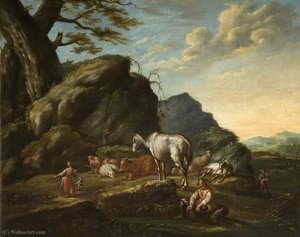
In Piece of Livestock, Philipp Peter Roos organizes a pastoral scene through a close-up, ground-level perspective that establishes an immediate intimacy with the subjects. The composition is dominated by a large, seated cow positioned slightly to the right of the center. To the left, a smaller lamb or calf provides a sense of scale, while a woman interacts with a dog in the space behind the primary subject. This arrangement…

5
Resting Flock with Shepherds (1681) autorstwa Philipp Peter Roos

Resting Flock with Shepherds

1681 · Oil On Canvas · Bawarskie Państwowe Zbiory Malarstwa, Monachium

Resting Flock with Shepherds is an oil painting by the German Baroque artist Philipp Peter Roos. Created about 1681, this work captures a quiet moment within a rugged landscape. The composition focuses on a group of livestock and a shepherd, rendered with a sense of immediate presence that draws the viewer into the scene.

7
Liberation of Io (1681) autorstwa Philipp Peter Roos

Liberation of Io

1681 · Oil · Bawarskie Państwowe Zbiory Malarstwa, Monachium

In this Baroque-style oil painting, the mythological drama of the Liberation of Io unfolds with a sudden, heavy intensity. Created by Philipp Peter Roos about 1681, the scene captures a moment of profound tension between the divine and the mortal. A massive, powerful bull dominates the foreground, its muscular form rendered with a weight that feels almost tangible. This central figure looms over the landscape, its presence commanding the space…

8
Piece of Cattle (1681) autorstwa Philipp Peter Roos

Piece of Cattle

1681 · Oil On Canvas · Bawarskie Państwowe Zbiory Malarstwa, Monachium

This oil on canvas painting, dated 1681, presents a monochromatic scene rendered in various shades of gray. In the foreground, a young woman is positioned amidst a group of livestock, including sheep or goats. The composition is a medium shot, placing the human subject and the animals in the immediate front and middle ground. The terrain is undulating, forming rolling hills that recede into a background of hazy mountains and…

10
Shepherd with Cow, Sheep and Goats in Italian Mountain Landscape (1680) autorstwa Philipp Peter Roos

Shepherd with Cow, Sheep and Goats in Italian Mountain Landscape

1680 · Oil

The scene unfolds in Shepherd with Cow, Sheep and Goats in Italian Mountain Landscape, a work that captures a quiet moment of pastoral life. This painting, created about 1680, brings together a shepherd and his diverse herd amidst a rugged, mountainous setting. The figures and animals exist within a landscape that feels both immediate and deeply rooted in the natural world.

Kontynuacja zestawienia Philipp Peter Roos, od 11 do 92

11Goat Herd with a Goatherd (1680) autorstwa Philipp Peter RoosGoat Herd with a Goatherd1680 · Słowacka Galeria Narodowa w Bratysławie 12The Herd (1698) autorstwa Philipp Peter RoosThe Herd1698 · Yekaterinburg Museum of Fine Arts 13Cattle Piece (1688) autorstwa Philipp Peter RoosCattle Piece1688 · Statens Museum for Kunst 14Landscape with a Bull, Sheep and Goats (1688) autorstwa Philipp Peter RoosLandscape with a Bull, Sheep and Goats1688 · Statens Museum for Kunst 15A Shepherd with his Herd (1688) autorstwa Philipp Peter RoosA Shepherd with his Herd1688 · Statens Museum for Kunst 16Goats and Sheep (1690) autorstwa Philipp Peter RoosGoats and Sheep1690 · Muzeum Narodowe w Krakowie 17Goats and Sheep (1690) autorstwa Philipp Peter RoosGoats and Sheep1690 · Muzeum Narodowe w Krakowie 18Shepherd's Idyl in a Romantic Landscape with Ruins (1700) autorstwa Philipp Peter RoosShepherd's Idyl in a Romantic Landscape with Ruins1700 · Słowacka Galeria Narodowa w Bratysławie 19Herd by an Ancient Well (1700) autorstwa Philipp Peter RoosHerd by an Ancient Well1700 · Słowacka Galeria Narodowa w Bratysławie 20Shepherd Couple and Small Livestock in Italian Landscape (1710) autorstwa Philipp Peter RoosShepherd Couple and Small Livestock in Italian Landscape1710 · Bawarskie Państwowe Zbiory Malarstwa 21Orpheus and the animals (1700) autorstwa Philipp Peter RoosOrpheus and the animals1700 · Gemäldegalerie 22Shepherd and sheeps (1700) autorstwa Philipp Peter RoosShepherd and sheeps1700 · Musée d'art et d'histoire de Narbonne 23Various animals gathered before Noah's Ark (1669) autorstwa Philipp Peter RoosVarious animals gathered before Noah's Ark1669 · Museo del Prado 24A Military Encampment (1655) autorstwa Philipp Peter RoosA Military Encampment1655 · Detroit Institute of Arts 25Landscape with Cattle, Goats and Figures autorstwa Philipp Peter RoosLandscape with Cattle, Goats and Figures 26Caravan at the Fountain (1681) autorstwa Philipp Peter RoosCaravan at the Fountain1681 · Bawarskie Państwowe Zbiory Malarstwa 27Shepherd Scene (1680) autorstwa Philipp Peter RoosShepherd Scene1680 · Bratislava City Gallery 28Herdestück (1681) autorstwa Philipp Peter RoosHerdestück1681 · Bawarskie Państwowe Zbiory Malarstwa 29Piece of Cattle (1681) autorstwa Philipp Peter RoosPiece of Cattle1681 · Bawarskie Państwowe Zbiory Malarstwa 30Herdestück (1681) autorstwa Philipp Peter RoosHerdestück1681 · Bawarskie Państwowe Zbiory Malarstwa 31The Animals Leave the Ark of Noah (1680) autorstwa Philipp Peter RoosThe Animals Leave the Ark of Noah1680 32Bolognese Dog (1688) autorstwa Philipp Peter RoosBolognese Dog1688 · Statens Museum for Kunst 33The Rest after the Hunt (1695) autorstwa Philipp Peter RoosThe Rest after the Hunt1695 34Ravine with a Stream, a Shepherd and His Herd autorstwa Philipp Peter RoosRavine with a Stream, a Shepherd and His HerdNational Gallery Prague 35Herd with Sleeping Shepherds autorstwa Philipp Peter RoosHerd with Sleeping ShepherdsKunsthistorisches Museum 36Landscape with a Grotto (1690) autorstwa Philipp Peter RoosLandscape with a Grotto1690 · Ermitaż 37Shepherd with Goat Herd, Horse and Two Dogs autorstwa Philipp Peter RoosShepherd with Goat Herd, Horse and Two DogsBawarskie Państwowe Zbiory Malarstwa 38Landscape with Cattle autorstwa Philipp Peter RoosLandscape with CattleNational Gallery of Ireland 39Landscape with shepherd and animals autorstwa Philipp Peter RoosLandscape with shepherd and animalsNational Museum of Fine Arts 40Landscape with figures and animals autorstwa Philipp Peter RoosLandscape with figures and animalsNational Museum of Fine Arts 41Shepherd and animals in a landscape autorstwa Philipp Peter RoosShepherd and animals in a landscapeNational Museum of Fine Arts 42Shepherd and animals in a landscape autorstwa Philipp Peter RoosShepherd and animals in a landscapeNational Museum of Fine Arts 43Landscape with Goatherd and Goats autorstwa Philipp Peter RoosLandscape with Goatherd and GoatsMuseum of Fine Arts 44Horse and Goats Grazing autorstwa Philipp Peter RoosHorse and Goats GrazingNational Gallery Prague 45Shepherd with a Herd of Sheep and Goats autorstwa Philipp Peter RoosShepherd with a Herd of Sheep and GoatsNational Gallery Prague 46Landscape autorstwa Philipp Peter RoosLandscape 47A Landscape with a Milkmaid autorstwa Philipp Peter RoosA Landscape with a Milkmaid 48Rider Meeting autorstwa Philipp Peter RoosRider MeetingKunsthistorisches Museum 49Pigeons autorstwa Philipp Peter RoosPigeonsStatens Museum for Kunst 50Landscape with a Waterfall autorstwa Philipp Peter RoosLandscape with a WaterfallErmitaż 51Dead Hare autorstwa Philipp Peter RoosDead HareNationalmuseum 52Landscape with Flock of Sheep autorstwa Philipp Peter RoosLandscape with Flock of SheepKunsthistorisches Museum 53Sheep and Goat in a Rocky Landscape, autorstwa Philipp Peter RoosSheep and Goat in a Rocky Landscape,Städel Museum 54Landskap med hjord autorstwa Philipp Peter RoosLandskap med hjordNationalmuseum 55A Goat Resting autorstwa Philipp Peter RoosA Goat RestingNationalmuseum 56Grasing sheeps autorstwa Philipp Peter RoosGrasing sheeps 57Landscape with Sheep autorstwa Philipp Peter RoosLandscape with SheepHarvard Art Museums 58Rams with ruins in the background autorstwa Philipp Peter RoosRams with ruins in the backgroundMuzeum Narodowe w Warszawie 59Herd in the mountains autorstwa Philipp Peter RoosHerd in the mountainsMuzeum Narodowe w Warszawie 60Cattle at the waterfall autorstwa Philipp Peter RoosCattle at the waterfallMuzeum Narodowe w Warszawie 61Birds in a Landscape autorstwa Philipp Peter RoosBirds in a Landscape 62Landscape with Shepherd Boy and Sheep autorstwa Philipp Peter RoosLandscape with Shepherd Boy and Sheep 63The stag hunt autorstwa Philipp Peter RoosThe stag hunt 64Horse and Goats autorstwa Philipp Peter RoosHorse and Goats 65Landscape with Shepherd, Sheep and Dog autorstwa Philipp Peter RoosLandscape with Shepherd, Sheep and Dog 66Landscape with Bull, Goats and Attendant autorstwa Philipp Peter RoosLandscape with Bull, Goats and Attendant 67Sheep and Landscape autorstwa Philipp Peter RoosSheep and Landscape 68Cattle and Sheep autorstwa Philipp Peter RoosCattle and Sheep 69A Goatherd and His Flock autorstwa Philipp Peter RoosA Goatherd and His FlockCalke Abbey 70Landscape with Sheep autorstwa Philipp Peter RoosLandscape with Sheep 71The Shepherd and His Horse autorstwa Philipp Peter RoosThe Shepherd and His Horse 72Pastoral landscape autorstwa Philipp Peter RoosPastoral landscape 73Shepherd with Dog, Goats and Sheep autorstwa Philipp Peter RoosShepherd with Dog, Goats and Sheep 74Cattle in an Italian Landscape autorstwa Philipp Peter RoosCattle in an Italian Landscape 75Landscape with Cattle autorstwa Philipp Peter RoosLandscape with Cattle 76A waterfall autorstwa Philipp Peter RoosA waterfall 77A Shepherd Boy with Sheep, Goats and Cattle autorstwa Philipp Peter RoosA Shepherd Boy with Sheep, Goats and CattleBelton House 78Goatherd and Goats autorstwa Philipp Peter RoosGoatherd and Goats 79Sheep autorstwa Philipp Peter RoosSheep 80Hounds Attacking a Bull autorstwa Philipp Peter RoosHounds Attacking a Bull 81Herdsman Sleeping Amidst His Sheep, Goats and Cattle autorstwa Philipp Peter RoosHerdsman Sleeping Amidst His Sheep, Goats and Cattle 82Goats autorstwa Philipp Peter RoosGoats 83Farm Animals in a Landscape with an Old Man Drinking autorstwa Philipp Peter RoosFarm Animals in a Landscape with an Old Man Drinking 84Herdsman with Sheep and Goats autorstwa Philipp Peter RoosHerdsman with Sheep and GoatsNostell Priory 85Landscape with Goats and Cattle autorstwa Philipp Peter RoosLandscape with Goats and Cattle 86A Shepherd and His Flock in a Landscape autorstwa Philipp Peter RoosA Shepherd and His Flock in a LandscapeNostell Priory 87Study of Goats autorstwa Philipp Peter RoosStudy of Goats 88Studies in Human and Animal Anatomy autorstwa Philipp Peter RoosStudies in Human and Animal Anatomy 89Italianate Landscape with a Goat and Sheep autorstwa Philipp Peter RoosItalianate Landscape with a Goat and Sheep 90A Goat, Sheep and a Dog Resting in a Landscape autorstwa Philipp Peter RoosA Goat, Sheep and a Dog Resting in a Landscape 91Landscape with a Herd autorstwa Philipp Peter RoosLandscape with a HerdErmitaż 92Krowy i kozy pijące w strumieniu autorstwa Philipp Peter RoosKrowy i kozy pijące w strumieniuFondazione Brescia Musei

Tematy, które przyciągnęły wzrok Philipp Peter Roos

Cztery motywy najczęściej powracające w tych oryginałach, z których każdy doczekał się swojego najdoskonalszego przykładu.

Muzea przechowujące oryginały Philipp Peter Roos

8 muzeów, w których znajduje się najwięcej obrazów z tej strony.

Muzea Miasto Dzieła artysty Philipp Peter Roos Obrazy z tej listy
Bawarskie Państwowe Zbiory Malarstwa, MonachiumBawarskie Państwowe Zbiory Malarstwa Monachium 15 Goats and Flock of Sheep, Piece of Livestock, Landscape with Cattle and Shepherd
Statens Museum for Kunst, KopenhagaStatens Museum for Kunst Kopenhaga 5 Cattle Piece, Landscape with a Bull, Sheep and Goats, A Shepherd with his Herd
National Museum of Fine Arts, Buenos AiresNational Museum of Fine Arts Buenos Aires 4 Landscape with shepherd and animals, Landscape with figures and animals, Shepherd and animals in a landscape
Słowacka Galeria Narodowa w Bratysławie, BratysławaSłowacka Galeria Narodowa w Bratysławie Bratysława 3 Goat Herd with a Goatherd, Shepherd's Idyl in a Romantic Landscape with Ruins, Herd by an Ancient Well
National Gallery Prague, PragaNational Gallery Prague Praga 3 Ravine with a Stream, a Shepherd and His Herd, Horse and Goats Grazing, Shepherd with a Herd of Sheep and Goats
Kunsthistorisches Museum, WiedeńKunsthistorisches Museum Wiedeń 3 Herd with Sleeping Shepherds, Rider Meeting, Landscape with Flock of Sheep
Ermitaż, Sankt PetersburgErmitaż Sankt Petersburg 3 Landscape with a Grotto, Landscape with a Waterfall, Landscape with a Herd
Nationalmuseum, StockholmNationalmuseum Stockholm 3 Dead Hare, Landskap med hjord, A Goat Resting

Philipp Peter Roos dekada po dekadzie: oryginały definiujące każdy okres

Dzieła według dekad

Wybierz dekadę, aby zobaczyć dzieło, które ją definiuje.

Pytania kolekcjonerów o obrazy Philipp Peter Roos

Z jakiego dzieła najbardziej znany jest Philipp Peter Roos?Odkryj odpowiedź

Goats and Flock of Sheep (1681), Bawarskie Państwowe Zbiory Malarstwa, Monachium. Następne są Piece of Livestock (1681) oraz Landscape with Cattle and Shepherd (1681).

W jakim wieku był Philipp Peter Roos, gdy powstało Goats and Flock of Sheep?Odkryj odpowiedź

24 lat: Goats and Flock of Sheep pochodzi z 1681, a Philipp Peter Roos urodził(a) się w 1657.

Jakie są dziesięć najsłynniejszych obrazów, których autorem jest Philipp Peter Roos?Odkryj odpowiedź

Goats and Flock of Sheep, Piece of Livestock, Landscape with Cattle and Shepherd, Piece of Livestock, Resting Flock with Shepherds, Resting Flock with Shepherds, Liberation of Io, Piece of Cattle, Returning Flock with Shepherds i Shepherd with Cow, Sheep and Goats in Italian Mountain Landscape. Powyższy ranking zawiera rok powstania oraz muzeum dla każdego z nich.

Ile obrazów pozostawił po sobie Philipp Peter Roos?Odkryj odpowiedź

Nasz katalog zawiera 93 dzieł artysty Philipp Peter Roos, datowanych od 1669 do 1700.

W których muzeach znajdują się arcydzieła Philipp Peter Roos?Odkryj odpowiedź

W większości znajdują się w Bawarskie Państwowe Zbiory Malarstwa (Monachium), Statens Museum for Kunst (Kopenhaga) i National Museum of Fine Arts (Buenos Aires). Powyższa tabela muzeów zawiera ich pełną listę.

W których latach Philipp Peter Roos namalował swoje najsłynniejsze dzieła?Odkryj odpowiedź

W 1680s: 21 z 92 dzieł na tej stronie powstało w tym czasie, w tym Goats and Flock of Sheep.

Jakie są pierwsze i ostatnie słynne oryginały Philipp Peter Roos?Odkryj odpowiedź

Na tej stronie najwcześniejszy to Various animals gathered before Noah's Ark (1669), a najpóźniejszy Shepherd's Idyl in a Romantic Landscape with Ruins (1700).

Jakie tematy Philipp Peter Roos wybierał najczęściej?Odkryj odpowiedź

Landscape (33), Animals (29) i Goats (19), w ramach 92 dzieł na tej stronie.

Której techniki Philipp Peter Roos używał najczęściej?Odkryj odpowiedź

Oil On Canvas, dla 18 z 92 dzieł na tej stronie.

Do jakiego nurtu artystycznego należy Philipp Peter Roos?Odkryj odpowiedź

Baroque, sądząc po oryginałach na tej stronie.

Które dzieła Philipp Peter Roos znajdują się w Bawarskie Państwowe Zbiory Malarstwa?Odkryj odpowiedź

Goats and Flock of Sheep, Piece of Livestock i Landscape with Cattle and Shepherd: Bawarskie Państwowe Zbiory Malarstwa, Monachium posiada 15 dzieł widocznych na tej stronie.

Philipp Peter Roos: życie i twórczość

Pasterz z Tivoli: Życie i dziedzictwo Philippa Petera Roosa

W złotym świetle włoskiego baroku niewiele nazwisk przywołuje pastoralny spokój wsi tak silnie, jak Philipp Peter Roos. Znany historii pod sugestywnym przydomkiem, Rosa di Tivoli, ten urodzony w Niemczech mistrz przekształcił gatunek pejzażu poprzez głęboką, niemal instynktowną więź ze światem natury. Urodzony w 1655 roku w Nadrenii – konkretnie w pobliżu Sankt Goar – Roos od najmłodszych lat był przeznaczony dla pędzla. Był synem Johann Heinricha Roosa, szanowanego malarza pejzażowego, który przekazał mu fundamenty harmonii tonalnej i kompozycyjnej równowagi, które później zdefiniowały dojrzały styl artysty. Ta wczesna nauka nie dotyczyła jedynie techniki; była to imersja w sposób postrzegania świata przez pryzmat światła, cienia i cichej godności ziemi.

Trajektoria życia Roosa zmieniła się dramatycznie w 1677 roku, co było wynikiem szczodrości Karola I, lennika Hesji-Kassel. Dostrzegając rozkwitający talent młodego malarza, lennik zapewnił środki finansowe, które pozwoliły Roosowi wyruszyć w transformacyjną podróż do Rzymu. Ta migracja z tradycji germańskich do serca włoskiego baroku pozwoliła Roosowi chłonąć witalną energię rzymskiej sztuki. To właśnie tutaj szukał mentora u słynnego Giacinto Brandiego, którego wpływ pomógł udoskonalić zdolność Roosa do łączenia klasycznej struktury z bardziej spontanicznym, atmosferycznym realizmem. Ten okres w Rzymie był również głęboko osobisty; to właśnie w tych latach Roos zakochał się w Isabellie Brandi, córce swojego mentora. Ich związek ostatecznie doprowadził go do osiedlenia się w Tivoli, co na zawsze związało jego tożsamość z krajobrazem, który tak kochał.

Żywe Studio: Artystyczna natura świata

To, co naprawdę wyróżnia dzieło Rosa di Tivoli, to nieporównywana autentyczność jego zwierzęcych tematów. W przeciwieństwie do wielu współczesnych mu artystów, którzy traktowali zwierzęta jedynie jako dekoracyjne dodatki w pejzażu, Roos podchodził do każdego stworzenia – od potężnego byka po zwinna kozę – z nabożnością portrecisty. Jego rezydencja w Tivoli słynęła z koncepcji przypominającej żywe studio; utrzymywał on rozległą kolekcję egzotycznych i domowych zwierząt, skutecznie zamieniając swoje otoczenie w nieustanne studium ruchu, anatomii i temperamentu. Ta intymna bliskość pozwalała mu uchwycić subtelne drgnięcie ucha czy napięcie mięśniowe zwierzęcia w trudnych chwilach, nadając jego płótnom zapierającą dech w piersiach witalność.

Jego techniczne mistrzostwo jest widoczne w sposobie, w jaki poruszał się w zawiłościach estetyki baroku. Choć jego kompozycje często czerpią z pełnych spokoju i atmosferyczności cech Złotego Wieku Holandii, są one przesycone dramatycznym intensywnością charakterystyczną dla szkoły włoskiej. Jego prace często ukazują:

  • Pastoralny spokój: Idylliczne sceny, w których pasterze i inwentarz żyją w stanie ponadczasowej, cichej harmonii.
  • Dramatyczne działanie: Rzadkie, lecz uderzające momenty napięcia, takie jak przedstawienia ogarów atakujących zdobycz, które ukazują jego zdolność do oddawania surowego, naturalistycznego konfliktu.
  • Mistrzostwo tonalne: Wyrafinowane wykorzystanie stonowanych, ziemistych palet, które osadzają jego pejzaże w poczuciu głębokiego realizmu i atmosferycznej głębi.

Znaczenie historyczne i duch baroku

Historyczne znaczenie Philippa Petera Roosa tkwi w jego zdolności do wypełnienia luki między ustrukturyzowanymi tradycjami pejzażu Europy Północnej a emocjonalnym, pełnym światła dramatem Italii. Pojawił się w czasach, gdy ówczesne dociekania naukowe zaczęły wymagać bardziej precyzyjnych obserwacji świata przyrody, nawet gdy tematy religijne i mitologiczne wciąż dominowały w świadomości artystycznej. W jego malarstwie odnajdujemy zarówno skrupulatność detalu naturalisty, jak i poetycką duszę romantyka. Dokumentując florę i faunę rzymskiej prowincji z taką oddaniem, stworzył zapis wizualny, który mówi tyle samo o duchu epoki, co o samych podmiotach przedstawień.

Choć odszedł w 1706 roku, pozostawiając po sobie dziedzictwo wyryte w samej ziemi Tivoli, jego wpływ przetrwał. Pozostaje kluczową postacią dla każdego, kto studiuje ewolucję malarstwa animalistycznego oraz rozwój pejzażu w stylu włoskim. Przez jego oczy nie widzimy jedynie zbioru zwierząt hodowlanych; jesteśmy świadkami głębokiego święta życia w jego najbardziej fundamentalnych, nieozdobionych formach. Jego twórczość wciąż rezonuje jako świadectwo potęgi obserwacji i nieprzemijającego piękna pastoralnego ideału.