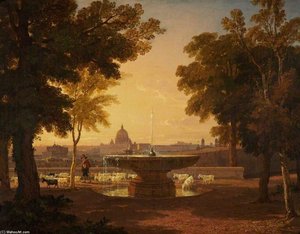
Portret Penry Williams

81 najsłynniejszych obrazów artysty Penry Williams – wybór z galerii

Aktualizacja: Listopad 2026 · ranking według naszego wskaźnika popularności (liczba wyszukiwań, wizyt i zamówień dla każdego dzieła) · 84 dzieł Penry Williams w naszym katalogu

W skrócie

Z wszystkich oryginałów pozostawionych przez Penry Williams, najsłynniejszym jest Mediterranean Bay Seen Through An Arch. Tuż za nimi znajdują się Painting of a young boy riding a pony (1829) oraz A ferry on the Ninfa, Sermoneta in the distance - a scene in the Pontine marshes, near Rome (1838). Nasz katalog zawiera 84 dzieł autorstwa Penry Williams; galeria zachowała 81 najbardziej podziwianych na świecie prac, z których każda została przedstawiona wraz z datą powstania, informacją o muzeum oraz jej historią.

1802 – 1885, Merthyr Tudful Romanticism Najwięcej dzieł: National Museum Cardiff

10 najlepszych obrazów artysty Penry Williams: wybór galerii

1
Mediterranean Bay Seen Through An Arch autorstwa Penry Williams

Mediterranean Bay Seen Through An Arch

A heavy stone archway anchors the foreground, its surface textured by time and draped in thick, green ivy. This masonry acts as a threshold, separating the viewer from the expanse of the Mediterranean Sea. Through this opening, the water stretches toward a distant horizon in shifting shades of blue. Small sailboats drift upon the surface, their white shapes punctuating the deep azure. The sunlight hits the stone and the leaves…

2
Painting of a young boy riding a pony (1829) autorstwa Penry Williams

Painting of a young boy riding a pony

1829 · Watercolor

There is a certain stillness in this 1829 watercolor that feels almost private, as if we have stumbled upon a fleeting moment of childhood caught in the soft light of an overcast afternoon. A young boy sits atop a pony, his small frame balanced with a natural ease that suggests he is quite at home in this pastoral setting. The pony, rendered in deep shades of brown and black, appears…

3
A ferry on the Ninfa, Sermoneta in the distance - a scene in the Pontine marshes, near Rome (1838) autorstwa Penry Williams

A ferry on the Ninfa, Sermoneta in the distance - a scene in the Pontine marshes, near Rome

1838 · Oil On Canvas

The composition centers on a wooden raft navigating the calm waters of the River Ninfa. In the foreground, a group of figures occupies the vessel, their presence grounding the scene in the daily realities of 19th-century rural transport. A man’s pole creates a strong diagonal line, guiding the eye across the water toward the receding shoreline. The landscape unfolds in layers, moving from the immediate ripples of the river to…

4
A peasant family by a fountain in an Italian landscape (1862) autorstwa Penry Williams

A peasant family by a fountain in an Italian landscape

1862 · Oil On Canvas

A peasant family by a fountain in an Italian landscape emerges from the brush of Penry Williams, a painter who found his true home amidst the light of the Mediterranean. Born in Merthyr Tydfil, United Kingdom, in 1802, Williams eventually leaves his Welsh roots behind to settle in the heart of Italy. This specific scene, captured about 1862, finds its soul in the quiet rhythms of rural life. The work…

5
Italian peasants in a landscape near lake Nemi (1860) autorstwa Penry Williams

Italian peasants in a landscape near lake Nemi

1860 · Oil On Canvas

The oil on canvas captures a specific moment of midday clarity. The light is natural and direct, casting shadows that define the contours of the path and the figures. There is a sense of heat in the colors—the greens of the leaves and the warm tones of the soil suggest a sun-drenched afternoon. The sky is filled with clouds that possess a visible, textured quality, rendered with brushstrokes that suggest…

6
Fisher Boys autorstwa Penry Williams

Fisher Boys

Two figures occupy a serene shoreline, their presence anchored by a dark-hulled boat resting upon the sand. To the left, a figure in a white shirt and dark trousers stands in quiet contemplation, while beside them, a companion wears a red hat and light-colored attire typical of traditional maritime life. A single large oar leans against the vessel, a silent indicator of recent labor or the anticipation of departure. The…

7
Waterfall In The Neath Valley autorstwa Penry Williams

Waterfall In The Neath Valley

Painting

Waterfall In The Neath Valley is a painting by Penry Williams. The artist, born in 1802 in Merthyr Tydfil, was the son of a house-painter. Although his origins are in Wales, Williams spent much of his life in Rome. His background in the United Kingdom provided the foundation for a career that eventually centered in Italy.

8
Ysgwd or Scwd Fall, Neath Valley (1819) autorstwa Penry Williams

Ysgwd or Scwd Fall, Neath Valley

1819

Ysgwd or Scwd Fall, Neath Valley is a painting by Penry Williams. The work is a landscape study of a specific natural feature within the Neath Valley. This piece belongs to a body of work where the artist returned to the landscapes of his native Wales. The painting dates to about 1819.

9
Sgwd yr Henryd, Vale of Neath (1819) autorstwa Penry Williams

Sgwd yr Henryd, Vale of Neath

1819 · Oil On Board · National Museum Cardiff, Cardiff

The rushing waters of Sgwd yr Henryd, Vale of Neath find their expression through the hand of Penry Williams. Created in 1819, this work captures a specific moment of natural movement within the Welsh landscape. The artist, Penry Williams, brings a sense of life to the scene, perhaps drawing from the very air and light of the valley itself.

10
Sgwd Gwladys, Vale of Neath (1819) autorstwa Penry Williams

Sgwd Gwladys, Vale of Neath

1819 · National Museum Cardiff, Cardiff

Sgwd Gwladys, Vale of Neath is a landscape study by Penry Williams. The artist, born in 1802 in Merthyr Tydfil, United Kingdom, turned his gaze back toward the rugged terrain of his native Wales. This specific work captures a natural feature within the Neath Valley, focusing on the movement of water and the weight of the surrounding earth. It was painted about 1819.

Kontynuacja zestawienia Penry Williams, od 11 do 81

11Scene In The Roman Campagna autorstwa Penry WilliamsScene In The Roman Campagna 12The Visitation autorstwa Penry WilliamsThe Visitation 13Italian Peasant Children autorstwa Penry WilliamsItalian Peasant Children 14A Passiontide Procession autorstwa Penry WilliamsA Passiontide Procession 15The Vision Of Saint Bruno autorstwa Penry WilliamsThe Vision Of Saint BrunoMuseo del Prado 16The Temple Of Vesta, Rome autorstwa Penry WilliamsThe Temple Of Vesta, Rome 17Tivoli autorstwa Penry WilliamsTivoli 18By The Well autorstwa Penry WilliamsBy The Well 19An Italian Girl With A Tambourain On A Terrace autorstwa Penry WilliamsAn Italian Girl With A Tambourain On A Terrace 20The Shrine - autorstwa Penry WilliamsThe Shrine - 21Labourers autorstwa Penry WilliamsLabourers 22Mother and Child autorstwa Penry WilliamsMother and Child 23Porth Yr Ogof autorstwa Penry WilliamsPorth Yr Ogof 24Swansea autorstwa Penry WilliamsSwansea 25Roman Aqueduct In The Campana autorstwa Penry WilliamsRoman Aqueduct In The Campana 26Pozzuoli autorstwa Penry WilliamsPozzuoli 27Italian Peasants - autorstwa Penry WilliamsItalian Peasants - 28The Feast In The House Of Levi autorstwa Penry WilliamsThe Feast In The House Of Levi 29Gwaelod Y Garth autorstwa Penry WilliamsGwaelod Y Garth 30Santa Maria Maggiore Seen From The Gardens autorstwa Penry WilliamsSanta Maria Maggiore Seen From The Gardens 31Two Girls With A Tambourine autorstwa Penry WilliamsTwo Girls With A Tambourine 32The Ferry autorstwa Penry WilliamsThe Ferry 33South Wales Industrial Landscape autorstwa Penry WilliamsSouth Wales Industrial LandscapeNational Library of Wales 34Mass For The Reapers autorstwa Penry WilliamsMass For The Reapers 35Helping Out A Friend On The Road autorstwa Penry WilliamsHelping Out A Friend On The Road 36The Tiber With The Temple Of Vesta, Santa Maria autorstwa Penry WilliamsThe Tiber With The Temple Of Vesta, Santa Maria 37Landscape With Figures And A Ruin autorstwa Penry WilliamsLandscape With Figures And A Ruin 38An Ischian Peasant Study autorstwa Penry WilliamsAn Ischian Peasant Study 39The Temple of Vesta autorstwa Penry WilliamsThe Temple of Vesta 40A Goatherd on the Romas Campagna autorstwa Penry WilliamsA Goatherd on the Romas CampagnaMusée national des beaux-arts du Québec 41Two Saints autorstwa Penry WilliamsTwo Saints 42Merthyr Riots autorstwa Penry WilliamsMerthyr Riots 43The Temple Of Vesta, The Piazza Di Bocca Di Verita autorstwa Penry WilliamsThe Temple Of Vesta, The Piazza Di Bocca Di Verita 44Porth-yr-ogof, Brecknockshire autorstwa Penry WilliamsPorth-yr-ogof, Brecknockshire 45A Goatherd On The Roman Campagna autorstwa Penry WilliamsA Goatherd On The Roman Campagna 46Crawshay's Cyfarthfa Ironworks autorstwa Penry WilliamsCrawshay's Cyfarthfa Ironworks 47The Festa Of The Madonna Dell'arco At Naples autorstwa Penry WilliamsThe Festa Of The Madonna Dell'arco At Naples 48Field Marshal General Suwarrow autorstwa Penry WilliamsField Marshal General Suwarrow 49The Procession To The Christening autorstwa Penry WilliamsThe Procession To The Christening 50Bridge Over The River Taff autorstwa Penry WilliamsBridge Over The River Taff 51The Italian Family - Ferry On The River Ninfa autorstwa Penry WilliamsThe Italian Family - Ferry On The River Ninfa 52The Assumption Of The Virgin autorstwa Penry WilliamsThe Assumption Of The Virgin 53At The Well autorstwa Penry WilliamsAt The Well 54The Tambourine autorstwa Penry WilliamsThe Tambourine 55Repose autorstwa Penry WilliamsRepose 56Massacre Of The Innocents autorstwa Penry WilliamsMassacre Of The Innocents 57Cyfarthfa Castle autorstwa Penry WilliamsCyfarthfa Castle 58Saint John autorstwa Penry WilliamsSaint John 59Cyfarthfa Ironworks Interior At Night autorstwa Penry WilliamsCyfarthfa Ironworks Interior At Night 60Two Roman ladies and their children autorstwa Penry WilliamsTwo Roman ladies and their children 61Italian Goatherds autorstwa Penry WilliamsItalian Goatherds 62Merthyr Riots - autorstwa Penry WilliamsMerthyr Riots - 63Ha! Ha! I've Got The Chink autorstwa Penry WilliamsHa! Ha! I've Got The Chink 64Neapolitan Peasants At A Fountain - autorstwa Penry WilliamsNeapolitan Peasants At A Fountain - 65Sgwd Yr Eira, Vale Of Neath autorstwa Penry WilliamsSgwd Yr Eira, Vale Of Neath 66An Autumn Festival autorstwa Penry WilliamsAn Autumn Festival 67Peasant Girls – Sorrento autorstwa Penry WilliamsPeasant Girls – Sorrento 68Pilgrims Reposing At A Cross autorstwa Penry WilliamsPilgrims Reposing At A Cross 69Sgwd Gwladys, Vale Of Neath autorstwa Penry WilliamsSgwd Gwladys, Vale Of Neath 70Subiaco autorstwa Penry WilliamsSubiaco 71Procession To The Christening Near Araccia autorstwa Penry WilliamsProcession To The Christening Near Araccia 72The Shrine autorstwa Penry WilliamsThe Shrine 73A Mother And Child Beneath An Arbour At Evening autorstwa Penry WilliamsA Mother And Child Beneath An Arbour At Evening 74Upper Clyngwyn Fall Or Hendrebolon Fall, Neath Valley autorstwa Penry WilliamsUpper Clyngwyn Fall Or Hendrebolon Fall, Neath Valley 75The Shrine - autorstwa Penry WilliamsThe Shrine - 76The Grape Pickers; And Figures In An Extensive Landscape autorstwa Penry WilliamsThe Grape Pickers; And Figures In An Extensive Landscape 77A Distant View Of Saint Peter's, Rome autorstwa Penry WilliamsA Distant View Of Saint Peter's, Rome 78Eionon Garn On The Perddyn Or Ysgwd Or Scwd Fall, Neath Valley autorstwa Penry WilliamsEionon Garn On The Perddyn Or Ysgwd Or Scwd Fall, Neath Valley 79Spanish Lady autorstwa Penry WilliamsSpanish LadyBawarskie Państwowe Zbiory Malarstwa 80Italian Girl With Tambourine autorstwa Penry WilliamsItalian Girl With Tambourine 81Italian Peasants autorstwa Penry WilliamsItalian Peasants

Słynne obrazy Penry Williams epoka po epoce

Tematy, które przyciągnęły wzrok Penry Williams

Cztery motywy najczęściej powracające w tych oryginałach, z których każdy doczekał się swojego najdoskonalszego przykładu.

Muzea przechowujące oryginały Penry Williams

5 muzeów, w których znajduje się najwięcej obrazów z tej strony.

Muzea Miasto Dzieła artysty Penry Williams Obrazy z tej listy
National Museum Cardiff, CardiffNational Museum Cardiff Cardiff 2 Sgwd yr Henryd, Vale of Neath, Sgwd Gwladys, Vale of Neath
Museo del Prado, MadrytMuseo del Prado Madryt 1 The Vision Of Saint Bruno
National Library of Wales, AberystwythNational Library of Wales Aberystwyth 1 South Wales Industrial Landscape
Musée national des beaux-arts du Québec, Quebec CityMusée national des beaux-arts du Québec Quebec City 1 A Goatherd on the Romas Campagna
Bawarskie Państwowe Zbiory Malarstwa, MonachiumBawarskie Państwowe Zbiory Malarstwa Monachium 1 Spanish Lady

Penry Williams dekada po dekadzie: oryginały definiujące każdy okres

Dzieła według dekad

Wybierz dekadę, aby zobaczyć dzieło, które ją definiuje.

Pytania kolekcjonerów o obrazy Penry Williams

Z jakiego dzieła najbardziej znany jest Penry Williams?Odkryj odpowiedź

Mediterranean Bay Seen Through An Arch. Następne są Painting of a young boy riding a pony (1829) oraz A ferry on the Ninfa, Sermoneta in the distance - a scene in the Pontine marshes, near Rome (1838).

Jakie są dziesięć najsłynniejszych obrazów, których autorem jest Penry Williams?Odkryj odpowiedź

Mediterranean Bay Seen Through An Arch, Painting of a young boy riding a pony, A ferry on the Ninfa, Sermoneta in the distance - a scene in the Pontine marshes, near Rome, A peasant family by a fountain in an Italian landscape, Italian peasants in a landscape near lake Nemi, Fisher Boys, Waterfall In The Neath Valley, Ysgwd or Scwd Fall, Neath Valley, Sgwd yr Henryd, Vale of Neath i Sgwd Gwladys, Vale of Neath. Powyższy ranking zawiera rok powstania oraz muzeum dla każdego z nich.

Ile obrazów pozostawił po sobie Penry Williams?Odkryj odpowiedź

Nasz katalog zawiera 84 dzieł artysty Penry Williams, datowanych od 1819 do 1862.

W których muzeach znajdują się arcydzieła Penry Williams?Odkryj odpowiedź

W większości znajdują się w National Museum Cardiff (Cardiff), Museo del Prado (Madryt) i National Library of Wales (Aberystwyth). Powyższa tabela muzeów zawiera ich pełną listę.

W których latach Penry Williams namalował swoje najsłynniejsze dzieła?Odkryj odpowiedź

W 1810s: 3 z 81 dzieł na tej stronie powstało w tym czasie, w tym Ysgwd or Scwd Fall, Neath Valley.

Jakie są pierwsze i ostatnie słynne oryginały Penry Williams?Odkryj odpowiedź

Na tej stronie najwcześniejszy to Ysgwd or Scwd Fall, Neath Valley (1819), a najpóźniejszy A peasant family by a fountain in an Italian landscape (1862).

Jakie tematy Penry Williams wybierał najczęściej?Odkryj odpowiedź

Landscape (8), Italy (7) i Trees (5), w ramach 81 dzieł na tej stronie.

Której techniki Penry Williams używał najczęściej?Odkryj odpowiedź

Oil On Canvas, dla 11 z 81 dzieł na tej stronie.

Do jakiego nurtu artystycznego należy Penry Williams?Odkryj odpowiedź

Romanticism, sądząc po oryginałach na tej stronie.

Które dzieła Penry Williams znajdują się w National Museum Cardiff?Odkryj odpowiedź

Sgwd yr Henryd, Vale of Neath i Sgwd Gwladys, Vale of Neath: National Museum Cardiff, Cardiff posiada 2 dzieł widocznych na tej stronie.

Penry Williams: życie i twórczość

Penry Williams: Rzymski Wizjoner

Penry Williams, nazwisko być może mniej znane niż nazwiska wielu jego współczesnych, jawi się jako postać niezwykle istotna dla brytyjskiej sztuki XIX wieku – a konkretnie dla tętniącego życiem i pełnego wpływów świata włoskiego malarstwa pejzażowego. Urodzony w 1802 roku w walijskim Merthym Tydfil, w rodzinie malarza domowego, Williams rozpoczął swoją artystyczną podróż od formalnej edukacji w Londynie, kształtowanej przez kontakt z Royal Academy oraz jej znamienitymi mistrzami, takimi jak Henry Fuseli. Jednak to przeprowadzka do Rzymu w 1827 roku w pełni zdefiniowała jego karierę i ugruntowała jego pozycję jako szanowanego artysty w kręgach angielskiej społeczności ekspatów przebywającej w Wiecznym Mieście. Co więcej, Williams nie był jedynie kronikarzem włoskich widoków; posiadał on niezwykłą zdolność chwytania nie tylko wizualnego piękna, ale także atmosfery i ducha rzymskiego życia, nasycając swoje dzieła realizmem łagodnie przełamanym romantyczną wrażliwością.

Wczesne szkolenie wyposażyło go w solidne fundamenty rysunku i kompozycji. Program nauczania Royal Academy zapewnił mu rygorystyczne podstawy zasad sztuki klasycznej, podczas gdy wpływ Fuseliego jest wyraźnie widoczny w początkowych portretach Williamsa – charakteryzujących się dramatycznym światłocieniem i ekspresyjną charakterystyką postaci. Srebrny medal, który zdobył w 1821 roku od Society of Arts za „rysunek z antyku”, był sygnałem jego rozkwitającego talentu i stanowił przełomowy moment w jego rozwoju artystycznym. Ten wczesny sukces utorował drogę do późniejszej eksploracji malarstwa pejzażowego, gatunku, który ostatecznie stał się jego znakiem rozpoznawczym.

Rzymska pracownia i rozwój artystyczny

Decyzja Williamsa o stałym osiedleniu się w Rzymie miała charakter transformacyjny. Miasto stało się nie tylko tematem jego płócien, ale także jego domem i pracownią. Jego rzymski warsztat szybko zyskał uznanie jako jedno z najpopularniejszych miejsc odwiedzanych przez angielskich turystط, oferując wgląd w życie i twórczość sukcesywnego artysty żyjącego na obczyźnie. To stabilne środowisko pozwoliło mu udoskonalić technikę i wypracować własny, charakterystyczny styl – taki, który łączył skrupulatną obserwację z lirycznym podejściem do koloru i światła.

W latach 30. i 40. XIX wieku Williams regularnie wystawiał swoje prace w Royal Academy, British Institution oraz Society of British Artists w Londynie. Choć jego tematyka w tym okresie obejmowała również portrety i sceny z Anglii, to właśnie włoskie pejzaże prawdziwie porywały publiczność. Z niezwykłą starannością studiował światło, barwę i atmosferę rzymskiej prowincji, tworząc obrazy będące jednocześnie realistycznymi i przesyconymi romantyzmem. Jego dzieła często przedstawiały życie codzienne – chłopów pracujących w polach, tętniące życiem place targowe czy spokojne brzegi rzek – oferując widzom intymny wgląd w rytm włoskiego społeczeństwa.

Kluczowe dzieła i styl artystyczny

Kilka obrazów Williamsa wyróżnia się jako szczególnie godne uwagi przykłady jego kunsztu i wizji. „Festa of the Madonna dell’ Arco” (rytowana przez D. Lucasa w 1830 roku) to pełna witalności przedstawienie procesji religijnej w Rzymie, uchwycona z niezwykłym detalem, oddającym energię i emocje towarzyszące wydarzeniu. „Ferry on the River Ninfa” ukazuje jego umiejętność oddania migotliwej powierzchni wody oraz bujnej roślinności otaczającego krajobraz. Z kolei „Il Voto, or the Convalescent” oferuje przejmujący portret chorego mężczyzny pod opieką w rzymskim ogrodzie, demonstrując wrażliwość artysty na ludzkie emocje.

Styl Williamsa można określić jako klasyczne malarstwo pejzażowe w duchu włoskim – trzymał się on ustalonych technik i konwencji gatunku. Posiadał jednak unikalną zdolność tchnięcia w swoje prace poczucia bezpośredniości i autentyczności. Jego obrazy nie są jedynie malowniczymi reprezentacjami Włoch; są one przesycone namacalną atmosferą – poczuciem ciepła, światła i ludzkiej więzi. Szczególnie godne uwagi było jego operowanie kolorem, w którym wykorzystywał bogatą paletę barw ziemistych i żywych odcieni, aby stworzyć wrażenie głębi i realizmu.

Dziedzictwo i uznanie

Penry Williams zmarł w Rzymie 27 lipca 1885 roku, pozostawiając po sobie bogaty dorobek, który do dziś jest ceniony za piękno i wartość artystyczną. Jego obrazy trafiły do zbiorów prestiżowych instytucji, takich jak National Gallery oraz Tate Gallery, co ugruntowało jego miejsce w historii brytyjskiej sztuki. Jego dziedzictwo wykracza jednak poza pojedyncze dzieła; pomógł on ustanowić tradycję angielskiego malarstwa pejzażowego we Włoszech, inspirując kolejne pokolenia artystów do odkrywania piękna i bogactwa włoskiej prowincji.

Dziś malarstwo Williamsa stanowi niezwykle cenne okno na życie w XIX wieku – zarówno w Anglii, jak i we Włoszech. Są one świadectwem jego umiejętności artystycznych, przenikliwej obserwacji oraz zdolności do uchwycenia esencji konkretnego miejsca i czasu. Jego twórczość pozostaje żywym przypomnieniem o nieprzemijającym uroku malarstwa pejzażowego i transformującej mocy sztuki.