Portret Marj Bond

12 najsłynniejszych obrazów artysty Marj Bond, każdy niepowtarzalny

Aktualizacja: Listopad 2026 · ranking według naszego wskaźnika popularności (liczba wyszukiwań, wizyt i zamówień dla każdego dzieła) · 12 dzieł Marj Bond w naszym katalogu

W skrócie

Eagle and Jaguar Warriors (Green Faces) (1993) to obraz autorstwa Marj Bond, który przyciąga najwięcej spojrzeń; oryginał znajduje się w Nhs Lothian, Edynburg. Następnie wzrok kieruje się na Votive Queen (1997) i Oasis (1997). Spośród 12 dzieł Marj Bond w naszym katalogu, tych 12 jest najbardziej znanych – każde z nich to unikatowy oryginał, przedstawiony wraz z rokiem powstania, muzeum oraz powodem, dla którego przetrwało próbę czasu.

urodzony 1939 Najwięcej dzieł: Nhs Lothian

10 najlepszych obrazów autorstwa Marj Bond według oka galerii

1
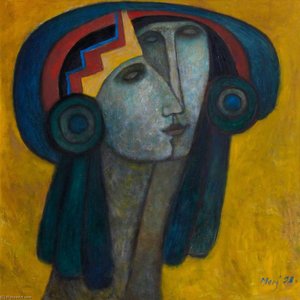
Eagle and Jaguar Warriors (Green Faces) (1993) autorstwa Marj Bond

Eagle and Jaguar Warriors (Green Faces)

1993 · Oil On Canvas · Nhs Lothian, Edynburg

A woman stares out from a field of intense yellow, her gaze steady and heavy with a quiet, internal gravity. She occupies the center of the frame, her form defined by bold, angular lines that carve her presence out of the space. Her features carry the weight of ancient lineages, framed by an elaborate headdress and large earrings that suggest a status far beyond the ordinary. The light falls evenly…

2
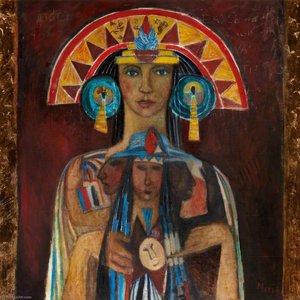
Votive Queen (1997) autorstwa Marj Bond

Votive Queen

1997 · Oil On Canvas

The artwork presents a stylized portrait of a woman, viewed from a frontal perspective. Her face is elongated, characterized by angular, geometric planes that define the nose, cheekbones, and jawline. A large, stylized archway frames the upper portion of the composition, enclosing the subject's head and upper torso. The background consists of a textured square featuring vertical stripes in varying shades of brown and beige. The figure is adorned with…

3
Oasis (1997) autorstwa Marj Bond

Oasis

1997 · Watercolor · Scottish National Gallery of Modern Art, Edynburg

In the vast, sun-drenched expanse of Oasis, created in 1997, the viewer is immediately transported into a realm where the boundaries between reality and dreamscape dissolve. Marj Bond, an artist renowned for her ability to weave together the tangible textures of landscape with the ethereal whispers of the inner spirit, presents us with a scene that transcends mere desert scenery. This large-scale masterpiece, measuring 106 x 106 cm, serves as…

Słynne obrazy artysty Marj Bond, od 11 do 12

Muzea przechowujące oryginały Marj Bond

2 muzeów, w których znajduje się najwięcej obrazów z tej strony.

Muzea Miasto Dzieła artysty Marj Bond Obrazy z tej listy
Nhs Lothian, EdynburgNhs Lothian Edynburg 7 Eagle and Jaguar Warriors (Green Faces), Eagle and Jaguar (Sun Goddess), Eagle and Jaguar
Scottish National Gallery of Modern Art, EdynburgScottish National Gallery of Modern Art Edynburg 1 Oasis

Twórczość Marj Bond na przestrzeni lat: unikalne oryginały każdego dzieła

W okresie od 1993 do 1997, co daje łącznie 5 lat, Marj Bond stworzył każdy z zaprezentowanych tutaj datowanych oryginałów: krótki czas, rok po roku.

Dzieła według lat

Wybierz rok, aby zobaczyć oryginały.

Obrazy artysty Marj Bond: pytania do galerii

Jakie jest najsłynniejsze dzieło artysty Marj Bond?Odkryj odpowiedź

Eagle and Jaguar Warriors (Green Faces) (1993), Nhs Lothian, Edynburg. Następne są Votive Queen (1997) oraz Oasis (1997).

W jakim wieku Marj Bond stworzył/a Eagle and Jaguar Warriors (Green Faces)?Odkryj odpowiedź

54 lat: Eagle and Jaguar Warriors (Green Faces) pochodzi z 1993, a Marj Bond urodził(a) się w 1939.

Które dziesięć obrazów Marj Bond jest najbardziej znanych?Odkryj odpowiedź

Eagle and Jaguar Warriors (Green Faces), Votive Queen, Oasis, Eagle and Jaguar (Sun Goddess), Eagle and Jaguar, Three Figures in a Landscape, Undulating Perthshire, Sun and Moon, Aztec Head i Eagle and Jaguar Warriors (Heart). Powyższy ranking zawiera rok powstania oraz muzeum dla każdego z nich.

Ile znanych dzieł stworzył Marj Bond?Odkryj odpowiedź

Nasz katalog zawiera 12 dzieł artysty Marj Bond, datowanych od 1993 do 1997.

Gdzie można zobaczyć najsłynniejsze oryginały Marj Bond?Odkryj odpowiedź

W większości znajdują się w Nhs Lothian (Edynburg) i Scottish National Gallery of Modern Art (Edynburg). Powyższa tabela muzeów zawiera ich pełną listę.

W jakim okresie Marj Bond stworzył/a swoje najsłynniejsze obrazy?Odkryj odpowiedź

W 1993: 3 z 12 dzieł na tej stronie powstało w tym czasie, w tym Eagle and Jaguar Warriors (Green Faces).

Który z najsłynniejszych obrazów artysty Marj Bond powstał najwcześniej, a który najpóźniej?Odkryj odpowiedź

Na tej stronie najwcześniejszy to Eagle and Jaguar Warriors (Green Faces) (1993), a najpóźniejszy Votive Queen (1997).

Jakich materiałów Marj Bond używał najczęściej?Odkryj odpowiedź

Oil On Canvas, dla 2 z 12 dzieł na tej stronie.

Jakie oryginały Marj Bond można zobaczyć w Nhs Lothian?Odkryj odpowiedź

Eagle and Jaguar Warriors (Green Faces), Eagle and Jaguar (Sun Goddess) i Eagle and Jaguar: Nhs Lothian, Edynburg posiada 7 dzieł widocznych na tej stronie.

Marj Bond: portret artysty

Marj Bond: A Weaver of Scottish Landscapes and Inner Worlds

Marjorie “Marj” Brasch, a name now synonymous with the vibrant heart of Scottish watercolour, wasn’t simply an artist; she was a conduit, channeling the raw beauty of her homeland – its rugged landscapes, ancient myths, and deeply felt spirituality – onto canvas. Born in Paisley, Scotland, in 1936, into a family steeped in music and tradition, Marj's artistic journey began not with formal training but with an innate compulsion to capture the world around her. This early drive, coupled with a restless spirit of exploration and a profound connection to nature, would ultimately define her distinctive style and enduring legacy. Her life was one of constant movement – a deliberate rejection of settled routines in favor of immersing herself in diverse cultures and landscapes, experiences that profoundly shaped her artistic vision. She wasn’t merely painting what she saw; she was translating the *feeling* of Scotland into colour and form.

Early Influences and Artistic Development

Marj's formal training at Glasgow School of Art in the mid-1950s provided a crucial foundation, exposing her to the techniques and philosophies of established masters like Alex Dick, David Donaldson, Mary Armour, and Benno Schotz. However, it was the influence of the Scottish Colourists – figures like George Leslie Pearce and Francis Cadell – that truly resonated with her. Their bold use of colour, expressive brushwork, and ability to imbue landscapes with a sense of emotional intensity became a guiding light for Marj’s own work. Crucially, she moved away from the tonal realism prevalent at the time, embracing a brighter palette and a more intuitive approach to composition. This shift was dramatically influenced by her travels, particularly her 1988 sabbatical in India, where she experienced a transformative awakening to colour and texture. The vibrant hues of Indian textiles, the intricate patterns, and the sheer abundance of light ignited within her a desire to break free from the constraints of traditional painting techniques. She began experimenting with handmade paper, incorporating its unique textures and imperfections into her work – a deliberate act of embracing imperfection and celebrating the beauty of the hand-crafted.

A Journey Through Cultures: Landscapes as Mirrors

Marj’s artistic evolution wasn't confined to Scotland; it was fueled by an insatiable curiosity and a willingness to engage with diverse cultures. Her travels to Mexico, Morocco, Cuba, and Italy weren’t simply vacations; they were immersive experiences that profoundly impacted her artistic sensibilities. Each journey yielded new visual vocabulary – the geometric patterns of Mayan architecture in Yucatan, the rich ochre tones of Moroccan landscapes, the vibrant colours of Cuban textiles, the subtle hues of Italian light. These influences manifested in her work through a layering of motifs and symbols, creating complex narratives that spoke to universal themes of spirituality, mythology, and the interconnectedness of all things. Her paintings became visual diaries, documenting not just places but also the emotional resonance she felt within them. The recurring presence of animals – eagles, jaguars, wolves – often symbolized strength, wisdom, and a connection to the wild.

Key Works and Recognition

Marj’s distinctive style quickly garnered recognition within the Scottish art world. She was awarded the Anne Redpath Award in 1984, a prestigious honor recognizing her talent and originality. The Crawford Arts Centre Special Award in St Andrews in 1987 further cemented her position as a leading contemporary watercolourist. Her work has been exhibited extensively throughout the UK and internationally, including Sweden, France, America, London, and Dublin. Notable works such as “Eagle and Jaguar Warriors (Green Faces)” (1993), a powerful expressionistic portrait blending indigenous motifs with bold colours, exemplify her unique approach. Her paintings are now held in private and public collections across the globe, including Perth Museum & Art Gallery and Edinburgh University, testament to their enduring appeal.

Legacy and Continuing Influence

Marj Bond’s death in 2023 marked the loss of a truly original voice in Scottish art. Her legacy extends beyond her individual paintings; she demonstrated the transformative power of travel and cultural exchange, inspiring countless artists to embrace new perspectives and push the boundaries of their creative practice. Her willingness to experiment with texture, colour, and symbolism continues to resonate today, reminding us that art can be a powerful tool for exploring our inner worlds and connecting with the beauty and complexity of the world around us. Her work stands as a vibrant celebration of Scottish heritage, infused with a global perspective and an unwavering commitment to artistic innovation.