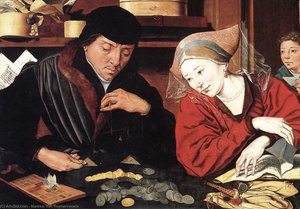
Portret Marinus Van Reymerswaele

Obrazy: 43 najsłynniejszych dzieł artysty Marinus Van Reymerswaele – spojrzenie galerii

Aktualizacja: Listopad 2026 · ranking według naszego wskaźnika popularności (liczba wyszukiwań, wizyt i zamówień dla każdego dzieła) · 43 dzieł Marinus Van Reymerswaele w naszym katalogu

W skrócie

Według opinii kuratorów galerii, najsłynniejszym obrazem Marinus Van Reymerswaele jest The Calling of Matthew (1536), którego oryginał znajduje się w Museum voor Schone Kunsten w Gandawa. The Virgin Nursing the Child (1525) i The Moneychanger and his Wife (1538) dopełniają trio, które zna każde oko. Z 43 dzieł Marinus Van Reymerswaele w naszym katalogu, galeria prezentuje poniżej 43 najsłynniejszych prac – każda z nich jest oryginałem z podaniem roku powstania, muzeum oraz cech wyróżniających ją na tle innych.

1490 – 1546, Reimerswaal Northern renaissance Najwięcej dzieł: Museo del Prado

10 najlepszych obrazów artysty Marinus Van Reymerswaele w galerii

1
The Calling of Matthew (1536) autorstwa Marinus Van Reymerswaele

The Calling of Matthew

1536 · Oil On Canvas · Museum voor Schone Kunsten, Gandawa

To stand before this depiction of The Calling of Matthew is to step across the threshold of time and into a moment charged with divine electricity. The scene captures not merely an event, but a profound spiritual pivot point—the instant grace intersects with ordinary human life. We are drawn immediately to the central interaction: the commanding gesture of Jesus Christ reaching out, beckoning Matthew from his worldly pursuits. The composition…

2
The Virgin Nursing the Child (1525) autorstwa Marinus Van Reymerswaele

The Virgin Nursing the Child

1525 · Oil · Museo del Prado, Madryt

In this intimate oil painting from 1525, we find ourselves drawn into a private, tender encounter between a mother and her infant. The composition is centered and close, pulling the viewer into the immediate space shared by the Virgin and the Child. There is a profound sense of maternal warmth here, expressed through the soft, naturalistic rendering of their skin tones. A deep teal or dark blue garment provides a…

3
The Moneychanger and his Wife (1538) autorstwa Marinus Van Reymerswaele

The Moneychanger and his Wife

1538 · Oil On Panel · Museo del Prado, Madryt

The Moneychanger and his Wife is an oil on panel created by Marinus Van Reymerswaele. This work, dated 1539, offers a focused glimpse into the mercantile atmosphere of the sixteenth-century Low Countries. It remains a significant example of the artist's ability to render the textures of a prosperous, yet morally complex, domestic and commercial life.

4
The Moneychangers (1525) autorstwa Marinus Van Reymerswaele

The Moneychangers

1525 · Oil On Panel · Ermitaż, Sankt Petersburg

A heavy, dark fur hat rests atop a man's head, its texture thick and coarse against the pale light. He leans forward, his body a shadow cast over a table of ledgers and scattered coins. Beside him, a woman in a white headpiece watches the transaction, her presence a quiet counterpoint to the metallic clink of wealth. The air in the room feels thick, crowded by the proximity of their…

5
St Jerome (1547) autorstwa Marinus Van Reymerswaele

St Jerome

1547 · Oil On Panel · Museo del Prado, Madryt

In the quiet, contemplative depths of Marinus van Reymerswaele’s St Jerome, we are invited into a world where the pursuit of divine knowledge meets the heavy reality of human existence. Completed around 1547, this oil-on-panel masterpiece serves as a profound window into the Northern Renaissance—a period defined by an almost obsessive devotion to detail and a deep-seated fascination with the symbolic language of everyday objects. The painting captures the saint…

6
Parable of the unjust steward (1540) autorstwa Marinus Van Reymerswaele

Parable of the unjust steward

1540 · Oil · Kunsthistorisches Museum, Wiedeń

In this 1540 oil painting, the composition is crowded with the physical remnants of commerce and administration. Two primary figures occupy the immediate foreground. On the left, an older man wears a large, pointed dark green hat and a heavy red robe. His facial features are sharp and weathered. To his right, a bearded man looks upward with a startled or contemplative expression, his dark garments accented by red drapery.…

7
Saint Jerome (1521) autorstwa Marinus Van Reymerswaele

Saint Jerome

1521 · Oil On Panel · Sacred Art Museum of Funchal, Funchal

A somber, tightly framed composition captures a moment of intense spiritual struggle. The subject is immersed in a claustrophobic atmosphere, where deep, earthy tones of crimson and burgundy robes meet a background of dark shadows. Light falls sharply upon the saint's face and weathered hands, creating a chiaroscuro effect that pulls the viewer into his private, intellectual labor. Every texture is rendered with meticulous precision, from the coarse hair of…

8
Saint Jerome (1528) autorstwa Marinus Van Reymerswaele

Saint Jerome

1528 · Oil On Panel · Bawarskie Państwowe Zbiory Malarstwa, Monachium

The portrait of Saint Jerome emerges from the shadows of the sixteenth century. Painted by Marinus Van Reymerswaele, this work captures the scholar in a moment of heavy, silent thought. The artist, born in Reimerswaal, Netherlands, brought a meticulous eye to the textures of the saint's world. This specific depiction dates to about 1528.

9
Parable of the unjust steward (1530) autorstwa Marinus Van Reymerswaele

Parable of the unjust steward

1530 · Oil · Muzeum Narodowe w Warszawie, Warszawa

A heavy silence fills the room, thick with the scent of old parchment and the tension of an unspoken debt. Two men sit anchored in a shallow space, their lives colliding over a desk cluttered with the debris of commerce. On the left, a man in a voluminous red cloak gazes upward, his expression caught between a sudden realization and a quiet dread. His dark vest and green sleeves are…

Obrazy artysty Marinus Van Reymerswaele, uszeregowane od 11 do 43 miejsca

11Saint Jerome with a Skull (after Albrecht Dürer) (1530) autorstwa Marinus Van ReymerswaeleSaint Jerome with a Skull (after Albrecht Dürer)1530 12The Money Changers (1540) autorstwa Marinus Van ReymerswaeleThe Money Changers1540 · Rhode Island School of Design Museum of Art 13The Tax Collector and His Wife (1538) autorstwa Marinus Van ReymerswaeleThe Tax Collector and His Wife1538 · Bawarskie Państwowe Zbiory Malarstwa 14Saint Jerome (1534) autorstwa Marinus Van ReymerswaeleSaint Jerome1534 · Bijbels Museum 15The Merchant and his Wife (1540) autorstwa Marinus Van ReymerswaeleThe Merchant and his Wife1540 · Statens Museum for Kunst 16The Tax Collectors (1538) autorstwa Marinus Van ReymerswaeleThe Tax Collectors1538 · Palazzo Pepoli Campogrande 17The Tax Collectors (1538) autorstwa Marinus Van ReymerswaeleThe Tax Collectors1538 · Royal Palace of Naples 18Two Tax Collectors (1540) autorstwa Marinus Van ReymerswaeleTwo Tax Collectors1540 19The Misers (1540) autorstwa Marinus Van ReymerswaeleThe Misers1540 · Bawarskie Państwowe Zbiory Malarstwa 20St. Jerome in his Cell (1550) autorstwa Marinus Van ReymerswaeleSt. Jerome in his Cell1550 · Gemäldegalerie 21Two Tax Collectors (1550) autorstwa Marinus Van ReymerswaeleTwo Tax Collectors1550 22The Banker and his Wife (1551) autorstwa Marinus Van ReymerswaeleThe Banker and his Wife1551 · Królewskie Muzeum Sztuk Pięknych Antwerpia 23Two Excisemen (1550) autorstwa Marinus Van ReymerswaeleTwo Excisemen1550 · Audley End House 24The Moneychanger and his wife (1550) autorstwa Marinus Van ReymerswaeleThe Moneychanger and his wife1550 · Gemäldegalerie 25St. Jerome in His Study (1550) autorstwa Marinus Van ReymerswaeleSt. Jerome in His Study1550 · Schorr Collection 26The Calling of Saint Matthew (1530) autorstwa Marinus Van ReymerswaeleThe Calling of Saint Matthew1530 · Thyssen-Bornemisza Museum 27St. Jerome in His Study autorstwa Marinus Van ReymerswaeleSt. Jerome in His StudyMusée des Beaux-Arts de Reims 28St Jerome (1541) autorstwa Marinus Van ReymerswaeleSt Jerome1541 · Koninklijk Museum voor Schone Kunsten 29Two tax collectors (1540) autorstwa Marinus Van ReymerswaeleTwo tax collectors1540 · Muzeum Narodowe w Warszawie 30Saint Jerome in his Study (1501) autorstwa Marinus Van ReymerswaeleSaint Jerome in his Study1501 · Museo del Prado 31The Moneychanger and his Wife (1541) autorstwa Marinus Van ReymerswaeleThe Moneychanger and his Wife1541 · Staatliche Kunstsammlungen Dresden 32The Calling of St. Matthew (1540) autorstwa Marinus Van ReymerswaeleThe Calling of St. Matthew1540 · Muzeum Kolekcji im. Jana Pawła II 33St Jerome autorstwa Marinus Van ReymerswaeleSt JeromeRijksmuseum 34Tax collector autorstwa Marinus Van ReymerswaeleTax collectorNew Orleans Museum of Art 35The Money Changer autorstwa Marinus Van ReymerswaeleThe Money ChangerGemäldegalerie 36The Money Changers autorstwa Marinus Van ReymerswaeleThe Money ChangersMuseo de Bellas Artes de Bilbao 37The Tax Collectors autorstwa Marinus Van ReymerswaeleThe Tax CollectorsErmitaż 38Saint Jerome in His Study autorstwa Marinus Van ReymerswaeleSaint Jerome in His Study 39The Banker and His Wife autorstwa Marinus Van ReymerswaeleThe Banker and His WifeMusée des Beaux-Arts 40The Tax Collectors autorstwa Marinus Van ReymerswaeleThe Tax CollectorsKoninklijk Museum voor Schone Kunsten 41Two tax gatherers autorstwa Marinus Van ReymerswaeleTwo tax gatherers 42Money-Changer and his Wife (1539) autorstwa Marinus Van ReymerswaeleMoney-Changer and his Wife1539 · Museo del Prado 43The Tax Collectors (1540) autorstwa Marinus Van ReymerswaeleThe Tax Collectors1540 · Luwr

Tematy, które przyciągnęły wzrok Marinus Van Reymerswaele

Cztery motywy najczęściej powracające w tych oryginałach, z których każdy doczekał się swojego najdoskonalszego przykładu.

Muzea przechowujące oryginały Marinus Van Reymerswaele

8 muzeów, w których znajduje się najwięcej obrazów z tej strony.

Muzea Miasto Dzieła artysty Marinus Van Reymerswaele Obrazy z tej listy
Museo del Prado, MadrytMuseo del Prado Madryt 5 The Virgin Nursing the Child, The Moneychanger and his Wife, St Jerome
Bawarskie Państwowe Zbiory Malarstwa, MonachiumBawarskie Państwowe Zbiory Malarstwa Monachium 3 Saint Jerome, The Tax Collector and His Wife, The Misers
Gemäldegalerie, BerlinGemäldegalerie Berlin 3 St. Jerome in his Cell, The Moneychanger and his wife, The Money Changer
Ermitaż, Sankt PetersburgErmitaż Sankt Petersburg 2 The Moneychangers, The Tax Collectors
Muzeum Narodowe w Warszawie, WarszawaMuzeum Narodowe w Warszawie Warszawa 2 Parable of the unjust steward, Two tax collectors
Królewskie Muzeum Sztuk Pięknych Antwerpia, AntwerpiaKrólewskie Muzeum Sztuk Pięknych Antwerpia Antwerpia 2 The Calling of Saint Matthew, The Banker and his Wife
Koninklijk Museum voor Schone Kunsten, AntwerpiaKoninklijk Museum voor Schone Kunsten Antwerpia 2 St Jerome, The Tax Collectors
Museum voor Schone Kunsten, GandawaMuseum voor Schone Kunsten Gandawa 1 The Calling of Matthew

Marinus Van Reymerswaele, jedno kultowe dzieło na dekadę

Dzieła według dekad

Wybierz dekadę, aby zobaczyć dzieło, które ją definiuje.

Obrazy artysty Marinus Van Reymerswaele: odpowiedzi galerii

Który obraz Marinus Van Reymerswaele jest najsłynniejszy ze wszystkich?Odkryj odpowiedź

The Calling of Matthew (1536), Museum voor Schone Kunsten, Gandawa. Następne są The Virgin Nursing the Child (1525) oraz The Moneychanger and his Wife (1538).

Ile lat miał Marinus Van Reymerswaele, gdy ukończył The Calling of Matthew?Odkryj odpowiedź

46 lat: The Calling of Matthew pochodzi z 1536, a Marinus Van Reymerswaele urodził(a) się w 1490.

Które to 10 najlepszych obrazów Marinus Van Reymerswaele?Odkryj odpowiedź

The Calling of Matthew, The Virgin Nursing the Child, The Moneychanger and his Wife, The Moneychangers, St Jerome, Parable of the unjust steward, Saint Jerome, Saint Jerome, Parable of the unjust steward i The Calling of Saint Matthew. Powyższy ranking zawiera rok powstania oraz muzeum dla każdego z nich.

Ile dzieł stworzył/a Marinus Van Reymerswaele?Odkryj odpowiedź

Nasz katalog zawiera 43 dzieł artysty Marinus Van Reymerswaele, datowanych od 1501 do 1541.

Gdzie można znaleźć najsłynniejsze oryginały autorstwa Marinus Van Reymerswaele?Odkryj odpowiedź

W większości znajdują się w Museo del Prado (Madryt), Bawarskie Państwowe Zbiory Malarstwa (Monachium) i Gemäldegalerie (Berlin). Powyższa tabela muzeów zawiera ich pełną listę.

Kiedy Marinus Van Reymerswaele stworzył swoje najsłynniejsze obrazy?Odkryj odpowiedź

W 1530s: 11 z 43 dzieł na tej stronie powstało w tym czasie, w tym The Calling of Matthew.

Które z najsłynniejszych dzieł Marinus Van Reymerswaele należą do jego najwcześniejszych i najpóźniejszych prac?Odkryj odpowiedź

Na tej stronie najwcześniejszy to Saint Jerome in his Study (1501), a najpóźniejszy St Jerome (1541).

Do jakich tematów Marinus Van Reymerswaele powracał najczęściej?Odkryj odpowiedź

Man (19), Table (18) i Coins (15), w ramach 43 dzieł na tej stronie.

W jakiej technice najczęściej tworzył Marinus Van Reymerswaele?Odkryj odpowiedź

Oil On Panel, dla 32 z 43 dzieł na tej stronie.

Z jakim nurtem związany jest Marinus Van Reymerswaele?Odkryj odpowiedź

Northern renaissance, sądząc po oryginałach na tej stronie.

Które oryginały artysty Marinus Van Reymerswaele znajdują się w zbiorach Museo del Prado?Odkryj odpowiedź

The Virgin Nursing the Child, The Moneychanger and his Wife i St Jerome: Museo del Prado, Madryt posiada 5 dzieł widocznych na tej stronie.

Marinus Van Reymerswaele: artysta

Tajemniczy mistrz antwerpskich cieni

W tętniącym życiem, kupieckim sercu Niderlandów XVI wieku, pojawił się malarz, którego pędzel potrafił uchwycić głębokie napięcie między duchową pobożnością a ziemską chciwością. Marinus Van Reymerswaele, artysta, którego samo nazwisko przywołuje nadmorskie miasto Reimerswaal, gdzie przyszedł na świat, pozostaje jedną z najbardziej fascynujących zagadek renesansu niderlandzkiego. Jego życie podążało typową ścieżką wykwalifikowanego rzemieślnika; po studiach w Leuven, znalazł zawodowe oparcie w prestiżowym Antwerpskim cechu świętego Łukasza. Zapisany jako uczeń malarza szkła Symona van Daele, Reymerswaele posiadał niezwykłe oko do detalu i światła, które w późniejszych latach zdefiniowało jego mistrzostwo w operowaniu teksturą i atmosferą.

W miarę jak osadzał się w Antwerpii, będącej epicentrum europejskiego handlu, jego twórczość zaczęła odzwierciedlać złożoną tożsamość samego miasta. Prowadził niezwykle płodną pracownię, tętniące życiem studio zdolne do tworzenia licznych wersji jego najsłynniejszych tematów. Ta pracowitość pozwoliła jego specyficznemu językowi wizualnemu — połączeniu skrupulatnego realizmu z ciętą komentarzem społecznym — przeniknąć do kolekcje ówczesnych elit. Jego obrazy nie tylko przedstawiały sceny; one inscenizowały dramaty moralne, które odzwierciedlały niepokoje epoki zawieszonej między średniowieczną pobożnością a nadchodzącą falą kapitalizmu.

Galeria chciwości i łaski

Spojrzenie na dzieło przypisywane Reymerswaele to wejście w przestrzeń, w której sacrum zderza się z profanum. Był mistrzem bardzo specyficznej, powracającej ikonografii, która podbijała wyobraźnię publiczności XVI wieku. Jego kompozycje często koncentrowały się wokół czterech kluczowych motywów, badających ludzką kondycję przez różne pryzmaty:

  • Intensywna praca nad studiami św. Hieronima, reprezentująca uczoną oddanie i religijną kontemplację.
  • Tętniąca życiem aktywność poborców podatkowych, służąca jako satyryczny komentarz do chciwości i korupcji.
  • Wymieniacz pieniędzy i jego żona, ukazujący punkt styku życia domowego i handlu.
  • Świat prawniczy, na przykład prawnik w swoim gabinecie, odzwierciedlający rosnącą złożoność biurokracji miejskiej.

Jego arcydzieło, Dwaj poborcy podatkowi, stanowi uderzający przykład sztuki renesansu północnego. Dzięki zastosowaniu techniki olejnej na dębowym drewnie, osiągnął poczucie głębi i tekstury, które tchnęło życie w jego podmioty. Obraz ten służy jako żywy komentarz do korupcji urzędników skarbowych, wykorzystując szczegółowy opis ubioru i otoczenia, aby osadzić swoją satyrę w rozpoznawalnej rzeczywistości. W tych pracach ciężkie, staroświeckie szaty postaci dodają warstwę krytyki społecznej, przypominając widzowi o zmieniającym się krajobrazie moralnym epoki.

Dziedzictwo i artystyczne wpływy

Rozwój stylistyczny, jaki przeszedł Marinus Van Reymerswaele, ukazuje głęboki wpływ flamandzkiego malarza Quentina Matsysa. Ta więź pomogła ukształtować jego zdolność do łączenia elementów realizmu z ostrym, często karykaturalnym poczuem humoru. Jego twórczość charakteryzuje się dbałością o szczegół, która pozwala widzowi dostrzec najdrobniejsze tekstury manuskryptów, dokumentów prawnych i monet, z których wszystkie służą jako symbole epoki pochłoniętej bogactwem i prawem.

Choć pracował intensywnie w Antwerpii, jego podróż ostatecznie skierowała go z powrotem w stronę Północnych Niderlandów. Po pracy w Antwerpii trwającej co najmniej do 1540 roku, przeniósł się do Goes, gdzie dopełnił się jego żywot. Choć wiele jego paneli rozpoznajemy dzięki atrybucji, a nie podpisowi, jego wpływ na malarstwo gatunkowe pozostaje niezaprzeczalny. Pozostawił po sobie wizualne dziedzictwo, które nieustannie fascynuje, oferując głęboki wgląd w umysł artysty zmagającego się z wiarą, nauką i nieustannie obecnymi cieniami ludzkiej chciwości.