Portret Leon Bakst

100 najsłynniejszych obrazów artysty Leon Bakst – wybór z galerii

Aktualizacja: Listopad 2026 · ranking według naszego wskaźnika popularności (liczba wyszukiwań, wizyt i zamówień dla każdego dzieła) · 154 dzieł Leon Bakst w naszym katalogu

W skrócie

Spośród wszystkich dzieł oryginalnych, które pozostawił Leon Bakst, najsłynniejszym jest Projekt z Kwiatami w Siatce, znajdujący się w kolekcji The Baltimore Museum of Art w Baltimore. Tuż za nimi znajdują się Costume design for the ballet ''Cleopatra'' (1909) oraz Operatic costume designs (1911). Nasz katalog zawiera 154 dzieł autorstwa Leon Bakst; galeria zachowała 100 najbardziej podziwianych na świecie prac, z których każda została przedstawiona wraz z datą powstania, informacją o muzeum oraz jej historią.

1866 – 1924, Grodno Art nouveau Najwięcej dzieł: The Baltimore Museum of Art

10 najlepszych obrazów artysty Leon Bakst: wybór galerii

1
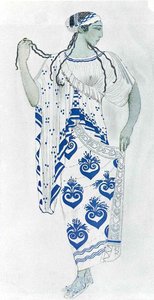
Projekt z Kwiatami w Siatce autorstwa Leon Bakst

Projekt z Kwiatami w Siatce

Farby malarskie · The Baltimore Museum of Art, Baltimore

Design with Flowers in Grid – Léon Bakst: Een Symfonie van Kleur en Beweging Léon Bakst (1866-1924), een Russische kunstenaar die zich onderscheidde als een pionier binnen het theater en de kunstdecoratie, staat bekend om zijn baanbrekende stijl en zijn prachtige samenwerking met Sergei Diaghilev’s Ballets Russes. Zijn werk verklaart waarom hij een essentiële figuur is geworden in de ontwikkeling van zowel Art Nouveau als Orientalisme – stromingen die elkaar…

2
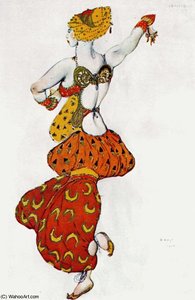
Costume design for the ballet ''Cleopatra'' (1909) autorstwa Leon Bakst

Costume design for the ballet ''Cleopatra''

1909 · Painting

This work, titled Costume design for the ballet ''Cleopatra'', was created by the artist Léon Bakst. It represents a significant moment in the history of theatrical aesthetics, specifically designed for the ballet Cleopatra. The piece dates to 1909, a period when the artist was establishing a new visual language for the stage.

3
Operatic costume designs (1911) autorstwa Leon Bakst

Operatic costume designs

1911 · Painting

Operatic costume designs, created by Léon Bakst in 1911, captures a moment of theatrical movement. The work features two women in elaborate attire; one is dressed in a blue garment accented with green circles, while the other wears red. Their poses suggest a choreographed interaction, with one figure appearing to dance while holding the arm of her companion.

4
Drawing young divinity Narcisse costume, ballet Diaghilev (1911) autorstwa Leon Bakst

Drawing young divinity Narcisse costume, ballet Diaghilev

1911 · Watercolor

The scene unfolds through Drawing young divinity Narcisse costume, ballet Diaghilev, a vision conceived by the artist Léon Bakst. This work captures a specific moment of theatrical creation from 1911. It exists as a design for the set of the ballet Narcisse, a production that first met its audience at the Théâtre de Monte Carlo in 1911. The atmosphere of the stage is shaped by the creative energy of the…

5
Portrait of Boris Nikolayevich Bugaev (Andrey Bely) (1905) autorstwa Leon Bakst

Portrait of Boris Nikolayevich Bugaev (Andrey Bely)

1905 · Charcoal

The artwork is titled Portrait of Boris Nikolayevich Bugaev (Andrey Bely), a work created by the artist Léon Bakst. This portrait, executed in 1905, presents a head-and-shoulders view of the subject. The sitter is a prominent Russian Symbolist writer, captured in a moment of quietude. The gaze of the man meets the viewer from a position of stillness.

6
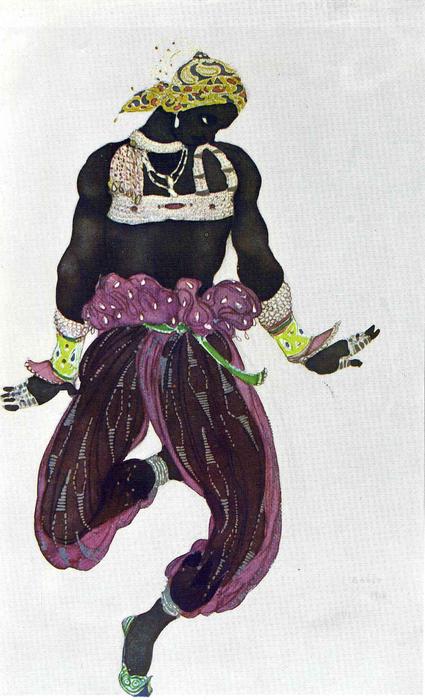
Scheherazade negre argent (1910) autorstwa Leon Bakst

Scheherazade negre argent

1910 · Watercolor

A solitary male figure commands the space, frozen in a moment of theatrical tension. He leans into a stylized pose, his body elongated to emphasize a sense of rhythmic movement that seems to pulse even in stillness. The silhouette is defined by sharp, geometric lines—the triangular peak of a headpiece and the rectangular weight of his garments—which create a striking contrast against the dark, somber atmosphere. Every muscle and fold…

7
Scheherezade odalisque (1910) autorstwa Leon Bakst

Scheherezade odalisque

1910 · Watercolor

The artwork titled Scheherezade odalisque was created by the artist Léon Bakst. This specific piece is a watercolor illustration produced in 1910. The work originates from a period when the artist was actively involved in the visual development of the Ballets Russes, contributing to the aesthetic language of theatrical productions such as Scheherazade.

8
The Butterfly (Costume Design for Anna Pavlova) (1913) autorstwa Leon Bakst

The Butterfly (Costume Design for Anna Pavlova)

1913 · Gouache · Museum of Fine Arts, Boston

The Butterfly (Costume Design for Anna Pavlova) is a dynamic costume design illustration created in 1913. The composition features a central female figure captured in a mid-stride or dancing pose. She is surrounded by expansive, swirling fabric elements that suggest the wings of a butterfly. The color palette is dominated by primary colors, specifically bright yellow and deep cobalt blue, accented with orange and white.

9
Portrait of Miss Paoloff (1916) autorstwa Leon Bakst

Portrait of Miss Paoloff

1916 · Oil

The Portrait of Miss Paoloff by Léon Bakst captures a fleeting moment of grace. In this work, the ballerina Miss Paoloff appears mid-movement, her body caught in a dynamic pose that suggests the energy of a live performance. She wears her performance attire, a tutu that seems to catch the light as she moves through the space. The scene feels suspended in time, as if the dancer has just pivoted…

10
Portrait of the Marchesa Casati (1912) autorstwa Leon Bakst

Portrait of the Marchesa Casati

1912 · Charcoal

This work, titled Portrait of the Marchesa Casati, is a striking study by the artist Léon Bakst. Created about 1912, the portrait captures the likeness of the Marchesa Casati in a moment of quiet contemplation. It is a piece that reflects the artist's ability to translate a specific presence onto paper through a focused, intimate lens.

Kontynuacja zestawienia Leon Bakst, od 11 do 100

11Portrait of the Marchesa Casati (1912) autorstwa Leon BakstPortrait of the Marchesa Casati1912 12fantasy on modern costume (atalanta) (1912) autorstwa Leon Bakstfantasy on modern costume (atalanta)1912 13The sleeping beauty eastern prince and his page (1916) autorstwa Leon BakstThe sleeping beauty eastern prince and his page1916 14Portrait of a Lady (1917) autorstwa Leon BakstPortrait of a Lady1917 15Mme Ida Rubinstein (1917) autorstwa Leon BakstMme Ida Rubinstein1917 · Metropolitan Museum of Art 16Samarkand Sultan (1922) autorstwa Leon BakstSamarkand Sultan1922 17russian peasant woman (1922) autorstwa Leon Bakstrussian peasant woman1922 18Dmitry Filosof portrait (1897) autorstwa Leon BakstDmitry Filosof portrait1897 19Art open letter of Red Cross (1904) autorstwa Leon BakstArt open letter of Red Cross1904 20supper (1902) autorstwa Leon Bakstsupper1902 21cleopatre danse juive (1910) autorstwa Leon Bakstcleopatre danse juive1910 22helene de sparte ida rubinstein in act iv (1912) autorstwa Leon Baksthelene de sparte ida rubinstein in act iv1912 23The Supper (1902) autorstwa Leon BakstThe Supper1902 24Big Philanthropic Puppet Bazaar, St. Petersburg (1899) autorstwa Leon BakstBig Philanthropic Puppet Bazaar, St. Petersburg1899 25Medee (Jean Anouilh) autorstwa Leon BakstMedee (Jean Anouilh) 26Leonid Massine autorstwa Leon BakstLeonid Massine 27Portrait of Jean Cocteau autorstwa Leon BakstPortrait of Jean Cocteau 28Ida Rubinstein autorstwa Leon BakstIda Rubinstein 29untitled (4764) autorstwa Leon Bakstuntitled (4764) 30untitled (1211) autorstwa Leon Bakstuntitled (1211) 31untitled (1495) autorstwa Leon Bakstuntitled (1495) 32Costume Design For 'la Fée De Richesse' autorstwa Leon BakstCostume Design For 'la Fée De Richesse' 33St. Sebastian, from ''The Martyr of St. Sebastian'' autorstwa Leon BakstSt. Sebastian, from ''The Martyr of St. Sebastian'' 34helene de sparte costume for ida rubinstein as helene autorstwa Leon Baksthelene de sparte costume for ida rubinstein as helene 35Ballet Music - Introduction (Humphrey Searle) autorstwa Leon BakstBallet Music - Introduction (Humphrey Searle) 36untitled (4724) autorstwa Leon Bakstuntitled (4724) 37untitled (9134) autorstwa Leon Bakstuntitled (9134) 38Costume for Nijinsky (1910) autorstwa Leon BakstCostume for Nijinsky1910 39scheherezade odalisque (1910) autorstwa Leon Bakstscheherezade odalisque1910 40le dieu bleu a young rajah (1911) autorstwa Leon Bakstle dieu bleu a young rajah1911 41narcisse the nymph echo (1911) autorstwa Leon Bakstnarcisse the nymph echo1911 42Le dieu bleu a young rajah (1911) autorstwa Leon BakstLe dieu bleu a young rajah1911 43fantasie sur le costume moderne (1910) autorstwa Leon Bakstfantasie sur le costume moderne1910 44Vase (self-portrait) (1906) autorstwa Leon BakstVase (self-portrait)1906 45Scheherezade odalisque (1910) autorstwa Leon BakstScheherezade odalisque1910 46Narcisse a youth (1911) autorstwa Leon BakstNarcisse a youth1911 47Le dieu bleu Nijinsky in title role (1911) autorstwa Leon BakstLe dieu bleu Nijinsky in title role1911 48loiseau de feu costume pour tamara karsavina (1910) autorstwa Leon Bakstloiseau de feu costume pour tamara karsavina1910 49Fantasy on modern costume (1910) autorstwa Leon BakstFantasy on modern costume1910 50scheherazade negre argent (1910) autorstwa Leon Bakstscheherazade negre argent1910 51The Firebird, the tsarevna (1910) autorstwa Leon BakstThe Firebird, the tsarevna1910 52loiseau de feu the firebird (1910) autorstwa Leon Bakstloiseau de feu the firebird1910 53Narcisse -Boeotian (1911) autorstwa Leon BakstNarcisse -Boeotian1911 54Portrait of Russian painter Filipp Andreevich Maljawin autorstwa Leon BakstPortrait of Russian painter Filipp Andreevich Maljawin 55scheherezade scenery (1910) autorstwa Leon Bakstscheherezade scenery1910 56le martyre de saint sebastien ida rubinstein as st sebastian (1911) autorstwa Leon Bakstle martyre de saint sebastien ida rubinstein as st sebastian1911 57Costume Design for 'Scheherazade' (1910) autorstwa Leon BakstCostume Design for 'Scheherazade'1910 58The Firebird, costume for Tamara Karsavina (1910) autorstwa Leon BakstThe Firebird, costume for Tamara Karsavina1910 59scheherazade la sultane bleue (1910) autorstwa Leon Bakstscheherazade la sultane bleue1910 60narcisse a youth (1911) autorstwa Leon Bakstnarcisse a youth1911 61Sketch for the ballet 'La Peri', by Paul Dukas (1911) autorstwa Leon BakstSketch for the ballet 'La Peri', by Paul Dukas1911 62Scheherazade shah shahriar (1910) autorstwa Leon BakstScheherazade shah shahriar1910 63cleopatre greek dancer (1910) autorstwa Leon Bakstcleopatre greek dancer1910 64Front cover of Comoedia (1909) autorstwa Leon BakstFront cover of Comoedia1909 65loiseau de feu michel fokine as tsarevitch (1910) autorstwa Leon Bakstloiseau de feu michel fokine as tsarevitch1910 66Scheherazade la sultane bleue (1910) autorstwa Leon BakstScheherazade la sultane bleue1910 67cleopatre syrian dance (1909) autorstwa Leon Bakstcleopatre syrian dance1909 68narcisse a nymph (1911) autorstwa Leon Bakstnarcisse a nymph1911 69Le martyre de Saint Sebastien act I set design (1911) autorstwa Leon BakstLe martyre de Saint Sebastien act I set design1911 70Le martyre de Saint Sebastien act IV set design (1911) autorstwa Leon BakstLe martyre de Saint Sebastien act IV set design1911 71The carnival Chiarina (1910) autorstwa Leon BakstThe carnival Chiarina1910 72narcisse bacchante (1911) autorstwa Leon Bakstnarcisse bacchante1911 73la peri natasha trouhanova as the peri (1911) autorstwa Leon Bakstla peri natasha trouhanova as the peri1911 74In the artist's studio (1908) autorstwa Leon BakstIn the artist's studio1908 75la peri iksander (1911) autorstwa Leon Bakstla peri iksander1911 76The .arnival - Estrella (1910) autorstwa Leon BakstThe .arnival - Estrella1910 77Cleopatre danse juive (1910) autorstwa Leon BakstCleopatre danse juive1910 78le dieu bleu nijinsky in title role (1911) autorstwa Leon Bakstle dieu bleu nijinsky in title role1911 79Downpour (1906) autorstwa Leon BakstDownpour1906 80Scheherazade the chief eunuch (1910) autorstwa Leon BakstScheherazade the chief eunuch1910 81Costume design for a bacchante in 'Narcisse' by Tcherepnin (1911) autorstwa Leon BakstCostume design for a bacchante in 'Narcisse' by Tcherepnin1911 82le dieu bleu the bride (1912) autorstwa Leon Bakstle dieu bleu the bride1912 83Nijinsky's Faun Costume in 'L'Apres Midi d'un Faune' by Claude Debussy from the front cover of the programme for the 7th season of the 'Ballets Russes' (1912) autorstwa Leon BakstNijinsky's Faun Costume in 'L'Apres Midi d'un Faune' by Claude Debussy from the front cover of the programme for the 7th season of the 'Ballets Russes'1912 84Design for a lady's dress (1912) autorstwa Leon BakstDesign for a lady's dress1912 85sadko one of the chorus (1917) autorstwa Leon Bakstsadko one of the chorus1917 86L'apres midi d'un faune, another nymph (1912) autorstwa Leon BakstL'apres midi d'un faune, another nymph1912 87lapres midi dun faune another nymph (1912) autorstwa Leon Bakstlapres midi dun faune another nymph1912 88le dieu bleu a pilgrim (1912) autorstwa Leon Bakstle dieu bleu a pilgrim1912 89le dieu bleu bayadere (1912) autorstwa Leon Bakstle dieu bleu bayadere1912 90lapres midi dun faune nijinsky as the faun (1912) autorstwa Leon Bakstlapres midi dun faune nijinsky as the faun1912 91Le dieu bleu bayadere with peacock (1912) autorstwa Leon BakstLe dieu bleu bayadere with peacock1912 92Daphnis and Chloe scenery for act II (1912) autorstwa Leon BakstDaphnis and Chloe scenery for act II1912 93daphnis et chloe set design act ii (1912) autorstwa Leon Bakstdaphnis et chloe set design act ii1912 94Les femmes de bonne humeur - set design (1917) autorstwa Leon BakstLes femmes de bonne humeur - set design1917 95sadko the green monster (1917) autorstwa Leon Bakstsadko the green monster1917 96le dieu bleu setting (1912) autorstwa Leon Bakstle dieu bleu setting1912 97loiseau de feu costume (1913) autorstwa Leon Bakstloiseau de feu costume1913 98helene de sparte act ii set design (1912) autorstwa Leon Baksthelene de sparte act ii set design1912 99La legende de Joseph Potiphar (1914) autorstwa Leon BakstLa legende de Joseph Potiphar1914 100daphnis et chloe costume (1912) autorstwa Leon Bakstdaphnis et chloe costume1912

Słynne obrazy Leon Bakst epoka po epoce

Tematy, które przyciągnęły wzrok Leon Bakst

Cztery motywy najczęściej powracające w tych oryginałach, z których każdy doczekał się swojego najdoskonalszego przykładu.

Muzea przechowujące oryginały Leon Bakst

3 muzeów, w których znajduje się najwięcej obrazów z tej strony.

Muzea Miasto Dzieła artysty Leon Bakst Obrazy z tej listy
The Baltimore Museum of Art, BaltimoreThe Baltimore Museum of Art Baltimore 1 Projekt z Kwiatami w Siatce
Museum of Fine Arts, BostonMuseum of Fine Arts Boston 1 The Butterfly (Costume Design for Anna Pavlova)
Metropolitan Museum of Art, Nowy JorkMetropolitan Museum of Art Nowy Jork 1 Mme Ida Rubinstein

Leon Bakst dekada po dekadzie: oryginały definiujące każdy okres

Dzieła według dekad

Wybierz dekadę, aby zobaczyć dzieło, które ją definiuje.

Pytania kolekcjonerów o obrazy Leon Bakst

Z jakiego dzieła najbardziej znany jest Leon Bakst?Odkryj odpowiedź

Projekt z Kwiatami w Siatce, The Baltimore Museum of Art, Baltimore. Następne są Costume design for the ballet ''Cleopatra'' (1909) oraz Operatic costume designs (1911).

Jakie są dziesięć najsłynniejszych obrazów, których autorem jest Leon Bakst?Odkryj odpowiedź

Projekt z Kwiatami w Siatce, Costume design for the ballet ''Cleopatra'', Operatic costume designs, Drawing young divinity Narcisse costume, ballet Diaghilev, Portrait of Boris Nikolayevich Bugaev (Andrey Bely), Scheherazade negre argent, Scheherezade odalisque, The Butterfly (Costume Design for Anna Pavlova), Portrait of Miss Paoloff i Portrait of the Marchesa Casati. Powyższy ranking zawiera rok powstania oraz muzeum dla każdego z nich.

Ile obrazów pozostawił po sobie Leon Bakst?Odkryj odpowiedź

Nasz katalog zawiera 154 dzieł artysty Leon Bakst, datowanych od 1897 do 1922.

W których muzeach znajdują się arcydzieła Leon Bakst?Odkryj odpowiedź

W większości znajdują się w The Baltimore Museum of Art (Baltimore), Museum of Fine Arts (Boston) i Metropolitan Museum of Art (Nowy Jork). Powyższa tabela muzeów zawiera ich pełną listę.

W których latach Leon Bakst namalował swoje najsłynniejsze dzieła?Odkryj odpowiedź

W 1910s: 71 z 100 dzieł na tej stronie powstało w tym czasie, w tym Operatic costume designs.

Jakie są pierwsze i ostatnie słynne oryginały Leon Bakst?Odkryj odpowiedź

Na tej stronie najwcześniejszy to Dmitry Filosof portrait (1897), a najpóźniejszy Samarkand Sultan (1922).

Jakie tematy Leon Bakst wybierał najczęściej?Odkryj odpowiedź

Designs and sketches (28), Clothing (26) i Woman (9), w ramach 100 dzieł na tej stronie.

Której techniki Leon Bakst używał najczęściej?Odkryj odpowiedź

Watercolor, dla 5 z 100 dzieł na tej stronie.

Do jakiego nurtu artystycznego należy Leon Bakst?Odkryj odpowiedź

Art nouveau, sądząc po oryginałach na tej stronie.

Leon Bakst: życie i twórczość

Wczesne Lata i Ziśnięcie Artystyczne

Léon Bakst, urodzony jako Lew Samojłowicz Rosenberg w 1866 roku w Grodnie – mieście, które wówczas należało do Imperium Rosyjskiego – jego życie artystyczne było fascynującą opowieścią, splatającą w sobie naturalny talent i ograniczenia społeczne. Jego rodzina, choć komfortowo sytuowana materialnie, miała powiązania z dworem cesarskim dzięki jego przodkowi, wybitnemu krawcowi, który cieszył się patronatem cara. To tło wpłynęło na młodego Lejba, ukształtowało jego świadomość kulturową i jednocześnie wywołało wczesną pasję do rysunku, która została udowodniona, gdy zaledwie dwunastoletni wygrał konkurs. Jednak ten rozwijający się artystyczny skłonności początkowo spotkały się z oporem ze strony jego rodziców, którzy niechętnie chcieli przyjąć tak nietypową ścieżkę. Pomimo ich rezerw, Bakst wytrwał i ostatecznie studiował na prestiżowej Akademii Sztuk w Petersburgu jako student niezaocznia, uzupełniając swoją edukację pracą ilustratorem książek – praktyczna konieczność, która wyćwiczyła jego umiejętności i zapewniła niezależność finansową. W 1889 roku przyjął pseudonim artystyczny „Bakst”, pragmatyczna decyzja prawdopodobnie motywowana obawami o to, czy jego nazwisko urodowe nie utrudni kariery w społeczeństwie często dyskryminującym osoby żydowskie. To ujawnia wyzwania napotykane przez artystów z marginalizowanych społeczności w tamtym czasie.

Świat Sztuki i Przyjęcie Nowoczesności

Rozwój artystyczny Baksta naprawdę rozkwitł dzięki jego zaangażowaniu w wpływowy ruch „Świat Sztuki”. Szybko stał się kluczową postacią obok takich luminarów jak Sergei Diaghilev i Alexandre Benois, przyczyniając się znacząco do rozwoju grupy pod tym samym tytułem poprzez swoje sugestywne grafiki. Ta afiliacja przyniosła mu szerokie uznanie i ugruntowała jego pozycję jako rosnącej gwiazdy w rosyjskich kręgach artystycznych. Wczesne prace Baksta obejmowały przekonujące portrety wybitnych postaci, takich jak Filipp Malyavin, Wasilij Rozanow, Andrei Bely i Zinaida Gippius, demonstrujące jego zdolność nie tylko do uchwycenia podobieństwa fizycznego, ale także esencji intelektualnej i emocjonalnej swoich podmiotów. Jego styl w tym okresie był fascynującą mieszanką rosyjskich tradycji artystycznych z rosnącymi wpływami europejskimi – szczególnie Orientalizmem i wczesnym Modernizmem. Przyjmował żywe kolory, egzotyczne motywy i stylizowane formy, zapowiadając rewolucyjny język wizualny, który później wprowadził na scenę. Ta gotowość do eksperymentowania i syntezy różnorodnych wpływów uczynił go artystą wrażliwym na zmieniające się prądy swojej epoki.

Rewolucja na Scenie z Ballets Russes

Kluczowym momentem w karierze Baksta stał się 1908 rok, kiedy zaczął projektować dekoracje i kostiumy teatralne – zmiana ta na zawsze zmieniła krajobraz projektowania scenicznego. Jego współpraca z Sergei Diaghilev’s Ballets Russes okazała się transformacyjna, rewolucjonizując estetykę teatralną i catapulting zarówno tych artystów na światową sławę. Projekty Baksta były przełomowe; odchodziły od realistycznych przedstawień, przyjmując stylizowane formy, jaskrawe kolory i poczucie luksusowej fantazji. Produkcje takie jak *Cleopatra*, *Scheherazade* (1910) – być może jego najbardziej ikoniczny utwór, *Carnaval* (1910), *Spectre de la Rose* (1911) i szczególnie *L’Après-midi d'un Faune* (1912) stały się legendarne ze względu na swój wizualny rozmach. *L’Après-midi d'un Faune*, w szczególności, był przełomowym dziełem, które głęboko wpłynęło na rozwój baletu i projektowania scenicznego, ustanawiając nowy język estetyczny dla tej formy sztuki. Nie tworzył jedynie tła; konstruował wciągające światy, wzmacniające emocjonalny wpływ choreografii i muzyki. Kostiumy były równie innowacyjne, często wykorzystując egzotyczne tkaniny, błyszczące ozdoby i odważne sylwetki, które podważały konwencjonalne pojęcie stroju teatralnego.

Dziedzictwo i Trwałe Wpływy

Dziedzictwo Leona Baksta wykracza poza jego wkład w balet. Jest uznawany za jednego z najważniejszych postaci w historii projektowania scenicznego, znacząco wpływając na zarówno projektowanie dekoracji, jak i kostiumów przez kolejne pokolenia. Jego projekty przyczyniły się również do rozwoju Art Deco ze względu na nacisk na stylizowane formy, bogate kolory i egzotyczne motywy – świadectwo jego dalekiego zasięgu wpływu na kulturę wizualną. Pomimo otrzymania pewnych krytyk za postrzegane przepychań, praca Baksta była szeroko celebrowana, a jego pogrzeb w 1924 roku był świadectwem obecności wielu wybitnych artystów, poetów, muzyków, tancerzy i krytyków – poruszający dowód szacunku, jaki czuł się do niego. Dziś jego dzieła znajdują się w muzeach na całym świecie i nadal inspirują poprzez reprodukcje dostępne na platformach takich jak OriginalUniqueArt.com, zapewniając, że jego innowacyjny duch i wizja artystyczna przetrwają dla odbiorców na całym świecie. Zdolność Baksta do syntezy różnorodnych wpływów, przyjęcia eksperymentowania i tworzenia oszałamiających wizualnie światów umocnił jego pozycję jako prawdziwego wizjonera XX wieku.