Portret Konstantin Makowski

100 najsłynniejszych obrazów artysty Konstantin Makowski, każdy niepowtarzalny

Aktualizacja: Listopad 2026 · ranking według naszego wskaźnika popularności (liczba wyszukiwań, wizyt i zamówień dla każdego dzieła) · 393 dzieł Konstantin Makowski w naszym katalogu

W skrócie

Emperor Alexander II on His Deathbed (1881) to obraz autorstwa Konstantin Makowski, który przyciąga najwięcej spojrzeń. Następnie wzrok kieruje się na Happy Arcadia (1890) i Peter the Great in His Studio (1870). Spośród 393 dzieł Konstantin Makowski w naszym katalogu, tych 100 jest najbardziej znanych – każde z nich to unikatowy oryginał, przedstawiony wraz z rokiem powstania, muzeum oraz powodem, dla którego przetrwało próbę czasu.

1839 – 1915, Moskwa Realism Najwięcej dzieł: Ermitaż

10 najlepszych obrazów autorstwa Konstantin Makowski według oka galerii

1
Emperor Alexander II on His Deathbed (1881) autorstwa Konstantin Makowski

Emperor Alexander II on His Deathbed

1881 · Oil On Canvas

To stand before Konstantin Yegorovich Makovsky's Emperor Alexander II on His Deathbed is to step across the threshold of history and into a realm saturated with profound, quiet emotion. Painted in 1881, this oil on canvas masterpiece transcends mere portraiture; it is a meditation on mortality, legacy, and the weight of imperial life. Makovsky, a master of Russian Romanticism and a key figure among the Peredvizhniki, possessed an unparalleled gift…

2
Happy Arcadia (1890) autorstwa Konstantin Makowski

Happy Arcadia

1890 · Oil On Canvas

In this monumental oil painting from 1890, we find ourselves transported to a lush, green meadow where the boundaries between the real and the mythical dissolve. The scene is one of profound relaxation, a quiet celebration of life set amidst a field of colorful wild flowers and fluttering butterflies. At the heart of the composition, three women in diaphanous, flowing white dresses move with a rhythmic grace. One woman carries…

3
Peter the Great in His Studio (1870) autorstwa Konstantin Makowski

Peter the Great in His Studio

1870 · Oil On Canvas · Ermitaż, Sankt Petersburg

A single shaft of light falls from the upper right, striking a heavy roll of parchment. Within this glow, the figure of Peter I emerges from the deep shadows of a workshop. He is not yet an emperor, but a man immersed in the grit of labor. His hands hold the weight of drawings and plans. Around his feet, wood shavings lie scattered across the floor, small curls of debris…

4
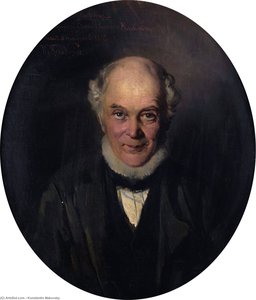
Egor Ivanovich Makovsky (1859) autorstwa Konstantin Makowski

Egor Ivanovich Makovsky

1859 · Oil

This portrait, titled Egor Ivanovich Makovsky, was executed by the artist Konstantin Makovsky. Created about 1859, the work captures the likeness of the subject, Egor Ivanovich Makovsky, in a formal composition. The piece belongs to the genre of portraiture, focusing on the individual's presence and character.

5
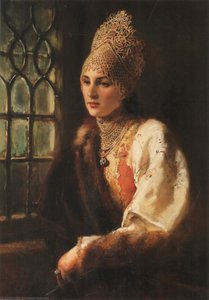
Boyar's Wife at the Window (1885) autorstwa Konstantin Makowski

Boyar's Wife at the Window

1885 · Oil On Canvas

A woman sits by a window, her chin resting heavily in her hands. She wears a dress of heavy, ornate fabric, the weight of her status visible in every fold of the cloth. Her gaze is fixed on something beyond the glass, lost in a quiet, internal observation. The window is fitted with iron bars, a cold geometry that cuts through the soft light of the room. In the background,…

6
Mother and Daughter in an Interior (1883) autorstwa Konstantin Makowski

Mother and Daughter in an Interior

1883 · Oil

The room feels warm, held in a soft, intimate stillness. A woman sits in a chair, her body angled toward the small life resting in her lap. They are draped in deep red fabrics that seem to glow against the muted tones of the interior. This shared color binds them together, creating a visual pulse of affection between mother and child. In the background, the soft silhouette of a couch…

7
Mermaids (1879) autorstwa Konstantin Makowski

Mermaids

1879 · Oil On Canvas

In "Mermaids," Konstantin Makovsky transports the viewer into a moonlit aquatic realm where the boundaries between myth and reality dissolve. Painted about 1879, the scene captures a fantastical encounter as mythical creatures emerge from the depths to interact with humans. These mermaids move through the water, their presence turning a quiet night into a moment of profound enchantment. The interaction between the human figures and these legendary beings creates a…

8
Cup of honey (1890) autorstwa Konstantin Makowski

Cup of honey

1890 · Oil

The painting Cup of honey, created around 1890, is a portrait of a woman. The subject is depicted wearing a crown and a veil that partially obscures her features. She is shown holding a bowl in her hands. The composition includes several specific elements: a cup placed on a surface near the center, another bowl located towards the bottom left corner, and two spoons, one positioned closer to the top…

9
Lady in Black (1864) autorstwa Konstantin Makowski

Lady in Black

1864 · Oil

The woman stares directly from the canvas, her gaze meeting the viewer with an intensity that feels almost startling. She is draped in a deep blue dress, accented by delicate white lace that catches the light against the darker fabric. Her hair is pulled back into a neat bun, revealing the elegant line of her neck and the subtle shimmer of her earrings and necklace. A round frame encircles her…

10
Children running from the Storm (1872) autorstwa Konstantin Makowski

Children running from the Storm

1872 · Oil

In this 1872 composition, we find ourselves witnessing a sudden, frantic movement through an outdoor landscape. A woman, driven by an instinctive need to protect, clutches two children to her body as they flee from an approaching storm. There is a palpable sense of haste in her posture, a physical shield offered against the impending rain. In the background, other figures appear to be caught in the same sudden shift…

Słynne obrazy artysty Konstantin Makowski, od 11 do 100

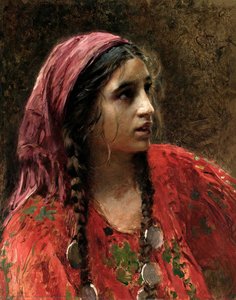
11Angels (1872) autorstwa Konstantin MakowskiAngels1872 12Tea Drinking (1914) autorstwa Konstantin MakowskiTea Drinking1914 13Dervishes in Cairo (1875) autorstwa Konstantin MakowskiDervishes in Cairo1875 14Peter the Great in His Studio (1870) autorstwa Konstantin MakowskiPeter the Great in His Studio1870 · Ermitaż 15Self Portrait (1856) autorstwa Konstantin MakowskiSelf Portrait1856 16Kuzma Minin (1850) autorstwa Konstantin MakowskiKuzma Minin1850 17Portrait of an Old Man (1860) autorstwa Konstantin MakowskiPortrait of an Old Man1860 18Portrait of the Mining Engineer Nikolay Teplov (1878) autorstwa Konstantin MakowskiPortrait of the Mining Engineer Nikolay Teplov1878 · Ermitaż 19Widow (1865) autorstwa Konstantin MakowskiWidow1865 20Portrait of Princess S.Stroganova (1864) autorstwa Konstantin MakowskiPortrait of Princess S.Stroganova1864 21Male Portrait (1870) autorstwa Konstantin MakowskiMale Portrait1870 22Fair Booths on Admiralty Square, St. Petersburg (1869) autorstwa Konstantin MakowskiFair Booths on Admiralty Square, St. Petersburg1869 23Portrait of Ossip Petrov (1870) autorstwa Konstantin MakowskiPortrait of Ossip Petrov1870 24Girl with a bouquet (1876) autorstwa Konstantin MakowskiGirl with a bouquet1876 25Child Funeral (1872) autorstwa Konstantin MakowskiChild Funeral1872 26The handing over of the Sacred Carpet in Cairo (1876) autorstwa Konstantin MakowskiThe handing over of the Sacred Carpet in Cairo1876 27Portrait of Catherine Dolgorukov (1847-1922) (1880) autorstwa Konstantin MakowskiPortrait of Catherine Dolgorukov (1847-1922)1880 28Peasant Boy (1880) autorstwa Konstantin MakowskiPeasant Boy1880 29African (1882) autorstwa Konstantin MakowskiAfrican1882 30Portrait of the Young Lady with Green Dress (1879) autorstwa Konstantin MakowskiPortrait of the Young Lady with Green Dress1879 31Portrait of Prince P.Vyazemsky (1880) autorstwa Konstantin MakowskiPortrait of Prince P.Vyazemsky1880 32Portrait of Adleberg (1883) autorstwa Konstantin MakowskiPortrait of Adleberg1883 33Sunday evening in the village (1879) autorstwa Konstantin MakowskiSunday evening in the village1879 34The Russian Bride's Attire (1889) autorstwa Konstantin MakowskiThe Russian Bride's Attire1889 · Fine Arts Museums of San Francisco 35Serezha (Portrait of Son in Sailor Suit) (1887) autorstwa Konstantin MakowskiSerezha (Portrait of Son in Sailor Suit)1887 36Portrait of the Young Lady (1890) autorstwa Konstantin MakowskiPortrait of the Young Lady1890 37Landlady (1886) autorstwa Konstantin MakowskiLandlady1886 38Volkov's Family (1898) autorstwa Konstantin MakowskiVolkov's Family1898 · Ermitaż 39Models waiting for Artist (basking Italians) (1904) autorstwa Konstantin MakowskiModels waiting for Artist (basking Italians)1904 40Piper (1910) autorstwa Konstantin MakowskiPiper1910 41Portrait of M.G. Savina autorstwa Konstantin MakowskiPortrait of M.G. SavinaErmitaż 42Grand Duke Alexis of Russia autorstwa Konstantin MakowskiGrand Duke Alexis of RussiaMusée d'Orsay 43Flowers 1 (1884) autorstwa Konstantin MakowskiFlowers 11884 44The Boyarynia (1885) autorstwa Konstantin MakowskiThe Boyarynia1885 45Girl Dressed as Flora autorstwa Konstantin MakowskiGirl Dressed as Flora 46Portrait of Maria Feodorovna (Dagmar of Denmark) autorstwa Konstantin MakowskiPortrait of Maria Feodorovna (Dagmar of Denmark) 47Portrait of the Girl with a Blue Ribbon in a Hair (1890) autorstwa Konstantin MakowskiPortrait of the Girl with a Blue Ribbon in a Hair1890 48Difficult Negotiations (1883) autorstwa Konstantin MakowskiDifficult Negotiations1883 49Moor autorstwa Konstantin MakowskiMoor 50Portrait of the Italian Boy autorstwa Konstantin MakowskiPortrait of the Italian Boy 51Gypsy autorstwa Konstantin MakowskiGypsy 52Portrait of Vladimir Makovsky in Childhood (1854) autorstwa Konstantin MakowskiPortrait of Vladimir Makovsky in Childhood1854 53Petersburg Patio (1850) autorstwa Konstantin MakowskiPetersburg Patio1850 54Reclining Model (1850) autorstwa Konstantin MakowskiReclining Model1850 55Portrait of Nikolay Nekrasov (1856) autorstwa Konstantin MakowskiPortrait of Nikolay Nekrasov1856 56Christ among the teachers (1860) autorstwa Konstantin MakowskiChrist among the teachers1860 57Female Portrait (1860) autorstwa Konstantin MakowskiFemale Portrait1860 58Still Life (1860) autorstwa Konstantin MakowskiStill Life1860 59Portrait of Alexander II of Russia (1860) autorstwa Konstantin MakowskiPortrait of Alexander II of Russia1860 60Male Portrait (1863) autorstwa Konstantin MakowskiMale Portrait1863 61Model (1858) autorstwa Konstantin MakowskiModel1858 62Portrait of Artist Alexander Popov (1863) autorstwa Konstantin MakowskiPortrait of Artist Alexander Popov1863 63Portrait of the Count Nikolay Muravyov-Amursky (1863) autorstwa Konstantin MakowskiPortrait of the Count Nikolay Muravyov-Amursky1863 64Portrait of E.Makovsky, Artist's Father (1856) autorstwa Konstantin MakowskiPortrait of E.Makovsky, Artist's Father1856 65Portrait of the Girl Zhenia (1860) autorstwa Konstantin MakowskiPortrait of the Girl Zhenia1860 66Meeting of Isaac and Eleazar (1858) autorstwa Konstantin MakowskiMeeting of Isaac and Eleazar1858 67By the Toilet (1863) autorstwa Konstantin MakowskiBy the Toilet1863 68Sewer (1861) autorstwa Konstantin MakowskiSewer1861 69Satyr and Nymph (1863) autorstwa Konstantin MakowskiSatyr and Nymph1863 70Portrait of an Unknown (1863) autorstwa Konstantin MakowskiPortrait of an Unknown1863 71Charon carries dead souls across the River Styx (1861) autorstwa Konstantin MakowskiCharon carries dead souls across the River Styx1861 72False Dmitry's Agents Murdering Feodor Godunov and his Mother (1862) autorstwa Konstantin MakowskiFalse Dmitry's Agents Murdering Feodor Godunov and his Mother1862 73Cairo (1867) autorstwa Konstantin MakowskiCairo1867 74Children in a Field (1870) autorstwa Konstantin MakowskiChildren in a Field1870 75Egyptian Warrior (1871) autorstwa Konstantin MakowskiEgyptian Warrior1871 76Negress (1870) autorstwa Konstantin MakowskiNegress1870 77Girl in Burnous (1870) autorstwa Konstantin MakowskiGirl in Burnous1870 78Cairene (1870) autorstwa Konstantin MakowskiCairene1870 79Oriental Motif (1870) autorstwa Konstantin MakowskiOriental Motif1870 80Portrait of Children Stasovy (1870) autorstwa Konstantin MakowskiPortrait of Children Stasovy1870 81Summer Day (1870) autorstwa Konstantin MakowskiSummer Day1870 82Date (1866) autorstwa Konstantin MakowskiDate1866 83Bacchante (1870) autorstwa Konstantin MakowskiBacchante1870 84Girl in a Kerchief (Portrait of the Girl) (1870) autorstwa Konstantin MakowskiGirl in a Kerchief (Portrait of the Girl)1870 85Reaper (1871) autorstwa Konstantin MakowskiReaper1871 86Arab Boy with an Orange (1870) autorstwa Konstantin MakowskiArab Boy with an Orange1870 87Prince Oscar Bernadotte, Duke of Ostgotlandiya (1870) autorstwa Konstantin MakowskiPrince Oscar Bernadotte, Duke of Ostgotlandiya1870 88Woman with Rake (1870) autorstwa Konstantin MakowskiWoman with Rake1870 89Peasant Dinner during Harvesting (1871) autorstwa Konstantin MakowskiPeasant Dinner during Harvesting1871 90Cairo (1870) autorstwa Konstantin MakowskiCairo1870 91Portrait of O.Makovskaya (1864) autorstwa Konstantin MakowskiPortrait of O.Makovskaya1864 92Portrait of Artist K.Bornikov (1868) autorstwa Konstantin MakowskiPortrait of Artist K.Bornikov1868 93Irrigation in Egypt (1870) autorstwa Konstantin MakowskiIrrigation in Egypt1870 94In the Garden (1870) autorstwa Konstantin MakowskiIn the Garden1870 95Girl in Oriental Dress (1870) autorstwa Konstantin MakowskiGirl in Oriental Dress1870 96Portrait of V.Makovsky, Artist's Brother (1868) autorstwa Konstantin MakowskiPortrait of V.Makovsky, Artist's Brother1868 97Household Conversation (1868) autorstwa Konstantin MakowskiHousehold Conversation1868 98Fair Booths on Admiralty Square, St. Petersburg (1869) autorstwa Konstantin MakowskiFair Booths on Admiralty Square, St. Petersburg1869 99Muhammed's carpet moving from Mecca to Cairo (1875) autorstwa Konstantin MakowskiMuhammed's carpet moving from Mecca to Cairo1875 · Narodowa Galeria Armenii 100Portrait of Vera Zubova (1877) autorstwa Konstantin MakowskiPortrait of Vera Zubova1877

Słynne obrazy Konstantin Makowski epoka po epoce

Tematy, które przyciągnęły wzrok Konstantin Makowski

Cztery motywy najczęściej powracające w tych oryginałach, z których każdy doczekał się swojego najdoskonalszego przykładu.

Muzea przechowujące oryginały Konstantin Makowski

4 muzeów, w których znajduje się najwięcej obrazów z tej strony.

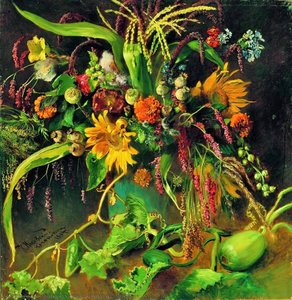
Muzea Miasto Dzieła artysty Konstantin Makowski Obrazy z tej listy
Ermitaż, Sankt PetersburgErmitaż Sankt Petersburg 7 Peter the Great in His Studio, Peter the Great in His Studio, Portrait of the Mining Engineer Nikolay Teplov
Fine Arts Museums of San Francisco, San FranciscoFine Arts Museums of San Francisco San Francisco 1 The Russian Bride's Attire
Musée d'Orsay, ParyżMusée d'Orsay Paryż 1 Grand Duke Alexis of Russia
Narodowa Galeria Armenii, ErewanNarodowa Galeria Armenii Erewan 1 Muhammed's carpet moving from Mecca to Cairo

Konstantin Makowski na przestrzeni dekad: jeden unikatowy oryginał dla każdego

Dzieła według dekad

Wybierz dekadę, aby zobaczyć dzieło, które ją definiuje.

Obrazy artysty Konstantin Makowski: pytania do galerii

Jakie jest najsłynniejsze dzieło artysty Konstantin Makowski?Odkryj odpowiedź

Emperor Alexander II on His Deathbed (1881). Następne są Happy Arcadia (1890) oraz Peter the Great in His Studio (1870).

W jakim wieku Konstantin Makowski stworzył/a Emperor Alexander II on His Deathbed?Odkryj odpowiedź

42 lat: Emperor Alexander II on His Deathbed pochodzi z 1881, a Konstantin Makowski urodził(a) się w 1839.

Które dziesięć obrazów Konstantin Makowski jest najbardziej znanych?Odkryj odpowiedź

Emperor Alexander II on His Deathbed, Happy Arcadia, Peter the Great in His Studio, Egor Ivanovich Makovsky, Boyar's Wife at the Window, Mother and Daughter in an Interior, Mermaids, Cup of honey, Lady in Black i Children running from the Storm. Powyższy ranking zawiera rok powstania oraz muzeum dla każdego z nich.

Ile znanych dzieł stworzył Konstantin Makowski?Odkryj odpowiedź

Nasz katalog zawiera 393 dzieł artysty Konstantin Makowski, datowanych od 1850 do 1914.

Gdzie można zobaczyć najsłynniejsze oryginały Konstantin Makowski?Odkryj odpowiedź

W większości znajdują się w Ermitaż (Sankt Petersburg), Fine Arts Museums of San Francisco (San Francisco) i Musée d'Orsay (Paryż). Powyższa tabela muzeów zawiera ich pełną listę.

W jakim okresie Konstantin Makowski stworzył/a swoje najsłynniejsze obrazy?Odkryj odpowiedź

W 1870s: 35 z 100 dzieł na tej stronie powstało w tym czasie, w tym Peter the Great in His Studio.

Który z najsłynniejszych obrazów artysty Konstantin Makowski powstał najwcześniej, a który najpóźniej?Odkryj odpowiedź

Na tej stronie najwcześniejszy to Kuzma Minin (1850), a najpóźniejszy Tea Drinking (1914).

Jakie tematy preferował Konstantin Makowski?Odkryj odpowiedź

Portraits (18), Women (14) i Portrait (14), w ramach 100 dzieł na tej stronie.

Jakich materiałów Konstantin Makowski używał najczęściej?Odkryj odpowiedź

Oil On Canvas, dla 30 z 100 dzieł na tej stronie.

Do jakiego nurtu należy twórczość Konstantin Makowski?Odkryj odpowiedź

Realism i Romanticism, sądząc po oryginałach na tej stronie.

Jakie oryginały Konstantin Makowski można zobaczyć w Ermitaż?Odkryj odpowiedź

Peter the Great in His Studio, Peter the Great in His Studio i Portrait of the Mining Engineer Nikolay Teplov: Ermitaż, Sankt Petersburg posiada 5 dzieł widocznych na tej stronie.

Konstantin Makowski: portret artysty

A Life Immersed in Russian Realism: The World of Konstantin Makovsky

Konstantin Yegorovich Makovsky, urodzony w 1839 roku w Moskwie, w rodzinie o silnych artystycznych korzeniach, stał się jednym z najbardziej cenionych i dochodzących majątku malarzy swojej epoki. Jego ojciec, Egor Ivanowicz Makovsky, był amatorskim artystą i kluczową postacią w ustanawianiu fundamentów edukacji artystycznej w Moskwie, a jego matka pielęgnowała zamiłowanie do harmonii i ekspresji u młodego Konstanina. Ta podwojna inspiracja – wizualne sztuki od ojca i głęboka wrażliwość muzyczna od matki – ukształtowała jego artystyczną wrażliwość, która przeniknęła przez całą jego twórczość. Rodzinna atmosfera kreatywna wykraczała poza Konstanina; jego bracia Władysław i Nikołaj również podjęli kariery malarskie, a siostra Aleksandra tworzyła z nimi zespół artystyczny, tworząc dynastię talentów. Już od najmłodszego wieku Makovsky wykazywał wyjątkowe zdolności, wprowadzając się do Moskwyńskiej Szkoły Malarstwa, Rzeźby i Architektury w wieku dwunastu lat, gdzie rozwinął się pod okiem Karla Bryullowa i Wasilija Tropinina. Bryullov zainspirował go do romantyzmu i dekoracyjności, cech, które subtelnie wpłynęły na jego późniejsze, bardziej realistyczne prace.

From Academic Roots to the Wanderers' Path

Makovsky kontynuował swoją edukację artystyczną w Imperialnej Akademii Sztuk Pięknych w Sankt Petersburgu, rozpoczynając ją w 1858 roku. Tam tworzył ważne wczesne dzieła, takie jak *Ukaranie Ślepego* (1860) i *Agenci Fałszywego Dmitri zabijają syna Borisa Godunowa* (1862), prezentując rozwijającą się umiejętność kompozycji narracyjnej i historycznej szczegółowości. Jednak jego udział w „Powstaniu Czternastu” w 1863 roku zdefiniował jego artystyczną ścieżkę. Wraz z trzynaścioma innymi studentami Makovsky stanął przeciwko restrykcyjnemu skupieniu Akademii na tematach mitologicznych, zamiast tego malując życie codzienne i realia rosyjskie. Ten akt buntu oznaczał zaangażowanie w wolność artystyczną i otworzył drogę do jego afiliacji z *Wandererami* – grupą artystów poświęconych bezpośredniemu dostarczaniu sztuki ludowi poprzez wystawy podróżne. Ruch ten miał na celu odłączenie się od akademickich ograniczeń i poruszenie kwestii społecznych, odzwierciedlając zmieniające się prądy rosyjskiego społeczeństwa. Prace Makovsky wcześniecej fazy idealnie wpisywały się w tę etos, koncentrując się na scenach życia codziennego – trudach i triumfach zwykłych Rosjan – jak to pokazują obrazy *Widowka* (1865) i *Sprzedawca Heringów* (1867).

Capturing the Soul of Russia: Themes and Style

Przez całą karierę Makovsky’ego jego dzieła służyły jako okno na rosyjskie życie, szczególnie jego bogatą historię i kulturę. Posiadał niezwykłą zdolność uchwycenia niuansów rosyjskiego charakteru i tradycji. Jego obrazy nie były jedynie przedstawieniami; były wciągającymi doświadczeniami, które przenosili widzów do tętniących życiem targowisk, okazałych wesel lub intymnych spotkań rodzinnych. *Rosyjska Panna Pierwotna* (1889), znana również jako *Pod Koroną*, jest doskonałym przykładem – rozbudowaną kompozycją przedstawiającą przedślubne rytuały, pełną symboliki i żywych kolorów. Podobnie obrazy takie jak *Wesele Bojarskie, Ceremonia Przyjęcia, Przed Weselem* demonstrują jego fascynację rosyjskimi zwyczajami i uroczystościami. Chociaż początkowo związany z celem *Wandererów* skupiającym się na realizmie społecznym, styl Makovsky’ego ewoluował z czasem. Podróż do Egiptu i Serbii w latach 80. XIX wieku wywołała przesunięcie w kierunku eksploracji problemów artystycznych związanych z kolorem i formą, prowadząc do bardziej wyrafinowanych i dekoracyjnych kompozycji. Ta transformacja, choć przyniosła mu szerokie uznanie i sukces finansowy, spotkała się również z krytyką ze strony niektórych osób, które uważali, że stracił dotychczasowe zaangażowanie w ideę ruchu.

Recognition and a Tragic End

Do końca XIX wieku Konstantin Makovsky był powszechnie uznawany za najbardziej cenionego i najlepiej opłaconego artystę w Rosji. Jego umiejętność uchwycenia zarówno historycznej wielkości, jak i intymnych ludzkich emocji rezonowała z publicznością na całym świecie. Kulminacyjnym momentem jego uznania było wystawa Światowa w Paryżu w 1889 roku, gdzie otrzymał Duży Złoty Medal za *Śmierć Iwana Groźnego*, *Osąd nad Paris* i *Demon i Tamara*. Dzieła te prezentowały jego mistrzostwo kompozycji, dramatyczne oświetlenie i głębię psychologiczną. Jednak życie Makovsky’ego zostało tragicznie skrócone w 1915 roku. Podczas podróży po Sankt Petersburgu jego powóz z koni uległ wypadkowi samochodowemu, w wyniku którego doszło do poważnych obrażeń. Zmarł w 1915 roku w Sankt Petersburgu. Jego nagła śmierć zakończyła niezwykłą karierę, która na stałe wpisała się w historię rosyjskiej sztuki.

Legacy and Influence

Dziedzictwo Konstanina Makovsky’ego wykracza poza jego imponujący zbiór dzieł. Odegrał kluczową rolę w kształtowaniu krajobrazu rosyjskiej sztuki w okresie znaczących zmian społecznych i politycznych. Jego zaangażowanie w przedstawianie życia rosyjskiego, połączone z umiejętnościami technicznymi i wizją artystyczną, zainspirowały pokolenia artystów. *On zawarł most między tradycją akademicką a nowym realizmem*, otwierając drogę dla przyszłych eksploracji tożsamości narodowej i dziedzictwa kulturowego w sztuce. Dziś obrazy Makovsky’ego są przechowywane w renomowanych muzeach i prywatnych kolekcjach na całym świecie, nadal fascynując widzów swoją piękną, szczegółową i głęboką świadomością ludzkiej kondycji. Jego dziedzictwo trwa jako dowód siły sztuki do odzwierciedlania, zachowywania i celebrowania bogactwa kultury rosyjskiej.