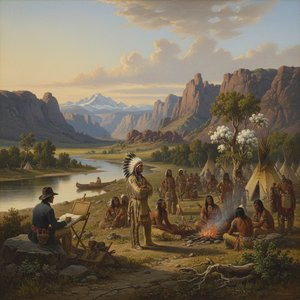
A Swiss Eye on the American West: The Life and Art of Karl Bodmer
Johann Carl Bodmer, a name perhaps less familiar than some of his contemporaries, nevertheless holds a unique place in art history as one of the first European artists to meticulously document the landscapes and cultures of the American West. Born in Zurich, Switzerland, in 1809, Bodmer’s life was inextricably linked to adventure, scientific inquiry, and a profound respect for the vanishing world he sought to capture on paper. His early years were shaped by his uncle, Johann Jakob Meier, an engraver who instilled in him a rigorous attention to detail and a mastery of draftsmanship – skills that would prove invaluable during his extraordinary journey with Prince Maximilian zu Wied-Neuwied. Initially recognized for his picturesque views of the Rhine and Moselle valleys, meticulously etched and published as travel albums, Bodmer’s talent quickly caught the eye of the ambitious prince, who envisioned an expedition to explore the vast interior of North America.Journey to the Missouri: Documenting a Vanishing World
In 1832, Bodmer embarked on this remarkable undertaking, joining Prince Maximilian on a daring expedition up the Missouri River. This wasn’t merely a leisurely exploration; it was a carefully orchestrated scientific endeavor, with Bodmer tasked not just as an artist but as a visual chronicler of Native American tribes and the dramatic landscapes they inhabited. For two years, he traveled alongside the prince and his entourage, enduring hardships and witnessing firsthand the challenges faced by these indigenous communities in the face of westward expansion. His role extended far beyond simple illustration; Bodmer became deeply involved in documenting tribal customs, religious ceremonies, and daily life – a task demanding both artistic skill and genuine cultural sensitivity. He meticulously recorded his observations in over 400 drawings and watercolors, capturing everything from sweeping vistas of the Missouri River to intimate portraits of individuals belonging to tribes such as the Mandan, Hidatsa, Sioux, and Blackfeet. The images he produced are remarkable for their accuracy and a subtle understanding of the subjects’ cultures – a testament to Bodmer's dedication and his ability to connect with those he depicted. The expedition wasn’t without its difficulties; supplies were often scarce, weather conditions unpredictable, and encounters with Native American tribes sometimes fraught with tension. Yet, through it all, Bodmer continued to work tirelessly, producing an astonishingly comprehensive visual record of a rapidly changing world.Artistic Style and Influences: Romanticism Meets Ethnography
Bodmer’s artistic style is a fascinating synthesis of Romantic ideals and ethnographic observation. Rooted in the Romantic tradition—characterized by an emphasis on emotion, individualism, and a deep appreciation for nature—his work transcends mere aesthetic beauty. It's infused with a keen awareness of cultural context and a desire to represent Native American societies with respect and dignity. The influence of earlier landscape painters like Caspar David Friedrich is evident in his dramatic compositions – the sweeping skies, the evocative use of light and shadow – while his portraiture reveals a sensitivity to human expression reminiscent of artists such as Jean-Auguste-Dominique Ingres. However, what truly distinguishes Bodmer’s work is its meticulous attention to detail—not just in terms of physical appearance but also in capturing the nuances of tribal customs, clothing, tools, and ceremonial objects. He wasn't simply painting landscapes or portraits; he was creating visual documents that offered invaluable insights into the material culture and social structures of these tribes. The combination of Romantic aesthetics with ethnographic precision makes Bodmer’s work uniquely valuable—a testament to his artistic skill and intellectual curiosity.Legacy and Rediscovery: A Lasting Impact
Despite the immense effort invested in the expedition and the subsequent publication of Prince Maximilian's *Travels in the Interior of North America*, illustrated with Bodmer’s aquatints, the work initially received a muted response. The book was expensive and failed to achieve widespread popularity, leading to financial hardship for both men. Bodmer, disillusioned by the lack of recognition, eventually settled in Barbizon, France, joining the ranks of artists associated with the Barbizon school—known for their plein air painting and realistic depictions of rural life. While he continued to paint and exhibit his work, Bodmer’s contributions to American history remained largely overlooked for many years. It wasn't until the 20th century that his art began to receive the critical attention it deserved. Today, Bodmer’s paintings and watercolors are celebrated as invaluable historical documents—a crucial visual record of Native American cultures before they were irrevocably altered by colonization. Museums around the world, including the Joslyn Art Museum in Omaha and collections in Switzerland, proudly display his work, ensuring that his legacy endures. His images offer a poignant glimpse into a vanishing world, reminding us of the importance of preserving cultural heritage and understanding diverse perspectives.- His images provide a crucial visual record of Native American cultures before they were irrevocably altered by colonization.
- Bodmer’s meticulous attention to detail and artistic skill continue to inspire artists and scholars alike.
- He stands as a testament to the power of art to document, preserve, and illuminate the human experience.