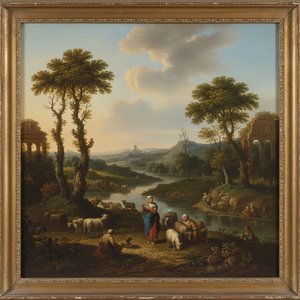
The Inventive Hand of a Dutch Painter
Jan van Nickelen was more than a mere practitioner of the Dutch Golden Age; he was a man of technical restlessness. Born in Haarlem in 1655, his early training was a direct inheritance from his father, Isaak van Nickelen. This was no casual apprenticeship. His father did not just teach him the brush; he provided the mathematical foundation of perspective that would define his spatial logic. Beyond the canvas, Jan was an experimentalist. He sought to disrupt textile production through innovation, though a lack of capital prevented these ideas from reaching the market. He was a man constantly testing the limits of his materials, even developing a specific hard varnish to suit his unique technical demands.
This technical curiosity led him to create chassinets—painted silk backdrops designed for shadow plays and decorative room screens. These were not standard paintings. They were functional, tactile objects that merged fine art with interior design. His ability to manipulate light and surface through these silk screens earned him the attention of the highest circles, including Johann Wilhelm, the Elector Palatine. Through connections with figures like Herman van der Mijn, Jan moved from the local guilds of Haarlem to the courts of Europe.
A Career of Movement and Patronage
The trajectory of Jan's life followed the shifting centers of European power. After becoming a member of the Haarlem Guild of St. Luke in 1688, his professional path took him through Dusseldorp and eventually to Kassel in 1716. His work was often tied to the specific needs of his patrons. He did not just paint scenes; he fulfilled commissions for large-scale screens depicting the properties of his clients. This was art as a tool of status and spatial decoration.
His final years were spent in the service of the Landgrave in Kassel. For five years, he worked on the decorations for the residence "Slot Winterkaste." His death in 1721 cut these projects short, leaving behind a legacy defined by technical versatility rather than a single, narrow genre. Even his family was steeped in this professional rigor; his daughter, Jacoba Maria van Nickelen, became a flower painter, trained by Herman van der Mijn.
Pytania i odpowiedzi
Czy mogę przeglądać dzieła Jan van Nickelen według słów kluczowych?
Strona Według słów kluczowych artysty Jan van Nickelen grupuje jego dzieła według słów kluczowych.
Jakich kolorów Jan van Nickelen używał najczęściej?
Profil kolorystyczny twórczości Jan van Nickelen można zobaczyć na stronie Genom Palety artysty.
Czy dostępna jest wirtualna wycieczka 3D po dziełach Jan van Nickelen?
Wirtualna Galeria 3D artysty Jan van Nickelen to strona prezentująca jego dzieła w wirtualnej galerii trójwymiarowej.
Jak mogę znaleźć dzieła artysty Jan van Nickelen w konkretnej palecie barw?
Aby znaleźć prace artysty Jan van Nickelen w konkretnej palecie barw, skorzystaj ze strony Według palet kolorystycznych poświęconej temu artyście.