Portret Jakob Van Strij

40 najsłynniejszych obrazów artysty Jakob Van Strij, każdy niepowtarzalny

Aktualizacja: Listopad 2026 · ranking według naszego wskaźnika popularności (liczba wyszukiwań, wizyt i zamówień dla każdego dzieła) · 41 dzieł Jakob Van Strij w naszym katalogu

W skrócie

The yacht of the Chamber of Rotterdam for the Dutch East India Company salutes an East-Indiaman and a Dutch man-of-war on the roadstead of Hellevoetsluis. to obraz autorstwa Jakob Van Strij, który przyciąga najwięcej spojrzeń; oryginał znajduje się w Maritime Museum Rotterdam, Rotterdam. Następnie wzrok kieruje się na Landscape with Cattle (1800) i Dutch River landscape with cows (1781). Spośród 41 dzieł Jakob Van Strij w naszym katalogu, tych 40 jest najbardziej znanych – każde z nich to unikatowy oryginał, przedstawiony wraz z rokiem powstania, muzeum oraz powodem, dla którego przetrwało próbę czasu.

1756 – 1815, Dordrecht Najwięcej dzieł: Dordrechts Museum

10 najlepszych obrazów autorstwa Jakob Van Strij według oka galerii

1
The yacht of the Chamber of Rotterdam for the Dutch East India Company salutes an East-Indiaman and a Dutch man-of-war on the roadstead of Hellevoetsluis. autorstwa Jakob Van Strij

The yacht of the Chamber of Rotterdam for the Dutch East India Company salutes an East-Indiaman and a Dutch man-of-war on the roadstead of Hellevoetsluis.

Oil On Canvas · Maritime Museum Rotterdam, Rotterdam

Introduction Jacob van Strij Dordrecht was a Dutch painter, printmaker, and draftsman born in 1756. He was known for his landscapes, maritime scenes, and portraits. One of his most famous works is "The Yacht of the Chamber of Rotterdam for the Dutch East India Company Salutes an East-Indiaman and a Dutch Man-of-War on the Roadstead of Hellevoetsluis." Historical Context During the 17th century, the Dutch East India Company (VOC) was…

2
Landscape with Cattle (1800) autorstwa Jakob Van Strij

Landscape with Cattle

1800 · Metropolitan Museum of Art, Nowy Jork

Landscape with Cattle is an artwork by Jacob van Strij. The painting was created probably ca. 1800. This work is an oil on wood composition that measures 80 x 107.3 cm. The artist, Jacob van Strij, was born in Dordrecht, Dutch Republic, and lived from 2 October 1756 to 4 February 1815.

3
Dutch River landscape with cows (1781) autorstwa Jakob Van Strij

Dutch River landscape with cows

1781 · Oil On Canvas

The composition centers on a riverbank in the Dutch countryside, where the land meets a wide, open sky. In the foreground, several figures and livestock occupy the immediate space. Two women and a man are positioned near a group of cows and sheep, tending to the animals. The livestock is rendered with attention to texture, from the coarse fur of the cows to the soft wool of the sheep. To…

4
Equestrian Portrait of Cornelis (1639–1680) and Michiel Pompe van Meerdervoort (1638–1653) with Their Tutor and Coachman ("Starting for the Hunt") (1794) autorstwa Jakob Van Strij

Equestrian Portrait of Cornelis (1639–1680) and Michiel Pompe van Meerdervoort (1638–1653) with Their Tutor and Coachman ("Starting for the Hunt")

1794 · Oil On Canvas · Dordrechts Museum, Dordrecht

In this 1652 oil on canvas, we find ourselves observing a quiet, yet charged, moment of preparation. Two young men, Cornelis and Michiel Pompe van Meerdervoort, sit astride their horses, poised for a hunt. There is a certain stillness in their posture that suggests the anticipation of movement. They are accompanied by a tutor and a coachman, figures who ground the composition and provide a sense of social order. The…

5
Cows at Pasture (1800) autorstwa Jakob Van Strij

Cows at Pasture

1800 · Oil · Muzeum Narodowe w Krakowie, Kraków

The landscape unfolds in muted, naturalistic tones, where ochre and sienna earth meets a hazy, atmospheric sky of soft blues and greys. In the center-right, a large, light-colored cow is rendered in profile, its anatomical details—ribs and udder—suggested through precise, painterly brushstrokes. To the far left, a second cow rests upon the ground, while on the far right, a seated figure appears partially obscured, tending to the task at hand.…

Słynne obrazy artysty Jakob Van Strij, od 11 do 40

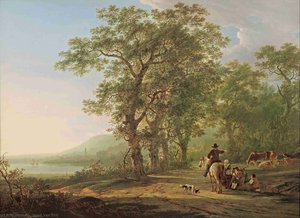
11Landscape with cows resting a the bank of the river (Oude) Maas, in the backgrouns Dordrecht (1793) autorstwa Jakob Van StrijLandscape with cows resting a the bank of the river (Oude) Maas, in the backgrouns Dordrecht1793 · Dordrechts Museum 12River landscape near Dordrecht, with a horseman and cattle (1793) autorstwa Jakob Van StrijRiver landscape near Dordrecht, with a horseman and cattle1793 · Dordrechts Museum 13Cattle resting on a bank (1793) autorstwa Jakob Van StrijCattle resting on a bank1793 · Amsterdam Museum 14Cattle in a Landscape (1800) autorstwa Jakob Van StrijCattle in a Landscape1800 · Attingham Park 15Landscape with River and Trees in the Vicinity of Dordrecht (1810) autorstwa Jakob Van StrijLandscape with River and Trees in the Vicinity of Dordrecht1810 · Dordrechts Museum 16The Discharge of Water from the Alblasserwaard Flooded on 30 January 1809 through the Sluices of Elshout (1809) autorstwa Jakob Van StrijThe Discharge of Water from the Alblasserwaard Flooded on 30 January 1809 through the Sluices of Elshout1809 · Dordrechts Museum 17Landscape with Cows near a Ruin (1807) autorstwa Jakob Van StrijLandscape with Cows near a Ruin1807 · Rijksmuseum 18Landscape with Figures autorstwa Jakob Van StrijLandscape with FiguresDordrechts Museum 19Italianizing Landscape with Shepherd, Shepherd Boy and Cows autorstwa Jakob Van StrijItalianizing Landscape with Shepherd, Shepherd Boy and CowsDordrechts Museum 20Italianizing Landscape with Rider and Some Resting Travelers and a Building on the Left in the Background autorstwa Jakob Van StrijItalianizing Landscape with Rider and Some Resting Travelers and a Building on the Left in the BackgroundDordrechts Museum 21Italianizing Landscape with a Ruin and a Three-Masted Ship in the Background autorstwa Jakob Van StrijItalianizing Landscape with a Ruin and a Three-Masted Ship in the BackgroundDordrechts Museum 22Landscape with shepherds and cattle at water autorstwa Jakob Van StrijLandscape with shepherds and cattle at water 23Pastoral scene autorstwa Jakob Van StrijPastoral sceneMuzeum Narodowe w Warszawie 24Figures in a forest landscape autorstwa Jakob Van StrijFigures in a forest landscapeArt Gallery of South Australia 25Landscape with a Shepherd (1800) autorstwa Jakob Van StrijLandscape with a Shepherd1800 · Rijksmuseum 26Dutch Landscape with Cattle near Farmhouse autorstwa Jakob Van StrijDutch Landscape with Cattle near FarmhouseDordrechts Museum 27Landscape with Entrance Gate to a Castle autorstwa Jakob Van StrijLandscape with Entrance Gate to a CastleDordrechts Museum 28Cattle near a River autorstwa Jakob Van StrijCattle near a RiverGaleria Dulwich 29Pastoral scene autorstwa Jakob Van StrijPastoral sceneMuzeum Narodowe w Warszawie 30Untitled (494) autorstwa Jakob Van StrijUntitled (494)Dordrechts Museum 31Two Boeiers and a Cat under Sail autorstwa Jakob Van StrijTwo Boeiers and a Cat under Sail 32Landscape with Cattle, Sheep, and Herders autorstwa Jakob Van StrijLandscape with Cattle, Sheep, and Herders 33Autumn Landscape autorstwa Jakob Van StrijAutumn LandscapeDordrechts Museum 34Wooded Landscape with Resting Cattle autorstwa Jakob Van StrijWooded Landscape with Resting Cattle 35Landscape with cattle driver and shepherd. autorstwa Jakob Van StrijLandscape with cattle driver and shepherd.Rijksmuseum 36Milking time autorstwa Jakob Van StrijMilking timeRijksmuseum 37Pastureland with cattle autorstwa Jakob Van StrijPastureland with cattleRijksmuseum 38Cattle and a Donkey in a Landscape autorstwa Jakob Van StrijCattle and a Donkey in a Landscape 39Dutch Landscape with Figures autorstwa Jakob Van StrijDutch Landscape with FiguresSmithsonian American Art Museum 40Landscape with Cattle autorstwa Jakob Van StrijLandscape with CattleMetropolitan Museum of Art

Tematy, które przyciągnęły wzrok Jakob Van Strij

Cztery motywy najczęściej powracające w tych oryginałach, z których każdy doczekał się swojego najdoskonalszego przykładu.

Muzea przechowujące oryginały Jakob Van Strij

8 muzeów, w których znajduje się najwięcej obrazów z tej strony.

Muzea Miasto Dzieła artysty Jakob Van Strij Obrazy z tej listy
Dordrechts Museum, DordrechtDordrechts Museum Dordrecht 17 Equestrian Portrait of Cornelis (1639–1680) and Michiel Pompe van Meerdervoort (1638–1653) with Their Tutor and Coachman ("Starting for the Hunt"), Winter Landscape with Children on the Ice under a Bridge, Mountainous Landscape with River
Rijksmuseum, AmsterdamRijksmuseum Amsterdam 5 Landscape with Cows near a Ruin, Landscape with a Shepherd, Landscape with cattle driver and shepherd.
Metropolitan Museum of Art, Nowy JorkMetropolitan Museum of Art Nowy Jork 2 Landscape with Cattle, Landscape with Cattle
Muzeum Narodowe w Warszawie, WarszawaMuzeum Narodowe w Warszawie Warszawa 2 Pastoral scene, Pastoral scene
Maritime Museum Rotterdam, RotterdamMaritime Museum Rotterdam Rotterdam 1 The yacht of the Chamber of Rotterdam for the Dutch East India Company salutes an East-Indiaman and a Dutch man-of-war on the roadstead of Hellevoetsluis.
Muzeum Narodowe w Krakowie, KrakówMuzeum Narodowe w Krakowie Kraków 1 Cows at Pasture
Rijksmuseum Twenthe, EnschedeRijksmuseum Twenthe Enschede 1 Meadow Landscape with Cattle
Amsterdam Museum, AmsterdamAmsterdam Museum Amsterdam 1 Cattle resting on a bank

Jakob Van Strij na przestrzeni dekad: jeden unikatowy oryginał dla każdego

Dzieła według dekad

Wybierz dekadę, aby zobaczyć dzieło, które ją definiuje.

Obrazy artysty Jakob Van Strij: pytania do galerii

Jakie jest najsłynniejsze dzieło artysty Jakob Van Strij?Odkryj odpowiedź

The yacht of the Chamber of Rotterdam for the Dutch East India Company salutes an East-Indiaman and a Dutch man-of-war on the roadstead of Hellevoetsluis., Maritime Museum Rotterdam, Rotterdam. Następne są Landscape with Cattle (1800) oraz Dutch River landscape with cows (1781).

Które dziesięć obrazów Jakob Van Strij jest najbardziej znanych?Odkryj odpowiedź

The yacht of the Chamber of Rotterdam for the Dutch East India Company salutes an East-Indiaman and a Dutch man-of-war on the roadstead of Hellevoetsluis., Landscape with Cattle, Dutch River landscape with cows, Equestrian Portrait of Cornelis (1639–1680) and Michiel Pompe van Meerdervoort (1638–1653) with Their Tutor and Coachman ("Starting for the Hunt"), Cows at Pasture, Meadow Landscape with Cattle, Winter Landscape with Children on the Ice under a Bridge, Mountainous Landscape with River, Summer Landscape outside Dordrecht i Harbor View with Ships in Calm Water near a Quay. Powyższy ranking zawiera rok powstania oraz muzeum dla każdego z nich.

Ile znanych dzieł stworzył Jakob Van Strij?Odkryj odpowiedź

Nasz katalog zawiera 41 dzieł artysty Jakob Van Strij, datowanych od 1781 do 1810.

Gdzie można zobaczyć najsłynniejsze oryginały Jakob Van Strij?Odkryj odpowiedź

W większości znajdują się w Dordrechts Museum (Dordrecht), Rijksmuseum (Amsterdam) i Metropolitan Museum of Art (Nowy Jork). Powyższa tabela muzeów zawiera ich pełną listę.

W jakim okresie Jakob Van Strij stworzył/a swoje najsłynniejsze obrazy?Odkryj odpowiedź

W 1790s: 9 z 40 dzieł na tej stronie powstało w tym czasie, w tym Equestrian Portrait of Cornelis (1639–1680) and Michiel Pompe van Meerdervoort (1638–1653) with Their Tutor and Coachman ("Starting for the Hunt").

Który z najsłynniejszych obrazów artysty Jakob Van Strij powstał najwcześniej, a który najpóźniej?Odkryj odpowiedź

Na tej stronie najwcześniejszy to Dutch River landscape with cows (1781), a najpóźniejszy Landscape with River and Trees in the Vicinity of Dordrecht (1810).

Jakie tematy preferował Jakob Van Strij?Odkryj odpowiedź

Landscape (8), Animals (4) i Sky (3), w ramach 40 dzieł na tej stronie.

Jakich materiałów Jakob Van Strij używał najczęściej?Odkryj odpowiedź

Oil On Canvas, dla 5 z 40 dzieł na tej stronie.

Jakie oryginały Jakob Van Strij można zobaczyć w Dordrechts Museum?Odkryj odpowiedź

Equestrian Portrait of Cornelis (1639–1680) and Michiel Pompe van Meerdervoort (1638–1653) with Their Tutor and Coachman ("Starting for the Hunt"), Winter Landscape with Children on the Ice under a Bridge i Mountainous Landscape with River: Dordrechts Museum, Dordrecht posiada 17 dzieł widocznych na tej stronie.

Jakob Van Strij: portret artysty

Mistrz zimowego objęcia: Życie i dziedzictwo Jakoba Van Strija

W cichych, dotkniętych mrozem krajobrazach późnego osiemnastowiecznego okresu, niewielu artystów potrafiło uchwycić ulotne piękno holenderskiego cyklu pór roku tak przejmująco, jak Jakob Van Strij. Urodzony w historycznym mieście Dordrecht 2 października 1756 roku, Van Strij był malarzem, którego dusza zdawała się nierozerwalnie związana ze zmianami atmosferycznymi Niderlandów. Wywodził się z linii artystycznego oddania, będąc synem Leenderta van Strija, szanowanego malarza i rysownika, który zapewnił mu wczesną edukację. To rodzinne fundamenty, w połączeniu z obecnością jego brata Abrahama – współzałożyciela prestiżowego towarzystwa rysunkowego Pictura Dordrecht – sprawiły, że wychowanie Jakoba było przesiąknięte rygorystycznymi tradycjami holenderskiej sztuki wizualnej.

Jego droga ku artystycznej dojrzałości zaprowadziła go poza granice ojczyzny, do tętniącej życiem akademickiej atmosfery Antwerpii. Między latami 1774 a 1776 Van Strij uczęszczał na zajęcia Andriesa Cornelisa Lensa w Akademii Sztuk Pięknych. To właśnie w tym formacyjnym okresie jego biegłość techniczna zaczęła łączyć się z głęboką wrażliwością na światło. Pod okiem tak wybitnych mentorów opanował klasyczne zasady kompozycji oraz delikatną grę cieni – umiejętności, które pozwoliły mu później tchnąć życie w zamarznięte rzeki i zamglone pastwiska, stające się jego znakiem rozpoznawczym.

Wizja zakorzeniona w Złotym Wieku

Choć Van Strij żył i tworzył w okresie przejścia od późnego baroku do wczesnego rokoka, jego artystyczne serce pozostało zakotwiczone w uwielbieniu dla Złotego Wieku Holandii. Spoglądał wstecz, ku mistrzom siedemnastego wieku, aby odnaleźć drogę w przyszłość, czerpiąc ogromną inspirację z perspektywy powietrznej Alberta Cuypa oraz dramatycznego światłocienia Rembrandta van Rijna. Ta więź z przeszłością jest widoczna w jego zdolności do manipulowania światłem, które służyło mu nie tylko jako oświetlenie formy, ale jako nośnik emocji i nastroju pór roku.

Jego dorobek charakteryzuje się niezwykłą wszechstronnością tematyczną, choć najbardziej słynie z konkretnych gatunków, które przywołują poczucie ponadczasowego spokoju:

  • Pejzaże zimowe: Być może jego najbardziej trwały wkład; prace te oddają ciszę świata spowitego śniegiem, gdzie przenikliwy chłód jest łagodzony przez ciepło subtelnego, promiennego światła.
  • Malarstwo marynistyczne: Wykazując się keenym okiem do morskiego dziedzictwa Niderlandów, z wielką precyzją oddawał ruch wody oraz majestat statków.
  • Sceny pasterskie: Jego przedstawienia bydła, pasterzy i życia wiejskiego odzwierciedlają głęboki szacunek dla rytmów natury i cichej godności prowincji.

Osiągnięcia artystyczne i znaczenie historyczne

Poza technicznym kunsztem jako malarz, rytownik i rysownik, Jakob Van Strij był uważany przez współczesnych za człowieka o wielkim intelekcie i kulturze. Był osobą szeroko wykształconą, która współtworzyła życie intelektualne Dordrechtu, wygłaszając odczyty w Teekengenootschap Pictura na temat zawiłości mitologii oraz nieprzemijającego geniuszu Dawnych Mistrzów. Ta dualność – bycia skrupulatnym obserwatorem natury i uczonym kustoszem historii sztuki – pozwoliła mu tworzyć dzieła, które były jednocześnie wizualnie urzekające i głęboko osadzone w intelektualnej tradycji.

Choć jego życie dobiegło końca w 1815 roku, wpływ Van Strija trwa nadal w licznych kolekcjach, w których spoczywają jego skarby, od Dordrechts Museum po Smithsonian American Art Museum. Jego zdolność do przekształcania prostego krajobrazu w głęboką medytację nad światłem i porami roku zapewnia mu miejsce w kanonie holenderskiej sztuki. Nie malował on jedynie tego, co widział; malował odczucie wiatru, ciężar śniegu i nieustanny spokój holenderskiego krajobrazu, pozostawiając po sobie dziedzictwo, które nieustannie budzi zachwyt w każdym, kto na nie spojrzy.