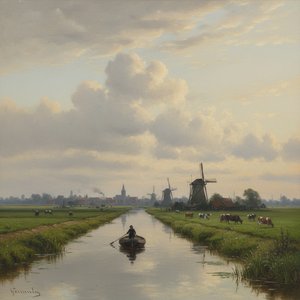
The Painter of Air
Copenhagen, 1868. A boy named Henry Jacob Knudsen watches the water and the ships with an intensity that foreshadows a life spent chasing horizons. He enters the Royal Danish Academy of Fine Arts in 1884, but the halls of academia cannot contain his restlessness. By 1886, lacking the recognition he seeks, he turns away from the classroom and toward the sea. The transition is sudden. He becomes a sailor, then a captain, navigating the Atlantic with a schooner of his own. This is not merely travel; it is a search for light.
The salt spray and the shifting tides become his true instructors. He moves through the world not as a tourist, but as an observer of atmosphere. He eventually adopts his mother's name, Brokmann, in 1892, a change that marks his emergence as a distinct figure on the canvas. His eyes are fixed on the way light dissolves form, finding deep inspiration in the works of Claude Lorrain and Turner. He begins to call himself the painter of the air.
Atmosphere and Exploration
The sails of his schooner carry him to remote corners of the globe. He seeks out island groups that few eyes have seen before. In Luxor, he establishes a studio, anchoring himself in the heat of Egypt to capture the desert's breath. The Sahara becomes another stage for his experiments with light and shadow. His work focuses on the intangible—the haze, the mist, and the weight of the sky.
His compositions often center on specific, geographically anchored moments:
- The rugged cliffs and coastal light of Ajaccio.
- The shaded depths of Sous-bois.
- The sun-drenched landscapes of Corsica, such as the house at Piana.
- The tranquil waters near Lake Garda.
There is a physical presence to his travels. He does not just paint scenes; he inhabits them. Whether it is the port of Palermo in 1907 or the rocky terrain of Seis, the atmosphere is the primary subject. The landscape serves as the medium through which the air itself is rendered visible.
A Life Between Sea and Canvas
Wealth, acquired through marriage, provides the means to sustain this nomadic existence. He possesses the freedom to sail his own vessel across the Atlantic, hunting for motifs that defy easy capture. This independence allows him to move between the Mediterranean and the African desert with ease. His career is a sequence of arrivals in new lands, each bringing a different quality of light to his palette.
The end comes in Bolzano, 1933. He leaves behind a body of work that remains anchored in the fleeting moments of the natural world. His paintings, such as those held in the Petit Palais in Paris, remain as records of a life lived in pursuit of the sky.
Pytania i odpowiedzi
Gdzie mogę zobaczyć wszystkie dzieła Henry Brokmann?
Wszystkie dzieła Henry Brokmann dostępne w niniejsza strona można przeglądać na stronie Wszystkie dzieła artysty.
Czy mogę przeglądać dzieła Henry Brokmann według kolorów?
Indeks kolorystyczny artysty Henry Brokmann to strona, która porządkuje jego dzieła według kolorów.
Gdzie można znaleźć dzieła Henry Brokmann pogrupowane według tematów?
Atlas tematów artysty Henry Brokmann to strona, która grupuje dzieła artysty według ich tematyki.
Czy mogę przeglądać dzieła Henry Brokmann według palety kolorystycznej?
Aby znaleźć prace artysty Henry Brokmann w konkretnej palecie barw, skorzystaj ze strony Według palet kolorystycznych poświęconej temu artyście.