Portret Gustave Boulanger

28 najsłynniejszych obrazów artysty Gustave Boulanger – wybór z galerii

Aktualizacja: Listopad 2026 · ranking według naszego wskaźnika popularności (liczba wyszukiwań, wizyt i zamówień dla każdego dzieła) · 28 dzieł Gustave Boulanger w naszym katalogu

W skrócie

Z wszystkich oryginałów pozostawionych przez Gustave Boulanger, najsłynniejszym jest Hercules at the Feet of Omphale (1861). Tuż za nimi znajdują się Galatea and the Shepherd Acis (1860) oraz Charles Garnier (1884). Nasz katalog zawiera 28 dzieł autorstwa Gustave Boulanger; galeria zachowała 28 najbardziej podziwianych na świecie prac, z których każda została przedstawiona wraz z datą powstania, informacją o muzeum oraz jej historią.

1824 – 1888, Paryż Academic painting Najwięcej dzieł: Musée Carnavalet

10 najlepszych obrazów artysty Gustave Boulanger: wybór galerii

1
Hercules at the Feet of Omphale (1861) autorstwa Gustave Boulanger

Hercules at the Feet of Omphale

1861

A Masterpiece of Drama and Intensity The painting Hercules at the Feet of Omphale by Gustave Clarence Rodolphe Boulanger, created in 1861, is a striking example of neoclassical art. This oil on canvas masterpiece captures a pivotal moment from Greek mythology, where Hercules, the legendary hero, finds himself at the mercy of Omphale, the queen of Lydia. Artistic Elements and Symbolism The painting depicts Omphale in a state of nudity,…

2
Galatea and the Shepherd Acis (1860) autorstwa Gustave Boulanger

Galatea and the Shepherd Acis

1860 · Oil

Galatea and the Shepherd Acis is an oil painting by Gustave Boulanger. Executed about 1860, the work belongs to the Academic tradition, reflecting the artist's rigorous training in the French atelier system. Boulanger, a prominent figure in the 19th-century French art establishment, utilized this medium to explore classical themes through a lens of meticulous detail and formal precision.

3
Charles Garnier (1884) autorstwa Gustave Boulanger

Charles Garnier

1884 · Oil On Canvas

In this 1884 portrait, Gustave Boulanger captures the architect Charles Garnier in a moment of quietude. The subject is presented from the chest up, his profile turned toward the right. He exists within an oval vignette, a soft shape emerging from a neutral, textured background. The man’s presence is defined by the weight of his dark coat and the steady set of his features. It is a study of a…

4
The Mother of the Gracchi (1885) autorstwa Gustave Boulanger

The Mother of the Gracchi

1885 · Oil On Canvas · Gothenburg Museum of Art, Gothenburg

In "The Mother of the Gracchi" by Gustave Boulanger, a maternal figure occupies the center of a quiet, classical world. She stands upon weathered stone steps, flanked closely by two young children. This grouping forms a stable, pyramidal arrangement that anchors the scene. The composition is vertical and centered, drawing the eye immediately to the intimate connection between the woman and her children. An eye-level perspective brings the viewer into…

5
Phryne (1850) autorstwa Gustave Boulanger

Phryne

1850 · Oil On Canvas · Van Gogh Museum, Amsterdam

In this 1850 oil painting, a nude woman reclines within a setting defined by heavy drapery and patterned surfaces. The figure is positioned centrally, her body angled amidst a collection of cushions and folded fabrics. Light enters from the upper left, casting shadows that define the contours of her torso and limbs. The skin tones appear luminous, achieved through fine glazing techniques that contrast with the darker, shadowy background. The…

6
Portrait de Madame Lambinet, née Nathalie Sinclair ( 1926), dernière propriétaire de l'hôtel (futur musée Lambinet) autorstwa Gustave Boulanger

Portrait de Madame Lambinet, née Nathalie Sinclair ( 1926), dernière propriétaire de l'hôtel (futur musée Lambinet)

Oil

Nathalie Sinclair, known as Madame Lambinet, sits within a frame of deep, velvet shadows. She wears a black dress, its surface textured with delicate floral patterns that catch the light. A yellow ribbon cinches her neck, a sharp point of color against the dark fabric. She holds a parasol, a quiet accessory of a life lived in the refined spaces of the Second Empire. Behind her, heavy green curtains fall…

Kontynuacja zestawienia Gustave Boulanger, od 11 do 28

Tematy, które przyciągnęły wzrok Gustave Boulanger

Cztery motywy najczęściej powracające w tych oryginałach, z których każdy doczekał się swojego najdoskonalszego przykładu.

Muzea przechowujące oryginały Gustave Boulanger

6 muzeów, w których znajduje się najwięcej obrazów z tej strony.

Muzea Miasto Dzieła artysty Gustave Boulanger Obrazy z tej listy
Musée Carnavalet, ParyżMusée Carnavalet Paryż 5 La Rotonde de la Villette Encircled by the Versailles Troops, The Hôtel de Ville on Fire, Besieged by the Troops of Versailles, Episode of the Commune, Place de la Concorde
Gothenburg Museum of Art, GothenburgGothenburg Museum of Art Gothenburg 1 The Mother of the Gracchi
Van Gogh Museum, AmsterdamVan Gogh Museum Amsterdam 1 Phryne
Musée National Magnin, DijonMusée National Magnin Dijon 1 Ulysse et Euryclée
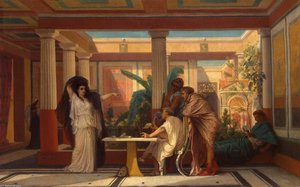
Ermitaż, Sankt PetersburgErmitaż Sankt Petersburg 1 Theatrical Rehearsal in the House of an Ancient Rome Poet
Musée d'Orsay, ParyżMusée d'Orsay Paryż 1 The flute concert

Gustave Boulanger dekada po dekadzie: oryginały definiujące każdy okres

Dzieła według dekad

Wybierz dekadę, aby zobaczyć dzieło, które ją definiuje.

Pytania kolekcjonerów o obrazy Gustave Boulanger

Z jakiego dzieła najbardziej znany jest Gustave Boulanger?Odkryj odpowiedź

Hercules at the Feet of Omphale (1861). Następne są Galatea and the Shepherd Acis (1860) oraz Charles Garnier (1884).

W jakim wieku był Gustave Boulanger, gdy powstało Hercules at the Feet of Omphale?Odkryj odpowiedź

37 lat: Hercules at the Feet of Omphale pochodzi z 1861, a Gustave Boulanger urodził(a) się w 1824.

Jakie są dziesięć najsłynniejszych obrazów, których autorem jest Gustave Boulanger?Odkryj odpowiedź

Hercules at the Feet of Omphale, Galatea and the Shepherd Acis, Charles Garnier, The Mother of the Gracchi, Phryne, Portrait de Madame Lambinet, née Nathalie Sinclair ( 1926), dernière propriétaire de l'hôtel (futur musée Lambinet), La Rotonde de la Villette Encircled by the Versailles Troops, The Hôtel de Ville on Fire, Besieged by the Troops of Versailles, Episode of the Commune, Place de la Concorde i Assault of a Cemetery by Regular Troops, May 1871. Powyższy ranking zawiera rok powstania oraz muzeum dla każdego z nich.

Ile obrazów pozostawił po sobie Gustave Boulanger?Odkryj odpowiedź

Nasz katalog zawiera 28 dzieł artysty Gustave Boulanger, datowanych od 1850 do 1885.

W których muzeach znajdują się arcydzieła Gustave Boulanger?Odkryj odpowiedź

W większości znajdują się w Musée Carnavalet (Paryż), Gothenburg Museum of Art (Gothenburg) i Van Gogh Museum (Amsterdam). Powyższa tabela muzeów zawiera ich pełną listę.

W których latach Gustave Boulanger namalował swoje najsłynniejsze dzieła?Odkryj odpowiedź

W 1870s: 6 z 28 dzieł na tej stronie powstało w tym czasie, w tym La Rotonde de la Villette Encircled by the Versailles Troops.

Jakie są pierwsze i ostatnie słynne oryginały Gustave Boulanger?Odkryj odpowiedź

Na tej stronie najwcześniejszy to Phryne (1850), a najpóźniejszy The Mother of the Gracchi (1885).

Jakie tematy Gustave Boulanger wybierał najczęściej?Odkryj odpowiedź

Woman (4), Classical art (3) i Portraiture (3), w ramach 28 dzieł na tej stronie.

Której techniki Gustave Boulanger używał najczęściej?Odkryj odpowiedź

Oil On Canvas, dla 3 z 28 dzieł na tej stronie.

Do jakiego nurtu artystycznego należy Gustave Boulanger?Odkryj odpowiedź

Academic painting, sądząc po oryginałach na tej stronie.

Które dzieła Gustave Boulanger znajdują się w Musée Carnavalet?Odkryj odpowiedź

La Rotonde de la Villette Encircled by the Versailles Troops, The Hôtel de Ville on Fire, Besieged by the Troops of Versailles i Episode of the Commune, Place de la Concorde: Musée Carnavalet, Paryż posiada 5 dzieł widocznych na tej stronie.

Gustave Boulanger: życie i twórczość

Gustave Boulanger (1824-1888): A Life Immersed in Classical Echoes and Oriental Hues

Gustave Clarence Rodolphe Boulanger, a name resonating with the meticulous detail and dramatic flair of 19th-century Academic painting, was born in Paris in 1824. His early life took a somber turn when he was orphaned at the age of fourteen, finding guardianship under his uncle, Constant Desbrosses. This pivotal moment steered him toward artistic pursuits, beginning formal training in 1840 with Pierre-Jules Jollivet before progressing to the atelier of Paul Delaroche. It was within Delaroche’s studio that a formative friendship blossomed with Jean-Léon Gérôme, an association that would profoundly shape Boulanger's artistic trajectory and aesthetic sensibilities. This connection wasn’t merely one of camaraderie; it represented an alignment of vision within the burgeoning Néo-Grec movement—a revival of classical themes infused with a fresh perspective, often tinged with exoticism and sensuality.

The Seeds of Artistic Vision: Early Influences

Boulanger's artistic development was shaped by formative experiences that instilled in him a deep appreciation for both tradition and innovation. His upbringing amidst the constraints of an orphaned childhood fostered resilience and determination—qualities that would prove invaluable as he embarked on his artistic journey. The École des Beaux-Arts in Paris provided him with foundational training under luminaries like Pierre-Jules Jollivet and Paul Delaroche, equipping him with the technical skills necessary to excel within the Academic framework. Crucially, it was Delaroche’s studio where Boulanger encountered Jean-Léon Gérôme—a fellow student whose unwavering belief in the transformative potential of classical ideals would become a cornerstone of Boulanger's artistic worldview. This partnership wasn’t simply one of shared ambition; it represented an intellectual kinship that fueled their mutual fascination with the revival of Greco-Roman art and its capacity to inspire profound emotional responses.

The Néo-Grec Movement: Classical Revival and Sensual Exploration

The Néo-Grec movement—a reaction against the prevailing Romantic aesthetic—captured Boulanger’s imagination precisely because it dared to reimagine antiquity not merely as a source of moral instruction, but as a realm of sensual beauty and dramatic narrative. Artists like Gérôme and Boulanger championed a stylistic approach that prioritized meticulous draftsmanship, monumental scale, and vibrant color palettes—elements deliberately borrowed from the artistic conventions of Classical Greece and Rome. They rejected the sentimentalism and emotional excess characteristic of Romantic painting, favoring instead a disciplined aesthetic rooted in observation and intellectual rigor. Boulanger’s exploration of classical mythology and history was infused with an unmistakable erotic undertone—a deliberate provocation against prevailing societal norms that sought to suppress desire and celebrate heroism. As Gérôme eloquently articulated, “When they appear on the contemporary art scene, the Néo-Grecs will be defended as rejuvenators of the Classical tradition by some, condemned as gravediggers of history painting by others…they rarely give an orthodox image of Antiquity, some, like Gérôme, Boulanger and Hamon, not hesitating to choose licentious subjects, to parody mythological characters, or to invent very personal allegories of Antiquity.”

A Journey East: Inspiration from Algeria

A transformative voyage to Algeria in 1845 irrevocably altered Boulanger’s artistic trajectory. Initially tasked with managing his uncle’s business affairs—a responsibility that demanded considerable practicality—the expedition unexpectedly ignited a lifelong passion for Orientalist subjects. The vibrant landscapes of the Algerian Sahara, teeming with exotic flora and fauna; the bustling marketplaces overflowing with spices and textiles; and the intricate rituals and customs of Berber communities captivated Boulanger's imagination. This immersive experience served as an indelible catalyst for his artistic creativity—inspiring him to depict scenes from distant lands with unparalleled accuracy and emotional intensity. Unlike many of his contemporaries who approached Orientalism with a detached scholarly gaze, Boulanger embraced its sensual allure and dramatic grandeur—translating the exotic beauty of North Africa onto canvas with breathtaking virtuosity.

Monumental Achievements: Pompeii and Beyond

Boulanger’s artistic ambition culminated in his triumph at the Prix de Rome in 1849—a prestigious scholarship awarded to aspiring painters who demonstrated exceptional talent and adherence to Academic principles. This victory secured him a coveted position at Villa Medici, where he spent several years honing his craft amidst the inspiring surroundings of Florence—the epicenter of Renaissance art and culture. During his time there, Boulanger embarked on ambitious projects that showcased his mastery of monumental painting—most notably *Ulysses*, which cemented his reputation as one of France’s foremost artists. Subsequent commissions for public buildings—including the decorations for the Paris Opera House and five panels illustrating civic virtues—further solidified his influence within the Parisian artistic landscape. Boulanger's magnum opus, *The Slave Market* (1888), exemplifies his unwavering commitment to portraying historical narratives with dramatic grandeur and psychological depth—a testament to his enduring legacy as a champion of Academic art and a visionary interpreter of Classical and Oriental themes. His paintings continue to resonate with audiences today, offering invaluable insights into the artistic sensibilities of the Victorian era and demonstrating the transformative power of tradition combined with intellectual curiosity.