Portret Frederic Sackrider Remington

100 najsłynniejszych obrazów artysty Frederic Sackrider Remington – wybór z galerii

Aktualizacja: Listopad 2026 · ranking według naszego wskaźnika popularności (liczba wyszukiwań, wizyt i zamówień dla każdego dzieła) · 346 dzieł Frederic Sackrider Remington w naszym katalogu

W skrócie

Spośród wszystkich dzieł oryginalnych, które pozostawił Frederic Sackrider Remington, najsłynniejszym jest The Old Stage-Coach of the Plains (1901), znajdujący się w kolekcji Amon Carter Museum of American Art w Fort Worth. Tuż za nimi znajdują się Coming Through the Rye (1902) oraz The Broncho Buster (1895). Nasz katalog zawiera 346 dzieł autorstwa Frederic Sackrider Remington; galeria zachowała 100 najbardziej podziwianych na świecie prac, z których każda została przedstawiona wraz z datą powstania, informacją o muzeum oraz jej historią.

1861 – 1909, Canton (wieś) Najwięcej dzieł: Amon Carter Museum of American Art

10 najlepszych obrazów artysty Frederic Sackrider Remington: wybór galerii

1
The Old Stage-Coach of the Plains (1901) autorstwa Frederic Sackrider Remington

The Old Stage-Coach of the Plains

1901 · Oil On Canvas · Amon Carter Museum of American Art, Fort Worth

In the quiet, silvered shadows of the American West, Frederic Remington’s 1901 masterpiece, The Old Stage-Coach of the Plains, breathes life into a vanishing era. This is not merely a painting of a journey; it is an immersive nocturnal experience that captures the very heartbeat of the frontier. As the eye meets the canvas, one is immediately transported to a desolate, moonlit landscape where the struggle for progress is etched…

2
Coming Through the Rye (1902) autorstwa Frederic Sackrider Remington

Coming Through the Rye

1902 · Bronze · Amon Carter Museum of American Art, Fort Worth

In the heart of Frederic Remington’s prolific career lies a masterpiece that transcends mere sculpture to become a visceral embodiment of the American West. "Coming Through the Rye," created in 1902, is far more than a depiction of movement; it is a testament to courage, resilience, and the relentless pursuit of survival against a formidable landscape. As viewers encounter this bronze work, they are immediately swept into a pivotal scene…

3
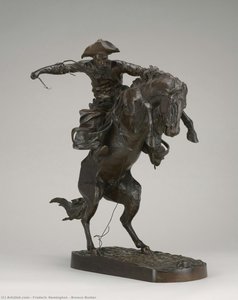
The Broncho Buster (1895) autorstwa Frederic Sackrider Remington

The Broncho Buster

1895 · Bronze · Amon Carter Museum of American Art, Fort Worth

In the heart of the American frontier, where the dust of the plains meets the unyielding spirit of the pioneer, lies the essence of Frederic Remington’s most enduring masterpiece, The Broncho Buster. Sculpted in 1895 and brought to life through the medium of bronze, this work is far more than a mere depiction of a rodeo event; it is a visceral capture of a fleeting moment of pure, unadulterated struggle.…

4
The Trooper (1891) autorstwa Frederic Sackrider Remington

The Trooper

1891 · Oil On Canvas

To gaze upon Frederic Remington's "The Trooper" is not merely to observe a painting; it is to step directly into the heart of the American West at the turn of the twentieth century. This oil on canvas, executed in 1891, captures a moment suspended between action and reflection—a tableau vivant brimming with untamed energy. The scene unfolds under an imagined vast sky, depicting a lone rider astride his powerful horse…

5
The Charge of the Rough Riders (1898) autorstwa Frederic Sackrider Remington

The Charge of the Rough Riders

1898 · Acrylic On Canvas · Frederic Remington Art Museum, Ogdensburg

Frederic Remington’s “The Charge of the Rough Riders” isn't merely a depiction of a pivotal moment in American history; it’s an immersive experience rendered in oil on canvas, capturing the raw energy and determination of Theodore Roosevelt’s expedition to Cuba during the Spanish-American War. Painted in 1898, this artwork transcends simple chronology, becoming a testament to Remington's masterful ability to translate observation into emotive visual storytelling.

6
Hunter’s Supper autorstwa Frederic Sackrider Remington

Hunter’s Supper

Oil On Canvas · National Cowboy - Western Heritage Museum, Oklahoma City

To gaze upon Frederic Remington's depiction of Hunter’s Supper is to be instantly transported across the vast, untamed expanse of the American West. This painting is far more than a mere record of men gathered after a day of pursuit; it is an immersion into the very essence of masculine fellowship and survival under the immense canvas of the wilderness. The central focus, naturally, is the campfire—a beacon of flickering…

7
Fight for the Waterhole (1903) autorstwa Frederic Sackrider Remington

Fight for the Waterhole

1903 · Oil On Canvas · Museum of Fine Arts, Houston

We are looking at Fight for the Waterhole, a work by Frederic Remington. Created in 1903, this painting captures a moment of intense struggle within the American West. The scene depicts cowboys and cattle gathered around a small water source, a vital necessity in such an arid landscape. It is a depiction of conflict, centered on the desperate need for a scarce resource.

8
Trooper of the Plains (1909) autorstwa Frederic Sackrider Remington

Trooper of the Plains

1909 · Sculpture Bronze · Frederic Remington Art Museum, Ogdensburg

Frederic Remington’s “Trooper of the Plains,” captured in this evocative black and white photograph, isn’t merely a depiction of a cowboy on horseback; it’s a potent distillation of the American West itself – a vanishing world rendered with breathtaking realism and imbued with a profound sense of adventure. Created in 1909, during a pivotal moment in the nation's fascination with its frontier heritage, this sculpture, and now faithfully reproduced, embodies…

9
The Grass Fire (1908) autorstwa Frederic Sackrider Remington

The Grass Fire

1908 · Acrylic On Canvas · Amon Carter Museum of American Art, Fort Worth

Frederic Remington's "The Grass Fire," painted in 1908, is more than just a depiction of Native Americans on horseback; it’s a poignant snapshot of a vanishing era and a testament to an artist’s profound engagement with the American West. Measuring 101 x 68 cm, this artwork captures a moment of raw energy and quiet resilience as a group of riders navigate a landscape consumed by wildfire – a visual metaphor…

10
The Broncho Buster (1905) autorstwa Frederic Sackrider Remington

The Broncho Buster

1905 · Bronze · Amon Carter Museum of American Art, Fort Worth

In the pantheon of American iconography, few images possess the raw, kinetic energy found in Frederic Remington’s The Broncho Buster. Created at the height of the late nineteenth century, this masterful bronze sculpture serves as a visceral window into the soul of the American West. It is not merely a depiction of a rider and a horse; it is a frozen moment of high-stakes drama, capturing the precise second where…

Kontynuacja zestawienia Frederic Sackrider Remington, od 11 do 100

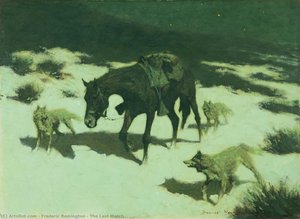
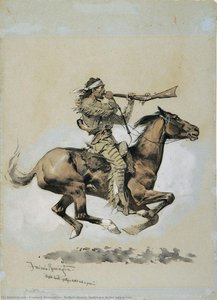
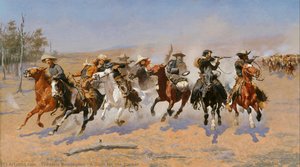
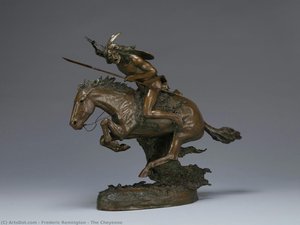
11The Grass Fire (1908) autorstwa Frederic Sackrider RemingtonThe Grass Fire1908 · Amon Carter Museum of American Art 12Historians of the Tribe (1890) autorstwa Frederic Sackrider RemingtonHistorians of the Tribe1890 · Art Institute of Chicago 13The Bronco Buster (1895) autorstwa Frederic Sackrider RemingtonThe Bronco Buster1895 · Grohmann Museum 14Coming Through the Rye (1902) autorstwa Frederic Sackrider RemingtonComing Through the Rye1902 · Frederic Remington Art Museum 15The Stampede (1910) autorstwa Frederic Sackrider RemingtonThe Stampede1910 · Frederic Remington Art Museum 16The Broncho Buster (1895) autorstwa Frederic Sackrider RemingtonThe Broncho Buster1895 · Frederic Remington Art Museum 17The Broncho Buster (1910) autorstwa Frederic Sackrider RemingtonThe Broncho Buster1910 · Metropolitan Museum of Art 18Przez dym wyskoczył odważny żołnierz (1897) autorstwa Frederic Sackrider RemingtonPrzez dym wyskoczył odważny żołnierz1897 · Amon Carter Museum of American Art 19The Wicked Pony (1898) autorstwa Frederic Sackrider RemingtonThe Wicked Pony1898 · Amon Carter Museum of American Art 20Cavalry in an Arizona Sand-Storm (1889) autorstwa Frederic Sackrider RemingtonCavalry in an Arizona Sand-Storm1889 · Amon Carter Museum of American Art 21The Long-Horn Cattle Sign (1908) autorstwa Frederic Sackrider RemingtonThe Long-Horn Cattle Sign1908 · Amon Carter Museum of American Art 22Bronco Buster (1895) autorstwa Frederic Sackrider RemingtonBronco Buster1895 · Sagamore Hill National Historic Site 23The Parley (1903) autorstwa Frederic Sackrider RemingtonThe Parley1903 · Thyssen-Bornemisza Museum 24The Broncho Buster (1895) autorstwa Frederic Sackrider RemingtonThe Broncho Buster1895 · Amon Carter Museum of American Art 25The Rattlesnake (1905) autorstwa Frederic Sackrider RemingtonThe Rattlesnake1905 · Amon Carter Museum of American Art 26Trooper of the Plains 1868 (1909) autorstwa Frederic Sackrider RemingtonTrooper of the Plains 18681909 · Amon Carter Museum of American Art 27The Rattlesnake (1908) autorstwa Frederic Sackrider RemingtonThe Rattlesnake1908 · Amon Carter Museum of American Art 28The Fall of the Cowboy (1895) autorstwa Frederic Sackrider RemingtonThe Fall of the Cowboy1895 · Amon Carter Museum of American Art 29The Last March (1906) autorstwa Frederic Sackrider RemingtonThe Last March1906 · Frederic Remington Art Museum 30The Smoke Signal (1908) autorstwa Frederic Sackrider RemingtonThe Smoke Signal1908 · Amon Carter Museum of American Art 31Eph on the Trail (1880) autorstwa Frederic Sackrider RemingtonEph on the Trail1880 · Frederic Remington Art Museum 32Fight for the Water Hole (1903) autorstwa Frederic Sackrider RemingtonFight for the Water Hole1903 · Museum of Fine Arts 33Aiding a Comrade (1890) autorstwa Frederic Sackrider RemingtonAiding a Comrade1890 · Museum of Fine Arts 34The Pursuit (1896) autorstwa Frederic Sackrider RemingtonThe Pursuit1896 · Virginia Museum of Fine Arts 35Cavalryman of the Line, Mexico (1889) autorstwa Frederic Sackrider RemingtonCavalryman of the Line, Mexico1889 · Amon Carter Museum of American Art 36An Indian Trapper (1889) autorstwa Frederic Sackrider RemingtonAn Indian Trapper1889 · Amon Carter Museum of American Art 37Buffalo Hunter Spitting a Bullet into a Gun (1892) autorstwa Frederic Sackrider RemingtonBuffalo Hunter Spitting a Bullet into a Gun1892 · Frederic Remington Art Museum 38A Reconnaissance (1902) autorstwa Frederic Sackrider RemingtonA Reconnaissance1902 · Amon Carter Museum of American Art 39The Wounded Bunkie (1896) autorstwa Frederic Sackrider RemingtonThe Wounded Bunkie1896 · Amon Carter Museum of American Art 40The Cowboy (1902) autorstwa Frederic Sackrider RemingtonThe Cowboy1902 · Amon Carter Museum of American Art 41The Bronco Buster autorstwa Frederic Sackrider RemingtonThe Bronco BusterMuzeum de Young 42A Dash for the Timber (1889) autorstwa Frederic Sackrider RemingtonA Dash for the Timber1889 · Amon Carter Museum of American Art 43Modern Comanche (1890) autorstwa Frederic Sackrider RemingtonModern Comanche1890 44Mounted Cowboy in Chaps with Race Horse (1908) autorstwa Frederic Sackrider RemingtonMounted Cowboy in Chaps with Race Horse1908 45A Dash for the Timber (1889) autorstwa Frederic Sackrider RemingtonA Dash for the Timber1889 · Amon Carter Museum of American Art 46Ridden Down (1905) autorstwa Frederic Sackrider RemingtonRidden Down1905 · Amon Carter Museum of American Art 47The Old Stage Coach of the Plains (1901) autorstwa Frederic Sackrider RemingtonThe Old Stage Coach of the Plains1901 · Amon Carter Museum of American Art 48Moose Head (1889) autorstwa Frederic Sackrider RemingtonMoose Head1889 · Frederic Remington Art Museum 49The Cheyenne (1901) autorstwa Frederic Sackrider RemingtonThe Cheyenne1901 · Denver Art Museum 50He Lay Where He Had Been Jerked, Still as a Log (also known as Jerked Down) (1893) autorstwa Frederic Sackrider RemingtonHe Lay Where He Had Been Jerked, Still as a Log (also known as Jerked Down)1893 51Bronco Buster autorstwa Frederic Sackrider RemingtonBronco BusterThe Baltimore Museum of Art 52Crow Indians Firing into the Agency (1887) autorstwa Frederic Sackrider RemingtonCrow Indians Firing into the Agency1887 · Amon Carter Museum of American Art 53The Stampede (1909) autorstwa Frederic Sackrider RemingtonThe Stampede1909 · Amon Carter Museum of American Art 54Studio at Ingleneuk (1907) autorstwa Frederic Sackrider RemingtonStudio at Ingleneuk1907 · Frederic Remington Art Museum 55Untitled (posssibly The Cigarette) (1908) autorstwa Frederic Sackrider RemingtonUntitled (posssibly The Cigarette)1908 · Frederic Remington Art Museum 56A Comanche (1888) autorstwa Frederic Sackrider RemingtonA Comanche1888 · Frederic Remington Art Museum 57The Cheyenne (1906) autorstwa Frederic Sackrider RemingtonThe Cheyenne1906 · Frederic Remington Art Museum 58Polo cast no. 2 (1904) autorstwa Frederic Sackrider RemingtonPolo cast no. 21904 · Frederic Remington Art Museum 59Ridden Down (1906) autorstwa Frederic Sackrider RemingtonRidden Down1906 · Amon Carter Museum of American Art 60Hasty Intrenchment Drill In the United States Army (1896) autorstwa Frederic Sackrider RemingtonHasty Intrenchment Drill In the United States Army1896 · Briscoe Western Art Museum 61A Cavalryman (1892) autorstwa Frederic Sackrider RemingtonA Cavalryman1892 · Amon Carter Museum of American Art 62Packing and Paddling in the Adirondacks (1880) autorstwa Frederic Sackrider RemingtonPacking and Paddling in the Adirondacks1880 · Frederic Remington Art Museum 63His First Lesson (1903) autorstwa Frederic Sackrider RemingtonHis First Lesson1903 · Amon Carter Museum of American Art 64A Hunting Outfit (1880) autorstwa Frederic Sackrider RemingtonA Hunting Outfit1880 · Frederic Remington Art Museum 65The Mountain Man (1903) autorstwa Frederic Sackrider RemingtonThe Mountain Man1903 · Amon Carter Museum of American Art 66A Cavalryman's Breakfast on the Plains (1892) autorstwa Frederic Sackrider RemingtonA Cavalryman's Breakfast on the Plains1892 · Amon Carter Museum of American Art 67The Infantry Soldier (1901) autorstwa Frederic Sackrider RemingtonThe Infantry Soldier1901 · Amon Carter Museum of American Art 68The Last of His Race (also known as Vanishing American) (1908) autorstwa Frederic Sackrider RemingtonThe Last of His Race (also known as Vanishing American)1908 · Yale University Art Gallery 69I Will Tell the White Man (1900) autorstwa Frederic Sackrider RemingtonI Will Tell the White Man1900 · Art Institute of Chicago 70By Putting a Carbine Bullet Through Its Brain (1887) autorstwa Frederic Sackrider RemingtonBy Putting a Carbine Bullet Through Its Brain1887 · Amon Carter Museum of American Art 71Lieutenant Casey Commandant of Cheyenne Scouts (1890) autorstwa Frederic Sackrider RemingtonLieutenant Casey Commandant of Cheyenne Scouts1890 · Frederic Remington Art Museum 72The Fall of the Cowboy (1895) autorstwa Frederic Sackrider RemingtonThe Fall of the Cowboy1895 · Amon Carter Museum of American Art 73Pony Tracks in the Buffalo Trails (1904) autorstwa Frederic Sackrider RemingtonPony Tracks in the Buffalo Trails1904 · Amon Carter Museum of American Art 74Guard of the Whiskey Trader (1906) autorstwa Frederic Sackrider RemingtonGuard of the Whiskey Trader1906 75Ninth Cavalry Colored Troops on Washing Duty in the Golf (1898) autorstwa Frederic Sackrider RemingtonNinth Cavalry Colored Troops on Washing Duty in the Golf1898 · Frederic Remington Art Museum 76The Cowboy (1902) autorstwa Frederic Sackrider RemingtonThe Cowboy1902 · Amon Carter Museum of American Art 77an appeal for justice autorstwa Frederic Sackrider Remingtonan appeal for justice 78A Pack Train (1909) autorstwa Frederic Sackrider RemingtonA Pack Train1909 79One of the Boys (1887) autorstwa Frederic Sackrider RemingtonOne of the Boys1887 · Frederic Remington Art Museum 80The Cheyenne Type autorstwa Frederic Sackrider RemingtonThe Cheyenne Type 81Unhorsed autorstwa Frederic Sackrider RemingtonUnhorsed 82Against the Sunset autorstwa Frederic Sackrider RemingtonAgainst the Sunset 83Paddling the Wounded British Officer (1897) autorstwa Frederic Sackrider RemingtonPaddling the Wounded British Officer1897 · Art Institute of Chicago 84dragon (1847) autorstwa Frederic Sackrider Remingtondragon1847 85a scout (1868) autorstwa Frederic Sackrider Remingtona scout1868 86Touchdown, Yale vs. Princeton, Thanksgiving Day, Nov. 27, 1890, Yale 32, Princeton 0 (1890) autorstwa Frederic Sackrider RemingtonTouchdown, Yale vs. Princeton, Thanksgiving Day, Nov. 27, 1890, Yale 32, Princeton 01890 · Yale University Art Gallery 87Roasting the Christmas Beef in a Cavalry Camp (1892) autorstwa Frederic Sackrider RemingtonRoasting the Christmas Beef in a Cavalry Camp1892 · Yale University Art Gallery 88A Texas Pony (1889) autorstwa Frederic Sackrider RemingtonA Texas Pony1889 · Yale University Art Gallery 89Scouts Climbing a Mountain (1891) autorstwa Frederic Sackrider RemingtonScouts Climbing a Mountain1891 · Museum of Fine Arts 90The Lookout (1887) autorstwa Frederic Sackrider RemingtonThe Lookout1887 · Museum of Fine Arts 91Pueblo Indian Village (1889) autorstwa Frederic Sackrider RemingtonPueblo Indian Village1889 · Museum of Fine Arts 92Mexican Infantry "On the March" (1890) autorstwa Frederic Sackrider RemingtonMexican Infantry "On the March"1890 · Museum of Fine Arts 93The Advance Guard (1888) autorstwa Frederic Sackrider RemingtonThe Advance Guard1888 · Smithsonian American Art Museum 94A Mexican Vaquero (1890) autorstwa Frederic Sackrider RemingtonA Mexican Vaquero1890 · Art Institute of Chicago 95The Mexican Major (1889) autorstwa Frederic Sackrider RemingtonThe Mexican Major1889 · Art Institute of Chicago 96Mounted Indian Scout (1891) autorstwa Frederic Sackrider RemingtonMounted Indian Scout1891 · Cincinnati Art Museum 97Tom Kicked Away the Stirrups and Grasped the Low Branch of a Live Oak Tree (1888) autorstwa Frederic Sackrider RemingtonTom Kicked Away the Stirrups and Grasped the Low Branch of a Live Oak Tree1888 98Cavalry in an Arizona Sandstorm (1889) autorstwa Frederic Sackrider RemingtonCavalry in an Arizona Sandstorm1889 99The Moose Hunt (1890) autorstwa Frederic Sackrider RemingtonThe Moose Hunt1890 100Mandan Initiation Ceremony (the Sundance) (1888) autorstwa Frederic Sackrider RemingtonMandan Initiation Ceremony (the Sundance)1888

Słynne obrazy Frederic Sackrider Remington epoka po epoce

Tematy, które przyciągnęły wzrok Frederic Sackrider Remington

Cztery motywy najczęściej powracające w tych oryginałach, z których każdy doczekał się swojego najdoskonalszego przykładu.

Muzea przechowujące oryginały Frederic Sackrider Remington

8 muzeów, w których znajduje się najwięcej obrazów z tej strony.

Muzea Miasto Dzieła artysty Frederic Sackrider Remington Obrazy z tej listy
Amon Carter Museum of American Art, Fort WorthAmon Carter Museum of American Art Fort Worth 45 The Old Stage-Coach of the Plains, Coming Through the Rye, The Broncho Buster
Frederic Remington Art Museum, OgdensburgFrederic Remington Art Museum Ogdensburg 43 The Charge of the Rough Riders, Trooper of the Plains, Coming Through the Rye
Museum of Fine Arts, HoustonMuseum of Fine Arts Houston 31 Fight for the Waterhole, Fight for the Water Hole, Aiding a Comrade
Art Institute of Chicago, ChicagoArt Institute of Chicago Chicago 16 Historians of the Tribe, I Will Tell the White Man, Paddling the Wounded British Officer
Yale University Art Gallery, Nowe HavaneYale University Art Gallery Nowe Havane 5 Touchdown, Yale vs. Princeton, Thanksgiving Day, Nov. 27, 1890, Yale 32, Princeton 0, Roasting the Christmas Beef in a Cavalry Camp, A Texas Pony
Metropolitan Museum of Art, Nowy JorkMetropolitan Museum of Art Nowy Jork 6 The Broncho Buster
National Cowboy - Western Heritage Museum, Oklahoma CityNational Cowboy - Western Heritage Museum Oklahoma City 2 Hunter’s Supper
Thyssen-Bornemisza Museum, MadrytThyssen-Bornemisza Museum Madryt 2 The Parley

Frederic Sackrider Remington dekada po dekadzie: oryginały definiujące każdy okres

Dzieła według dekad

Wybierz dekadę, aby zobaczyć dzieło, które ją definiuje.

Pytania kolekcjonerów o obrazy Frederic Sackrider Remington

Z jakiego dzieła najbardziej znany jest Frederic Sackrider Remington?Odkryj odpowiedź

The Old Stage-Coach of the Plains (1901), Amon Carter Museum of American Art, Fort Worth. Następne są Coming Through the Rye (1902) oraz The Broncho Buster (1895).

W jakim wieku był Frederic Sackrider Remington, gdy powstało The Old Stage-Coach of the Plains?Odkryj odpowiedź

40 lat: The Old Stage-Coach of the Plains pochodzi z 1901, a Frederic Sackrider Remington urodził(a) się w 1861.

Jakie są dziesięć najsłynniejszych obrazów, których autorem jest Frederic Sackrider Remington?Odkryj odpowiedź

The Old Stage-Coach of the Plains, Coming Through the Rye, The Broncho Buster, The Trooper, The Charge of the Rough Riders, Hunter’s Supper, Fight for the Waterhole, Trooper of the Plains, The Grass Fire i The Broncho Buster. Powyższy ranking zawiera rok powstania oraz muzeum dla każdego z nich.

Ile obrazów pozostawił po sobie Frederic Sackrider Remington?Odkryj odpowiedź

Nasz katalog zawiera 346 dzieł artysty Frederic Sackrider Remington, datowanych od 1880 do 1909.

W których muzeach znajdują się arcydzieła Frederic Sackrider Remington?Odkryj odpowiedź

W większości znajdują się w Amon Carter Museum of American Art (Fort Worth), Frederic Remington Art Museum (Ogdensburg) i Museum of Fine Arts (Houston). Powyższa tabela muzeów zawiera ich pełną listę.

W których latach Frederic Sackrider Remington namalował swoje najsłynniejsze dzieła?Odkryj odpowiedź

W 1900s: 37 z 100 dzieł na tej stronie powstało w tym czasie, w tym The Old Stage-Coach of the Plains.

Jakie są pierwsze i ostatnie słynne oryginały Frederic Sackrider Remington?Odkryj odpowiedź

Na tej stronie najwcześniejszy to Eph on the Trail (1880), a najpóźniejszy Trooper of the Plains (1909).

Jakie tematy Frederic Sackrider Remington wybierał najczęściej?Odkryj odpowiedź

American west (34), Horseback riding (25) i Cowboy (21), w ramach 100 dzieł na tej stronie.

Której techniki Frederic Sackrider Remington używał najczęściej?Odkryj odpowiedź

Oil On Canvas, dla 50 z 100 dzieł na tej stronie.

Które dzieła Frederic Sackrider Remington znajdują się w Amon Carter Museum of American Art?Odkryj odpowiedź

The Old Stage-Coach of the Plains, Coming Through the Rye i The Broncho Buster: Amon Carter Museum of American Art, Fort Worth posiada 37 dzieł widocznych na tej stronie.

Frederic Sackrider Remington: życie i twórczość

A Chronicler of the Vanishing West: The Life and Art of Frederic Remington

Frederic Sackrider Remington, urodzony w Cantonie, Nowy Jork, 4 października 1861 roku, nie był produktem Zachodu, który tak żywo przedstawiał; raczej był Wschodziarzem, który wykształcił swoją artystyczną tożsamość dzięki fascynacji i poświęconemu studiowaniu. Jego pochodzenie wskazywało na życie z dala od kurzu szlaków i kawalerii – dziedzictwo francuskiego Basków połączone ze stanowczymi korzeniami republikańskimi Nowego Anglii, ojciec był pułkownikiem i redaktorem gazety wojennej, a powiązania z rodową firmą Remington Arms poprzez odległych krewnych. Mimo to, wczesne narażenie na tematy wojskowe, połączone ze sprytem, dążeniem do opowiadania historii, doprowadziło go do drogi stającą się prawdopodobnie najbardziej rozpoznawalnym artystą Zachodu. Jego dzieciństwo przeniosło się do Bloomington, Illinois, następnie z powrotem do Cantonu i wreszcie Ogdensburga, Nowy Jork, ale jego wyobraźnia pozostała urzeczona opowieściami o życiu na pograniczu. Chociaż początkowo kierowany edukacją wojskową w Vermont Episcopal Institute, prawdziwym powołaniem Remingtona nie było poddawanie się rozkazom, lecz obserwowanie i interpretowanie otaczającego go świata poprzez sztukę. Krótki pobyt w Yale University potwierdził to; futbol i szkicowanie miały znacznie większe znaczenie niż formalne studia akademickie.

Od Ilustratora do Malarza: Tworzenie Wizji Artystycznej

Podróż artystyczna Remingtona nie zaczęła się od monumentalnych płócien, lecz od tuszu i papieru. Jego pierwsza opublikowana praca, rysunek dla *Yale Courant*, sygnalizowała wczesny predyspozycję do uchwytywania akcji i narracji. Kluczowa podróż do Montany w 1881 roku zapaliła jego wieczną obsesję na punkcie Zachodu. Nie była to jedynie obserwacja turysty – Remington dążył do zanurzenia się w kulturze, obserwując kowbojów, Indian i sam krajobraz. Początkowo próbował prowadzić ranch i zajmować się wydobyciem złota, ale te przedsięwzięcia okazały się nieudane, uwalniając go do całkowitego poświęcenia się sztuce. Wracając na Wschód, szybko zyskał uznanie jako ilustrator w magazynach takich jak *Harper’s Weekly* i *Collier’s*, jego dynamiczne przedstawienia scen zachodnich fascynowały amerykańską publiczność, która tęskniła za opowieściami o życiu na pograniczu. Ilustracje te nie były jedynie raportem – były nasycone dramatem, energią i romantyzowaną wizją Zachodu, która głęboko rezonowała z wyobraźnią społeczeństwa. To właśnie dzięki tej pracy Remington doskonalił swoje umiejętności w kompozycji, uchwytywaniu ruchu i przekazywaniu emocji – cech, które później definiowały jego obrazy. Otrzymał minimalne formalne szkolenie poza kilkoma lekcjami rysunku w Yale i krótkim okresem pobytu w Art Students League, rozwijając zamiast tego unikalny styl charakteryzujący się energiczną fakturą pędzla, jaskrawymi kolorami i skupieniem na realizmie połączonym z dramatycznym wdziękiem.

Uwiecznianie Znikającego Świata: Tematyka i Styl

Sztuka Remingtona jest nierozerwalnie związana z konkretnym momentem w historii Ameryki – końcem ery Zachodu. Jego obrazy zamieszkują ikoniczne postacie: twardych kowbojów prowadzących bydło, stoickich Indian konfrontujących się z utratą ziemi i amerykańskich żołnierzy kawalerii zaangażowanych zarówno w bohaterskie bitwy, jak i tragiczne konflikty. Nie uciekał od przedstawiania surowych realiów życia na pograniczu, ale jego dzieła często opierają się na romantyzowanym portrecie, podkreślając męstwo, przygodę i konflikt kultur. Jego obrazy nie są jedynie dokumentami historycznymi; to sugestywne narracje, które badają tematy bohaterstwa, straty i nieunikniony postęp. Styl Remingtona ewoluował z czasem, od bardziej formalnych, akademickich przedstawień do luźniejszych, bardziej ekspresyjnych faktur pędzla. Był mistrzem uchwytywania ruchu – koni galopujących przez równiny, kowbojów walczących z bykami i żołnierzy wjeżdżających do bitwy. Często wykorzystywał szybkie szkice i zdjęcia jako materiały referencyjne, ale jego sztuka zawsze przekraczała zwykłe naśladowanie, będąc nasycona własną unikalną wizją i intensywnością emocjonalną. Znane obrazy takie jak *My Ranch*, *Waiting in the Moonlight*, *Ridden Down* (1905) i *The Long-Horn Cattle Sign* (1908) ilustrują jego zdolność do uchwycenia zarówno potęgi, jak i kruchości Amerykańskiego Zachodu.

Wpływ i Trwałe Dziedzictwo

Frederic Remington zmarł nagle w 1909 roku w wieku 48 lat, pozostawiając za sobą rozległą kolekcję dzieł sztuki, która nadal fascynuje odbiorców dzisiaj. Jego wpływ na sztukę zachodnią jest niepodważalny; nie tylko przedstawiał Zachód, ale pomógł *zdefiniować* go dla pokoleń Amerykanów. Ustanowił język wizualny dla pogranicza – ikonografię kowbojów, Indian i żołnierzy kawalerii, która głęboko zakorzeniła się w wyobraźni ludzkiej. Jego dzieła zainspirowały wielu innych artystów, w tym N.C. Wyetha i Zane’a Greya. Muzeum Sztuki Zachodniej w Ogdensburgu, Nowy Jork, stanowi świadectwo jego trwałego dziedzictwa, zachowując obszerną kolekcję jego obrazów, rzeźb i materiałów archiwalnych. Jego dzieła są wystawiane w licznych muzeach w całym kraju, w tym Metropolitan Museum of Art i Amon Carter Museum of American Art. Przedstawienia Remingtona, choć czasem krytykowane za romantyzowany obraz Zachodu, oferują cenną wgląd w kluczowy okres w historii Ameryki. Uchwycił nie tylko to, *co było*, ale także to, *w co ludzie wierzyli* o Zachodzie – jego mitach, legendach i trwałym uroku. Pozostaje potężnym symbolem ducha amerykańskiego – chroniczem zanikającego świata, który przekształcił go w trwałe dziedzictwo artystyczne.