The Academy and the Munich School
Florian Stanisław Cynk spent his formative years moving between the studios of Kraków, Dresden, and Munich. He began his studies at the Academy of Fine Arts in Kraków under Wojciech Stattler and Władysław Łuszczkiewicz. These early years provided a foundation that he later expanded upon while attending the Dresden Academy of Fine Arts and the Academy of Fine Arts, Munich, under Hermann Anschütz. His time in Munich, specifically between 1863 and 1867, placed him within the circle of the Munich School.
His brushwork followed a smooth, classicist academic style. This approach favored clarity and precision over loose or experimental strokes. In Kraków, he became a fixture of the local art scene, eventually serving as a professor of drawing at his alma mater. He also held the position of secretary of the Kraków Academy from 1873 to 1878 and later directed the Kraków Society of Friends of Fine Arts.
Religious Subjects and Historical Compositions
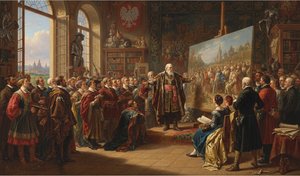
Much of his work focused on religious themes and historical scenes, particularly those relating to the Jagiellonian rule. He had a particular interest in portraits of legends and figures from Polish history. Some of his notable works include:
- Matki Bożej Królowej Korony Polskiej / Our Mother of God of the Polish Crown (1888)
- Długosz and Saint Casimir (circa 1869)
- Kinga of Poland
He often worked alongside Jan Matejko. Their collaboration was practical and deep; Cynk helped Matejko with the perspective on large-scale history paintings and created copies of Matejko's works to be used as models for woodcuts. Together, they painted portraits of Saints Kinga and Adalbert for the church in Stary Wiśnicz.
Illustrations and Teaching
Beyond the canvas, Cynk worked as an illustrator, providing drawings for periodicals such as Tygodnik Illustrowany. His ability to translate complex scenes into print was a necessary skill for the era's growing demand for illustrated news and literature.
His influence extended through the many students who sat in his classrooms. He taught a generation of artists, including:
- Stanisław Wyspiański
- Piotr Stachiewicz
- Wojciech Weiss
- Ludwik Misky
- Artur Markowicz
His life ended in Kraków in 1912, leaving behind a body of work held in the National Museum in Warsaw, Cracow National Museums, and the National Gallery in Lviv.
Pytania i odpowiedzi
W jakim mieście i kraju urodził(a) się Florian Cynk?
Florian Cynk urodził się w Kraków w Poland.
Czy mogę odwiedzić wirtualne muzeum dzieł Florian Cynk?
Zapraszamy na wirtualny spacer: strona Wirtualna Galeria 3D artysty Florian Cynk prezentuje jego dzieła w galerii trójwymiarowej.
Gdzie mogę zobaczyć wszystkie dzieła autorstwa Florian Cynk?
Wszystkie dzieła Florian Cynk dostępne w niniejsza strona można przeglądać na stronie Wszystkie dzieła artysty.