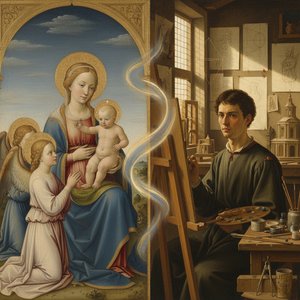
The Archaic Vision of Filippo Balbi
In the vibrant tapestry of nineteenth-century Italian art, few figures stand as uniquely as Filippo Balbi. Born in Naples in 1806, a city steeped in the shadows of antiquity and the brilliance of the Baroque, Balbi developed a creative voice that deliberately turned away from the burgeoning realism of his era. Instead, he sought refuge in an archaic style, a deliberate aesthetic choice that allowed him to breathe life into allegorical and religious narratives with a sense of timelessness. His early training at the Academy of Fine Arts in Naples provided him with a rigorous technical foundation, yet it was his subsequent move to Rome that would truly shape his artistic soul, placing him at the heart of classical tradition and historical grandeur.
Balbi’s career was defined by a profound devotion to sacred spaces and the monumental task of decorating the architectural gems of Italy. His work often functioned as a bridge between the earthly and the divine, utilizing large-scale compositions to transform religious environments. One of his earliest significant milestones arrived in 1844 with the commission of a Madonna della Cintura for the Convent of the Madonna della Neve in Frosinone. This period marked the beginning of a lifelong engagement with ecclesiastical art, where he mastered the ability to weave complex theological themes into visually arresting compositions that commanded the attention of the faithful.
A Legacy Carved in Stone and Fresco
The true magnitude of Balbi’s contribution to Italian art is perhaps most visible in his extensive work for the Certosa di Trisulti. Beginning in 1854, he embarked on a monumental undertaking that would become a cornerstone of his legacy. His hands breathed life into the ceilings and walls of this historic complex, creating an immersive environment through a variety of mediums. From expansive canvases to delicate lunettes and even eclectic frescoes within the pharmacy, Balbi’s output for the Certosa demonstrates a remarkable versatility and a tireless commitment to decorative storytelling.
Beyond the purely religious, Balbi possessed a keen interest in the intersection of art and science, as evidenced by his Testa anatomica (1854). This piece, now preserved within the Museo di Storia della Medicina at the Sapienza University of Rome, reveals an artist capable of applying his classical precision to the study of human form and biological reality. His ability to navigate between the ethereal realms of the Immaculate Conception and the tangible complexities of anatomy highlights a multifaceted intellect that refused to be confined by a single genre.
As we reflect on the life of Filippo Balbi, we see an artist who acted as a guardian of tradition during a period of rapid modernization. His achievements include:
- Mastery of Allegory: The ability to translate complex religious and mythological concepts into accessible, emotive visual language.
- Architectural Integration: A profound skill in designing works specifically tailored to the unique geometry of ceilings, lunettes, and frescoes.
- Historical Preservation: Creating a body of work that continues to serve as a vital link to the spiritual and cultural heritage of regions like Frosinone and Rome.
Though he passed away in Alatri in 1890, Balbi’s influence lingers in the quiet majesty of the churches and monasteries he adorned. He remains a significant figure for those who appreciate the power of the archaic style—a reminder that art can serve as a timeless vessel for the eternal.
Pytania i odpowiedzi
Czy mogę przeglądać dzieła Filippo Balbi według słów kluczowych?
Strona Według słów kluczowych artysty Filippo Balbi grupuje jego dzieła według słów kluczowych.
Gdzie mogę zobaczyć dzieła Filippo Balbi w wirtualnej galerii 3D?
Wirtualna Galeria 3D artysty Filippo Balbi to strona prezentująca jego dzieła w wirtualnej galerii trójwymiarowej.
Gdzie mogę zobaczyć wszystkie dzieła Filippo Balbi?
Wszystkie dzieła Filippo Balbi dostępne w niniejsza strona można przeglądać na stronie Wszystkie dzieła artysty.
Czy mogę przeglądać dzieła Filippo Balbi według tematyki?
Dzieła artysty Filippo Balbi można przeglądać według tematów na stronie Atlas tematów.