Portret David Cox

100 najsłynniejszych obrazów artysty David Cox – wybór z galerii

Aktualizacja: Listopad 2026 · ranking według naszego wskaźnika popularności (liczba wyszukiwań, wizyt i zamówień dla każdego dzieła) · 498 dzieł David Cox w naszym katalogu

W skrócie

Z wszystkich oryginałów pozostawionych przez David Cox, najsłynniejszym jest Going to the Hayfield (1850). Tuż za nimi znajdują się George IV Embarking for Scotland at Greenwich (1823) oraz Going to the Hayfield (1849). Nasz katalog zawiera 498 dzieł autorstwa David Cox; galeria zachowała 100 najbardziej podziwianych na świecie prac, z których każda została przedstawiona wraz z datą powstania, informacją o muzeum oraz jej historią.

1783 – 1859, Birmingham Romanticism Najwięcej dzieł: Birmingham Museum and Art Gallery

10 najlepszych obrazów artysty David Cox: wybór galerii

1
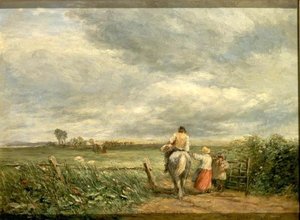
Going to the Hayfield (1850) autorstwa David Cox

Going to the Hayfield

1850 · Watercolor

The scene unfolds in "Going to the Hayfield," a work created by the artist David Cox. In this 1849 composition, the quiet rhythms of rural life take center stage. Figures move through the landscape, their presence tied to the seasonal tasks of the countryside. The air feels heavy with the atmosphere of a specific afternoon, capturing a moment of simple, everyday activity within the English landscape.

2
George IV Embarking for Scotland at Greenwich (1823) autorstwa David Cox

George IV Embarking for Scotland at Greenwich

1823 · Watercolor

The watercolor depicts a bustling maritime scene at Greenwich, centered on the ceremonial embarkation of George IV for Scotland. Numerous vessels occupy the water, some positioned near the shore and others further out. These boats carry various figures, and several are adorned with flags. On the banks, crowds of people gather to observe the event, some standing near the water's edge while others remain further back. A horse is visible…

3
Going to the Hayfield (1849) autorstwa David Cox

Going to the Hayfield

1849 · Oil On Canvas · Birmingham Museum and Art Gallery, Birmingham

David Cox's "Going to the Hayfield," painted in 1849, isn’t merely a landscape; it’s a carefully constructed distillation of Romantic sensibility and a profound connection to the English countryside. This evocative piece, now beautifully reproduced, transports us to a specific moment – a quiet afternoon as figures journey towards a hayfield bathed in the diffused light of an overcast sky. Cox, a pivotal figure bridging the gap between earlier landscape…

4
Rhyl Sands (1854) autorstwa David Cox

Rhyl Sands

1854 · Oil On Canvas · Tate Gallery, Londyn

David Cox’s “Rhyl Sands,” painted in 1854, isn't merely a depiction of a beach; it’s a carefully constructed evocation of the Romantic spirit – a yearning for the sublime beauty and untamed power of nature. Cox, a pivotal figure within the Birmingham School of watercolourists, masterfully captures a fleeting moment along the Welsh coast, imbuing the scene with an atmosphere of both tranquility and dramatic intensity. The painting transports us…

5
Study of a Dog (1840) autorstwa David Cox

Study of a Dog

1840 · Watercolor

In this intimate watercolor study, titled Study of a Dog, the viewer encounters a quiet moment of observation. The subject is a single dog, an animal captured in a state of repose. David Cox, a British artist who lived from 1783 to 1859, brings a sense of immediacy to this piece. The work emerges from the 1840s, a period when the artist's hand moved with increasing freedom. It belongs to…

6
The Skylark (1849) autorstwa David Cox

The Skylark

1849 · Oil On Canvas · Birmingham Museum and Art Gallery, Birmingham

In the vast tapestry of English landscape painting, few works capture the ephemeral beauty of the countryside with as much soul as David Cox’s The Skylark. Created in 1849, this masterpiece serves as a profound window into a serene, pastoral era, inviting the viewer to pause and breathe in the quietude of the rural landscape. The painting presents a sprawling field of grass that stretches toward a distant, hazy horizon,…

7
Storm off the Coast, Hastings (1813) autorstwa David Cox

Storm off the Coast, Hastings

1813 · Oil · Birmingham Museum and Art Gallery, Birmingham

There is a certain gravity in how the sky meets the sea in this 1813 work. The composition draws the eye along a diagonal path, moving from the heavy, dark presence of the cliffs in the foreground toward a lighter, mist-filled horizon. It is a scene of movement and tension, where the elements of sea, sky, and stone are caught in a moment of profound unrest. The palette relies on…

8
The Old Bridge at Bridgnorth, Shropshire (1809) autorstwa David Cox

The Old Bridge at Bridgnorth, Shropshire

1809 · Watercolor

The watercolor painting titled The Old Bridge at Bridgnorth, Shropshire, captures a quiet moment in the English countryside. Created by David Cox in 1809, the work presents a view of a small town nestled along the curves of a river. The scene focuses on the architecture of the bridge as it spans the water, anchoring the landscape within its natural setting.

9
Cornfield (1814) autorstwa David Cox

Cornfield

1814 · Watercolor

The air feels heavy and damp, thick with the scent of wet earth and the promise of rain. In this hazy landscape, a vast cornfield stretches toward a soft, clouded horizon, its breadth emphasized by long, horizontal strokes of ochre and muted green. Figures move through the middle ground, their forms softened by the mist, tending to a cart pulled by horses. There is a rhythmic, slow quality to their…

10
Near the Pont d'Arcole, Paris (1829) autorstwa David Cox

Near the Pont d'Arcole, Paris

1829 · Watercolor

The scene unfolds in the heart of a bustling Parisian street, captured in the work titled Near the Pont d'Arcole, Paris. This watercolor painting brings us into a moment of urban life, where the architecture of the city meets the movement of its people. The artist, David Cox, directs our gaze toward the structures and the atmosphere of the streets near the Pont d'Arcole.

Kontynuacja zestawienia David Cox, od 11 do 100

11Pont Neuf from the Quai de l'Ecole, Paris (1829) autorstwa David CoxPont Neuf from the Quai de l'Ecole, Paris1829 12Place du Palais Royal, Paris (1829) autorstwa David CoxPlace du Palais Royal, Paris1829 · Birmingham Museum and Art Gallery 13The Welsh Funeral (1848) autorstwa David CoxThe Welsh Funeral1848 · Birmingham Museum and Art Gallery 14Untitled (AQTKGL) (1853) autorstwa David CoxUntitled (AQTKGL)1853 15The Cross Roads (1850) autorstwa David CoxThe Cross Roads1850 · Birmingham Museum and Art Gallery 16Rhyl Sands (1854) autorstwa David CoxRhyl Sands1854 · Birmingham Museum and Art Gallery 17Scene in a Lane (1858) autorstwa David CoxScene in a Lane1858 18Beach Scene Sunrise (1820) autorstwa David CoxBeach Scene Sunrise1820 · Yale Center for British Art 19Fishing off Hastings (1810) autorstwa David CoxFishing off Hastings1810 · Yale Center for British Art 20The Junction of the Severn and the Wye with Chepstow in the Distance (1830) autorstwa David CoxThe Junction of the Severn and the Wye with Chepstow in the Distance1830 · Yale Center for British Art 21The Wyndcliff, River Wye (1842) autorstwa David CoxThe Wyndcliff, River Wye1842 · Birmingham Museum and Art Gallery 22German Der Strand von Rhyl (1854) autorstwa David CoxGerman Der Strand von Rhyl1854 · Manchester Art Gallery 23Left at a Girls' School (1812) autorstwa David CoxLeft at a Girls' School1812 · Birmingham Museum and Art Gallery 24Lake Scene, North Wales (1811) autorstwa David CoxLake Scene, North Wales1811 · Birmingham Museum and Art Gallery 25A View of Westminster Bridge, Looking West towards Lambeth Palace and Westminster Abbey (1811) autorstwa David CoxA View of Westminster Bridge, Looking West towards Lambeth Palace and Westminster Abbey1811 26In Windsor Park (1807) autorstwa David CoxIn Windsor Park1807 27Westminster from Lambeth (1813) autorstwa David CoxWestminster from Lambeth1813 28Sunset, Hastings: Beached Fishing Vessels (1811) autorstwa David CoxSunset, Hastings: Beached Fishing Vessels1811 29Gipsies on Dulwich Common (1808) autorstwa David CoxGipsies on Dulwich Common1808 · Birmingham Museum and Art Gallery 30Pastoral Scene in Herefordshire (1820) autorstwa David CoxPastoral Scene in Herefordshire1820 31Lugg Meadows, near Hereford (1817) autorstwa David CoxLugg Meadows, near Hereford1817 32Tour d'Horloge, Rouen (1829) autorstwa David CoxTour d'Horloge, Rouen1829 33The Opening of the New London Bridge (1831) autorstwa David CoxThe Opening of the New London Bridge1831 34St. Mary's Church and the Shire Hall, Warwick (1828) autorstwa David CoxSt. Mary's Church and the Shire Hall, Warwick1828 35Place St. Barthélemy, Rouen (1829) autorstwa David CoxPlace St. Barthélemy, Rouen1829 36Carthage: Aeneas and Achates (1825) autorstwa David CoxCarthage: Aeneas and Achates1825 37Junction of the Severn and the Wye with a Rainbow (1827) autorstwa David CoxJunction of the Severn and the Wye with a Rainbow1827 38Dockyard - Building a Sloop (1823) autorstwa David CoxDockyard - Building a Sloop1823 39Still LIfe: Basket, Foxgloves, Clothes and Other Objects (1823) autorstwa David CoxStill LIfe: Basket, Foxgloves, Clothes and Other Objects1823 · Birmingham Museum and Art Gallery 40A View of the Pavillon de Flore and the Tuileries from the Seine, Notre Dame, Paris (1829) autorstwa David CoxA View of the Pavillon de Flore and the Tuileries from the Seine, Notre Dame, Paris1829 41Hay on Wye (1824) autorstwa David CoxHay on Wye1824 42Porte St. Denis, Paris (1829) autorstwa David CoxPorte St. Denis, Paris1829 43Pirates' Isle (1826) autorstwa David CoxPirates' Isle1826 44Pavillon de Flore, Tuileries, Paris (1830) autorstwa David CoxPavillon de Flore, Tuileries, Paris1830 45St. Eustache, Paris (1829) autorstwa David CoxSt. Eustache, Paris1829 46Handsworth Old Church, Birmingham (1828) autorstwa David CoxHandsworth Old Church, Birmingham1828 47Ulverston Sands (1835) autorstwa David CoxUlverston Sands1835 · Birmingham Museum and Art Gallery 48Crossing Lancaster Sands (1835) autorstwa David CoxCrossing Lancaster Sands1835 49Street in Beauvais (1832) autorstwa David CoxStreet in Beauvais1832 50The Pont des Arts with the Louvre and Tuileries from the Quai Conti (1838) autorstwa David CoxThe Pont des Arts with the Louvre and Tuileries from the Quai Conti1838 51The Long Gallery, Hardwick Hall, Derbyshire (1839) autorstwa David CoxThe Long Gallery, Hardwick Hall, Derbyshire1839 52The Poplar Avenue, after Hobbema (1835) autorstwa David CoxThe Poplar Avenue, after Hobbema1835 53The Long Gallery, Hardwick Hall, Derbyshire (1839) autorstwa David CoxThe Long Gallery, Hardwick Hall, Derbyshire1839 54Going Out Hawking (1838) autorstwa David CoxGoing Out Hawking1838 55Peace and War: Lympne Church and Castle (1838) autorstwa David CoxPeace and War: Lympne Church and Castle1838 · Birmingham Museum and Art Gallery 56A Terrace, with Figures, Haddon Hall (1834) autorstwa David CoxA Terrace, with Figures, Haddon Hall1834 · Birmingham Museum and Art Gallery 57Windermere during the Regatta (1832) autorstwa David CoxWindermere during the Regatta1832 58Rhaiadr Cwm, North Wales (1836) autorstwa David CoxRhaiadr Cwm, North Wales1836 59Pass of Llanberis, Caernarvonshire, Wales (1836) autorstwa David CoxPass of Llanberis, Caernarvonshire, Wales1836 60The Long Gallery, Hardwick Hall, Derbyshire (1839) autorstwa David CoxThe Long Gallery, Hardwick Hall, Derbyshire1839 · Chatsworth House 61Crossing Lancaster Sands (1840) autorstwa David CoxCrossing Lancaster Sands1840 62View near Bettws-y-Coed (1846) autorstwa David CoxView near Bettws-y-Coed1846 · Birmingham Museum and Art Gallery 63On Lancaster Sands, Low Tide (1840) autorstwa David CoxOn Lancaster Sands, Low Tide1840 64Vale of Clwyd (1848) autorstwa David CoxVale of Clwyd1848 65Near Knaresborough (1844) autorstwa David CoxNear Knaresborough1844 66A Welsh Road (1846) autorstwa David CoxA Welsh Road1846 67The Vale of Dolwyddelan (1846) autorstwa David CoxThe Vale of Dolwyddelan1846 68A Country Track Leading to Harlech Castle (1842) autorstwa David CoxA Country Track Leading to Harlech Castle1842 69Carreg Cennan Castle (1844) autorstwa David CoxCarreg Cennan Castle1844 70Cottage Interior (1840) autorstwa David CoxCottage Interior1840 · Birmingham Museum and Art Gallery 71Outskirts of a Wood, with Gypsies (1843) autorstwa David CoxOutskirts of a Wood, with Gypsies1843 72Vale of Clwyd (1846) autorstwa David CoxVale of Clwyd1846 73Going to the Hayfield (1853) autorstwa David CoxGoing to the Hayfield1853 · Yale Center for British Art 74On the Medway (1850) autorstwa David CoxOn the Medway1850 75Horses Drinking (1855) autorstwa David CoxHorses Drinking1855 76A Mountain Torrent (1850) autorstwa David CoxA Mountain Torrent1850 77Flying the Kite (1853) autorstwa David CoxFlying the Kite1853 78On Carrington Moss, Cheshire (1851) autorstwa David CoxOn Carrington Moss, Cheshire1851 79Mountain Heights, Cader Idris (1850) autorstwa David CoxMountain Heights, Cader Idris1850 80Penman Bach (1852) autorstwa David CoxPenman Bach1852 81The Night Train (1849) autorstwa David CoxThe Night Train1849 82Vale of Clwyd (1849) autorstwa David CoxVale of Clwyd1849 83The Challange (1853) autorstwa David CoxThe Challange1853 84Peat Gatherers (1850) autorstwa David CoxPeat Gatherers1850 85Kenilworth Castle (1857) autorstwa David CoxKenilworth Castle1857 · Birmingham Museum and Art Gallery 86Darley Churchyard (1858) autorstwa David CoxDarley Churchyard1858 87On the Moors, near Bettws-y-Coed (1856) autorstwa David CoxOn the Moors, near Bettws-y-Coed1856 88Crossing the Moor (1858) autorstwa David CoxCrossing the Moor1858 89Stepping Stones, Bettws-y-Coed (1857) autorstwa David CoxStepping Stones, Bettws-y-Coed1857 90Clouds (1857) autorstwa David CoxClouds1857 91Moonlight Landscape (1850) autorstwa David CoxMoonlight Landscape1850 · Yale Center for British Art 92The Night Train (1849) autorstwa David CoxThe Night Train1849 · City Art Gallery 93Midday Rest autorstwa David CoxMidday Rest 94The Thames At Battersea autorstwa David CoxThe Thames At Battersea 95Returning Home autorstwa David CoxReturning Home 96Lancaster Sands 1 autorstwa David CoxLancaster Sands 1 97A Child With A Dog, Outside A Cottage autorstwa David CoxA Child With A Dog, Outside A Cottage 98The Jetty, Calais autorstwa David CoxThe Jetty, Calais 99Young Welsh Girl autorstwa David CoxYoung Welsh Girl 100In The Hayfield 1 autorstwa David CoxIn The Hayfield 1

Słynne obrazy David Cox epoka po epoce

Tematy, które przyciągnęły wzrok David Cox

Cztery motywy najczęściej powracające w tych oryginałach, z których każdy doczekał się swojego najdoskonalszego przykładu.

Muzea przechowujące oryginały David Cox

6 muzeów, w których znajduje się najwięcej obrazów z tej strony.

Muzea Miasto Dzieła artysty David Cox Obrazy z tej listy
Birmingham Museum and Art Gallery, BirminghamBirmingham Museum and Art Gallery Birmingham 54 Going to the Hayfield, The Skylark, Storm off the Coast, Hastings
Yale Center for British Art, New HavenYale Center for British Art New Haven 6 Beach Scene Sunrise, Fishing off Hastings, The Junction of the Severn and the Wye with Chepstow in the Distance
Tate Gallery, LondynTate Gallery Londyn 1 Rhyl Sands
Manchester Art Gallery, ManchesterManchester Art Gallery Manchester 1 German Der Strand von Rhyl
Chatsworth House, BakewellChatsworth House Bakewell 1 The Long Gallery, Hardwick Hall, Derbyshire
City Art Gallery, BirminghamCity Art Gallery Birmingham 1 The Night Train

David Cox dekada po dekadzie: oryginały definiujące każdy okres

Dzieła według dekad

Wybierz dekadę, aby zobaczyć dzieło, które ją definiuje.

Pytania kolekcjonerów o obrazy David Cox

Z jakiego dzieła najbardziej znany jest David Cox?Odkryj odpowiedź

Going to the Hayfield (1850). Następne są George IV Embarking for Scotland at Greenwich (1823) oraz Going to the Hayfield (1849).

W jakim wieku był David Cox, gdy powstało Going to the Hayfield?Odkryj odpowiedź

67 lat: Going to the Hayfield pochodzi z 1850, a David Cox urodził(a) się w 1783.

Jakie są dziesięć najsłynniejszych obrazów, których autorem jest David Cox?Odkryj odpowiedź

Going to the Hayfield, George IV Embarking for Scotland at Greenwich, Going to the Hayfield, Rhyl Sands, Study of a Dog, The Skylark, Storm off the Coast, Hastings, The Old Bridge at Bridgnorth, Shropshire, Cornfield i Near the Pont d'Arcole, Paris. Powyższy ranking zawiera rok powstania oraz muzeum dla każdego z nich.

Ile obrazów pozostawił po sobie David Cox?Odkryj odpowiedź

Nasz katalog zawiera 498 dzieł artysty David Cox, datowanych od 1807 do 1858.

W których muzeach znajdują się arcydzieła David Cox?Odkryj odpowiedź

W większości znajdują się w Birmingham Museum and Art Gallery (Birmingham), Yale Center for British Art (New Haven) i Tate Gallery (Londyn). Powyższa tabela muzeów zawiera ich pełną listę.

W których latach David Cox namalował swoje najsłynniejsze dzieła?Odkryj odpowiedź

W 1850s: 24 z 100 dzieł na tej stronie powstało w tym czasie, w tym Going to the Hayfield.

Jakie są pierwsze i ostatnie słynne oryginały David Cox?Odkryj odpowiedź

Na tej stronie najwcześniejszy to In Windsor Park (1807), a najpóźniejszy Scene in a Lane (1858).

Jakie tematy David Cox wybierał najczęściej?Odkryj odpowiedź

Landscape (13), Sky (10) i British countryside (8), w ramach 100 dzieł na tej stronie.

Której techniki David Cox używał najczęściej?Odkryj odpowiedź

Watercolor, dla 13 z 100 dzieł na tej stronie.

Do jakiego nurtu artystycznego należy David Cox?Odkryj odpowiedź

Romanticism, sądząc po oryginałach na tej stronie.

Które dzieła David Cox znajdują się w Birmingham Museum and Art Gallery?Odkryj odpowiedź

Going to the Hayfield, The Skylark i Storm off the Coast, Hastings: Birmingham Museum and Art Gallery, Birmingham posiada 18 dzieł widocznych na tej stronie.

David Cox: życie i twórczość

David Cox (1783–1859): Pioneer of Atmospheric Landscape Painting

David Cox (1783–1859) stands as a monumental figure in British landscape painting, recognized not merely for his prolific output but for fundamentally reshaping artistic perception and establishing the Birmingham School’s distinctive aesthetic—a precursor to Impressionism that continues to inspire admiration. Born April 29th, 1783, in Deritend, Birmingham, Cox's formative years were steeped in the industrial dynamism of his hometown yet nurtured by a mother who instilled within him a profound appreciation for nature and artistic contemplation. This duality would become central to his lifelong creative vision.
  • Early Life and Training: Cox’s father was a blacksmith, grounding him in practical skills alongside fostering an early fascination with visual representation. He enrolled at Joseph Barber's Academy in Birmingham, where he encountered fellow students Charles Barber and William Radclyffe—influences that would shape his artistic sensibilities.
  • The Influence of Barber’s Academy: Barber’s Academy instilled a disciplined approach to drawing and painting, emphasizing meticulous observation and technical precision. This foundational training proved invaluable as Cox embarked on his artistic journey.

A Journey into Welsh Landscapes and Artistic Evolution

Cox's artistic breakthrough arrived in 1805 with a transformative trip to Wales alongside Charles Barber. This expedition ignited within him an enduring passion for capturing the ethereal beauty of mountainous landscapes—a fascination that would permeate his oeuvre throughout his life. The dramatic interplay of light and shadow, characteristic of Welsh scenery, profoundly impacted Cox’s style, propelling him toward a more expressive and atmospheric approach. He began to experiment with looser brushwork and bolder color palettes, distancing himself from the prevailing academic conventions.
  • Birmingham School Style: Cox's distinctive Birmingham School style—characterized by luminous colors, dynamic compositions, and an unwavering focus on capturing fleeting moments of natural grandeur—became his trademark. This approach distinguished him from many of his contemporaries and cemented his place as a visionary artist.
  • Watercolor Mastery and Artistic Recognition

    Cox quickly gained renown for his watercolor paintings, particularly those depicting rural scenes and architectural subjects. His meticulous technique—combining precise detail with subtle tonal gradations—allowed him to convey an unparalleled sense of atmosphere and emotion. He exhibited regularly at the Royal Academy from 1805 onwards, securing commissions from prominent patrons and establishing himself as a respected artist within London’s artistic circles.
  • Influence of Dutch Masters: Cox's artistic vision drew inspiration from the luminist painters of the Dutch Golden Age—artists who prioritized capturing the effects of light on surfaces with remarkable accuracy. This influence is evident in his compositions and color palettes, reflecting a deep understanding of visual principles.
  • Legacy and Enduring Influence

    Cox’s artistic legacy extends far beyond his individual paintings. He played a pivotal role in establishing British landscape painting as a distinct genre—moving away from purely topographical representations toward more subjective interpretations of nature imbued with spiritual resonance. His pioneering use of loose brushwork and vibrant color palettes anticipated the innovations of Impressionist painters, securing his position as a crucial precursor to this revolutionary artistic movement.
  • Notable Works: Among Cox’s celebrated paintings are *The Wind on the Heath*, *Cottage in Herefordshire*, and *Junction of the Severn and the Wye with Chepstow in the distance*. These works exemplify his masterful technique and unwavering commitment to conveying the sublime beauty of the British countryside.
  • Cox died June 7th, 1859, in Birmingham. His son, David Cox Jr., continued his father’s artistic tradition, furthering the Birmingham School's distinctive aesthetic—a testament to David Cox Sr.’s enduring influence on British art history.