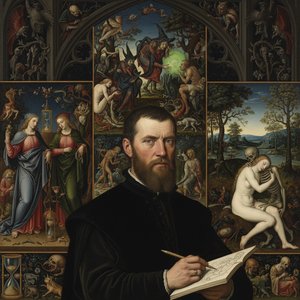
The Life and Academic Career of Clemens von Zimmermann
Clemens von Zimmermann was a German historical painter associated with the Düsseldorf school of painting. Born in Düsseldorf, he began his artistic journey by studying under Johann Peter von Langer. In 1808, he accompanied his master to Munich to enter the Academy. His professional trajectory saw him appointed as a professor and director of the school of art in Augsburg in 1815, and ten years later, he achieved the position of professor at the Munich Academy.
Throughout his career, Zimmermann contributed to significant decorative works, including frescoes at the Glyptothek where he assisted Peter von Cornelius. His decorative engagements extended to the colonnades of the Hofgarten, the corridor of the Alte Pinakothek, and the dining-hall of the Residenz.
Artistic Works and Legacy
The repertoire of Zimmermann includes a large number of portraits, notably those of Queen Hortense and King Max I of Bavaria. Beyond portraiture, he was active in etching and lithographing many views of Rome. His artistic legacy is preserved in collections such as the Neue Pinakothek, which contains two of his paintings:
- Cimabue finding Giotto sketching a Lamb
- Pilgrims to Loretto from the Roman Campagna
He passed away in Munich.
Pytania i odpowiedzi
Czy istnieje chronologiczny opis twórczości Clemens von Zimmermann?
Kariera Clemens von Zimmermann rozwija się etap po etapie na stronie Osiągnięcia artystyczne: jako pozioma oś czasu dzieł, pogrupowanych w rozdziały odpowiadające poszczególnym okresom twórczości.
Gdzie mogę zobaczyć wszystkie dzieła Clemens von Zimmermann?
Wszystkie dzieła Clemens von Zimmermann dostępne w niniejsza strona można przeglądać na stronie Wszystkie dzieła artysty.
Do jakiej epoki należał/a Clemens von Zimmermann?
Clemens von Zimmermann tworzył w okresie 19th Century. Epoka ta osadza twórczość artysty w kontekście historycznym.