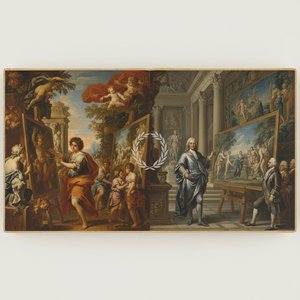
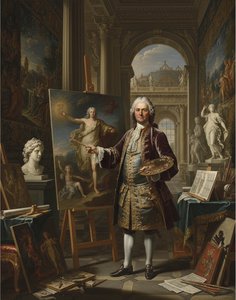
Early Life and Training
Charles Le Brun, a name synonymous with the grandeur of Louis XIV’s France, was born in Paris on February 24th, 1619. His artistic talent manifested early; at just eleven years old, he entered the studio of Simon Vouet, a prominent painter and influential figure in the burgeoning world of art. This apprenticeship was further enriched by the patronage of Chancellor Séguier, providing Le Brun with invaluable opportunities for development. He continued his studies under François Perrier, absorbing techniques and styles from another respected master, and quickly gained commissions from Cardinal Richelieu at a remarkably young age – a testament to his burgeoning skill. These early experiences laid the foundation for a career that would ultimately define an era.
Artistic Development and Style
A pivotal moment in Le Brun’s artistic journey occurred with his four-year sojourn in Rome between 1642 and 1646. Here, under the guidance of Nicolas Poussin, he immersed himself in the classical ideals of ancient Roman sculpture and meticulously copied works by Raphael. This period profoundly shaped his understanding of art theory and technique, moving him beyond mere imitation towards a deeper appreciation for composition, form, and color. Returning to Paris in 1646, Le Brun swiftly established himself as a leading artist, quickly surpassing the influence of his earlier mentors. His style began to evolve, distancing itself from the strict adherence to classical models favored by Poussin while retaining elements of both. He embraced the dynamism and emotional intensity characteristic of the Baroque period, developing a distinctive approach marked by dramatic compositions, rich palettes, and meticulous detail.
Le Brun’s artistic evolution culminated in his appointment as First Painter to the King in 1664 under Louis XIV. This prestigious position granted him unparalleled influence over French art, allowing him to shape the visual landscape of the court and nation. He became a central figure in the creation of monumental works that embodied the power and magnificence of the monarchy – grand historical paintings, elaborate portraits, and breathtaking decorative schemes.
Major Achievements and Royal Service
Le Brun’s career reached its zenith during Louis XIV's reign, a period of unprecedented artistic flourishing. He played an integral role in transforming the Palace of Versailles into a symbol of royal power and splendor. His designs were instrumental in shaping the Ambassadors’ Staircase, the iconic Hall of Mirrors – a dazzling display of light and reflection – and the serene Peace and War Rooms, each reflecting a distinct facet of the king's vision. These projects, alongside countless other commissions throughout the palace complex, cemented Le Brun’s reputation as one of France’s greatest architects and designers. Beyond Versailles, he contributed significantly to the decoration of numerous royal residences, including Sceaux and Marly-le-Roi, showcasing his versatility across various artistic disciplines.
Furthermore, in 1648, Le Brun founded the Académie Royale de Peinture et de Sculpture (Royal Academy of Painting and Sculpture), a pivotal institution that served as both a training ground for aspiring artists and a regulator of artistic standards. As its director for many years, he exerted considerable influence over the development of French art, shaping the education and practice of generations of painters.
Legacy and Historical Significance
Charles Le Brun’s legacy extends far beyond his individual works. He was not merely a painter; he was a theorist, a designer, and a key architect of the Baroque style in France. His emphasis on intellectual engagement alongside visual beauty profoundly influenced artistic education for decades to come. The scale and grandeur of his decorative schemes at Versailles set a new standard for royal palaces across Europe, inspiring countless imitators. Le Brun’s influence is inextricably linked to the rise of Louis XIV's power and the flourishing of French culture during the 17th century. His work remains a testament to the transformative potential of art and its ability to shape not only visual landscapes but also the very fabric of society.