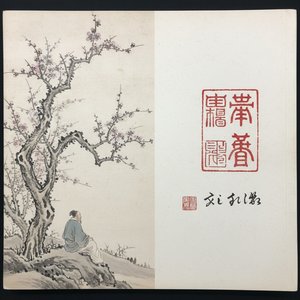
The Scholar's Quiet Vision
In the shifting landscape of the Yuan Dynasty, Cao Zhibai moved through the world as both a creator of images and a dedicated collector of books. Known by his courtesy names Youxuan and Zhensu, and often called by his sobriquet Yunxi, he belonged to a class of intellectuals who found solace in the written word and the brush. His life was defined by this dual devotion to the preservation of knowledge and the translation of nature onto silk. He was a man of deep learning, a bibliophile whose hands were as accustomed to turning delicate pages as they were to guiding a brush through ink and color.
His presence in history is felt through the quiet strength of his landscapes. He did not seek to reinvent the world, but rather to breathe life into the traditions of those who came before him. By looking backward, he found a way to move forward, capturing the essence of the mountains and mists that had long inspired the Chinese spirit.
The Language of Ink and Silk
The brushwork of Cao Zhibai tells a story of careful imitation and personal refinement. He drew much of his inspiration from the great traditions of the past, specifically the styles of Li Cheng and Guo Xi. His work sought to revitalize the landscape painting traditions of the Li-Guo school, bringing a renewed sense of structure and atmosphere to the medium. Through his hands, the ink and color on silk became a way to navigate the complexities of the natural world.
His technical approach was marked by several distinct characteristics:
- The use of ink and color on silk to create depth and texture.
- A stylistic lineage that echoed the monumental landscapes of earlier eras.
- A focus on the interplay between solid forms and ethereal atmosphere.
This method allowed him to create works that felt both grounded in history and uniquely his own. He worked with a precision that respected the weight of the mountains and the lightness of the clouds, ensuring that every stroke served the composition of the whole.
A Legacy in the Imperial Collection
The endurance of Cao Zhibai is evidenced by the survival of his works within the most prestigious repositories. His landscapes have been preserved through the centuries, finding a permanent home in the Palace Museum in Beijing. These surviving pieces offer a glimpse into the mind of a man who understood the permanence of art and the fleeting nature of the seasons. His ability to capture the spirit of the landscape ensured that his vision would remain long after his own time had passed.
He remains a significant figure for those who study the evolution of Chinese painting. His life reflects the intersection of scholarship and artistry, where the act of collecting books and the act of painting a mountain were parts of a single, unified pursuit of understanding the world.
Pytania i odpowiedzi
Na jakie okresy dzieli się kariera Cao Zhibai?
Chronologiczne zestawienie twórczości Cao Zhibai można znaleźć na stronie Osiągnięcia artystyczne, gdzie dzieła prezentowane są w kolejności ich powstania, podzielone na poszczególne etapy kariery.
Czy mogę przeglądać dzieła Cao Zhibai według techniki wykonania?
Strona Wszystkie techniki grupuje dzieła Cao Zhibai według techniki wykonania.
Jak mogę znaleźć dzieła artysty Cao Zhibai w konkretnej palecie barw?
Strona Według palet kolorystycznych grupuje dzieła Cao Zhibai według ich palet kolorystycznych.
Gdzie mogę zobaczyć wszystkie dzieła Cao Zhibai?
Wszystkie dzieła Cao Zhibai dostępne w niniejsza strona można przeglądać na stronie Wszystkie dzieła artysty.