Portret Albert Dunington

7 najsłynniejszych obrazów artysty Albert Dunington, każdy niepowtarzalny

Aktualizacja: Listopad 2026 · ranking według naszego wskaźnika popularności (liczba wyszukiwań, wizyt i zamówień dla każdego dzieła) · 7 dzieł Albert Dunington w naszym katalogu

W skrócie

The Queen on Board 'The Enchantress' at Trafford Wharf Ship Canal, Manchester (1894) to obraz autorstwa Albert Dunington, który przyciąga najwięcej spojrzeń; oryginał znajduje się w Salford Museum - Art Gallery, Greater Manchester. Następnie wzrok kieruje się na 'The Snowdrop' with the Directors of the Manchester Ship Canal Passing Barton Bridges, 7 December 1893 i Barton Aqueduct (1894). Spośród 7 dzieł Albert Dunington w naszym katalogu, tych 7 jest najbardziej znanych – każde z nich to unikatowy oryginał, przedstawiony wraz z rokiem powstania, muzeum oraz powodem, dla którego przetrwało próbę czasu.

1860 – 1941 Najwięcej dzieł: Salford Museum - Art Gallery

10 najlepszych obrazów autorstwa Albert Dunington według oka galerii

1
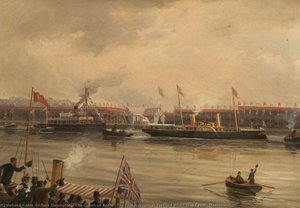
The Queen on Board 'The Enchantress' at Trafford Wharf Ship Canal, Manchester (1894) autorstwa Albert Dunington

The Queen on Board 'The Enchantress' at Trafford Wharf Ship Canal, Manchester

1894 · Watercolor · Salford Museum - Art Gallery, Greater Manchester

The scene captures a moment of regal dignity amidst the engineering marvels of the late nineteenth century. On the deck of the vessel The Enchantress, the Queen sits in a setting of quiet sophistication, surrounded by the movement of the Manchester Ship Canal. The composition balances the presence of the monarch with the bustling activity of the waterway, where several boats navigate the waters of Trafford Wharf. Flags flutter from…

2
'The Snowdrop' with the Directors of the Manchester Ship Canal Passing Barton Bridges, 7 December 1893 autorstwa Albert Dunington

'The Snowdrop' with the Directors of the Manchester Ship Canal Passing Barton Bridges, 7 December 1893

Oil On Canvas · Salford Museum - Art Gallery, Greater Manchester

The oil painting depicts a steamship named 'The Snowdrop' navigating through the waters beneath a canal bridge. The vessel occupies the foreground, its dark hull and structural lines cutting through the water. Above the ship, the arched architecture of the bridge spans the canal, creating a frame for the maritime activity. Smoke rises from the ship's funnel, drifting into an overcast sky. The scene is set against a landscape of…

4
Tintern Abbey (1894) autorstwa Albert Dunington

Tintern Abbey

1894 · Oil On Canvas · The Stirling Smith Art Gallery - Museum, Stirling

The scene captures a serene river landscape at sunset, where the sky is heavy with clouds that add depth to the horizon. A man rows a boat through the center of the water, his presence a quiet focal point amidst the vastness of the landscape. To the right, a bench sits empty, offering a silent invitation to observe the shifting light. The composition relies on the interplay of mountain silhouettes…

5
Lancing Mill, Sussex (1894) autorstwa Albert Dunington

Lancing Mill, Sussex

1894 · Oil On Canvas · The Stirling Smith Art Gallery - Museum, Stirling

In this 1894 oil on canvas, Albert Dunington depicts a working farm scene in Lancing, Sussex. The composition is centered on a field filled with hay bales, suggesting a period of harvest or grain storage. Five horses occupy the midground, some pulling carts and others being ridden by individuals. These animals move through the field alongside several people engaged in agricultural labor. In the background, a large windmill rises above…

6
Barton Aqueduct autorstwa Albert Dunington

Barton Aqueduct

Oil On Canvas · Salford Museum - Art Gallery, Greater Manchester

In this oil on canvas, we find ourselves observing a moment of stillness within a landscape defined by movement and engineering. The scene centers on a bridge spanning a river, a structure that anchors the composition and dictates the flow of the water below. Several boats rest upon the river, their presence suggesting the quiet rhythms of a working waterway. Figures move along the banks, their small scale emphasizing the…

7
Wick Harbour autorstwa Albert Dunington

Wick Harbour

· Wick Town Hall, Wick

The painting titled Wick Harbour is a work by the artist Albert Dunington. This piece measures 49 x 40 cm and depicts a harbor scene. The composition focuses on a maritime environment where several boats of various sizes are docked in the water. On the shore near these vessels, a group of people is positioned, appearing to attend to the ships or observe the surroundings.

Tematy, które przyciągnęły wzrok Albert Dunington

Cztery motywy najczęściej powracające w tych oryginałach, z których każdy doczekał się swojego najdoskonalszego przykładu.

Muzea przechowujące oryginały Albert Dunington

3 muzeów, w których znajduje się najwięcej obrazów z tej strony.

Muzea Miasto Dzieła artysty Albert Dunington Obrazy z tej listy
Salford Museum - Art Gallery, Greater ManchesterSalford Museum - Art Gallery Greater Manchester 4 The Queen on Board 'The Enchantress' at Trafford Wharf Ship Canal, Manchester, 'The Snowdrop' with the Directors of the Manchester Ship Canal Passing Barton Bridges, 7 December 1893, Barton Aqueduct
The Stirling Smith Art Gallery - Museum, StirlingThe Stirling Smith Art Gallery - Museum Stirling 2 Tintern Abbey, Lancing Mill, Sussex
Wick Town Hall, WickWick Town Hall Wick 1 Wick Harbour

Twórczość Albert Dunington na przestrzeni lat: unikalne oryginały każdego dzieła

Wszystkie przedstawione tutaj oryginalne dzieła Albert Dunington z datą powstania 1894 należą do jednego roku: są one uporządkowane według stopnia sławy.

Dzieła według lat

Wybierz rok, aby zobaczyć oryginały.

Obrazy artysty Albert Dunington: pytania do galerii

Jakie jest najsłynniejsze dzieło artysty Albert Dunington?Odkryj odpowiedź

The Queen on Board 'The Enchantress' at Trafford Wharf Ship Canal, Manchester (1894), Salford Museum - Art Gallery, Greater Manchester. Następne są 'The Snowdrop' with the Directors of the Manchester Ship Canal Passing Barton Bridges, 7 December 1893 oraz Barton Aqueduct (1894).

W jakim wieku Albert Dunington stworzył/a The Queen on Board 'The Enchantress' at Trafford Wharf Ship Canal, Manchester?Odkryj odpowiedź

34 lat: The Queen on Board 'The Enchantress' at Trafford Wharf Ship Canal, Manchester pochodzi z 1894, a Albert Dunington urodził(a) się w 1860.

Ile znanych dzieł stworzył Albert Dunington?Odkryj odpowiedź

Nasz katalog zawiera 7 dzieł autorstwa Albert Dunington.

Gdzie można zobaczyć najsłynniejsze oryginały Albert Dunington?Odkryj odpowiedź

W większości znajdują się w Salford Museum - Art Gallery (Greater Manchester), The Stirling Smith Art Gallery - Museum (Stirling) i Wick Town Hall (Wick). Powyższa tabela muzeów zawiera ich pełną listę.

W jakim okresie Albert Dunington stworzył/a swoje najsłynniejsze obrazy?Odkryj odpowiedź

W 1894: 4 z 7 dzieł na tej stronie powstało w tym czasie, w tym The Queen on Board 'The Enchantress' at Trafford Wharf Ship Canal, Manchester.

Jakie tematy preferował Albert Dunington?Odkryj odpowiedź

Boat (4), People (4) i Water (4), w ramach 7 dzieł na tej stronie.

Jakich materiałów Albert Dunington używał najczęściej?Odkryj odpowiedź

Oil On Canvas, dla 5 z 7 dzieł na tej stronie.

Jakie oryginały Albert Dunington można zobaczyć w Salford Museum - Art Gallery?Odkryj odpowiedź

The Queen on Board 'The Enchantress' at Trafford Wharf Ship Canal, Manchester, 'The Snowdrop' with the Directors of the Manchester Ship Canal Passing Barton Bridges, 7 December 1893 i Barton Aqueduct: Salford Museum - Art Gallery, Greater Manchester posiada 4 dzieł widocznych na tej stronie.

Albert Dunington: portret artysty

The Visionary of the Victorian Canal

Albert Dunington (1860–1941) remains a singular and evocative figure in the annals of British watercolour and oil painting, a master who captured the very soul of a transforming nation. Born in Lewisham, Kent, Dunington emerged from the prestigious Slade School of Fine Art, where his artistic sensibilities were forged under the watchful eyes of titans such as Frederic Leighton and Joseph Noel Paton. This rigorous classical training provided him with a profound command over composition and anatomy, yet it was his unique ability to marry this academic precision with a Romantic sensibility that truly defined his legacy. His work does not merely document landscapes; it breathes life into the industrializing veins of late nineteenth-century Britain, offering a window into an era where the pastoral beauty of the countryside met the burgeoning might of engineering progress.

The essence of Dunington’s oeuvre lies in his unparalleled ability to render the atmospheric nuances of the British landscape. He possessed an almost scientific eye for the subtle interplay of light, mist, and shadow, techniques that allowed him to imbue even the most industrial scenes with an ethereal, dreamlike quality. Whether he was capturing the quiet ripples of the Worcestershire Canal or the dramatic sunset over a river landscape, his brushwork conveyed a deep emotional resonance. His dedication to realism was never hollow; rather, it was underpinned by a sophisticated understanding of colour theory that allowed him to recreate the textures of stone, water, and sky with breathtaking fidelity. In his hands, the damp air of an English morning or the golden warmth of a departing sun became palpable elements that the viewer could almost feel.

A Legacy of Progress and Pastoral Serenity

Dunington’s artistic journey was marked by a fascinating tension between the celebration of natural beauty and the documentation of human achievement. He was an artist who found profound meaning in the intersection of nature and industry, a theme most vibrantly expressed in his depictions of the Manchester Ship Canal. His celebrated work, ‘The Snowdrop’ with the Directors of the Manchester Ship Canal Passing Barton Bridges (1893), serves as a magnificent historical document, capturing the grandeur of steamships and the excitement of engineering marvels set against the timeless backdrop of the Sussex countryside. This ability to find beauty in the mechanical and the monumental allowed him to transcend simple landscape painting, turning his canvases into narratives of national identity and progress.

Beyond the industrial, Dunington’s repertoire extended into the deeply tranquil and the classically sublime. His paintings often invite a sense of quiet contemplation, as seen in works like Tintern Abbey, where he masterfully utilizes soft brushstrokes and muted tones to evoke a sense of peace. In these pieces, the artist explores the relationship between man and the environment, often placing solitary figures within vast, sweeping vistas to emphasize the grandeur of the natural world. His prolific output, which includes over 300 paintings, demonstrates a lifelong commitment to exploring these diverse themes:

  • The Industrial Landscape: Capturing the monumental scale of new canals and bridges, documenting the era of great engineering feats.
  • Rural Life: Detailed portrayals of agricultural scenes, such as Lancing Mill, Sussex, which offer a nostalgic glimpse into the rhythms of late Victorian farming.
  • Atmospheric Studies: A mastery of light and weather, from the heavy mists of river valleys to the dramatic clarity of mountain vistas.
  • Historical Documentation: Creating lasting visual records of specific events and landmarks that shaped the British landscape.

Today, the works of Albert Dunington continue to resonate within public collections across Britain and beyond. His significance lies not only in his technical virtuosity but in his role as a visual chronicler of a pivotal moment in history. He captured a world in transition—a world where the ancient traditions of the English landscape were being reshaped by the relentless march of the industrial revolution, leaving behind a legacy of art that is as much about the enduring spirit of nature as it is about the indelible mark of human progress.