A Pioneer of American Modernism: The Life and Art of Abraham Walkowitz
Abraham Walkowitz, a figure often overshadowed by the brighter lights of early 20th-century American art, nevertheless played a crucial role in shaping its trajectory. Born in Tyumen, Siberia, in 1878, to Jewish parents, his life was marked by displacement and a relentless pursuit of artistic expression—a journey that ultimately led him to become one of the first true American modernists. His story is not just about individual talent but also about the confluence of cultural forces and personal experiences that forged a unique vision.
- Early Years & Artistic Instincts: Walkowitz’s childhood was far from conventional for a boy born in remote Siberia. Following his father's death, he and his mother emigrated to New York City, settling in the bustling Lower East Side. Even as a young child, he demonstrated an extraordinary sensitivity to visual form—a restless energy channeled into spontaneous drawings with chalk on floors, capturing movement and light with remarkable immediacy. This innate artistic impulse, nurtured from early childhood, would become the foundation of his entire career.
- Formal Training & European Influences: Seeking formal guidance, Walkowitz enrolled in art classes at the Cooper Union and the Educational Alliance in New York City. He then embarked on a transformative journey to Paris in 1906, where he studied at the Académie Julian under Jean-Paul Laurens. This immersion in traditional techniques provided a crucial grounding before he ventured into the uncharted territory of modernism. However, it was his encounters with European avant-garde movements—particularly Cubism and Futurism—that truly ignited his artistic imagination.
The Crucible of Modernity: Influences and Artistic Development
Walkowitz’s time in Paris wasn't merely a period of technical training; it was a pivotal moment of intellectual and aesthetic discovery. He became deeply involved with the circle surrounding Alfred Stieglitz and his 291 Gallery, a legendary hub for American modernists. This association proved to be far more than a professional connection—it was an immersion into a vibrant community of artists pushing the boundaries of representation and challenging conventional artistic norms. Figures like Arthur Dove, Marsden Hartley, and John Marin formed a close-knit group, collectively known as “The Stieglitz Quartet,” and Walkowitz found himself at the heart of this dynamic exchange.
A particularly significant encounter occurred during the 1907 memorial exhibition dedicated to Paul Cézanne in Paris. This event profoundly impacted Walkowitz’s approach to art, shifting his focus from meticulous realism to a more expressive exploration of form and structure. He began to experiment with flattened perspectives, simplified shapes, and bold color palettes—elements that would become hallmarks of his distinctive style. Crucially, he resisted the temptation to simply imitate European trends, instead seeking to synthesize these influences with his own unique sensibility, forging an authentically American voice within the burgeoning modernist movement. The influence of Isadora Duncan was also a key factor during this period.
- Isadora Duncan: A Defining Relationship: Walkowitz’s fascination with Isadora Duncan—the revolutionary dancer whose dynamic movements captivated him—became a central theme in his work. He produced over 5,000 drawings of her, not merely as portraits but as explorations of her spirit, her liberation, and her artistic innovation. These drawings are remarkable for their fluidity, dynamism, and evocative use of charcoal and watercolor, capturing the essence of Duncan’s performance with astonishing sensitivity.
Capturing Essence: Key Works and Artistic Style
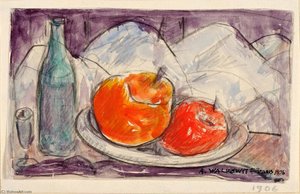
Walkowitz's artistic output was remarkably diverse, encompassing a wide range of subjects—cityscapes, still lifes, and, most notably, his extensive portraits of Isadora Duncan. His
New York Skyline (1913) stands as a prime example of his mastery of linear perspective and atmospheric depth, capturing the energy and dynamism of urban life with a hazy, impressionistic quality. Later works, such as
Metropolis, No. 1 (1919), reveal a darker, more Expressionistic sensibility, reflecting themes of destruction and loss through dramatic charcoal renderings.
- The Isadora Duncan Drawings: A Monumental Achievement: The Isadora Duncan Drawings represent Walkowitz’s most enduring legacy—a monumental achievement that transcends mere portraiture. These drawings are not simply representations of the dancer's physical form but profound explorations of her very essence, her spirit of liberation and artistic innovation. They are characterized by their fluid lines, dynamic compositions, and evocative use of charcoal and watercolor, capturing the movement and emotion of Duncan’s performances with remarkable power.
- Diverse Styles: While his work on Duncan dominated much of his output, Walkowitz also explored cityscapes, still lifes, and portraits of friends and family, often employing a blend of abstraction and representation to convey mood and atmosphere.
A Lasting Legacy: Historical Significance
Abraham Walkowitz played an indispensable role in shaping the landscape of early American Modernism. His involvement with Alfred Stieglitz’s 291 Gallery was instrumental in establishing a platform for modern art, introducing European artists to an American audience and fostering a community of like-minded innovators. The watershed moment of the Armory Show in 1913—where Walkowitz exhibited alongside other groundbreaking artists—marked a turning point in the acceptance of modern art within the United States. Beyond his contributions to the broader modernist movement, Walkowitz’s extensive drawings of Isadora Duncan provide invaluable insights into both her artistic practice and his own evolving style. Critics like Oscar Bluemner recognized his unique ability to absorb modernist influences without sacrificing originality, highlighting his contribution to a distinctly American form of modern art—one that was bold, innovative, and deeply personal. Walkowitz’s legacy continues to inspire artists today, reminding us of the power of artistic vision and the importance of forging one's own path in the pursuit of creative expression.