Zobacz w skali 1:1
 Wyślij
 Udostępnij
 Szczegóły
 Przewodnik

 Pobierz plik obrazu
 Podobne obiekty
 RTG
RTG Pokaz slajdów
 Statystyki
Koska Kar

 Czytaj więcej
Dzieło sztuki prezentowane na tej stronie podlega ochronie prawem autorskim, co oznacza, że nie mamy prawa do tworzenia ani sprzedaży jego identycznej reprodukcji. Ochrona ta jest egzekwowana na mocy umów międzynarodowych, takich jak Konwencja berneńska oraz przez przepisy prawa krajowego, w tym te określone w Prawo autorskie USA – Tytuł 17.
Metoda ta jest w pełni zgodna z przepisami prawa autorskiego, ponieważ nie polega na kopiowaniu ani powielaniu chronionego dzieła. Stanowi ona kreatywną reinterpretację – nowy obraz, który czerpie inspirację z oryginału, ale nie jest z nim tożsamy.
Giclée / Wydruk artystyczny
Wydruki giclée lub płótna o jakości muzealnej, szybka realizacja i szeroki wybór opcji wykończenia. ( Kup ręcznie malowany obraz Przełącz na wersję cyfrową)




P118B zł10

P118H zł10

P118W zł10

P438Z zł10

P508JH zł12

P508YH zł12

P805H zł10

P805Z zł10

P919BZ zł10

P919G zł10

P919XJ zł10

P959ZH zł10

P968JZ zł12

W106C zł8

W218G zł10

W218JH zł8

W218Y zł10

W307PJ zł10

W316G zł10

W316PJ zł8

W316Y zł10

W398PJ zł8

W4111J zł10

W500HY zł15

W500JH zł15

W692G zł12

W849H zł8

W940BG zł15

W953PJ zł8




Wybierz spośród naszych standardowych rozmiarów, które zachowują oryginalne proporcje dzieła sztuki.

Wpisz wymaganą szerokość i wysokość, aby dopasować grafikę do ramy lub ściany. Wydruk można jedynie przyciąć, nigdy nie powiększając go poza oryginalny obraz, dlatego format o innym proporcji spowoduje utratę części kompozycji. Przed rozpoczęciem druku prześlemy Ci cyfrowy podgląd do zatwierdzenia. Obraz wyświetlany na tej stronie nie pokazuje rzeczywistego przycięcia — jedynie podgląd oddaje ten efekt.
Dostawa na cały świat () w ciągu 2 tygodni zamiast standardowych 4/5 tygodni. (21 Październik)

Bezpłatna ekspresowa wysyłka na cały świat

Wysokiej jakości płótno lniane

Pełne ubezpieczenie transportowe

Gwarancja zwrotu należności celnych i podatków importowych

Gwarancja idealnego odwzorowania barw

100-dniowy okres na zwrot dzieła w przypadku wykrycia wad produkcyjnych

Gwarancja 100% zwrotu pieniędzy

Oferta przy zakupie wielu sztuk
 Opcja ze szkłem jest dostępna wyłącznie w rozmiarach poniżej 110 cm

Koska Kar
Giclée / Wydruk artystyczny
Rozmiar reprodukcji
-


Suma do zapłaty
zł 304
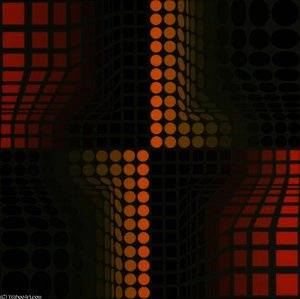
Koska Kar – A Geometric Dance of Perception by Victor Vasarely
Victor Vasarely’s “Koska Kar,” created in 1975, stands as a quintessential example of Op Art—Optical Art—a movement that revolutionized visual perception during the mid-20th century. More than just a decorative element, it's an invitation to question how our eyes interpret reality, achieved through masterful geometric abstraction and a deceptively simple color palette. This heliogravure print captures the essence of Vasarely’s artistic system, meticulously designed to stimulate visual illusions and challenge conventional notions of space and form.The Visual Illusion: Beyond What Meets The Eye
At first glance, “Koska Kar” presents a captivating arrangement of circles—large central circles surrounded by smaller ones—interspersed with squares of varying sizes. However, Vasarely’s genius lies in creating an optical illusion. Through careful manipulation of color and repetition, the painting appears to contain more shapes than are actually present on the surface. This technique is rooted in Gestalt psychology, specifically the principle of Prägnanz (good gestalt), which suggests that our brains instinctively seek patterns and order amidst visual stimuli. The artist deliberately disrupts this natural tendency, prompting viewers to actively engage with the artwork and experience its dynamic interplay of perception.Vasarely’s Geometric System: Precision and Controlled Chaos
Born Károly Vaszary in Pécs, Croatia, in 1906, Victor Vasarely (1906-1997) embarked on a lifelong pursuit of geometric abstraction following his initial studies in medicine. Influenced profoundly by the Bauhaus movement’s emphasis on functional design and rational aesthetics, he honed his artistic vision at Sándor Bortnyik’s Műhely workshop. This formative experience instilled in him a systematic approach to artmaking—a “geometric system”—characterized by precise calculations and controlled randomness. Vasarely meticulously plotted coordinates on paper, creating grids and intersecting lines that served as the foundation for his compositions. He believed that mathematics could unlock the secrets of visual perception, transforming abstract forms into vehicles for conveying complex ideas about order and dynamism.Color Palette and Emotional Resonance
The painting’s subdued color scheme—primarily blues accented with greens and yellows—contributes significantly to its emotional impact. Vasarely deliberately avoided vibrant hues, opting instead for tones that evoke tranquility and contemplation. Yet, the subtle shifts in color create a sense of movement and visual vibration, mirroring the underlying mathematical principles governing his artwork. This careful consideration of color isn’t merely decorative; it's integral to conveying the artist’s intention—to stimulate the viewer’s senses and provoke an experience beyond mere visual observation. The harmonious blend of colors reinforces the geometric patterns, creating a unified aesthetic that embodies Vasarely’s belief in the power of abstraction to communicate profound truths about human consciousness.Legacy and Influence: Shaping Modern Art
“Koska Kar” exemplifies Vasarely's enduring contribution to modern art history. His pioneering work in Op Art paved the way for subsequent explorations into perceptual illusion and visual stimulation, influencing artists across disciplines—from graphic design to architecture. Today, reproductions of “Koska Kar” continue to captivate audiences worldwide, serving as a testament to Vasarely’s unwavering commitment to pushing the boundaries of artistic expression and redefining our understanding of how we perceive the world around us. It remains an iconic image of geometric abstraction and a captivating demonstration of visual illusion—a timeless masterpiece that speaks volumes about the intersection of mathematics and art.Pytania i odpowiedzi
Jak mogę odkryć dzieła zbliżone do „Koska Kar” autorstwa Wiktór Wasaryli?
Dzieła podobne do „Koska Kar” znajdują się na stronie Podobne dzieła danego dzieła.
Gdzie zaleca się eksponować format Kwadrat dzieła „Koska Kar”?
Format Kwadrat dzieła „Koska Kar” autorstwa Wiktór Wasaryli jest rekomendowany do Salon lub strefa dzienna. Format oraz przestrzeń wspólnie pomagają w odpowiednim rozmieszczeniu reprodukcji.
Skąd pochodzą odwiedzający „Koska Kar” autorstwa Wiktór Wasaryli?
Statystyki dotyczące „Koska Kar” autorstwa Wiktór Wasaryli znajdują się na stronie Statystyki dzieła: obejmują one miesięczną liczbę odwiedzin danego dzieła, wizyty przy pracach artysty oraz podział ostatnich odwiedzających według krajów i języków.
Biografia artysty
A Life Forged in Geometry: The World of Victor Vasarely
Victor Vasarely (węg. Vásárhelyi Győző), (ur. 9 kwietnia 1906, Pecz, Węgry, zm. 15 marca 1997, Paryż, Francja) – artysta węgierskiego pochodzenia, który tworzył i pracował we Francji aż do śmierci. Jeden z czołowych przedstawicieli abstrakcji geometrycznej. Uważany za prekursora i przedstawiciela nurtu op-art. Tworzył poprzez komponowanie układów, wykorzystując geometryczne kształty (najbardziej charakterystyczne są kompozycje w kształcie kostki). Tworzył iluzję przestrzennej głębi na powierzchniach dwuwymiarowych, wykorzystując do tego jedynie abstrakcyjne plamy barwne. Pierwotnie w jego pracach dominowała czarno-biała kolorystyka, którą znacznie urozmaicił w swojej późniejszej działalności. Pierwotnie studiował medycynę, jednak po dwóch latach zmienił kierunek na malarstwo. Vasarely działał w węgierskim oddziale Bauhausu (Muhely) w Budapeszcie pod koniec lat 20. XX wieku. Here, Vasarely absorbed the tenets of functional design and geometric abstraction, seeds that would blossom into his signature style. These formative years weren't simply about acquiring technique; they were about dismantling traditional artistic conventions and embracing a new visual language rooted in logic and precision. From Early Abstraction to the Dawn of Op ArtThe late 1920s and early 1930s witnessed Vasarely’s gradual departure from representational art, as he delved deeper into the realm of geometric abstraction. Works like “Blue Study” and “Green Study,” created in 1929, exemplify this transition – a deliberate shedding of narrative content in favor of pure form and color relationships. While influenced by masters such as Piet Mondrian and Kazimir Malevich, Vasarely wasn’t content to simply emulate their styles. He sought to transcend the static compositions of his predecessors, aiming for a dynamism that would actively engage the viewer's perception. This quest led him to Paris in 1930, where he established himself as a graphic designer and advertising artist, honing his skills while continuing to develop his unique artistic vision. It was during this period that he began experimenting with techniques that would later become hallmarks of Op Art – manipulating shapes and colors to create illusions of movement and depth. The seeds were sown for a revolution in visual experience.The Systematic Illusion: Defining a Movement
By the 1960s, Victor Vasarely had fully emerged as a leading figure in the burgeoning Op Art movement. Unlike many artists who relied on intuition and spontaneous expression, Vasarely approached his work with a distinctly systematic methodology. He employed grids and mathematical principles to generate patterns that created powerful optical illusions – visual vibrations, swirling effects, and sensations of depth where none physically existed. This wasn’t about trickery; it was about revealing the inherent dynamism within perception itself. He believed in reproducibility and mass appeal, aiming to democratize art by making it accessible beyond the confines of galleries and museums. His work challenged viewers to question their own visual experience, forcing them to actively participate in the creation of meaning. He wasn't merely painting pictures; he was constructing experiences.Historical Significance
Vasarely’s contribution to art history is multifaceted. He moved beyond traditional painting techniques to create works that actively engage the viewer’s perception. His systematic approach challenged conventional notions of artistic creativity and paved the way for computer-generated art and digital design. By embracing reproducibility and commercial applications, Vasarely blurred the boundaries between fine art and popular culture, leaving an enduring mark on both. He wasn't simply creating aesthetically pleasing objects; he was conducting visual experiments that revealed fundamental truths about how we see the world. His work continues to resonate today, reminding us of the power of abstraction, the beauty of geometry, and the endless possibilities of human creativity.Influences and Development
Vasarely’s artistic journey began with a medical education in Budapest, but he quickly realized his true passion lay in visual expression. His enrollment at Sándor Bortnyik’s workshop – Műhely – profoundly shaped his early style, exposing him to the principles of functional design and geometric abstraction deeply rooted in the Bauhaus movement. This environment fostered a critical approach to traditional art forms, encouraging him to dismantle established conventions and develop a new visual language based on logic and precision. His time in Paris solidified this shift, as he honed his skills as a graphic designer and advertising artist while continuing to experiment with abstract forms and color relationships. The influence of Piet Mondrian’s reductive style and Kazimir Malevich's Suprematist explorations are evident in Vasarely’s early works, yet he ultimately sought to transcend mere imitation, aiming for a dynamic visual experience that engaged the viewer’s perception directly.Major Achievements
Vasarely’s legacy extends far beyond his paintings. He pioneered techniques of optical illusion and kinetic art, creating works that challenged our understanding of space and movement. His collaboration with Rosenthal porcelain resulted in the iconic “Suomi” tableware series, demonstrating his ability to integrate artistic principles into everyday objects. Perhaps most remarkably, Vasarely’s work was selected for display aboard the French-Soviet spacecraft Salyut 7 in 1982 – a testament to its universal appeal and groundbreaking nature. His Fondation Vasarely in Aix-en-Provence continues to preserve and promote his extensive body of work, ensuring that his innovative vision endures.
Wiktór Wasaryli
1906 - 1997 , Chorwacja
Najważniejsze informacje
- Artistic Movement Or Style: Op Art, Kinoart
- Artists Or Movements Influenced By This Artist: ['Projektowanie graficzne']
- Artists Who Influenced This Artist:
- Mondrian
- Malevich
- Date Of Birth: 9 kwietnia 1906
- Date Of Death: 15 marca 1997
- Full Name: Victor Vasarely
- Nationality: Węgiersko-Francuz
- Notable Artworks:
- Blue Study
- Green Study
- Place Of Birth: Pécs, Chorwacja
Zobacz także powiązane artykuły

Op Art Unveiled: The Science of Optical Illusion and Kinetic Movement in Geometric Abstraction
Explore the science of Op Art through the lens of masters like Victor Vasarely. Discover how geometric abstraction uses optical illusions to create movement and delve into the neuroaesthetics of perception with our expert art history guide.

Neo-Abstract Art: The High-Impact Evolution of Modern Visual Energy and Geometric Sophistication
Discover the power of Neo-Abstract art. Explore how bold geometric forms and high-impact visual energy are redefining modern design. Learn to curate sophisticated, high-energy spaces with the latest trends in contemporary abstraction and structural color.
Mastering Illusion: The Vibrant World of Victor Vasarely's Op Art and the Geometry of Perception
Explore the mesmerizing world of Victor Vasarely. Discover how his Bauhaus-inspired Op Art masters the science of perception through geometric abstraction and vibrant color. A sophisticated guide for discerning art collectors seeking to understand the legacy of optical illusion.

Geometria Sztuki: 10 Arcydzieł Abstrakcji Geometrycznej | OriginalUniqueArt.com
Odkryj 10 arcydzieł abstrakcji geometrycznej! Poznaj historię Mondriana, Kandinskiego i Maleвича. Inspiracje wnętrzarskie z malarstwem abstrakcyjnym – reprodukcje najwyższej jakości na OriginalUniqueArt.com. Eksploruj kolekcję online!

Victor Vasarely: Pioneering Op Art & Democratizing Visual Experience
Explore the revolutionary world of Victor Vasarely, father of Op Art. Discover his geometric masterpieces, artistic system, & lasting impact on modern design. A guide for discerning art collectors.