

 Zobacz w skali 1:1
 Wyślij
 Udostępnij
 Szczegóły
 Przewodnik

 Pobierz plik obrazu
 Podobne obiekty
 RTG
RTG Pokaz slajdów
 Statystyki
The South Gate, Exeter


 Czytaj więcej
Giclée / Wydruk artystyczny
Wydruki giclée lub płótna o jakości muzealnej, szybka realizacja i szeroki wybór opcji wykończenia. ( Kup ręcznie malowany obraz Przełącz na wersję cyfrową)




P118B $10

P118H $10

P118W $10

P438Z $10

P508JH $12

P508YH $12

P805H $10

P805Z $10

P919BZ $10

P919G $10

P919XJ $10

P959ZH $10

P968JZ $12

W106C $8

W218G $10

W218JH $8

W218Y $10

W307PJ $10

W316G $10

W316PJ $8

W316Y $10

W398PJ $8

W4111J $10

W500HY $15

W500JH $15

W692G $12

W849H $8

W940BG $15

W953PJ $8




Wybierz spośród naszych standardowych rozmiarów, które zachowują oryginalne proporcje dzieła sztuki.

Możesz wprowadzić własne wymiary, aby dopasować dzieło do konkretnej ramy lub przestrzeni. Jeśli wybrany rozmiar nie będzie odpowiadał proporcjom oryginalnego obrazu, przytniecie dzieło lub rozszerzymy obraz za pomocą odbicia lustrzanego lub jednolitego wypełnienia krawędzi. Przed rozpoczęciem produkcji prześlemy cyfrową wizualizację do Twojej akceptacji.
Prosimy pamiętać, że podgląd na ekranie nie odzwierciedla faktycznego przycinania ani rozszerzania. Tylko wizualizacja dokładnie pokaże końcową kompozycję.
Mimo dostępności niestandardowych rozmiarów, zalecamy wybór wymiaru z listy zdefiniowanej, aby zachować oryginalne proporcje.
Dostawa na cały świat () w ciągu 2 tygodni zamiast standardowych 4/5 tygodni. (26 Wrzesień)

Bezpłatna ekspresowa wysyłka na cały świat

Wysokiej jakości płótno lniane

Pełne ubezpieczenie transportowe

Gwarancja zwrotu należności celnych i podatków importowych

Gwarancja idealnego odwzorowania barw

100-dniowy okres na zwrot dzieła w przypadku wykrycia wad produkcyjnych

Gwarancja 100% zwrotu pieniędzy

Oferta przy zakupie wielu sztuk
 Opcja ze szkłem jest dostępna wyłącznie w rozmiarach poniżej 110 cm

The South Gate, Exeter
Giclée / Wydruk artystyczny
Rozmiar reprodukcji
-


Suma do zapłaty
$ 80
A Snapshot of a Bustling Era: Thomas Rowlandson’s “The South Gate, Exeter”
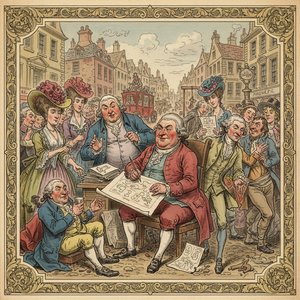
Thomas Rowlandson's watercolor, "The South Gate, Exeter," isn’t merely a depiction of a street scene; it’s a vibrant portal into the heart of Georgian England. Painted around 1810, this work captures a moment of intense urban life within the historic South Gate area of Exeter, offering a captivating glimpse into the daily rhythms and social dynamics of the time. Rowlandson, a master of satirical observation, doesn’t simply record; he breathes life into his subject, imbuing it with a palpable sense of energy and human interaction.
The composition immediately draws the eye to the central focus: the South Gate itself, rendered as a sturdy, imposing structure that anchors the scene. Flanking this grand entrance are buildings – shops and residences – layered with detail, each contributing to the overall density of the streetscape. Notice the careful arrangement of figures; they aren’t isolated individuals but rather part of a complex tapestry of activity—a merchant haggling over prices, children playing near a horse-drawn cart, shoppers navigating the crowded thoroughfare, and even a gentleman observing the scene with an air of detached amusement. Rowlandson's skill lies in his ability to compress this multitude of elements into a single, dynamic image.
The Art of Satirical Observation: Rowlandson’s Technique
Rowlandson’s distinctive style is immediately recognizable through his loose, expressive brushwork and the watercolor medium itself. The colors are rich and layered, creating a sense of depth and texture that belies the relatively flat perspective. He employs washes of color to build up form, allowing for subtle gradations in tone and light – a diffused daylight suggesting an overcast day. The lines are predominantly loose and gestural, conveying movement and immediacy. The artist’s hand is clearly visible in the application of paint, adding to the work's authenticity and charm.
Crucially, Rowlandson wasn’t interested in photographic realism; he prioritized capturing the *essence* of a scene – its atmosphere, its energy, and its social commentary. The slightly exaggerated proportions of figures, the crowded composition, and the overall sense of bustling activity all contribute to this effect. The artist's use of color is particularly noteworthy, with vibrant hues used for clothing and details, contrasting against the more muted tones of the buildings.
Historical Context: Exeter in the Early 19th Century
To fully appreciate “The South Gate, Exeter,” it’s essential to understand its historical context. Exeter, a significant trading center in Devon, was experiencing considerable growth during this period. The city's South Gate, as depicted by Rowlandson, represented the gateway to this thriving commercial hub. The scene captures a moment of relative prosperity, reflecting the economic vitality of the region. The presence of shops and merchants suggests a bustling marketplace, while the diverse array of figures hints at the social stratification within the community.
Furthermore, Rowlandson’s work reflects the broader artistic trends of the time – particularly the rise of Romanticism. While not strictly adhering to the movement's idealized aesthetic, his focus on capturing everyday life and portraying human emotion aligns with its core principles. The painting offers a glimpse into the lives of ordinary people, inviting viewers to contemplate their experiences and interactions.
Symbolic Layers: A Window into Georgian Society
Beyond its immediate visual appeal, “The South Gate, Exeter” is rich in symbolic meaning. The crowded marketplace represents the social hub of the city, a place where commerce, gossip, and community life intersected. The figures themselves embody various aspects of Georgian society – merchants, laborers, shoppers, and onlookers—each contributing to the complex tapestry of urban existence. Even the gate itself can be interpreted as a symbol of authority and control, guarding access to the heart of the city.
Rowlandson’s work serves as a valuable historical document, offering insights into the social customs, economic activities, and cultural values of 19th-century England. It's a testament to his keen eye for detail and his ability to capture the essence of a bygone era.
Biografia artysty
A Life Etched in Satire: The World of Thomas Rowlandson
Thomas Rowlandson, a name synonymous with Georgian England’s sharpest wit and most biting satire, emerged from humble beginnings to become one of the era's most celebrated caricaturists. Born in London on July 13th, 1756 – baptized later that month – his early life was marked by financial hardship, a circumstance that ultimately shaped his artistic trajectory. His father’s struggles led the family to Richmond, North Yorkshire, where young Thomas received an education nurtured by his uncle's support, granting him access to Dr. Barwis’ school in Soho Square. Even as a boy, Rowlandson’s talent for sketching was evident, adorning the margins of his books with playful depictions – a foreshadowing of the satirical career that lay ahead.Formative Years and Artistic Development
Rowlandson's formal artistic training began at the Royal Academy in 1772, where he honed his skills alongside aspiring artists from across England. A brief sojourn to Paris under Jean-Baptiste Pigalle proved invaluable, exposing him to continental techniques and broadening his artistic horizons. However, it was upon returning to London that Rowlandson truly discovered his distinctive voice. Initially attempting portraiture, he quickly realized that his true calling lay not in flattering representation but in pointed satire. The financial pressures following his aunt’s death – a significant loss – propelled him towards caricature as a means of survival, yet this shift wasn't merely pragmatic; it was an artistic awakening. He began to dissect the social landscape with ruthless accuracy, targeting politicians, aristocrats, and everyday citizens alike, capturing their vanities and exposing their flaws with unparalleled skill. His early works were characterized by a remarkable facility for line and a keen understanding of human expression, qualities that would become hallmarks of his mature style.Collaboration and The Rise to Prominence
The true flowering of Rowlandson’s career came through his fruitful collaboration with Rudolph Ackermann, a prominent publisher and art dealer. This partnership yielded some of his most enduring works, including the immensely popular *The Schoolmaster's Tour* (1809), a series of plates accompanied by verses from Dr. William Combe, and the iconic *Tour of Dr. Syntax in Search of the Picturesque* (1812). The *Dr. Syntax* series, with its subsequent installments – *Dr. Syntax in Search of Consolation* (1820) and *The Third Tour of Dr. Syntax in Search of a Wife* (1821) – captivated audiences with its whimsical narrative and Rowlandson’s masterful illustrations. These works weren't simply visual accompaniments to text; they were integral to the storytelling, enhancing the humor and social commentary through dynamic compositions and expressive characterizations. The delicate color washes and precise reed-pen outlines became synonymous with Rowlandson’s style, showcasing his technical brilliance and artistic flair. His ability to capture both the grandeur of landscapes and the absurdity of human behavior cemented his reputation as a leading artist of the era.A Legacy of Satire and Social Observation
Rowlandson's impact extends far beyond the immediate popularity of his works during his lifetime. He left behind an extensive body of art – over 381 artworks are cataloged at OriginalUniqueArt.com alone – that provides a vivid and often unflattering portrait of Georgian society. His caricatures weren’t merely about ridicule; they were astute observations on the political climate, social customs, and human foibles of his time. He fearlessly lampooned figures like the Duchess of Devonshire, William Pitt the Younger, and Napoleon Bonaparte, exposing their vulnerabilities and challenging established power structures. Beyond the overtly satirical, Rowlandson also produced a wealth of illustrations for novels and topographical works, demonstrating his versatility as an artist. His legacy continues to inspire artists and art enthusiasts today, offering a unique window into a bygone era. The enduring appeal of his work lies in its timeless relevance – the human tendencies towards vanity, hypocrisy, and absurdity that he so brilliantly captured remain remarkably consistent across centuries. His influence can be seen in subsequent generations of cartoonists and illustrators who have embraced satire as a means of social commentary.Preserving Rowlandson’s Vision
Today, Rowlandson's work is preserved in numerous museum collections worldwide, including those accessible through platforms like OriginalUniqueArt.com, which offers an extensive catalog of his creations alongside works by contemporaries such as Samuel Henry Gordon Alken and William Hogarth. Pieces like *Hengar House the Seat of Matthew Mitchell Esq., Cornwall* (1812) and *Glorious Defeat of the Dutch Navy* (1797) stand as testaments to his artistic skill and historical significance. Exploring these collections allows us to appreciate not only Rowlandson’s technical mastery but also the depth of his social insight. His art serves as a reminder that laughter can be a powerful tool for critique, and that even in the most frivolous of subjects, there is often a profound truth waiting to be revealed. The continued accessibility of his work ensures that Thomas Rowlandson's satirical vision will continue to provoke thought and inspire amusement for generations to come.
Thomas Rowlandson
1756 - 1827 , Wielka Brytania
Najważniejsze informacje
- Artistic Movement Or Style: Karykatura, Satyra
- Artists Or Movements Influenced By This Artist:
- Gillray
- Ackermann
- Artists Who Influenced This Artist:
- Rubens
- Gainsborough
- Date Of Birth: 13 lipca 1757
- Date Of Death: 21 kwietnia 1827
- Full Name: Thomas Rowlandson
- Nationality: Brytyjczyk
- Notable Artworks:
- Podróż Szkoły
- Dr. Syntax
- Wojna
- Handlarz koni
- Place Of Birth: Londyn, Wielka Brytania
Zobacz także powiązane artykuły

10 Legendarnych Akwareli, Które Zmieniły Sztukę. Inspiracje do Dekoracji Domu.
Odkryj 10 legendarnych akwareli Turner'a, Monet'a i innych mistrzów! Poznaj historie, techniki i inspiracje tych ponadczasowych dzieł. Reprodukcje obrazów najwyższej jakości na OriginalUniqueArt.com – idealne do dekoracji wnętrz.

Efemeryczne Wizje: Historia i Emocjonalny Rezonans Malarstwa Akwarelowego
Odkryj fascynującą historię malarstwa akwarelowego! Poznaj techniki mistrzów, romantyczny nurt i współczesne trendy. Inspiracje do dekoracji wnętrz oraz możliwość personalizacji obrazów na OriginalUniqueArt.com.
Thomas Rowlandson: Satire, Society & the Art of Caricature in Georgian England
Explore the witty world of Thomas Rowlandson, master Georgian caricaturist! Discover his satirical prints & insightful social commentary on 18th-century England. Learn about his life, techniques, and enduring influence.

Efemeryczne Wizje: Historia i Współczesna Praktyka Malarstwa Akwarelowego
Poznaj historię i techniki malarstwa akwarelowego! Odkryj inspiracje mistrzów, współczesne trendy oraz praktyczne porady dotyczące materiałów. Rozwiń swoją pasję z naszym przewodnikiem.

Ephemeral Visions: Exploring the Artistic Legacy & Nuances of Watercolor Painting
Explore the captivating world of watercolor painting! Discover its rich history, essential techniques, influential artists & collecting tips from art experts. A comprehensive guide for enthusiasts.
