American Realism · 1898
Salutat (Thomas Eakins, 1898)
Thomas Eakins (1844–1916) stworzył Salutat. Dzieło pochodzi z 1898. Należy do nurtu American Realism. Wykonano w technice Oil On Canvas. Przechowywane jest w Addison Gallery of American Art w Massachusetts, Stany Zjednoczone Ameryki.
- 1898
- Oil On Canvas
- Addison Gallery of American Art, Massachusetts

 Podgląd w skali 1:1

 Ręcznie malowany obraz olejny
 Wyślij jako kartkę
 Udostępnij
 Karta informacyjna


 Pobierz obraz
 Podobne obiekty
 RTG
 Pokaz slajdów
 Pytania i odpowiedzi

 Statystyki
Salutat w skrócie
- Tytuł
- Salutat
- Artysta
- Thomas Eakins (1844–1916)
- Miejsce urodzenia artysty
- Filadelfia, Stany Zjednoczone
- Data powstania
- 1898
- Technika wykonania
- Oil On Canvas
- Gdzie można je zobaczyć
- Addison Gallery of American Art, Massachusetts, Stany Zjednoczone Ameryki
- Ruch
- American Realism
- Temat
- human figure, performance art, monochromatic palette, psychological depth, american painting, realism technique
Co przedstawia Salutat?
A Portrait of Vulnerability: Exploring Thomas Eakins’ Salutat
- Subject Matter The painting “Salutat,” created in 1898 by American artist Thomas Eakins, depicts a solitary man standing amidst a crowd. Strikingly nude from the waist up, he presents his back to the audience, embodying an arresting stillness that contrasts sharply with the bustling activity surrounding him.
- Style and Technique Eakins’ masterful use of oil on canvas exemplifies realism—a hallmark of his oeuvre. The monochromatic palette—primarily shades of gray—intensifies the emotional impact, focusing attention squarely on the central figure's posture and expression. Precise brushstrokes contribute to a textured surface that conveys both physicality and psychological depth.
- Historical Context Produced during the late Victorian era, “Salutat” reflects the artistic currents of its time, prioritizing observation and anatomical accuracy over idealized representations. Eakins’ fascination with scientific illustration—evident in his meticulous rendering of musculature—mirrors a broader trend toward documenting the human form with unprecedented detail.
- Symbolism The man's posture – turned away from scrutiny – speaks to themes of introspection and vulnerability. The bucket held aloft symbolizes perhaps an act of defiance or performance, adding layers of narrative complexity to the composition. It invites contemplation on notions of exposure and self-presentation within a social context.
- Emotional Impact “Salutat” transcends mere visual depiction; it evokes feelings of quiet contemplation and subtle unease. The painting’s stark simplicity underscores the profound psychological portraiture characteristic of Eakins's work, prompting viewers to consider questions of identity and perception.
The Artist: Thomas Eakins – A Pioneer of Realism
Thomas Cowperthwait Eakins (1844-1916), born in Philadelphia, stands as a cornerstone of American art history. Unlike many artists of his era preoccupied with grand narratives or romantic ideals, Eakins relentlessly pursued the depiction of everyday life—the world of doctors, rowers, and hunters—with an unwavering commitment to anatomical precision and psychological insight.
His formative years instilled in him a profound appreciation for observation and scientific inquiry. This dedication would propel him to become one of the most influential realist painters of the late nineteenth century, challenging conventions and establishing a new standard for artistic representation. Eakins’s Philadelphia was not a city of picturesque vistas; it was a crucible of intellectual ferment—a place where he honed his skills and developed his distinctive vision.
Exploring Eakins's Method: Anatomical Precision and Monochromatic Palette
Eakins’ artistic approach stemmed from a deep understanding of human anatomy. He meticulously studied musculature, striving to capture the subtle nuances of posture and movement—a practice that would inform his paintings with remarkable accuracy. This scientific rigor extended beyond mere anatomical representation; it served as a springboard for exploring psychological states.
Furthermore, Eakins favored a monochromatic palette—primarily shades of gray—to heighten emotional resonance. By eliminating color, he focused the viewer’s gaze on form and texture, emphasizing the expressive qualities of light and shadow. This technique underscores his belief that visual art could convey profound truths about human experience.
Beyond Representation: The Psychological Depth of Salutat
"Salutat" isn't simply a portrait; it’s an invitation to delve into the complexities of human consciousness. Eakins skillfully captures the vulnerability inherent in solitude—the man’s averted gaze conveying a sense of introspection and confronting unspoken anxieties.
The painting’s deliberate simplicity amplifies its impact, prompting viewers to consider questions of identity and perception. Like Elizabeth at the Piano and Portrait of Professor Henry A. Rowland – also available on OriginalUniqueArt.com – “Salutat” exemplifies Eakins's unwavering dedication to portraying the human condition with unflinching honesty.
W którym muzeum znajduje się Salutat?
Addison Gallery of American Art
Massachusetts, Stany Zjednoczone Ameryki
Latarnia Amerykańskiej Wizji: Odkrywanie Addison Gallery Położona w historycznym kampusie Phillips Academy w Andover, w stanie Massachusetts, Addison Gallery of American Art to znacznie więcej niż tylko skarbiec obrazów i rzeźb; to żywe świadectwo ewoluującego ducha i nieprzemijającej siły artystycznej ekspresji Stanów Zjednoczonych. Założona w 1931 roku z wizją kształtowania krytycznego myślenia i estetycznej wrażliwości, Addison rozkwitła jako dynamiczne centrum nauki, dialogu i inspiracji – przestrzeń swobodnie dostępną dla każdego, kto pragnie nawiązać więź z bogatym dziedzictwem twórczym Ameryki. Jej historia to opowieść o przemyślanych nabytkach, starannym rozszerzaniu zbiorów oraz niezłomnym dążeniu do ukazania szerokości i głębi sztuki amerykańskiej – od jej kolonialnych korzeni aż po tętniący życiem puls ruchów współczesnych.


Zdjęcia w wysokiej rozdzielczości dzieła Salutat

Domena publiczna: artysta zmarł w 1916.
Inne rozmiary, kadrowanie i cytowanie →Thomas Eakins, Salutat (1898), Addison Gallery of American Art. Domena publiczna
Odpowiedzi na pytania dotyczące Salutat
Gdzie można zobaczyć oryginał „Salutat” – Thomas Eakins?
Oryginał dzieła „Salutat” – Thomas Eakins znajduje się w Addison Gallery of American Art, Massachusetts, Stany Zjednoczone Ameryki. Reprodukcja pozwala na eksponowanie pracy w domu.
W którym roku powstało dzieło "Salutat"?
„Salutat” – Thomas Eakins powstało w 1898.
Z jakiej techniki wykorzystano "Salutat"?
Thomas Eakins wykorzystał/a technikę Oil On Canvas w pracy „Salutat”. Technika ta definiuje materię oryginalnego dzieła.
Co przedstawia „Salutat” – Thomas Eakins?
Tematyka dzieła "Salutat" to human figure, performance art, monochromatic palette, psychological depth, american painting, realism technique, bucket gesture.
Czy dzieło "Salutat" znajduje się w domenie publicznej?
Status praw autorskich dla „Salutat” – Thomas Eakins: dzieło znajduje się w należy do domeny publicznej – autorskie prawa majątkowe wygasły. Określa to, czy reprodukcje obrazu mogą być sporządzane swobodnie.
Któremu artyście przypisuje się "Salutat"?
„Salutat” zostało stworzone przez Thomas Eakins. Informacje na tej stronie dotyczą oryginalnego dzieła autorstwa Thomas Eakins.
Do jakiego nurtu należy "Salutat"?
„Salutat” – Thomas Eakins należy do nurtu American Realism. Nurt ten stanowi stylistyczny kontekst dzieła.
Do którego etapu twórczości Thomas Eakins należy dzieło „Salutat”?
"Salutat" reprezentuje Mature Period twórczości Thomas Eakins.
Ile lat miał Thomas Eakins, gdy powstało dzieło „Salutat”?
Thomas Eakins stworzył/a "Salutat" w wieku 54 lat. Artysta urodził/a się w 1844, a datowanie dzieła to 1898.
O artyście: Thomas Eakins

1844–1916, Stany Zjednoczone
Thomas Eakins
Życie Thomasa Eakinsa Urodzony 25 lipca 1844 roku w Filadelfii, w stanie Pensylwania, Thomas Eakins prowadził życie głęboko zakorzenione w mieście swojego pochodzenia. Był człowiekiem wielu pasji i dyscyplin, rozwijającym się jako malarz, fotograf, rzeźbiarz oraz pedagog sztuk pięknych. Choć artystyczne poszukiwania często wiodły go na zagraniczne studia, geografia jego egzystencji pozostawała w dużej mierze skupiona wokół Filadelfii. Przenikał przez intelektualne i towarzyskie kręgi miasta, z niezwykłą uważnością obserwując ludzi oraz fizyczną rzeczywistość, która definiowała lokalny krajobraz.
Inne prace Thomas Eakins
 Gabinet Grossa1875
 Pływanie1885
 Max Schmitt na łódce jednoszczeblowej1871
 Portrait of Samuel Murray1889

Eseje o Salutat
 American contemporary realist paintersMasterpieces by Chuck Close and Amy Sherald define American contemporary realism. Explore the full collection online at OriginalUniqueArt.c…
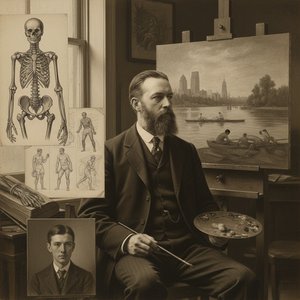 Thomas Eakins: Realism, Anatomy & the American Spirit – A Comprehensive Exploration of Life and LegacyExplore the life & legacy of Thomas Eakins, a pivotal American Realist painter. Discover his groundbreaking techniques, anatomical precisio…
 James Abbott McNeill Whistler: 25 Arcydzieł Sztuki Pejzażowej i Portretowej | OriginalUniqueArtOdkryj 25 arcydzieł Jamesa Abbotta McNeilla Whistler'a! Poznaj historię impresjonistycznych pejzaży, portretów i słynnych 'Nokturnów'. Repr…