Romanticism · 1830
Niagara Falls (Thomas Cole, 1830)
Thomas Cole (1801–1848) stworzył Niagara Falls. Dzieło pochodzi z 1830. Należy do nurtu Romanticism. Wykonano w technice Oil On Canvas.
- 1830
- Oil On Canvas

 Podgląd w skali 1:1

 Ręcznie malowany obraz olejny
 Wyślij jako kartkę
 Udostępnij
 Karta informacyjna


 Pobierz obraz
 Podobne obiekty
 RTG
 Pokaz slajdów
 Pytania i odpowiedzi

 Statystyki
Niagara Falls w skrócie
- Tytuł
- Niagara Falls
- Artysta
- Thomas Cole (1801–1848)
- Miejsce urodzenia artysty
- Bolton, Wielka Brytania
- Data powstania
- 1830
- Technika wykonania
- Oil On Canvas
- Ruch
- Romanticism
- Epoka
- 19th Century
- Temat
- waterfall, people, trees, rocks, river, mist
Co przedstawia Niagara Falls?
Identification of Niagara Falls by Thomas Cole
Niagara Falls is an oil painting created by Thomas Cole in 1830. The work focuses on the American wilderness and the depiction of natural power. It captures a large body of water falling from a great height, creating a scene of cascading water and rising mist. The landscape includes several trees and rocky terrain surrounding the falls.
The composition includes a man standing on a rock in the foreground. Two other individuals are visible within the scene: one person stands closer to the left side, while another is positioned further back on the right side. These figures provide a sense of scale against the massive movement of the water. The environment is characterized by lush, forested cliffs and a sky filled with clouds and mist.
The Composition and Visual Elements
The composition is centered on a large body of water falling from a great height, creating a vertical movement that dominates the scene. This cascading water descends into a lower river area, surrounded by several trees that frame the landscape. A man is positioned on a rock in the foreground, facing the falls. His presence provides a sense of scale against the massive volume of the water.
Two other people are visible within the landscape, distributed to create depth. One individual stands closer to the left side of the composition, while another person is located further back on the right side. These figures are placed amidst the natural terrain, which includes rocky outcrops and dense foliage. The arrangement of the trees and the placement of the figures guide the eye from the immediate foreground toward the distant, falling water.
Technique and Artistic Style
This oil painting is a primary example of the Romantic landscape style. As a foundational work of the Hudson River School, it utilizes a composition that emphasizes the scale of the natural world. The artist employs a specific technique of layering oil to render the textures of the cascading water and the surrounding rock formations. The application of paint allows for a depiction of mist rising from the base of the falls, creating a sense of atmospheric depth against the sky.
The artist relies heavily on the interplay of light and shadow to establish the environment. Light appears to catch the spray of the water and the edges of the foliage, while deep shadows are placed within the crevices of the cliffs and the dense areas of the forest. This contrast defines the physical volume of the landscape. The brushwork captures the movement of the water and the varied textures of the trees, grounding the scene in a tangible, physical reality.
Related Works by Thomas Cole
The artist's exploration of the American wilderness includes several significant compositions from different periods of his career. In 1826, he produced Kaaterskill Falls. This work focused on the vertical energy of the landscape. Later, in 1836, he completed The Oxbow. This painting juxtaposes a river valley against cultivated farmland. During that same year, he also finished The Course of Empire, a five-part series tracing the rise and fall of civilizations.
Cole continued to develop his approach to landscape and allegory in his later years. In 1842, he created The Voyage of Life, an allegorical series depicting the various stages of an individual's existence. These works demonstrate his ongoing interest in the relationship between the natural environment and human presence. His output moved from the study of specific waterfalls to broader, more complex thematic sequences.
Zdjęcia w wysokiej rozdzielczości dzieła Niagara Falls

Domena publiczna: artysta zmarł w 1848.
Inne rozmiary, kadrowanie i cytowanie →Thomas Cole, Niagara Falls (1830). Domena publiczna
Odpowiedzi na pytania dotyczące Niagara Falls
W którym roku powstało „Niagara Falls” – Thomas Cole?
„Niagara Falls” – Thomas Cole powstało w 1830.
W jakiej technice wykonano „Niagara Falls” – Thomas Cole?
Thomas Cole wykorzystał/a technikę Oil On Canvas w pracy „Niagara Falls”. Technika ta definiuje materię oryginalnego dzieła.
Co przedstawia „Niagara Falls” – Thomas Cole?
„Niagara Falls” – Thomas Cole przedstawia: waterfall, people, trees, rocks, river, mist, clouds.
Czy obraz „Niagara Falls” – Thomas Cole można swobodnie reprodukować?
„Niagara Falls” – Thomas Cole znajduje się w domenie publicznej (należy do domeny publicznej – autorskie prawa majątkowe wygasły). Status ten określa zasady reprodukcji obrazu tego dzieła.
Kto stworzył "Niagara Falls"?
„Niagara Falls” zostało stworzone przez Thomas Cole. Informacje na tej stronie dotyczą oryginalnego dzieła autorstwa Thomas Cole.
Do jakiego nurtu w sztuce należy „Niagara Falls” – Thomas Cole?
„Niagara Falls” to dzieło należące do nurtu Romanticism. Nurt ten określa tradycję artystyczną, w której osadzone jest dzieło.
Do którego okresu twórczości Thomas Cole należy dzieło „Niagara Falls”?
"Niagara Falls" reprezentuje Mature Period twórczości Thomas Cole.
Ile lat miał Thomas Cole, gdy powstało dzieło „Niagara Falls”?
Gdy w 1830 roku powstało dzieło „Niagara Falls”, Thomas Cole – urodzony/a w 1801 – miał/a 29 lat.
Czy dzieło „Niagara Falls” autorstwa Thomas Cole znajduje się w domenie publicznej i dlaczego?
Status praw autorskich do dzieła „Niagara Falls” – należy do domeny publicznej – autorskie prawa majątkowe wygasły – wynika z faktu, że artysta zmarł w 1848.
O artyście: Thomas Cole

1801–1848, Wielka Brytania
Thomas Cole
Życie i sztuka Thomas Cole Urodzony 1 lutego 1801 roku w Bolton le Moors w hrabstwie Lancashire w Anglii, Thomas Cole rozpoczął swoją drogę daleko od krajobrazów, które ostatecznie miały stać się jego znakiem rozpoznawczym. Jego rodzina wyemigrowała do Stanów Zjednoczonych w 1818 roku, szukając nowego początku na ziemiach pełnych ogromnych, nieodkrytych jeszcze terytoriów. W tych wczesnych latach był człowiekiem wielu rzemiosł – pracował jako rytownik, by w 1822 roku odnaleźć stałe zajęcie jako portrecista. W dużej mierze był samoukiem; swoje wrażliwe oko wypracował poprzez uważną obserwację natury oraz lekturę książek, zamiast poprzez formalne wykształcenie akademickie.
Inne prace Thomas Cole
 Oxbow
 Sen architekta1840
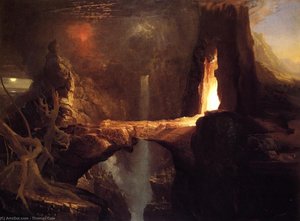 Wygnanie. Księżyc i Światło1828
 Widok Florencji z San Miniato1837

Eseje o Niagara Falls
 French artworks of the 1880sFrench Impressionist masterpieces by Claude Monet, Pierre-Auguste Renoir, and Georges Seurat. Find museum-quality reproductions on Original…
 Barbizon School vs. Hudson River School: Two Visions of the Natural WorldDiscover the key differences between Barbizon and Hudson River School landscapes. Master art history with our expert comparison guide.
 The Sublime Cascade: Examining the Tradition of Waterfall Landscapes in Art HistoryExplore the evolution of waterfall landscapes from the Northern Renaissance to the Hudson River School. Trace this epic art history now.