Hudson River School
Moonlight - Piazza Vecchia (Thomas Cole)
Thomas Cole (1801–1848) stworzył Moonlight - Piazza Vecchia. Należy do nurtu Hudson River School. Wykonano w technice Oil On Canvas.
- Oil On Canvas

 Podgląd w skali 1:1

 Ręcznie malowany obraz olejny
 Wyślij jako kartkę
 Udostępnij
 Karta informacyjna


 Pobierz obraz
 Podobne obiekty
 RTG
 Pokaz slajdów
 Pytania i odpowiedzi

 Statystyki
Moonlight - Piazza Vecchia w skrócie
- Tytuł
- Moonlight - Piazza Vecchia
- Artysta
- Thomas Cole (1801–1848)
- Miejsce urodzenia artysty
- Bolton, Wielka Brytania
- Technika wykonania
- Oil On Canvas
- Epoka
- 19th Century
- Temat
- moonlight, bridge, buildings, clock, river, person
Co przedstawia Moonlight - Piazza Vecchia?
Identification of Moonlight - Piazza Vecchia
Moonlight - Piazza Vecchia is an oil painting by Thomas Cole. The artist, born in 1801 in Bolton, United Kingdom, moved to the United States in 1818. He eventually settled in Catskill, New York, where he remained until his death on February 11, 1848.
The scene captures a cityscape under a moonlit atmosphere. A bridge overlooks a body of water, appearing as either a river or an ocean. In the foreground, two buildings flank the composition, with a clock hanging from a wall near the center. A solitary figure stands near the bridge, observing the nocturnal view. The moonlight casts a soft glow across the architecture and the water, establishing a serene mood.
The Composition and Visual Elements
The nocturnal cityscape is organized around a central bridge that spans a body of water, appearing as either a river or an ocean. In the foreground, the composition is framed by two buildings positioned on the left and right sides. Near the center of the image, a clock hangs from a wall, providing a focal point amidst the architectural details. A solitary figure stands near the bridge, appearing to observe the view or move through the urban space.
Atmospheric light defines the scene. Moonlight casts a soft glow across the environment, creating a serene and peaceful mood. This illumination interacts with the shadows of the buildings and the surface of the water to establish depth within the nocturnal setting. The interplay of light and shadow emphasizes the quietude of the city at night.
The Artistic Style of Thomas Cole
Working primarily with oil on canvas, Cole developed a technique characterized by a sophisticated use of light and shadow. He utilized this interplay to establish atmospheric depth and a sense of volume within his compositions. His approach frequently involved the placement of solitary structures or small figures against expansive, moody landscapes, a method that emphasizes the scale of the environment relative to human presence.
His brushwork demonstrates a keen ability to render the specific textures of the natural world. This attention to detail allows for a tactile quality in his depictions of wilderness and terrain. Through careful layering of pigments, he achieved a tonal richness that defines the visual weight of his subjects.
Related Works by Thomas Cole
Cole’s exploration of landscape and the passage of time is evident in several significant compositions. His 1836 work, The Oxbow, also known as The Connecticut River near Northampton, examines the tension between untamed nature and cultivated land. This same year saw the completion of The Course of Empire, a five-part series tracing the cyclical rise and fall of civilizations.
Other notable works include River in the Catskills, painted in 1843. These pieces reflect the artist's ongoing engagement with the American wilderness and the shifting relationship between the natural world and human presence.
Zdjęcia w wysokiej rozdzielczości dzieła Moonlight - Piazza Vecchia
Domena publiczna: artysta zmarł w 1848.
Thomas Cole, Moonlight - Piazza Vecchia. Domena publiczna
Odpowiedzi na pytania dotyczące Moonlight - Piazza Vecchia
W jakiej technice wykonano „Moonlight - Piazza Vecchia” – Thomas Cole?
„Moonlight - Piazza Vecchia” wykonano w technice Oil On Canvas.
Co przedstawia "Moonlight - Piazza Vecchia"?
„Moonlight - Piazza Vecchia” – Thomas Cole przedstawia: moonlight, bridge, buildings, clock, river, person, cityscape, night.
Czy „Moonlight - Piazza Vecchia” – Thomas Cole znajduje się w domenie publicznej?
„Moonlight - Piazza Vecchia” – Thomas Cole znajduje się w domenie publicznej (należy do domeny publicznej – autorskie prawa majątkowe wygasły). Status ten określa zasady reprodukcji obrazu tego dzieła.
Kto jest autorem dzieła "Moonlight - Piazza Vecchia"?
Autorem dzieła „Moonlight - Piazza Vecchia” jest Thomas Cole. Praca ta figuruje w katalogu pod nazwiskiem Thomas Cole.
Do jakiego nurtu należy "Moonlight - Piazza Vecchia"?
Nurt związany z „Moonlight - Piazza Vecchia” – Thomas Cole to Hudson River School. Ta klasyfikacja sytuuje dzieło wśród pokrewnych artystów i dzieł sztuki.
Czy dzieło „Moonlight - Piazza Vecchia” autorstwa Thomas Cole znajduje się w domenie publicznej i dlaczego?
Status praw autorskich do dzieła „Moonlight - Piazza Vecchia” – należy do domeny publicznej – autorskie prawa majątkowe wygasły – wynika z faktu, że artysta zmarł w 1848.
Co łączy "Moonlight - Piazza Vecchia" z resztą twórczości Thomas Cole?
"Moonlight - Piazza Vecchia" wpisuje się w nurt Hudson River School w twórczości Thomas Cole, której charakterystyczne motywy obejmują european old masters, hudson river school, romantic landscape, spiritual resonance, nature vs. civilization.
W jaki sposób tematyka dzieła "Moonlight - Piazza Vecchia" odnosi się do typowych motywów twórczości Thomas Cole?
„Moonlight - Piazza Vecchia” przedstawia moonlight, bridge, buildings, clock, river, person, cityscape, night, podczas gdy powracające motywy u Thomas Cole to european old masters, hudson river school, romantic landscape, spiritual resonance, nature vs. civilization. Porównanie tych dwóch elementów ukazuje, jak dzieło nawiązuje do typowej dla tego artysty tematyki.
O artyście: Thomas Cole

1801–1848, Wielka Brytania
Thomas Cole
Życie i sztuka Thomas Cole Urodzony 1 lutego 1801 roku w Bolton le Moors w hrabstwie Lancashire w Anglii, Thomas Cole rozpoczął swoją drogę daleko od krajobrazów, które ostatecznie miały stać się jego znakiem rozpoznawczym. Jego rodzina wyemigrowała do Stanów Zjednoczonych w 1818 roku, szukając nowego początku na ziemiach pełnych ogromnych, nieodkrytych jeszcze terytoriów. W tych wczesnych latach był człowiekiem wielu rzemiosł – pracował jako rytownik, by w 1822 roku odnaleźć stałe zajęcie jako portrecista. W dużej mierze był samoukiem; swoje wrażliwe oko wypracował poprzez uważną obserwację natury oraz lekturę książek, zamiast poprzez formalne wykształcenie akademickie.
Inne prace Thomas Cole
 Oxbow
 Sen architekta1840
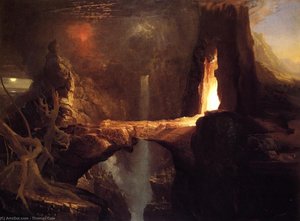 Wygnanie. Księżyc i Światło1828
 Widok Florencji z San Miniato1837
Eseje o Moonlight - Piazza Vecchia
 British artworks of the 1840s1840s British masterpieces by J. M. W. Turner and John Everett Millais. Shop museum-quality reproductions on OriginalUniqueArt.com.
 Barbizon School vs. Hudson River School: Two Visions of the Natural WorldDiscover the key differences between Barbizon and Hudson River School landscapes. Master art history with our expert comparison guide.
 British artworks of the 1820sBritish Romanticism in the 1820s features the iconic works of J.M.W. Turner, John Constable, and William Blake. View the full collection at…