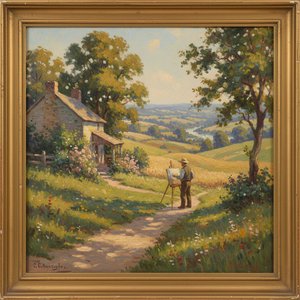
Wersja olejowa
 Wszystko o Small Landscape with Weir







































 W przypadku dzieł sztuki lub reprodukcji, których którykolwiek z boków przekracza 105 cm (około 41 cali), rama zostanie wysłana w formie zestawu do samodzielnego montażu. Metoda ta zapewnia bezpieczną dostawę i zapobiega uszkodzeniom podczas transportu.


Identification of the Landscape Painting
Small Landscape with Weir is a 19th Century genre work by the German painter Albert Lang. Created about 1873, the piece captures a quiet moment of rural stillness. The artist, born in Karlsruhe, brings a sense of structured observation to this intimate scene.
The painting focuses on a specific intersection of nature and human utility. It depicts a weir, a structure designed to manage the flow of water, set within a tranquil landscape. This work belongs to a period when the artist was refining his ability to translate the physical world into a language of light and shadow.
The scale of the work is modest, offering a private view of the water's edge. It remains a quiet fragment of the artist's early development. A single wooden beam anchors the composition against the mist.
Visual Composition and Subject Matter
A long wooden beam cuts through the space, creating a sharp diagonal from the upper left toward the center-right. This structural line anchors the eye against the soft, organic forms of the landscape. Below this beam, a dark foreground structure meets the middle-ground body of water. The water flows quietly, framed by the weight of man-made elements integrated into the earth. In the distance, hills recede into a pale horizon, layering the depth of the rural scene.
The subject is a quiet, rural landscape centered on a weir. This water management structure sits within the natural terrain, a silent intersection of human utility and the wild. The composition relies on these layers—the heavy timber, the moving water, and the distant slopes—to establish a sense of perspective. Everything remains still. The scene captures a moment of solitude where the only movement is the implied flow of the stream.
Artistic Style and Technical Details
The work is an Impressionistic study executed in oil on a small support, likely board or canvas. A strictly grayscale palette governs the surface, relying on a precise arrangement of black, white, and gray to define the scene. This monochromatic approach strips away the distraction of color to focus entirely on the weight of the air and the subtle shifts in light. The artist uses these tones to build a sense of mist and overcast stillness.
Visible, textured brushstrokes define the physical presence of the paint. These marks are loose and expressive, capturing the rhythmic movement of water as it passes through the weir. The paint is applied with a tactile quality that suggests the organic, irregular forms of the surrounding foliage. Every stroke works to translate the specific atmosphere of a quiet, rural moment into a tangible layer of pigment. The light does not merely sit upon the landscape; it seems to emerge from the interplay of gray and white.
The composition relies on the interplay of light and shadow to establish depth. Through the layering of dark foreground elements against the receding, lighter hills, a sense of space is carved out of the grayscale. The brushwork remains unhurried, prioritizing the sensation of the environment over fine, sharp detail. It is a quiet study of light and shadow.
Pytania i odpowiedzi
Czy Small Landscape with Weir jest dziełem namalowanym ręcznie, czy wydrukiem?
Malowane ręcznie: wykwalifikowany artysta wykonuje olejną kopię Small Landscape with Weir na płótnie lnianym.
Jaki rozmiar wybrać dla Small Landscape with Weir?
Wymiary oryginału to 14.5 x 10.0cm. Dostępne rozmiary obejmują zakres od 38.2 x 26.1 cm (zł789) do 243.9 x 166.7 cm (zł5998); tabela na tej stronie przedstawia główne warianty oraz ich ceny.
Ile trwa dostawa?
Czas dostawy wynosi od 4 do 5 tygodni, przy czym oferujemy bezpłatną ekspresową wysyłkę na cały świat; na tej stronie dostępna jest również opcja pilnej produkcji. Możesz dokonać zwrotu w ciągu 100 dni z pełnym zwrotem kosztów, bez żadnych dodatkowych warunków.
Gdzie znajduje się oryginał Small Landscape with Weir?
Oryginał znajduje się w zbiorach Bawarskie Państwowe Zbiory Malarstwa w Monachium.
Jakiej techniki użył/a Albert Lang w pracy Small Landscape with Weir?
Oil On Board
 Podgląd w skali 1:1

 Wyślij jako kartkę
 Udostępnij
 Szczegóły dzieła
 Karta informacyjna


 Pobierz obraz
 Podobne obiekty
 RTG
 Pokaz slajdów
 Pytania i odpowiedzi

 Statystyki