

 Zobacz w skali 1:1
 Wyślij
 Udostępnij
 Szczegóły

 Pobierz plik obrazu
 Podobne obiekty
 RTG
RTG Pokaz slajdów
 Statystyki
Merrills
 Akryl na płótnie
- Sztuka ścienna
- Scottish Impressionism
 38.0 x 55.0 cm
 Royal Scottish Academy of Art - Architecture
 Czytaj więcej
Ręcznie malowana reprodukcja olejowa
Ręcznie malowany obraz olejny na płótnie, wykonany na zamówienie przez naszych artystów w wybranym przez Ciebie wymiarze i oprawie. ( Przełącz na wersję drukowaną Przełącz na wersję cyfrową)




P118B $10

P118H $10

P118W $10

P438Z $10

P508JH $12

P508YH $12

P805H $10

P805Z $10

P919BZ $10

P919G $10

P919XJ $10

P959ZH $10

P968JZ $12

W106C $8

W218G $10

W218JH $8

W218Y $10

W307PJ $10

W316G $10

W316PJ $8

W316Y $10

W398PJ $8

W4111J $10

W500HY $15

W500JH $15

W692G $12

W849H $8

W940BG $15

W953PJ $8




Wybierz spośród naszych standardowych rozmiarów, które zachowują oryginalne proporcje dzieła sztuki.

Możesz wprowadzić własne wymiary, aby dopasować obraz do konkretnej ramy lub przestrzeni. Jeśli wybrany rozmiar nie będzie odpowiadał proporcjom oryginału, przytniecie dzieło sztuki lub rozszerzymy je o dodatkowe elementy, ręcznie domalowane przez artystę. Przed rozpoczęciem produkcji wyślemy projekt cyfrowy do Twojej akceptacji.
Należy pamiętać, że podgląd na ekranie nie odzwierciedla rzeczywistego przycinania ani rozszerzania obrazu. Tylko projekt dokładnie pokaże ostateczną kompozycję.
Choć oferujemy możliwość zamówienia niestandardowych rozmiarów, zalecamy wybór wymiaru z gotowej listy, aby zachować oryginalne proporcje dzieła.
Po złożeniu zamówienia zespół OriginalUniqueArt.com skontaktuje się z klientem drogą mailową w celu uzyskania instrukcji i prześle wizualizację projektu
Dostawa na całym świecie () w ciągu 3–4 tygodni zamiast standardowych 5 tygodni. (17 Wrzesień). Bez kompromisów w kwestii jakości.

Bezpłatna ekspresowa wysyłka na cały świat

Wysokiej jakości płótno lniane

Pełne ubezpieczenie transportowe

Gwarancja zwrotu należności celnych i podatków importowych

Gwarancja idealnego odwzorowania barw

100-dniowy okres na zwrot dzieła w przypadku wykrycia wad produkcyjnych

Gwarancja 100% zwrotu pieniędzy

Oferta przy zakupie wielu sztuk
 Opcja ze szkłem jest dostępna wyłącznie w rozmiarach poniżej 110 cm

Merrills
Technika wykonania
Rozmiar reprodukcji
-


Suma do zapłaty
$ 300
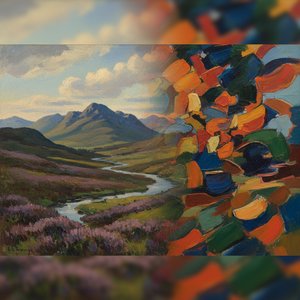
Merrills – A Symphony of Scottish Light
Sir William George Gillies’ “Merrills” stands as a testament to the enduring allure of Scottish landscape painting during the Edwardian era, capturing not merely a visual representation but an emotional resonance that speaks volumes about Victorian sensibilities and artistic innovation. Painted circa 1934, this artwork exemplifies Gillies' masterful blend of Impressionistic technique with Cubist influences—a stylistic dialogue reflecting the broader intellectual currents shaping European art at the time.The Landscape’s Embrace
The painting depicts a serene woodland scene bathed in dappled sunlight filtering through dense foliage. Foreground trees dominate the composition, their trunks rendered with textured brushstrokes that convey solidity and permanence against the softer hues of the undergrowth. Gillies skillfully employs atmospheric perspective—a technique championed by Cézanne and subtly adopted by Picasso—to create depth and illusionistic space. The distant hillsides are hazy blues and greens, diminishing in intensity as they recede into the background, drawing the viewer’s eye inwards towards the central focus of the piece.Cubist Echoes & Colourful Exploration
Gillies' engagement with Cubism is evident in his fragmented depiction of tree trunks and branches—a deliberate departure from traditional representational methods. However, unlike the purely geometric abstractions of Picasso and Braque, Gillies retains a palpable warmth and vibrancy achieved through careful colour orchestration. The palette leans towards muted greens and browns punctuated by splashes of ochre and crimson—colours that evoke autumnal hues and imbue the scene with an underlying sense of melancholy beauty. This chromatic boldness aligns him with Paul Klee’s pioneering explorations of childlike imagination and expressive colour, demonstrating Gillies' willingness to push artistic boundaries while retaining a connection to established traditions.Symbolism Within Tranquility
Beyond its formal qualities, “Merrills” carries symbolic weight reflecting Victorian fascination with nature as a source of solace and spiritual contemplation. The dense woodland represents the complexities of life—the interwoven relationships between individuals and their environment—yet simultaneously offers refuge from societal pressures. The dappled sunlight symbolizes enlightenment and divine grace, illuminating the hidden beauty within the natural world. Gillies’ meticulous attention to detail—from the individual leaves to the subtle gradations of colour—underscores his belief in art's capacity to convey profound emotional truths.A Legacy of Impressionistic Vision
“Merrills” remains a captivating example of Scottish Impressionism, showcasing Gillies’ ability to translate visual experience into emotionally resonant artwork. Its enduring appeal lies not only in its stunning depiction of the Scottish Highlands but also in its articulation of Victorian ideals—a celebration of beauty, tranquility, and the transformative power of artistic innovation. Reproductions at OriginalUniqueArt offer a chance to appreciate this masterpiece's timeless elegance and capture its evocative spirit for contemporary spaces.Biografia artysty
Early Life and Education
Sir William George Gillies, a name synonymous with the evocative beauty of Scottish landscapes and still lifes, was born in Haddington, East Lothian, on September 21st, 1898. His early life unfolded amidst the rolling hills and historic charm of his native region – an environment that would profoundly shape his artistic vision. Initially enrolled at the Edinburgh College of Art, Gillies’ academic pursuits were tragically interrupted by the exigencies of World War I. He bravely enlisted with the Royal Engineers, serving with distinction during a period of immense national upheaval. Following the war's conclusion, he returned to complete his education at the same institution, ultimately graduating and dedicating over four decades to nurturing young artists as a teacher. This commitment to education wasn’t merely a profession; it was a deeply held belief in the transformative power of art and its ability to connect individuals with their surroundings.Artistic Development and Influences
Gillies' artistic journey began with an initial exploration of Cubism, a movement that had captivated European artists in the early 20th century. His studies under André Lhote in Paris (1923) provided him with invaluable insight into the principles of this revolutionary style – its fragmented forms and geometric arrangements. A subsequent trip to Italy in 1924 further broadened his artistic horizons, exposing him to the classical traditions that had informed so much of Western art. Early works like “Two Pots, Saucer and Fruit” (1933) demonstrate this early influence, showcasing a Cézanne-inspired composition characterized by carefully arranged objects and a muted color palette reminiscent of Braque and Picasso. However, a pivotal moment arrived in 1934 when Gillies encountered the work of Paul Klee. The whimsical use of colour, the childlike quality of his forms, and the imaginative narratives embedded within Klee’s paintings profoundly impacted Gillies' approach to art. He began to incorporate these elements into his own compositions, gradually moving away from strict Cubist dogma and developing a distinctive style rooted in Scottish landscape and still life traditions.The 1922 Group and Collaborative Spirit
In 1922, a year marked by significant artistic ferment in Scotland, Gillies played a crucial role in establishing the “1922 Group.” Alongside fellow artists such as William Crozier, William Geissler, and William MacTaggart, he envisioned an exhibition society dedicated to providing a platform for emerging Scottish talent. The New Gallery in Edinburgh became the focal point of this collective endeavor for a decade, fostering a vibrant community of artists who shared a passion for innovation and experimentation. The 1922 Group wasn’t simply a means of showcasing art; it was a crucible where ideas were exchanged, techniques were refined, and a sense of camaraderie flourished – a vital ingredient in the development of Scottish modernism. It represented a conscious effort to elevate the profile of young artists within their country.Themes and Subject Matter
Gillies’ artistic focus primarily revolved around two distinct yet interconnected themes: landscapes and still lifes. He possessed an extraordinary ability to capture the essence of the Lothian, Fife, and Border regions of Scotland – translating the rugged beauty of these areas onto canvas with a remarkable sensitivity. His paintings weren't merely depictions of scenery; they were imbued with a profound understanding of light, atmosphere, and the subtle nuances of color. Equally significant was his exploration of still life compositions. These works often featured ceramics created by his younger sister, Emma Smith Gillies, whose untimely death in 1936 cast a long shadow over his artistic life. The poignant beauty of these objects served as a powerful reminder of loss and grief, imbuing the paintings with an undercurrent of melancholy and introspection. While he experimented with portraiture early in his career, landscapes and still lifes ultimately became the cornerstones of his artistic legacy.Major Achievements and Recognition
Throughout his illustrious career, Sir William George Gillies achieved numerous accolades that recognized his exceptional talent and unwavering dedication to art. He was elected an Associate of the Royal Scottish Academy (ARSA) in 1940, a significant step towards establishing his place within the established artistic community. In 1947, he received full membership into the Royal Scottish Academy (RSA), solidifying his position as one of Scotland’s leading artists. In 1957, he was awarded the Commander of the Order of the British Empire (CBE) for his contributions to art in Scotland, and later, in 1964, he became an Associate of the Royal Academy (RA). The highest honor bestowed upon him – knighthood – arrived in 1970. His legacy extended beyond his artistic achievements; he served as Principal of the Edinburgh College of Art from 1961 to 1966, guiding a new generation of artists and shaping the future direction of art education in Scotland. Gillies’ prolific output—estimated at over 2,000 works—testifies to his unwavering commitment to his craft. His paintings are now found in prestigious collections across Scotland and internationally, including those of Aberdeen, Dundee, Edinburgh, Glasgow, the Scottish Arts Council, the National Galleries of Scotland (Tate London, Ottawa, Peru), demonstrating a lasting impact on the art world.
William George Gillies
1898 - 1973 , Wielka Brytania
Najważniejsze informacje
- Artistic Movement Or Style: Kubizm, Malarstwo Szkockie
- Artists Or Movements Influenced By This Artist: ['Malarstwo Szkockie']
- Artists Who Influenced This Artist:
- André Lhote
- Cézanne
- Braque
- Picasso
- Paul Klee
- Date Of Birth: 1898
- Date Of Death: 1973
- Full Name: Sir William George Gillies
- Nationality: Skoćy
- Notable Artworks:
- Young Boy with a Teapot
- Krajobraz Śródziemnomorski z Pochmurnym Niebem
- Kompozycja – Żółty Misa i Przegrodzony Tkanina
- Place Of Birth: Haddington, Wielka Brytania
Zobacz także powiązane artykuły

Evocations of Place: A Historical Journey Through Landscape Art
Explore the rich history of landscape art with OriginalUniqueArt. Discover renowned artists, movements like Impressionism & Romanticism, and expert guidance for collecting timeless pieces. Find your perfect serene escape today!

Romantyczny Krajobraz w Malarstwie: 10 Arcydzieł, Które Zdefiniowały Epokę | OriginalUniqueArt.com
Odkryj 10 arcydzieł romantyzmu w malarstwie! Poznaj historie Caspara Davida Friedricha, Turnera i innych mistrzów. Inspiracje wnętrzarskie & reprodukcje obrazów najwyższej jakości na OriginalUniqueArt.com. Eksploruj kolekcję online!

John Constable: 25 Najlepszych Obrazów Mistrza Angielskiego Krajobrazu | OriginalUniqueArt
Odkryj 25 arcydzieł Johna Constable'a – mistrza angielskiego krajobrazu! Poznaj romantyczne pejzaże, technikę malarską i inspiracje z Dedham Vale. Reprodukcje obrazów najwyższej jakości na OriginalUniqueArt.com. Eksploruj pełną kolekcję online!

Golden Hues & Crimson Leaves: Capturing the Magic of Autumn Colors in Fine Art
Embark on a visual journey through the golden hues of autumn fine art. Discover how masters like Van Gogh capture seasonal magic through vibrant oil landscapes and explore expert tips for collecting timeless autumnal masterpieces.
Sir William George Gillies: A Scottish Colourist's Journey Through Landscape & Abstraction
Explore the captivating world of Sir William George Gillies, a leading Scottish Colourist. Discover his journey from Cubism to iconic landscapes & still lifes. Expert insights for collectors and art enthusiasts.


