
 Podgląd w skali 1:1
 Wyślij jako kartkę
 Udostępnij
 Szczegóły dzieła
 Przewodnik

 Pobierz obraz
 Podobne obiekty
 RTG
RTG Pokaz slajdów
 Q&A
Q&A Statystyki
Pieta

- 270.0 x 225.0 cm


 Rozwiń treść
Giclée / Wydruk artystyczny
Wydruki giclée lub płótna o jakości muzealnej, szybka realizacja i szeroki wybór opcji wykończenia. ( Zamów ręcznie malowaną reprodukcję Przejdź do wersji cyfrowej)




P118B zł10

P118H zł10

P118W zł10

P438Z zł10

P508JH zł12

P508YH zł12

P805H zł10

P805Z zł10

P919BZ zł10

P919G zł10

P919XJ zł10

P959ZH zł10

P968JZ zł12

W106C zł8

W218G zł10

W218JH zł8

W218Y zł10

W307PJ zł10

W316G zł10

W316PJ zł8

W316Y zł10

W398PJ zł8

W4111J zł10

W500HY zł15

W500JH zł15

W692G zł12

W849H zł8

W940BG zł15

W953PJ zł8




Wybierz spośród naszych standardowych rozmiarów, które zachowują oryginalne proporcje dzieła sztuki.

Wpisz wymaganą szerokość i wysokość, aby dopasować grafikę do ramy lub ściany. Wydruk można jedynie przyciąć, nigdy nie powiększając go poza oryginalny obraz, dlatego format o innych proporcjach spowoduje utratę części kompozycji. Przed rozpoczęciem druku prześlemy Ci cyfrowy podgląd do zatwierdzenia. Obraz wyświetlany na tej stronie nie pokazuje rzeczywistego przycięcia — jedynie podgląd oddaje ten efekt.
Dostawa na cały świat () w ciągu 2 tygodni zamiast standardowych 4/5 tygodni. (2 Listopad)

Bezpłatna ekspresowa wysyłka na cały świat

Wysokiej jakości płótno lniane

Pełne ubezpieczenie przesyłki

Gwarancja zwrotu należności celnych i podatków importowych

Gwarancja wiernego odwzorowania kolorów

100-dniowa polityka zwrotów (tylko w przypadku wad)

Gwarancja 100% zwrotu pieniędzy

Zniżka przy zakupie wielu sztuk
 Opcja ze szkłem jest dostępna wyłącznie w rozmiarach poniżej 110 cm

Pieta
Giclée / Wydruk artystyczny
Wymiary reprodukcji
-


Cena całkowita
zł 312
Pietà – A Renaissance Masterpiece Revisited
The Pietà by Sebastiano del Piombo stands as an enduring testament to the artistic fervor of the High Renaissance, capturing not merely a biblical scene but also the profound emotional complexities inherent in faith and grief. Executed around 1516 for the Chiesa di San Francesco in Viterbo – commissioned by Giovanni Botonti – this monumental oil on panel painting transcends mere representation; it achieves an unparalleled level of psychological depth and artistic sophistication, cementing del Piombo’s place among the foremost artists of his era.- Dimensions: 270 x 225 cm
- Location: Museo Civico, Viterbo, Italy
- Artist: Sebastiano del Piombo (1485 – 1547)
A Synthesis of Venetian and Roman Artistic Traditions
Del Piombo’s genius lay in his ability to fuse the luminous color palette characteristic of Venetian painting with the monumental grandeur championed by Rome. Trained initially under Giovanni Bellini and Giorgione, he absorbed the stylistic influences of these masters, particularly Giorgione's atmospheric perspective and poetic sensibility – elements that would permeate his entire oeuvre. However, unlike many contemporaries who adhered rigidly to established conventions, del Piombo embraced a daring experimentation that propelled him into the forefront of Mannerist innovation. This fusion is vividly apparent in “Pietà,” where the rich hues of Venetian colorism imbue the composition with an ethereal quality, contrasted against the stark darkness of the background landscape.Composition and Symbolism – Grief Embodied
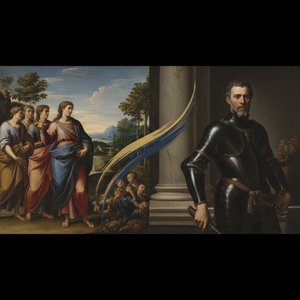
The central figure—Mary—is depicted seated gracefully, draped in a sumptuous blue robe adorned with a delicate white headscarf. Her pose exudes serenity despite her sorrowful gaze, conveying an exquisite balance between dignity and vulnerability. Beneath her hands rests the lifeless body of Jesus Christ, rendered with meticulous anatomical detail – a hallmark of Michelangelo’s influence on del Piombo's artistic approach. The artist skillfully employs chiaroscuro—the dramatic interplay of light and shadow—to sculpt volume and depth, intensifying the emotional impact of the scene. The landscape beneath the night sky serves as more than mere backdrop; it symbolizes purgatory, representing Mary’s spiritual journey toward redemption after witnessing Jesus’ crucifixion.Technique and Artistic Innovation
Del Piombo's mastery of oil paint—a technique favored by Venetian artists—allowed him to achieve remarkable tonal gradations and luminous effects that would have been unattainable with tempera. The artist meticulously rendered the textures of fabric, skin, and stone, demonstrating an unparalleled understanding of anatomical precision. Furthermore, the painting’s monumental scale contributes to its dramatic impact, immersing the viewer in a profound meditation on faith, compassion, and mortality. It is remarkable how del Piombo managed to convey such intense emotion through restrained artistic expression—a testament to his genius as a painter and humanist artist.Legacy and Influence
“Pietà” remains an iconic work of Renaissance art, inspiring countless artists throughout history. Its enduring appeal stems from its ability to capture the universal themes of grief, compassion, and divine grace—themes that continue to resonate with audiences today. The Museo Civico in Viterbo proudly houses this masterpiece, offering visitors a chance to experience firsthand the sublime beauty and emotional power of del Piombo’s artistic vision.Pytania i odpowiedzi
Czy mogę przyjrzeć się bliżej dziełu "Pieta"?
Strona Analiza rentgenowska dzieła „Pieta” – Sebastiano del Piombo to interaktywny podgląd, który pozwala na przeglądanie jedenastu warstw optycznych obrazu, w tym widoku w stylu rentgenowskim.
Jaki poziom kontrastu prezentuje „Pieta” – Sebastiano del Piombo?
Poziom kontrastu dzieła „Pieta” – Sebastiano del Piombo wynosi Delikatny.
Jaki format i orientacja druku są sugerowane dla „Pieta” – Sebastiano del Piombo?
Rozmiar Duży format, orientacja Orientacja pionowa: to sugerowane parametry druku dla dzieła „Pieta” – Sebastiano del Piombo.
Biografia artysty
A Venetian Soul in Roman Splendor
Sebastiano del Piombo, born Sebastiano Luciani around 1485 in the radiant heart of Venice, occupies a unique and often enigmatic position within the High Renaissance. His story isn’t one of immediate artistic recognition—rather, it unfolds as a compelling journey of adaptation, migration, and ultimately, a masterful synthesis of Venetian colorism with the imposing gravity of Roman form. Unlike many of his contemporaries whose paths were clearly defined from youth, Sebastiano's entry into painting was somewhat delayed; initially drawn to music – he possessed considerable skill as a lutenist – it wasn’t until his late teens or early twenties that he seriously embraced the canvas. This formative period in Venice instilled within him an enduring love for rich hues, atmospheric perspective, and a poetic sensibility that would remain hallmarks of his style even after relocating to Rome. The profound influence of Giorgione is particularly palpable in early attributions like the unfinished *Judgement of Solomon*, a work steeped in dramatic narrative and showcasing an innovative approach to composition, hinting at the artistic potential about to unfold.From Venice to the Heart of Roman Artistic Life
The year 1511 marked a pivotal moment in Sebastiano’s career as he journeyed to Rome, a city then pulsating with artistic energy under the patronage of Popes Julius II and Leo X. This move placed him directly into the orbit of Raphael, whose workshop was at its zenith, and soon after, into the complex world surrounding Michelangelo. Remarkably, unlike some artists who found themselves overshadowed by these titans, Sebastiano managed to carve out his own niche, even earning the respect – and occasional encouragement – of the notoriously critical Michelangelo himself. The two masters recognized a kindred spirit in each other’s pursuit of grandeur and anatomical precision; Michelangelo actively championed Sebastiano's work, urging him to compete with Raphael for prestigious commissions. This rivalry, though perhaps exaggerated by Vasari, undoubtedly fueled Sebastiano’s ambition and contributed to his growing reputation. His early Roman works, such as the frescoes in the Villa Farnesina – notably *Polyphemus* – demonstrate a masterful assimilation of classical motifs and a burgeoning confidence in handling large-scale compositions. He was quickly becoming a force within the Roman art scene, blending Venetian sensibilities with the demands of his new environment. The vibrant colors and atmospheric effects reminiscent of Giorgione were tempered by a growing awareness of Roman architectural principles and a desire to capture monumental figures with anatomical accuracy.The Synthesis of Styles: A Unique Artistic Vision
Sebastiano del Piombo’s artistic genius lay in his ability to reconcile the seemingly disparate traditions of Venice and Rome. While firmly rooted in the Venetian school's emphasis on color, light, and texture – a legacy inherited from Giorgione and Titian – he embraced the Roman preoccupation with monumental forms, anatomical accuracy, and dramatic narrative. This fusion is strikingly evident in *The Raising of Lazarus*, a powerful altarpiece commissioned for Narbonne Cathedral and now residing in London’s National Gallery. The painting showcases his command of oil paint to create luminous flesh tones and rich draperies, while the figures themselves possess a sculptural solidity reminiscent of Michelangelo's work. He didn’t simply copy Roman techniques; he transformed them through a distinctly Venetian lens, imbuing them with an emotional intensity that resonated deeply with viewers. This unique blend set him apart from his contemporaries and established him as a leading figure in Roman art after Raphael’s untimely death in 1520. He wasn't merely imitating; he was forging a new path, demonstrating that Venetian sensuality and Roman gravitas could coexist harmoniously on the same canvas. The *Raising of Lazarus* stands as a testament to his ability to synthesize these seemingly opposing forces into a cohesive and emotionally resonant whole – a masterpiece born from the meeting of two artistic worlds.Later Life and Enduring Legacy
The latter part of Sebastiano’s life took an unexpected turn in 1531 when he was appointed *piombatore*, Keeper of the Seals for the Papacy. This prestigious, yet demanding, position required him to attend to the Pope’s administrative duties and curtailed his artistic output considerably. Though financially secure, the responsibilities of office drew him away from painting, and his later works became fewer in number. He continued to receive commissions, primarily portraits, but the fervor and innovation of his earlier period seemed somewhat subdued. Despite this decline in productivity, Sebastiano remained a respected figure within Roman artistic circles until his death in 1547. His influence, however, proved less pervasive than that of Raphael or Michelangelo. This was partly due to a lack of numerous pupils and limited dissemination of his work through prints – a common practice for promoting an artist’s style during the Renaissance. Nevertheless, Sebastiano del Piombo's legacy endures as a testament to the power of artistic synthesis and the enduring allure of Venetian color combined with Roman monumentality. His works continue to fascinate art historians and viewers alike, offering a glimpse into a complex and compelling figure who navigated the turbulent currents of the High Renaissance.Notable Works
- The Three Philosophers (with Giorgione): A collaborative masterpiece showcasing early influences.
- Polyphemus: A fresco in Villa Farnesina, demonstrating classical style and masterful detail.
- Moses Receiving the Tables of the Law: Demonstrates mastery of oil on canvas and dramatic composition.
- The Raising of Lazarus: A powerful altarpiece blending Venetian color with Roman form.
- San Sebastiano: An evocative depiction of the saint, showcasing his skill in portraying human emotion.

Sebastiano del Piombo
1485 - 1547 , Włochy
Krótka nota
- Artistic Movement Or Style: Renesans, Mannerismus
- Artists Or Movements Influenced By This Artist: ['Michelangelo']
- Artists Who Influenced This Artist:
- Bellini
- Giorgione
- Raphael
- Date Of Birth: c. 1485
- Date Of Death: 1547
- Full Name: Sebastiano del Piombo
- Nationality: Włoski
- Notable Artworks:
- Polifem
- San Giovanni
- Łazarz
- Place Of Birth: Wenecja, Italia
Powiązane artykuły

Olej na płótnie: Historia, techniki i ponadczasowy urok malarskiego medium
Poznaj historię i techniki malarstwa olejowego! Od renesansowych mistrzów po współczesne zastosowania – wszystko o oleju na płótnie. Poradniki, konserwacja i inspiracje dla pasjonatów sztuki.
Sebastiano del Piombo: Bridging Venetian Colorism & Roman Grand Manner Portraiture
Explore the captivating art of Sebastiano del Piombo, a Renaissance master bridging Venetian colorism & Roman grandeur. Discover his iconic portraits and lasting influence on art history. Learn more at OriginalUniqueArt.

Trwała Spuścizna Malarstwa Olejnego: Technika, Historia i Estetyczny Wpływ
Poznaj historię i technikę malarstwa olejnego! Eksperckie artykuły o konserwacji, renowacji oraz współczesnych zastosowaniach. Dowiedz się więcej o mistrzach i trwałości obrazów olejnych.

The Enduring Power of Painting: A Historical & Contemporary Exploration of Form and Emotion
Explore the rich history & enduring techniques of oil painting with OriginalUniqueArt. Discover masterpieces, learn about art collecting, and find authentic handmade reproductions crafted by skilled artists.

Trwała Spuścizna Malarstwa Olejnego: Technika, Historia i Współczesna Praktyka
Poznaj historię i techniki malarstwa olejnego. Poradniki dla artystów, informacje o konserwacji oraz możliwość zamówienia wysokiej jakości reprodukcji obrazów. Ekspercka wiedza i gwarancja trwałości dzieł sztuki.

