Menu

() ·

A painting made for you, by hand

Pastoral

Ręcznie malowana reprodukcja olejowa

Ręcznie malowany obraz olejny na płótnie, wykonany na zamówienie przez naszych artystów w wybranym przez Ciebie wymiarze i oprawie. ( Przełącz na wydania drukowane Przejdź do wersji cyfrowej)

Opis obiektu

Odkryj piękno „Pastoral” (1893) od Rupert Charlesa Wulstena Bunny’ego - impresjonistycznego obrazu mitologicznych postaci inspirowanego sztuką romantyczną i symbolistyczną. Zamów wysokiej jakości reprodukcję!

Biografia artysty

Odkryj świetliste dzieła Ruperta Charlesa Wulstena Bunny'ego (1864-1947), australijskiego malarza celebrowanego w Paryżu. Poznaj jego bogaty styl kolorystyczny, idylliczne sceny z kobietami i wodą, symbolizm oraz estetyzm.

from ·

Chapter 1

How large should it be?

Slide to change the size; the picture on the left shows the frame at its real width. The proportions of the original are kept.

Standardowy format
personalizowane
CM
INCH

Wybierz spośród naszych standardowych rozmiarów, które zachowują oryginalne proporcje dzieła sztuki.

szerokość
wysokość

Wpisz wymaganą szerokość i wysokość, aby obraz pasował do Twojej ramy lub ściany. Ponieważ jest to dzieło malowane ręcznie, w przypadku rozmiaru o innych proporcjach artysta może domalować nieco więcej wokół obrazu lub przyciąć jego fragmenty — wybór należy do Ciebie. Przed rozpoczęciem pracy prześlemy Ci cyfrową wizualizację do zatwierdzenia. Obraz widoczny na tej stronie nie przedstawia rzeczywistego efektu — jedynie wizualizacja oddaje realny rezultat.

Chapter 2

How should it arrive?

Choose the edges of the stretched canvas

Choose your frame

Corner sample of the WhiteWrap canvas edge finish, stretched on lite drewno bars
White zł1
Corner sample of the BlurSideWrap canvas edge finish, stretched on lite drewno bars
Blurside zł1
Corner sample of the ExtendedWrap canvas edge finish, stretched on lite drewno bars
Extended zł1
Corner sample of the P118B picture frame: polistyren formowany, 5 cm wide and 3 cm thick
P118B zł10
Corner sample of the P118H picture frame: polistyren formowany, 5 cm wide and 3 cm thick
P118H zł10
Corner sample of the P118W picture frame: polistyren formowany, 5 cm wide and 3 cm thick
P118W zł10
Corner sample of the P438Z picture frame: polistyren formowany, 5.5 cm wide and 3.5 cm thick
P438Z zł10
Corner sample of the P508JH picture frame: polistyren formowany, 7 cm wide and 3.5 cm thick
P508JH zł12
Corner sample of the P508YH picture frame: polistyren formowany, 7 cm wide and 3.5 cm thick
P508YH zł12
Corner sample of the P805H picture frame: polistyren formowany, 5 cm wide and 3.5 cm thick
P805H zł10
Corner sample of the P805Z picture frame: polistyren formowany, 5 cm wide and 3.5 cm thick
P805Z zł10
Corner sample of the P919BZ picture frame: polistyren formowany, 7 cm wide and 3.5 cm thick
P919BZ zł10
Corner sample of the P919G picture frame: polistyren formowany, 7 cm wide and 3.5 cm thick
P919G zł10
Corner sample of the P919XJ picture frame: polistyren formowany, 7 cm wide and 3.5 cm thick
P919XJ zł10
Corner sample of the P959ZH picture frame: polistyren formowany, 5 cm wide and 3 cm thick
P959ZH zł10
Corner sample of the P968JZ picture frame: polistyren formowany, 6 cm wide and 4 cm thick
P968JZ zł12
Corner sample of the W106C picture frame: lite drewno, 5 cm wide and 3 cm thick
W106C zł8
Corner sample of the W218G picture frame: lite drewno, 5 cm wide and 3 cm thick
W218G zł10
Corner sample of the W218JH picture frame: lite drewno, 5 cm wide and 3 cm thick
W218JH zł8
Corner sample of the W218Y picture frame: lite drewno, 5 cm wide and 3 cm thick
W218Y zł10
Corner sample of the W307PJ picture frame: lite drewno, 6 cm wide and 3 cm thick
W307PJ zł10
Corner sample of the W316G picture frame: lite drewno, 6 cm wide and 3 cm thick
W316G zł10
Corner sample of the W316PJ picture frame: lite drewno, 6 cm wide and 3 cm thick
W316PJ zł8
Corner sample of the W316Y picture frame: lite drewno, 6 cm wide and 3 cm thick
W316Y zł10
Corner sample of the W398PJ picture frame: lite drewno, 5 cm wide and 3 cm thick
W398PJ zł8
Corner sample of the W4111J picture frame: lite drewno, 6.5 cm wide and 3.5 cm thick
W4111J zł10
Corner sample of the W500HY picture frame: lite drewno, 7 cm wide and 5 cm thick
W500HY zł15
Corner sample of the W500JH picture frame: lite drewno, 7 cm wide and 5 cm thick
W500JH zł15
Corner sample of the W692G picture frame: lite drewno, 8 cm wide and 4 cm thick
W692G zł12
Corner sample of the W849H picture frame: lite drewno, 5 cm wide and 3 cm thick
W849H zł8
Corner sample of the W940BG picture frame: lite drewno, 7.5 cm wide and 4.5 cm thick
W940BG zł15
Corner sample of the W953PJ picture frame: lite drewno, 6 cm wide and 3.5 cm thick
W953PJ zł8
Corner sample of the H24-GOLD picture frame: rzeźbione drewno pokryte gipsem, 10 cm wide and 6 cm thick
H24-GOLD zł30
Corner sample of the H24-SILVER picture frame: rzeźbione drewno pokryte gipsem, 10 cm wide and 6 cm thick
H24-SILVER zł30
Corner sample of the H36-GOLD picture frame: rzeźbione drewno pokryte gipsem, 15 cm wide and 6.5 cm thick
H36-GOLD zł45
Corner sample of the H36-SILVER picture frame: rzeźbione drewno pokryte gipsem, 15 cm wide and 6.5 cm thick
H36-SILVER zł45

Moulding: . Overall size with the frame: .

Chapter 3

Who paints it, and should anything change?

Examples of what can be changed: Replace face with customer photo; Add pet (e.g., replace cat with dog); Include hidden message in background; Change background landscape or elements.
After order, OriginalUniqueArt.com team will email client for instructions and provide a mockup preview

Dostawa na całym świecie () w ciągu 3–4 tygodni zamiast standardowych 5 tygodni. (29 Październik). Bez kompromisów w kwestii jakości.

Chapter 4

The finishing touches

A nameplate, as in a museum?

Szczegóły grawerowanej brązowej tabliczki

This elegant plaque features the artist's name and the title of the artwork, finely engraved for a timeless presentation.

It is made from bronze with a refined, elegant finish. The text is precisely laser-engraved for a sharp and permanent result. Measuring 9x2 cm, the plaque is compact yet easy to read. It's built to be durable and scratch-resistant, offering a professional, museum-quality look. Mounting is simple thanks to the included adhesive backing.

Szczegóły przezroczystej tabliczki akrylowej

The plaque includes essential engraved details such as the artist's name, the title of the artwork, the date it was created, the type of media used-like oil on canvas or watercolor-a brief description of the piece, and a QR code that links to the complete artwork information.

It is crafted from clear acrylic, offering a sleek, modern appearance. The text is UV-engraved in black to ensure strong visual contrast. With a size of 10x15 cm, it ensures optimal readability. It comes equipped with two metal hooks for secure wall mounting. The plaque is designed to be weather-resistant, making it suitable for various environments, and it includes interactive features that work seamlessly with smartphone scanning.

Szczegóły czarnej tabliczki akrylowej

This elegant plaque includes engraved information such as the artist's name, the title of the artwork, the date it was created, the type of media used (like oil on canvas or watercolor), a short description of the artwork, and a QR code for quick access to more information.

The plaque itself is made from refined black acrylic with a premium finish. The text is laser-engraved in white for high contrast and readability. Its size is 10x15 cm, designed to be easy to read. It comes with two metal hooks for professional mounting. The design is sleek and fits any interior style. It is also weather-resistant and durable, with built-in digital integration for mobile compatibility.

A protective varnish?

When do you need it?

Chapter 5

Your painting, as you ordered it

Pastoral

Technika reprodukcji

Wymiary reprodukcji

-

Wybitny mistrz artystyczny

Większa szczegółowość, finezja i dodatkowy czas na realizację

-

Opcje oprawy reprodukcji

-

-

W przypadku dzieł sztuki lub reprodukcji, których którykolwiek z boków przekracza 105 cm (około 41 cali), rama zostanie wysłana w formie zestawu do samodzielnego montażu. Metoda ta zapewnia bezpieczną dostawę i zapobiega uszkodzeniom podczas transportu.

Wymagany profesjonalny montaż – nie jest to produkt typu DIY.
Zestaw musi zostać złożony, a płótno naciągnięte przez doświadczonego profesjonalnego ramiarza, przy użyciu kleju do drewna (brak w zestawie), kleszczy do naciągania płótna oraz ścisków, które utrzymają krosna w równej pozycji podczas schnięcia kleju. Nieprawidłowy montaż lub nierównomierne napięcie płótna może trwale uszkodzić dzieło sztuki i nie podlega naszej gwarancji.

  • W zestawie znajdują się wszystkie listwy z litego drewna, precyzyjnie docięte do wymiarów.

  • Montaż odbywa się przy użyciu dołączonych wkrętów oraz kleju do drewna do łączenia narożników, którego zestaw nie zawiera i który musi zostać dostarczony przez ramiarza.

  • Wymagane są profesjonalne narzędzia, których nie ma w zestawie: kleszcze do naciągania płótna (napinacz) oraz zaciski, które pozwolą utrzymać listwy w równej pozycji podczas schnięcia kleju.

Ważne:
Do połączenia narożników niezbędny jest klej do drewna, listwy należy unieruchomić za pomocą ścisków do momentu całkowitego wyschnięcia kleju, a naciągnięcie płótna na złożoną ramę wymaga użycia kleszczy do naciągania płótna. Żaden z tych elementów nie jest dołączony do zestawu. Przed zamówieniem tego rozmiaru zalecamy konsultację z doświadczonym ramiarzem.

Etykieta obiektu

-

-

Lakier ochronny

Lakier z połyskiem (pogłębia kolory, chroni przed światłem i wilgocią)

-

Personalizacja dzieła

Przykłady możliwości personalizacji: zastąp twarz zdjęciem klienta; dodaj zwierzę domowe (np. zamień kota na psa); umieść ukrytą wiadomość w tle; zmień krajobraz lub elementy tła.

-

Ekspresowa

Dostawa na cały świat () w ciągu 3–4 tygodni zamiast standardowych 5 tygodni. (29 Październik). Bez kompromisów w kwestii jakości.

-

Przesyłka ekspresowa

Dostawa na cały świat () w ciągu 5 tygodni. (5 Listopad).

W cenie

Cena całkowita

zł 1733

Suma całkowita zł 1733

Opcja ze szkłem jest dostępna wyłącznie w rozmiarach poniżej 110 cm

Included with every order

  • Bezpłatna ekspresowa wysyłka na cały świat
  • Wysokiej jakości płótno lniane
  • Pełne ubezpieczenie przesyłki
  • Gwarancja zwrotu należności celnych i podatków importowych
  • Gwarancja wiernego odwzorowania kolorów
  • 100-dniowa polityka zwrotów (tylko w przypadku wad)
  • Gwarancja 100% zwrotu pieniędzy
  • Zniżka przy zakupie wielu sztuk

Pastoral - Rupert Charles Wulsten Bunny

Experience Rupert Bunny’s ‘Pastoral’ (1893): A luminous oil painting of mythological figures by an Australian Symbolist. Romantic, idyllic & rich in color.

Rupert Charles Wulsten Bunny (1864-1947), an australian painter, was born in st kilda, victoria, in 1864. he received a traditional and academic education in the arts under calderon and laurens. this foundation would later serve him well in his successful career as an expatriate artist in fin-de-siècle paris. Achievements and accolades Bunny's artistic prowess was recognized early, with an honourable mention at the paris salon of 1890 for his painting tritons. he further solidified his reputation by winning a bronze medal at the paris exposition universelle in 1900 for burial of st catherine of alexandria. The french state acquired 13 of his works, including those now housed in the musée du luxembourg and regional collections.

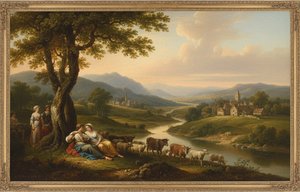
The painting depicts a classical scene of mythological figures – likely from greek mythology – engaged in various activities near the sea. It’s an oil painting with a somewhat romantic and idealized aesthetic, reminiscent of Pre-Raphaelite style. The composition is layered, featuring foreground figures interacting directly with the viewer, middle ground showing a larger group enjoying the water and shoreline, and a distant background landscape with mountains and sky. The lighting is soft and diffused, creating an atmospheric effect rather than sharp shadows. Lines are used to define forms – particularly the musculature of the nude figures – but also to create flowing drapery and naturalistic foliage. Shapes are predominantly organic: human bodies, waves, trees, and rocks. Textures appear smooth in many areas, suggesting a glazing technique, while the foliage and ground have more visible brushstrokes. The color palette is dominated by muted earth tones with highlights of blue and red. Perspective is somewhat flattened, contributing to the painting’s dreamlike quality. Depth is suggested through atmospheric perspective – distant elements are paler and less detailed.

Bunny first sketched sea nymphs and tritons in 1887, in the French province of Brittany. In his sketchbook, among drawings of ancient menhirs, steep cliffs and sea, one image shows a nude female whose legs end in fishtails, lying back over a rock in the sea. Brittany, known as a region of myth and legend, and a resort since the 1860s for painters inspired by its exoticism and the mystery of its silver light, therefore appears to have been one source of inspiration for Bunny’s images of tritons. Another source was the swiss romantic artist arnold böcklin, whose paintings abound in centaurs, tritons, nymphs and extravagant creations of fancy.

The 1893 painting was Bunny’s second ‘pastoral’ – ‘oddly enough named’, said the Magazine of Art, ‘seeing that it is, above all, a seashore picture of ideal nymphs’. Van Gogh wrote about Bunny's work, praising his luminous colorist style and masterful execution. The artist’s strong feelings about water can be traced back to childhood, when he saw a group of people strangely dressed in long white gowns walking into the sea near his home at St Kilda, Melbourne. From where Bunny watched, he did not realise that the solemn ceremony was a christian ritual of baptism.

Bunny’s conception of a pastoral was an allegory of the sort popularised by the french painter puvis de chavannes. It embodies themes of leisure, mythology, and beauty—a deliberate echo of Böcklin's fantastical landscapes and figures. The painting utilizes a glazing technique to achieve remarkable luminosity and depth, capturing the ethereal quality of the seaside setting.

The artwork’s meticulous attention to detail – particularly in rendering the musculature of the nude figures and the flowing drapery—demonstrates Bunny’s commitment to academic precision blended with Romantic idealism. The muted earth tones combined with splashes of blue and red evoke a sense of tranquility and wonder, inviting contemplation on the sublime.

The painting's symbolism speaks to notions of purity, rebirth, and harmony with nature – concepts central to both Pre-Raphaelite art and Victorian spiritual thought. It’s a testament to Bunny’s ability to distill complex ideas into visually arresting compositions that continue to resonate with audiences today.

Material: Oil paints on canvas

Pytania i odpowiedzi

Co przedstawia „Pastoral” – Rupert Charles Wulsten Bunny i jaki ma nastrój?

„Pastoral” – Rupert Charles Wulsten Bunny łączy w sobie mythological figures, sea landscape, classical art, ideal nymphs, brittany region, romanticism, water element, symbolic imagery z Romantyczny atmosferą.

Czy dzieło „Pastoral” autorstwa Rupert Charles Wulsten Bunny znajduje się w domenie publicznej i dlaczego?

Dzieło "Pastoral" autorstwa Rupert Charles Wulsten Bunny znajduje się w należy do domeny publicznej – autorskie prawa majątkowe wygasły. Okres ochrony praw autorskich liczony jest od daty śmierci artysty, a Rupert Charles Wulsten Bunny zmarł(a) w 1947.

W jaki sposób tematyka dzieła "Pastoral" odnosi się do typowych motywów twórczości Rupert Charles Wulsten Bunny?

Wśród motywów charakterystycznych dla twórczości Rupert Charles Wulsten Bunny – takich jak symbolist aesthetics, böcklin inspiration, christian ritual, baptism symbolism, brittany mythos, sea nymphs imagery, romantic idealism, water's importance – dzieło „Pastoral” wprowadza własne skupienie na mythological figures, sea landscape, classical art, ideal nymphs, brittany region, romanticism, water element, symbolic imagery.

More about this painting

Podgląd w skali 1:1 Podgląd AR Przełącz na wydania drukowane Przejdź do wersji cyfrowej Wyślij jako kartkę
Szczegóły dzieła Przewodnik Dodaj do ulubionych Pobierz obraz Podobne obiekty RTG Pokaz slajdów Q&A Statystyki

In numbers

  • 1893the year it was painted
  • 29frames to choose from
  • standard sizes, in its own proportions
  • 5weeks to paint and deliver it
Rupert Charles Wulsten Bunny

Rupert Charles Wulsten Bunny

1864 - 1947, Australia

Biografia artysty

Wczesne lata i edukacja

Rupert Charles Wulsten Bunny, australijski malarz, przyszedł na świat w 1864 roku w St Kilda, w stanie Victoria. Swoje artystyczne korzenie zapuścił poprzez tradycyjne i akademickie wykształcenie, kształcąc się pod okiem mistrzów, takich jak Calderon i Laurens. To solidne fundamenty przygotowały go do niezwykle sukcesywnej kariery emigranta-artysty w sercu paryskiego fin de siècle.

Osiągnięcia i wyróżnienia

Artystyczny kunszt Bunny'ego został dostrzeżony już na wczesnym etapie jego drogi, czego dowodem było wyróżnienie na Salonie Paryskim w 1890 roku za obraz Tritony. Swoją reputację jeszcze bardziej ugruntował, zdobywając brązowy medal podczas Wystawy Światowej w Paryżu w 1900 roku za dzieło Pogrzeb św. Katarzyny Aleksandryjskiej. Skala jego talentu sprawiła, że państwo francuskie nabyło aż 13 jego prac, w tym te, które obecnie zdobią zbiory Musée du Luxembourg oraz innych kolekcji regionalnych.

Styl artystyczny i tematyka

Krytycy sztuki opisywali Bunny'ego jako „przepych, kolorystę i wspaniale erudycyjnego malarza tematów idealnych”. Jego twórczość często przenosi widza w świat grup kobiecych postaci, które odpoczywają, śnią lub oddają się codziennym czynnościom przy rozległych taflach wody, prezentując unikalne połączenie symbolizmu z estetyzmem.
  • Najważniejsze dzieła:
  • Endormies (National Gallery of Victoria, Melbourne, Australia)
  • Sea Idyll (National Gallery of Victoria, Melbourne, Australia)
  • Pastoral (National Gallery of Australia, Canberra, Australia)

Dziedzictwo i obecność w sieci

Współcześnie dzieła Bunny'ego można odnaleźć w licznych muzeach oraz na platformach internetowych. Osoby pragnące zgłębić jego bogatą twórczość mogą odwiedzić [https://OriginalUniqueArt.com/@/rupert-charles-wulsten-bunny](https://OriginalUniqueArt.com/@/rupert-charles-wulsten-bunny), gdzie znajduje się obszerna kolekcja jego obrazów, w tym m.in. Endormies, Sea Idyll oraz Pastoral. Prace te są również dostępne do zakupu jako reprodukcje muzejskiej jakości poprzez /en/art/show/art-8xyffg-en/

Podsumowanie

Rupert Charles Wulsten Bunny, australijski malarz ze St Kilda w Victorii, pozostawił niezatarty ślad w świecie sztuki dzięki swojemu bogatemu i erudycyjnemu stylowi. Jego dziedzictwo nieustannie inspiruje kolejne pokolenia poprzez dzieła, które dziś są łatwo dostępne za pośrednictwem [https://OriginalUniqueArt.com](https://OriginalUniqueArt.com).

Najważniejsze informacje

  • Notable elements or techniques: Glazing technique, Atmospheric perspective
  • Subject or theme: Mythology, Leisure
  • Dimensions: 2510 x 1420 cm
  • Influences:
    • Arnold Böcklin
    • Puvis de Chavannes
  • Year: 1893
  • Artistic style: Romanticism

Quiz o sztuce

Do każdego pytania dotyczy tylko jedna poprawna odpowiedź.

Pytanie 1:
Jaký styl umění lze nejlépe asociovat s obrazem „Pastoral“?
Pytanie 2:
Kde byl Rupert Bunny inspirován při tvorbě obrazu „Pastoral“?
Pytanie 3:
Kdo byl další významný umělec, který ovlivnil styl Bunnyho obrazu „Pastoral“?
Pytanie 4:
Jaká byla hlavní tématická motivace obrazu „Pastoral“?
Pytanie 5:
Jaká byla hlavní technika použitá při tvorbě obrazu „Pastoral“?
Odkryj dzieła sztuki uporządkowane według tematów, stylów i cech charakterystycznych.