Podgląd w skali 1:1
 Wyślij jako kartkę
 Udostępnij
 Szczegóły dzieła
 Przewodnik

 Pobierz obraz
 Podobne obiekty
 RTG
RTG Pokaz slajdów
 Q&A
Q&A Statystyki
Little big painting

- 172.0 x 203.0 cm


 Rozwiń treść
Dzieło sztuki prezentowane na tej stronie podlega ochronie prawem autorskim, co oznacza, że nie mamy prawa do tworzenia ani sprzedaży jego identycznej reprodukcji. Ochrona ta jest egzekwowana na mocy umów międzynarodowych, takich jak Konwencja berneńska oraz przez przepisy prawa krajowego, w tym te określone w Prawo autorskie USA – Tytuł 17.
Metoda ta jest w pełni zgodna z przepisami prawa autorskiego, ponieważ nie polega na kopiowaniu ani powielaniu chronionego dzieła. Stanowi ona kreatywną reinterpretację – nowy obraz, który czerpie inspirację z oryginału, ale nie jest z nim tożsamy.
Giclée / Wydruk artystyczny
Wydruki giclée lub płótna o jakości muzealnej, szybka realizacja i szeroki wybór opcji wykończenia. ( Zamów ręcznie malowaną reprodukcję Przejdź do wersji cyfrowej)




P118B zł10

P118H zł10

P118W zł10

P438Z zł10

P508JH zł12

P508YH zł12

P805H zł10

P805Z zł10

P919BZ zł10

P919G zł10

P919XJ zł10

P959ZH zł10

P968JZ zł12

W106C zł8

W218G zł10

W218JH zł8

W218Y zł10

W307PJ zł10

W316G zł10

W316PJ zł8

W316Y zł10

W398PJ zł8

W4111J zł10

W500HY zł15

W500JH zł15

W692G zł12

W849H zł8

W940BG zł15

W953PJ zł8




Wybierz spośród naszych standardowych rozmiarów, które zachowują oryginalne proporcje dzieła sztuki.

Wpisz wymaganą szerokość i wysokość, aby dopasować grafikę do ramy lub ściany. Wydruk można jedynie przyciąć, nigdy nie powiększając go poza oryginalny obraz, dlatego format o innych proporcjach spowoduje utratę części kompozycji. Przed rozpoczęciem druku prześlemy Ci cyfrowy podgląd do zatwierdzenia. Obraz wyświetlany na tej stronie nie pokazuje rzeczywistego przycięcia — jedynie podgląd oddaje ten efekt.
Dostawa na cały świat () w ciągu 2 tygodni zamiast standardowych 4/5 tygodni. (2 Listopad)

Bezpłatna ekspresowa wysyłka na cały świat

Wysokiej jakości płótno lniane

Pełne ubezpieczenie przesyłki

Gwarancja zwrotu należności celnych i podatków importowych

Gwarancja wiernego odwzorowania kolorów

100-dniowa polityka zwrotów (tylko w przypadku wad)

Gwarancja 100% zwrotu pieniędzy

Zniżka przy zakupie wielu sztuk
 Opcja ze szkłem jest dostępna wyłącznie w rozmiarach poniżej 110 cm

Little big painting
Giclée / Wydruk artystyczny
Wymiary reprodukcji
-


Cena całkowita
zł 312
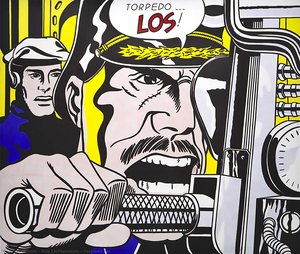
A Bold Statement: Exploring Roy Lichtenstein’s ‘Little Big Painting’
Little Big Painting, created in 1965 by American Pop Art icon Roy Lichtenstein, is a captivating and monumental work that embodies the spirit of its era. Measuring an impressive 172 x 203 cm, this piece isn't merely a depiction of books; it’s a vibrant commentary on art, perception, and the burgeoning consumer culture of the mid-20th century.Deconstructing Pop Art: Style & Technique
Lichtenstein masterfully employs the hallmarks of Pop Art in Little Big Painting. The artwork features bold, flat colors, stark black outlines, and a Ben-Day dot background – techniques directly borrowed from commercial printing processes like comic books. This deliberate aesthetic choice wasn’t about replicating reality; it was about *representing* representation, questioning the boundaries between “high” art and mass media. The stacking of rectangular book forms creates a dynamic sense of height and volume, while the simplified perspective emphasizes the graphic quality over realistic depth. The technique strongly suggests silkscreen printing, a method Lichtenstein frequently utilized to achieve his signature look.Historical Context: A Response to Abstract Expressionism
Little Big Painting belongs to Lichtenstein’s “Brushstrokes” series, created as a playful yet pointed critique of Abstract Expressionism – the dominant art movement preceding Pop Art. Artists like Jackson Pollock and Willem de Kooning were celebrated for their spontaneous, gestural brushwork. Lichtenstein cleverly subverts this by depicting *the idea* of a brushstroke, rendered with mechanical precision and devoid of any personal touch. The work is sourced from a comic panel, further emphasizing the artist’s engagement with popular culture as opposed to the perceived elitism of Abstract Expressionism.Symbolism & Interpretation: Knowledge and Mass Production
While seemingly straightforward – a stack of books – Little Big Painting invites deeper consideration. Books traditionally symbolize knowledge, learning, and intellectual pursuit. However, Lichtenstein’s treatment transforms this symbolism. The mechanical reproduction techniques suggest the mass dissemination of information, hinting at both the democratization *and* potential homogenization of culture. The lack of narrative within the image focuses attention on form and process rather than content, prompting viewers to contemplate the very nature of art itself.Emotional Impact & Interior Design
Little Big Painting exudes a sense of energy and playful irony. Its large scale and vibrant colors make it a commanding focal point in any space. The artwork’s bold aesthetic lends itself well to modern and contemporary interiors, adding a sophisticated pop of color and intellectual intrigue.- For Collectors: A significant piece within Lichtenstein's oeuvre, representing his pivotal role in the Pop Art movement.
- For Interior Designers: A statement artwork that injects personality and a conversation starter into any room.
- For Art Lovers: An accessible yet intellectually stimulating work that challenges conventional notions of art and culture.
Pytania i odpowiedzi
Jaką popularność cieszy się "Little big painting" w obrębie nurtu Pop Art?
„Little big painting” – Roy Lichtenstein jest klasyfikowane jako Ikoniczne i należy do nurtu Pop Art.
Gdzie mogę kupić cyfrową wersję dzieła „Little big painting” – Roy Lichtenstein?
Cyfrową wersję dzieła „Little big painting” – Roy Lichtenstein można zakupić na stronie Cyfrowy obraz: wysokiej rozdzielczości cyfrowe zdjęcie do pobrania.
Czy „Little big painting” – Roy Lichtenstein to portret, pejzaż czy kompozycja kwadratowa?
Dzieło „Little big painting” – Roy Lichtenstein ma format Pozioma. Format ten określa proporcje kompozycji.
Biografia artysty
The Genesis of a Pop Visionary
Roy Fox Lichtenstein, born in the vibrant metropolis of New York City on October 27, 1923, indelibly altered the landscape of twentieth-century art. Emerging as a pivotal figure within the Pop Art movement, Lichtenstein didn’t simply reflect his era; he actively interrogated it, transforming commonplace imagery into compelling artistic statements. His upbringing in an upper-middle-class Jewish family fostered both a cultural awareness and an early artistic inclination. Childhood exposure to museums and concerts, coupled with a deep appreciation for jazz music, laid the groundwork for a creative spirit that would challenge conventional notions of fine art. Though initially drawn to realistic drawing and painting during his formative years, Lichtenstein’s formal training commenced at the Art Students League in 1939 under Reginald Marsh, followed by studies at Ohio State University – interrupted briefly by wartime service in the Army. These experiences provided a robust technical foundation that would later be brilliantly re-contextualized through the lens of mass culture and commercial aesthetics. The seeds of his signature style weren’t sown within the hallowed halls of artistic tradition but rather in the often-overlooked world of everyday imagery, particularly comic books and advertising.From Abstraction to Appropriation: A Pivotal Shift
Lichtenstein's early work demonstrated a clear engagement with Abstract Expressionism, mirroring the dominant aesthetic trends of the post-war period. Figures like Jackson Pollock and Willem de Kooning were significant influences during this phase, reflecting the dynamism and emotional intensity that characterized the movement. However, this phase proved transitional, a stepping stone towards his revolutionary style. A crucial moment arrived during his tenure at Rutgers University where he encountered Allan Kaprow, whose influence reignited Lichtenstein’s interest in proto-pop imagery – artists like Robert Rauschenberg were already experimenting with collage and assemblage. This encounter sparked a critical shift in his artistic trajectory, leading him to question the established boundaries between “high” and “low” art. He began looking beyond the subjective expression of Abstract Expressionism towards the objective language of popular culture – specifically, comic books and advertising. The year 1961 marked a turning point with *Look Mickey*, a work that boldly appropriated characters from Disney comics, signaling the beginning of his signature style. This wasn’t mere imitation; it was an act of artistic re-evaluation, elevating commonplace imagery to the status of fine art. He didn't simply copy comic strips; he meticulously recreated them using techniques mimicking commercial printing processes, a deliberate blurring of the lines between original artwork and mass production. This appropriation wasn’t about celebrating consumerism uncritically but rather examining its pervasive influence on American society and challenging traditional artistic hierarchies.The Language of Ben-Day Dots and Bold Lines
Lichtenstein's artistic vocabulary is instantly recognizable: bold, primary colors, thick black outlines, and most famously, Ben-Day dots – a technique borrowed directly from the mechanical reproduction of comic books. These dots weren’t merely decorative; they were integral to his conceptual framework, representing the very process of mass production and challenging the traditional emphasis on the artist's hand. His paintings often enlarged details from comic strips to monumental scale, forcing viewers to confront the aesthetic qualities of an art form typically dismissed as trivial. Works like *Whaam!* (1963), *Drowning Girl* (1963), and *Oh, Jeff…I Love You, Too…But…* (1964) became iconic representations of Pop Art, capturing the anxieties and desires of a rapidly changing consumer culture. These weren’t simply depictions of comic book scenes; they were commentaries on themes of war, romance, and societal expectations, filtered through the visual language of mass media. He aimed to strip away any pretense of artistic subjectivity, presenting his work as objective reflections of American society – a mirror held up to its own manufactured reality. The deliberate flatness and lack of painterly gesture further emphasized this detachment, mimicking the impersonal nature of commercial printing.Major Achievements and Lasting Impact
Roy Lichtenstein’s influence extends far beyond the realm of painting. His innovative use of commercial techniques and appropriation paved the way for new generations of artists exploring themes of consumerism, media saturation, and cultural identity. The sale of *Masterpiece* in 2017 for $165 million solidified his position as one of the most commercially successful American artists of all time, but his legacy is not solely defined by monetary value. He challenged traditional notions of artistic authorship and originality, forcing a re-evaluation of what constitutes “art” itself. His work continues to inspire graphic designers, illustrators, and visual artists across various disciplines.- Major Achievements: Pioneered Pop Art style; achieved international recognition with groundbreaking exhibitions.
- Notable Works: *Whaam!*, *Drowning Girl*, *Oh, Jeff…I Love You, Too…But…*, *Masterpiece*.
- Teaching Career: Influenced aspiring artists at SUNY Oswego and Rutgers University.

Roy Lichtenstein
1923 - 1997 , Stany Zjednoczone
Krótka nota
- Artistic Movement Or Style: Pop Art
- Artists Or Movements Influenced By This Artist:
- Graficy
- Ilustratorzy
- Artists Who Influenced This Artist:
- Reginald Marsh
- Allan Kaprow
- Date Of Birth: 27 października 1923
- Date Of Death: 29 września 1997
- Full Name: Roy Fox Lichtenstein
- Nationality: Amerykański
- Notable Artworks:
- Whaam!
- Drowning Girl
- Oh, Jeff...
- Masterpiece
- Place Of Birth: Nowy Jork, USA
Powiązane artykuły
Top 10 arcydzieł Pop Artu, które zdefiniowały epokę | OriginalUniqueArt.com
Odkryj 10 arcydzieł Pop Artu, które zrewolucjonizowały świat sztuki! Poznaj historię Andy Warhola, Roya Lichtensteina i innych ikon. Reprodukcje obrazów najwyższej jakości na OriginalUniqueArt.com – inspiracje do wnętrz i kolekcjonowania.

Roy Lichtenstein: 25 Arcydzieł Pop Artu dla Kolekcjonerów i Miłośników Sztuki
Odkryj 25 arcydzieł Roy Lichtensteina – ikony pop artu, które zrewolucjonizowały sztukę XX wieku. Poznaj historie, techniki i inspiracje za słynnymi obrazami. Reprodukcje najwyższej jakości na OriginalUniqueArt.com! Eksploruj pełną kolekcję online.

The Psychology of the Palette: Decoding Roy Lichtenstein's Bold Color Theory
Explore the psychological depth of Roy Lichtenstein's color theory. An expert analysis for art students and collectors on Ben-Day dots, primary palettes, and the intersection of Pop Art with mass media history.

The Psychology of the Palette: Decoding Roy Lichtenstein’s Bold Color Theory
Explore the vibrant psychology behind Roy Lichtenstein’s color theory. Discover how Ben-Day dots and primary colors revolutionized Pop Art, transforming mass media into timeless masterpieces for modern collectors and interior design enthusiasts.
Beyond the Ben-Day Dots: Roy Lichtenstein's Pop Art Revolution & Enduring Legacy
Explore Roy Lichtenstein's revolutionary Pop Art! Discover the story behind Ben-Day dots, iconic works like 'Whaam!', and investment insights for collectors. Expert analysis & high-quality reproductions at OriginalUniqueArt.